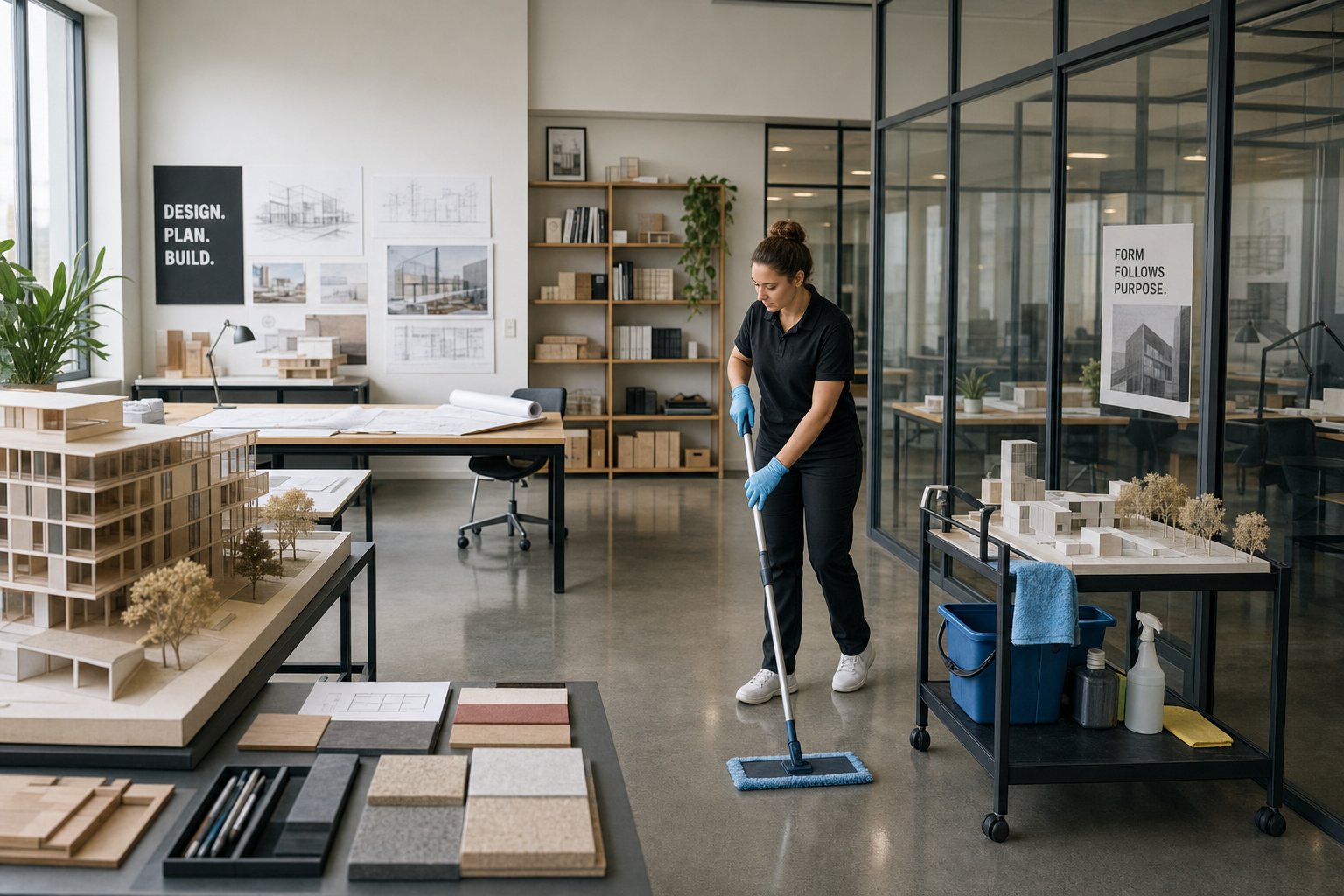
Architecture firm cleaning in NYC requires more judgment than a generic office route. A model-making table in SoHo, a material library near the Flatiron District, and a client presentation suite in Long Island City all carry different cleaning risks. Dust can settle on delicate prototypes, moisture can damage samples, and a misplaced object can disrupt a deadline. GreenPoint Maintenance Services provides MBE-certified commercial cleaning with zone-based checklists, Green Seal certified products, and StockPoint evidence so studio leaders can see what was serviced and what was intentionally left untouched. Call GreenPoint at 844-814-0810 to schedule a walkthrough and receive a fixed-price scope built around your studio's workflow.
Why architecture studios need a specialized cleaning scope
Architecture studios combine office work, fabrication, storage, and client presentation in one footprint. A conventional nightly checklist may be safe for desks and restrooms but inappropriate for basswood models, foam board, resin prints, plotter equipment, or unsealed material samples. ISSA cleaning principles emphasize defining soil, surface, and appearance expectations before assigning labor. GreenPoint starts by separating cleanable surfaces from protected work product, then records the boundaries in the site scope so the crew does not improvise around a deadline-critical model.
The goal is not to make every square foot look identical. GreenPoint Maintenance Services can assign an appearance level for reception and conference rooms, a dust-control plan for fabrication zones, and a lighter touch around active project tables. This lets a 12,000-square-foot studio buy the right service instead of paying for unnecessary wiping of sensitive materials. A walkthrough at 844-814-0810 gives the team a floor-plan-based route, named exclusions, and a practical escalation process when a project area changes.
NYC neighborhood logistics and studio access
Access conditions vary across the city. A West Chelsea studio may coordinate with a freight elevator and gallery deliveries, while a Brooklyn Navy Yard tenant may have a long path from the loading area to the suite. A practice near Grand Central or Penn Station may require cleaning after commuter traffic, and a Queens studio may share a service corridor with fabrication vendors. GreenPoint maps security desks, elevator reservations, loading windows, keys, alarms, and construction zones before setting the schedule.
Weather and construction add local soil. Salt tracked from sidewalks in winter, fine dust near a streetscape project, and moisture around entry doors can move quickly into a model shop. GreenPoint treats vestibules, mats, stairs, elevator cabs, and studio thresholds as separate zones and can add a daytime spot check when client tours or deliveries are scheduled. If the studio moves from a 7 p.m. close to an overnight production schedule, call 844-814-0810 so the route is revised rather than stretched.
Dust control for models, samples, and fabrication areas
Fine particulate control starts with source separation and the correct order of work. GreenPoint removes larger debris first, works from high to low, uses compatible microfiber on approved surfaces, and selects vacuum equipment appropriate to the material. HEPA filtration can help capture fine particles, but it does not make a fabrication area risk-free; active cutting, sanding, adhesives, and resin processes remain the studio's responsibility. The scope should identify where cleaners may vacuum, where they may only clean floors, and where they must wait for a project lead.
A useful checklist names model shelves, display plinths, sample drawers, plotter stands, drafting ledges, and floor edges rather than saying “dust studio.” GreenPoint can use StockPoint notes to record a protected table, a blocked aisle, or a material that was not moved. For broader guidance on filtration and source control, see [HEPA filtration in commercial cleaning](/blog/hepa-filtration-commercial-cleaning/). Managers can request an ATP or dust-trend discussion at 844-814-0810 when a high-touch client area needs measurable follow-up.
Client-facing areas and presentation readiness
Reception and presentation rooms are judged in seconds. Glass doors, conference tables, chair arms, display cases, touchscreens, light switches, and floors should be clean without streaks, residue, or a strong chemical odor. GreenPoint can target a Level 3 appearance for these spaces while using a lower but clearly defined standard for storage or back-of-house zones. The approach protects first impressions without forcing a premium detail-cleaning frequency across the entire studio.
Before a client review, the most visible defects are often not the ones on a general checklist: fingerprints on the entry glass, crumbs under a presentation table, dust on a white model base, or full waste near the plotter. A scheduled event reset can address these points without moving active work. GreenPoint supervisors use photos and notes in StockPoint to confirm approved areas, and the studio contact can call 844-814-0810 when a last-minute tour requires a scoped add-on.
Restrooms, kitchens, and high-touch surfaces
Studio kitchens and restrooms have ordinary office needs plus irregular occupancy from project teams, interns, vendors, and evening deadlines. Daily service should cover counters, sinks, faucet levers, refrigerator handles, microwave controls, tables, floors, dispensers, fixtures, mirrors, partitions, and waste. Color-coded microfiber prevents a restroom tool from entering the pantry. GreenPoint uses Green Seal certified products where suitable and follows the label for dilution, dwell time, ventilation, and personal protective equipment.
High-touch points also include shared printers, copier controls, model-shop door pulls, stair rails, badge readers, coffee equipment, and conference remotes. The [restroom cleaning best practices for high-traffic facilities](/blog/restroom-cleaning-best-practices-high-traffic/) guide explains why frequency should follow traffic. GreenPoint can add a daytime check for a studio with 60 or more occupants, and the manager can reach 844-814-0810 when a launch, critique, or public open house changes usage.
StockPoint proof without disturbing project work
A studio manager should not have to inspect every room after the crew leaves, but a simple signature is not enough evidence for a sensitive workplace. StockPoint records task completion, timestamps, GPS-tagged photos of approved areas, notes, and exceptions. GreenPoint configures photo rules so a project board, client name, drawing, or confidential screen is not captured. The dashboard can show that a corridor, restroom, or reception zone was serviced while preserving the studio's work product.
Verification is most useful when it changes the route. If photos show repeated debris near a plotter, GreenPoint can alter the vacuum sequence; if a lobby ATP trend rises after evening events, the team can add a touch-up. ATP is an operational signal, not a sterility claim. The [digital cleaning verification systems](/blog/digital-cleaning-verification-systems/) article explains how evidence supports accountability. GreenPoint's 98% client retention comes from that feedback loop, not from replacing a studio's project controls.
Chemical safety and worker coordination
Architecture practices often store adhesives, paints, solvents, coatings, and other materials that are outside a standard janitorial inventory. OSHA's [Hazard Communication Standard](https://www.osha.gov/hazcom) requires employers to communicate chemical hazards and maintain accessible safety information. GreenPoint's crew does not mix unknown products, move unlabeled containers, or clean a spill that belongs to a fabrication safety plan. The walkthrough identifies storage rooms, eyewash locations, restricted work areas, and the person to contact for an incident.
A written scope should also state where products are stored, how wet floors are marked, and which rooms require ventilation before reoccupancy. GreenPoint trains staff on label contact time, gloves, eye protection, and safe handling, while the studio maintains control of its own fabrication hazards. Fixed pricing, no hourly billing, and no hidden fees make the recurring route predictable; call GreenPoint at 844-814-0810 if seasonal work or a new shop adds complexity.
Floor, carpet, and material-library care
Studio floors collect paper fibers, sawdust, packaging, and tracked grit that can damage finishes and become visible during client tours. A daily route should dust-mop hard floors, vacuum carpet at a frequency tied to traffic, clean spill-prone areas promptly, and protect thresholds from winter salt. Periodic carpet extraction and floor refinishing should be scheduled around project deadlines and drying time. GreenPoint selects low-moisture methods when a studio cannot tolerate a long closure.
Material libraries need a lighter, more deliberate touch. Labels, swatches, tile edges, and sample drawers should not be rearranged unless the studio approves it. The cleaning plan can focus on accessible ledges, cabinet faces, floors, and touchpoints while leaving organized collections undisturbed. For budgeting context, review [commercial cleaning cost per square foot](/blog/commercial-cleaning-cost-per-square-foot/), then request a site-specific quote at 844-814-0810 because model density and access often matter more than raw area.
Choosing an NYC cleaning partner for an architecture firm
Ask vendors to explain how they protect active work, handle an after-hours alarm, staff an absence, and document a missed task. Request a sample zone map and a list of exclusions before comparing prices. A company that offers only a generic “office clean” may not have the supervision required for a studio with fabrication, confidential work, and irregular deadlines. GreenPoint provides named supervision, StockPoint visibility, and a written scope that distinguishes nightly service from periodic detail work.
GreenPoint is MBE/MWBE certified in New York programs, registered in SAM.gov, and serves Manhattan, the Bronx, Brooklyn, Queens, Staten Island, Westchester, Long Island, New Jersey, Connecticut, Pennsylvania, and Florida. That capability helps firms standardize service across offices while keeping local access details in each route. Start with [questions to ask a commercial cleaning company](/blog/questions-to-ask-commercial-cleaning-company/) and call 844-814-0810 to schedule a walkthrough with GreenPoint Maintenance Services.
Frequently asked questions
How often should an architecture studio be cleaned? Most studios need nightly cleaning of restrooms, kitchens, floors, and approved common surfaces, with dust-control frequency adjusted for fabrication and occupancy. GreenPoint builds the schedule by zone and project sensitivity.
Will cleaners move models or samples? Only if the written scope explicitly permits it. GreenPoint records protected areas and leaves active work, confidential documents, and delicate materials in place unless an authorized studio contact directs otherwise.
Can GreenPoint clean a model shop? GreenPoint can clean approved environmental surfaces and floors, but active cutting, sanding, solvents, adhesives, and hazardous materials remain under the studio safety program. The walkthrough defines the boundary and escalation contact.
What does StockPoint show? StockPoint can show task completion, timestamps, GPS-tagged photos of approved areas, notes, and exceptions. GreenPoint configures privacy rules to avoid project drawings, client information, and screens.
How do I get a quote in NYC? Call 844-814-0810 or email info@greenpointms.com with the address, square footage, fabrication areas, operating hours, and desired start date. GreenPoint will schedule a walkthrough and return a fixed-price scope.
Protect the studio and the next client presentation with GreenPoint Maintenance Services. Call 844-814-0810 for a walkthrough and fixed-price quote; GreenPoint combines Green Seal certified products, StockPoint proof, and a 98% client-retention record.