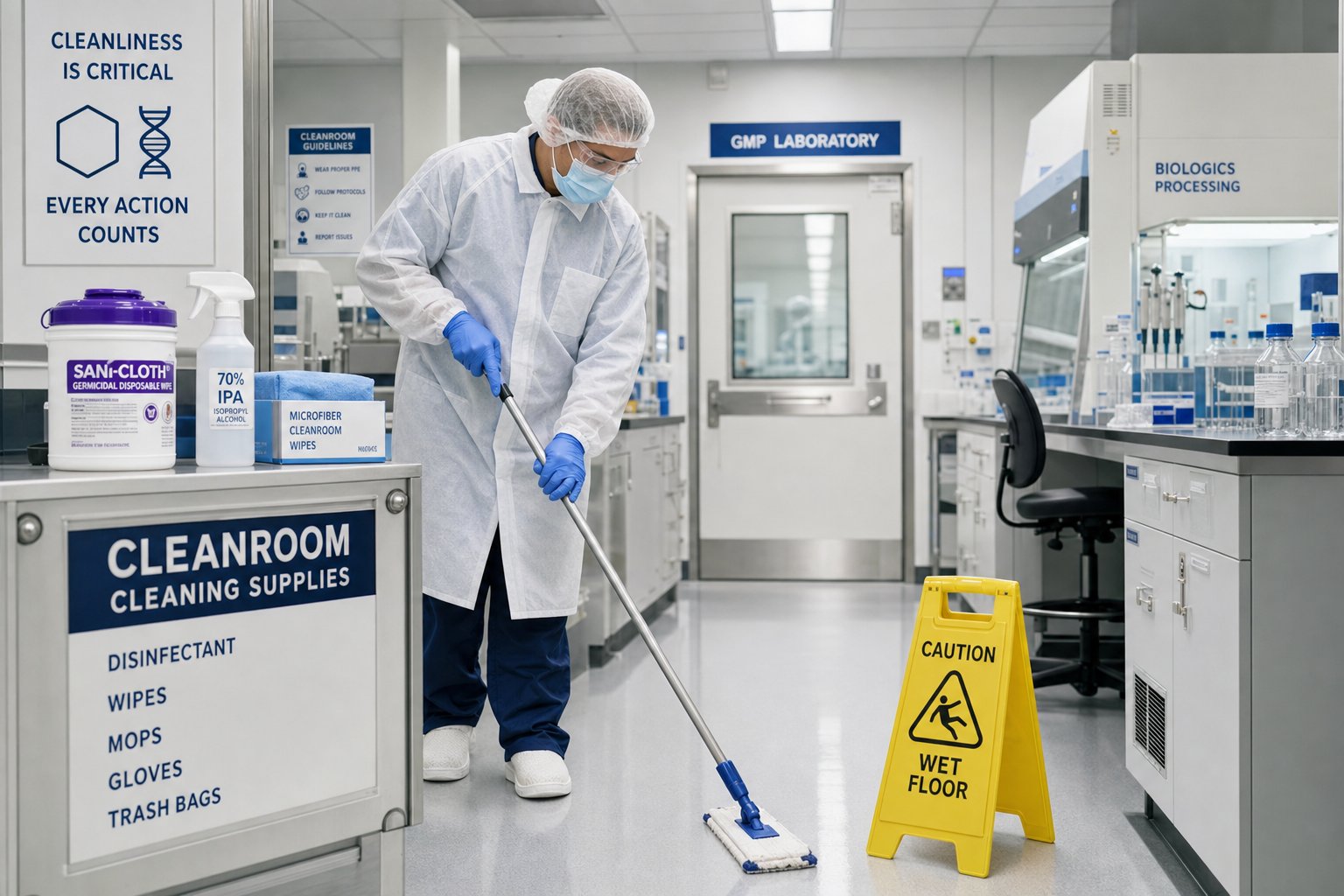
Biotech lab cleaning in New York and New Jersey is a controlled-workspace service, not ordinary office dusting. A life-science tenant in Long Island City, a research floor in Manhattan’s Flatiron district, and a campus in New Brunswick may combine labs, write-up areas, cold rooms, waste staging, and shared corridors under one lease. GreenPoint Maintenance Services builds a written zone map around the laboratory’s SOPs, uses StockPoint for time-stamped verification, and applies Green Seal certified products where the surface and protocol permit. Call GreenPoint at 844-814-0810 to schedule a walkthrough and receive a fixed-price proposal.
What makes biotech laboratory cleaning different
Laboratory cleaning exists inside a chain of custody for samples, equipment, chemicals, and waste. The cleaning vendor should understand which surfaces are environmental, which are research-critical, which areas require escort or gowning, and which tasks belong only to trained laboratory personnel. GreenPoint starts by interviewing the EHS lead, lab manager, and facilities contact; the resulting scope marks clean, controlled, support, and prohibited zones instead of assuming every room can be serviced the same way.
A strong program has a defined sequence and acceptance criteria. It may specify high-to-low work, one-direction movement, dedicated microfiber, approved disinfectant contact time, no spray near energized equipment, and a stop-work rule for unlabeled material. The [color-coded microfiber systems guide](/blog/color-coded-microfiber-systems-guide/) explains the basic control logic. GreenPoint’s supervisor converts the laboratory SOP into a practical route without rewriting the lab’s scientific or biosafety procedures.
NY and NJ site logistics
Life-science buildings often have stricter access than ordinary offices. A Long Island City lab may require a freight-elevator reservation and badge escort; a Manhattan tower may separate tenant and service elevators; a New Jersey campus may have multiple buildings, loading docks, and a shared hazardous-waste room. GreenPoint’s walkthrough captures access windows, gowning locations, material staging, emergency contacts, and the time needed to enter and exit without blocking research staff.
Transit and construction conditions also affect soil. Dust from a Hudson Yards or Jersey City build-out, winter salt near Penn Station, and rain tracked across a campus lobby can load entrances and corridors faster than a nightly route expects. GreenPoint can specify entrance checks, corridor frequency, and after-hours detail work while keeping controlled rooms on their approved cadence. Call 844-814-0810 whenever a new lab suite or change in occupancy requires a revised route.
Zone control from lobby to laboratory
The scope should name every transition: lobby, visitor corridor, gowning room, write-up area, lab support room, cold-storage approach, waste staging, and loading path. A cleaner may service office desks and public corridors while laboratory personnel handle benches, biosafety cabinets, hoods, instruments, and process equipment. GreenPoint uses visual zone labels, dedicated tools, and a supervisor check so the boundary is understood by both the crew and the lab.
Frequency follows risk and traffic. Public restrooms and break rooms may need daily or multiple-day checks; office areas often receive nightly service; controlled corridors may require a protocol-specific cadence; and high dusting or floor restoration can be scheduled monthly or quarterly. The [cleaning frequency standards by facility type](/blog/cleaning-frequency-standards-by-facility-type/) article provides a comparison framework. GreenPoint documents the actual decision in the scope rather than selling a generic “lab clean.”
Chemical, biological, and waste boundaries
The cleaning partner must stop when a task could expose a worker to research material, unknown residue, sharps, or regulated waste. The lab’s biosafety and EHS procedures control spill response, decontamination, sharps, and waste streams. GreenPoint’s role is to make the boundary explicit, train staff to recognize a stop-work condition, and escalate quickly to the designated laboratory contact. No janitorial checklist should imply that wiping a floor authorizes handling a container or opening a hood.
OSHA’s [Hazard Communication Standard](https://www.osha.gov/hazcom) supports labels, SDS access, and worker training, while OSHA’s [laboratory standard](https://www.osha.gov/laboratories) addresses chemical hygiene planning in covered laboratories. GreenPoint follows the site’s chemical-approval list, dilution instructions, PPE rules, ventilation requirements, and contact times. Green Seal certified products can reduce unnecessary chemical burden in suitable support zones, but certification never overrides the lab’s SOP.
StockPoint for audit-ready evidence
Research organizations need a record that is more useful than a cleaner’s initials. StockPoint records task completion, timestamps, GPS-tagged photos of approved environmental areas, notes, and exceptions. GreenPoint configures photography so no sample labels, screens, notebooks, patient information, or proprietary research are captured. The dashboard can show whether a corridor, restroom, write-up area, or support room was serviced within its window.
Evidence also makes corrective action faster. If a floor ATP trend rises in a break room, GreenPoint can review touchpoint frequency and cloth changes. If an auditor finds a missed high-dust task, the supervisor can add it to the route and document the correction. StockPoint is not a laboratory result and does not replace environmental monitoring; it is operational proof. Read [quality assurance commercial cleaning programs](/blog/quality-assurance-commercial-cleaning-program/) for a broader governance model.
Air, floors, and equipment protection
Biotech facilities often combine polished concrete, resilient sheet flooring, epoxy, carpet tile, and specialized anti-static surfaces. The cleaning method must match the manufacturer’s care instructions and the laboratory’s contamination-control plan. GreenPoint avoids aerosolizing product around sensitive equipment, controls moisture near thresholds, and schedules floor restoration when it will not interfere with experiments or material movement. A dry-floor check is a small step that protects both people and expensive equipment.
Settled dust control is part of good facility maintenance, but janitorial work cannot substitute for HVAC qualification, pressure relationships, or cleanroom validation. The [HEPA filtration and commercial cleaning](/blog/hepa-filtration-commercial-cleaning/) guide explains the complementary role of source control and filtration. GreenPoint coordinates with facilities and EHS, keeps products labeled, and can provide a periodic detail plan for ledges, doors, grilles, and support corridors. Schedule a site review at 844-814-0810.
Budgeting a lab cleaning program
Lab cleaning costs depend on controlled-area access, gowning and escort time, room count, floor type, waste boundaries, frequency, documentation, and the amount of office or amenity space included. A 15,000-square-foot mixed lab and office floor may require more management time than a 30,000-square-foot conventional office because each transition must be controlled. Quotes should list recurring work, periodic work, consumables, supervision, absence coverage, and any separately priced special response.
GreenPoint uses fixed pricing, no hourly billing, and no hidden fees after the scope is agreed. Procurement teams can also review GreenPoint’s MBE/MWBE certifications in New York programs, SAM.gov registration, insurance, training, and 98% client-retention record. Use the [commercial cleaning cost per square foot](/blog/commercial-cleaning-cost-per-square-foot/) article for initial questions, then call 844-814-0810 for a floor-plan review.
Selecting a laboratory janitorial partner
Ask vendors to describe a stop-work rule, clean-to-dirty movement, equipment exclusions, chemical approval, photo privacy, incident escalation, and backup coverage. Request a sample zone map and ask who will supervise the shift. A vendor that only promises “trained cleaners” without showing the control system leaves the lab to manage ambiguity. GreenPoint supplies a written route, named supervisor, and StockPoint evidence aligned to the facility’s access and SOP boundaries.
A capable regional partner can keep standards consistent as a research organization grows. GreenPoint serves Manhattan, Brooklyn, Queens, the Bronx, Staten Island, Westchester, Long Island, New Jersey, Connecticut, Pennsylvania, and Florida, while each site still receives a local walkthrough. Review [how to choose a commercial cleaning company](/blog/how-to-choose-commercial-cleaning-company/) and schedule a quote at 844-814-0810 or info@greenpointms.com.
Onboarding should include a documented access rehearsal. The GreenPoint supervisor can walk the badge path, gowning sequence, supply staging point, elevator route, and emergency exit with the facilities contact before recurring service begins. This catches practical failures such as a locked supply closet, a missing SDS binder, or a photo angle that reveals proprietary work. A short rehearsal protects the lab schedule and makes the first live shift less disruptive.
Research organizations should also define change control for the cleaning scope. A new instrument room, altered pressure regime, revised chemical list, or temporary construction partition may require a new route and briefing. GreenPoint records the change, updates the zone map, and confirms which tasks remain with the laboratory team. That discipline supports continuity when a growing NY or NJ life-science operation adds space faster than its original janitorial checklist can keep up.
Consumables and equipment should be staged outside controlled work areas unless the SOP says otherwise. GreenPoint can inventory approved cloths, liners, mop heads, and product quantities, then alert the facilities contact before a shortage interrupts a route. That small control reduces emergency substitutions and gives the lab a cleaner record of what entered each zone.
Frequently asked questions
Can a janitorial crew clean laboratory benches or hoods? Only if the facility explicitly assigns and approves the task with training and an SOP. In many labs, researchers or specialized technicians own benches, biosafety cabinets, hoods, instruments, and process equipment; GreenPoint focuses on defined environmental and support zones.
What happens if a cleaner finds an unknown spill? The cleaner follows the site stop-work and escalation procedure, isolates the area if directed, and contacts the lab or EHS lead. GreenPoint does not improvise chemical, biological, sharps, or regulated-waste response.
How does StockPoint protect research information? GreenPoint configures photo permissions and approved locations so records avoid sample labels, screens, notebooks, patient information, and proprietary work. StockPoint can still document timestamps, GPS-tagged environmental photos, tasks, notes, and exceptions.
How often should a biotech lab be cleaned? There is no universal frequency. GreenPoint separates public, office, support, controlled, and restricted zones, then sets cadence based on traffic, risk, SOPs, and access windows. Restrooms and break rooms may need more frequent checks than low-traffic support rooms.
How can an NY or NJ lab request a quote? Call GreenPoint at 844-814-0810 or email info@greenpointms.com. A walkthrough with facilities and EHS maps the zones, access, exclusions, and verification requirements before a fixed-price proposal is delivered.
For controlled-workspace cleaning that is easy to verify, call GreenPoint Maintenance Services at 844-814-0810. Schedule a NY or NJ walkthrough for a fixed-price scope backed by StockPoint and 98% client retention.