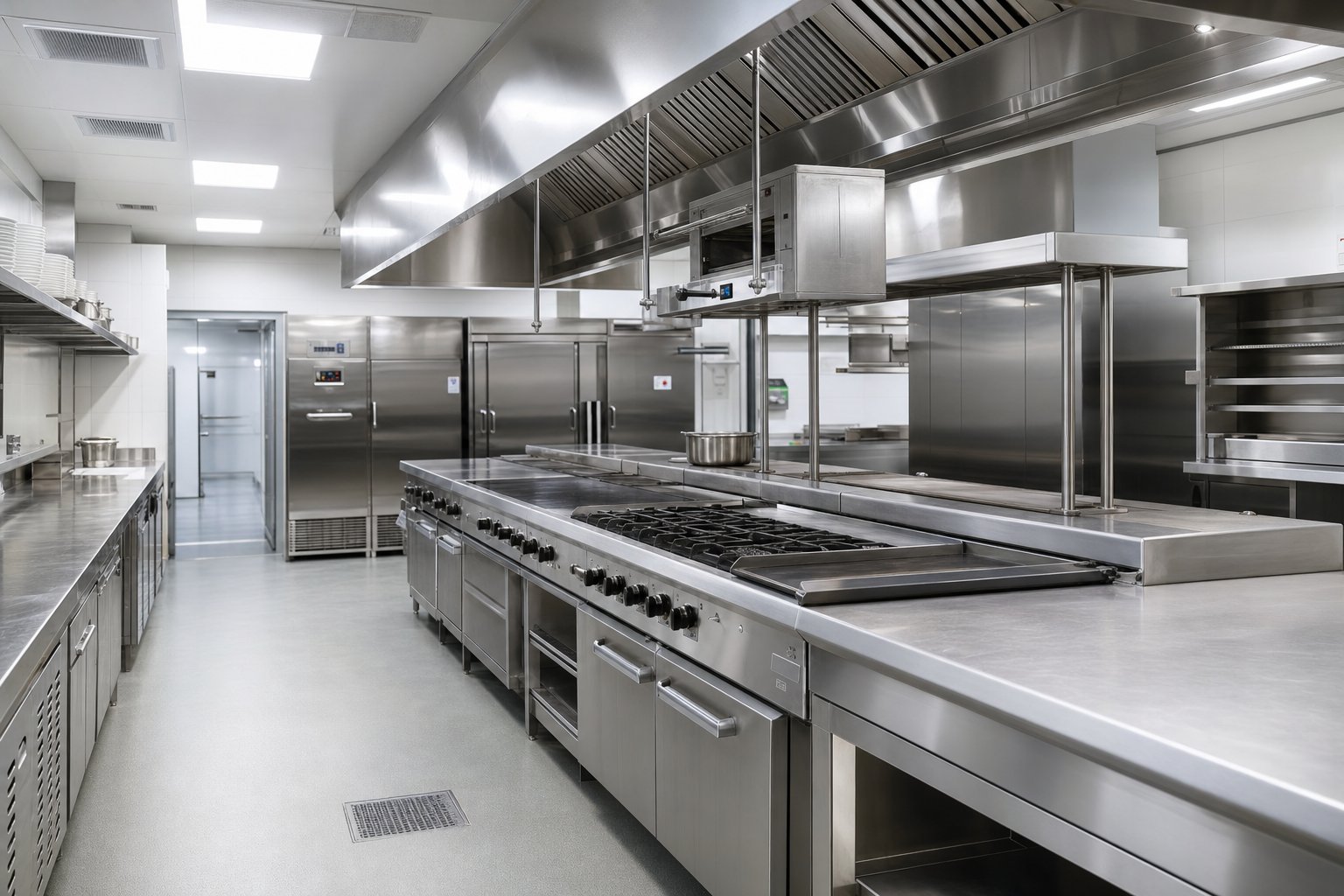
Catering kitchens and food halls have a different cleaning risk profile from a conventional office. Grease, food soil, allergens, wet floors, shared seating, delivery traffic, and overnight production all collide in one operating environment. In New York City, the cleaning program also has to support Article 81 food-service requirements, inspection readiness, and the practical realities of neighborhoods from Chelsea Market and Hudson Yards to Jackson Heights, Flushing, Long Island City, and Downtown Brooklyn. GreenPoint Maintenance Services helps operators build a documented cleaning routine around those realities, with fixed pricing, no hourly billing, and proof that work happened.
What NYC food-service cleaning must accomplish
NYC Department of Health and Mental Hygiene guidance treats cleaning and sanitizing as separate steps: remove soil first, then apply an appropriate sanitizer for the required contact time and concentration. A catering kitchen should be able to show a repeatable sequence for food-contact surfaces, prep tables, cutting boards, handles, sinks, floors, drains, refrigeration gaskets, and waste areas. A food hall adds public tables, condiment stations, shared dish-return points, elevator lobbies, and restrooms that may be used by thousands of guests each week. GreenPoint Maintenance Services documents the scope against the operator's actual menu, equipment, hours, and traffic instead of selling a generic nightly checklist.
The zones that need different frequencies
A useful frequency plan separates production from public areas. Food-contact prep surfaces need cleaning and sanitizing between incompatible tasks and at the close of production; high-touch handles, POS screens, railings, and shared seating often need several checks during service; floors need spot response immediately and a full clean at close; and drains, hood exteriors, walls, and under-equipment areas need scheduled deep-clean work. For a food hall with 12 vendors and 900 seats, a reasonable starting point is two public-area inspections per service period, nightly kitchen detail, and a weekly rotation for low-access areas. Use the [cleaning frequency standards by facility type](/blog/cleaning-frequency-standards-by-facility-type/) as a planning baseline, then adjust after an on-site walkthrough.
Allergen control deserves its own line item because a visually clean counter can still create a serious operational problem when tools or cloths move between prep zones. The kitchen manager should identify the surfaces and equipment that require a changeover clean, and the cleaning crew should use dedicated, labeled tools for those assignments. In a shared food hall, write down who cleans tenant-owned equipment, who cleans common corridors, and who responds when a vendor reports a spill or suspected cross-contact. GreenPoint can map those responsibilities to a zone list, record the completion time, and flag an exception for the kitchen lead instead of treating every surface as interchangeable.
Article 81, sanitation logs, and inspection readiness
Cleaning cannot replace a food establishment's licensed food-safety program, but it can make that program easier to execute and prove. Managers should retain product labels, safety data sheets, training records, sanitizer test results, incident reports, and dated cleaning logs. The NYC Health Code and DOHMH inspection process make conditions such as food-contact cleanliness, pest prevention, waste handling, and safe storage operational priorities. GreenPoint gives managers a sign-off trail for assigned tasks and exceptions, while the food operator remains responsible for verifying sanitizer concentrations and following each product label.
If a commissary or catering kitchen supports a school meal program, add the documentation expectations in the contract or operating plan. NYC DOE food-service environments may require tighter coordination around delivery windows, allergen controls, and access to occupied school buildings. A shared calendar prevents a cleaner from entering during meal prep or a school event, and it gives the facility manager one place to confirm who owns each task.
A practical clean-and-sanitize sequence
The repeatable sequence is: remove food and packaging, dry-pick or scrape loose soil, wash with the correct detergent, rinse when required, apply the labeled sanitizer, respect contact time, and air-dry. Never mix chemicals, and never assume that a product described as hospital-grade is automatically approved for a food-contact application. OSHA's Hazard Communication Standard requires accessible labels and Safety Data Sheets, while CDC food-safety guidance reinforces hand hygiene, separation of raw and ready-to-eat work, and prevention of cross-contamination. GreenPoint uses color-coded microfiber and tool separation so restroom tools never enter prep zones.
Grease, floors, drains, and slip prevention
Kitchen grease is both a cleanliness problem and a slip-and-fall exposure. A degreaser that works on a range hood exterior may be wrong for a sealed floor, painted wall, aluminum surface, or food-contact table. GreenPoint scopes dilution, dwell time, agitation, rinsing, and disposal for each surface, with a written rotation for under-counter edges, floor-wall junctures, drain covers, and loading areas. In a 10,000-square-foot food hall, a nightly machine scrub may cover the public floor while a 1,000- to 2,000-square-foot back-of-house zone receives detail work in sections, preventing rushed labor and standing water.
The cleaning plan should also name the response owner for spills. Near subway-adjacent sites such as Union Square, 34 St–Hudson Yards, Atlantic Avenue–Barclays Center, and Jackson Heights–Roosevelt Avenue, commuter surges can turn a small beverage spill into a crowded-floor hazard within minutes. GreenPoint can set response windows, place temporary warning signs, and record the completed intervention through StockPoint rather than relying on a verbal handoff.
Staffing and scheduling around NYC service patterns
A food hall in Midtown may have breakfast traffic before 8 a.m., a lunch peak from 11:30 a.m. to 2 p.m., and an event reset after the evening rush. A Williamsburg or Greenpoint Brooklyn venue may have weekend lines and late-night beverage service. A Queens commissary near LaGuardia or a Long Island City production kitchen may need a crew that can arrive after the final delivery, while a Chelsea Market operator may need discreet daytime touch-point service because back-of-house corridors stay busy. GreenPoint builds staffing around these windows and schedules walkthroughs before quoting so the proposal reflects actual access, not a guessed hourly bundle.
What catering kitchen cleaning costs
Pricing depends on square footage, production intensity, number of vendors, grease load, operating hours, equipment access, restroom count, and the required documentation. As a planning benchmark, routine office-style space may price around $0.05-$0.15 per square foot per visit, while food-service environments commonly run $0.12-$0.30 because of degreasing, food-contact controls, floor detail, waste staging, and shorter service windows. A 6,000-square-foot commissary serviced five nights per week can therefore have a very different monthly scope from a 30,000-square-foot hall with 15 kitchens and 1,000 seats. GreenPoint provides fixed pricing after a walkthrough, with no hourly billing and no hidden fees; call 844-814-0810 to request a quote.
The lowest invoice is not always the lowest total cost. A missed drain detail can create odor complaints, an unrecorded spill can become a claim, and an under-scoped overnight crew can leave a manager doing unpaid cleanup before the first delivery. Ask whether the quote includes consumables, machine work, periodic high dusting, emergency response, supply restocking, and supervisor inspections. GreenPoint explains inclusions and exclusions in plain language, offers a scheduled walkthrough before pricing, and keeps a consistent team assigned where access and product knowledge matter. That approach gives operators a stable budget while preserving a path to add a seasonal event reset or post-construction detail when needed.
Verification that managers can act on
A strong program measures completion and condition, not just attendance. GreenPoint's StockPoint workflow can pair timestamped, GPS-tagged photos with task checklists, exception notes, supervisor reviews, and a live dashboard. ATP testing can provide a quick relative signal on selected surfaces after cleaning; it is not a substitute for microbiological testing, a sanitizer test, or regulatory compliance. The useful question is whether the data identifies a missed zone early enough for a manager to correct it before the next service. GreenPoint reports the exception, assigns the correction, and keeps the record available for review.
A useful monthly review looks for patterns rather than isolated scores. Compare recurring exceptions by zone, time of day, vendor, and equipment type; then ask whether the root cause is access, training, chemical selection, staffing, or an unrealistic close window. ISSA quality-management principles favor measurable specifications and documented corrective action, while BLS data helps explain why retention and training affect consistency in a labor-intensive service. GreenPoint reviews trends with the client, updates the work plan when the operation changes, and keeps the conversation tied to evidence instead of impressions.
Managers can use the [what is ATP bioluminescence testing in cleaning](/blog/what-is-atp-bioluminescence-testing-cleaning/) explainer to set realistic expectations for ATP results. For broader vendor controls, the [quality assurance commercial cleaning program](/blog/quality-assurance-commercial-cleaning-program/) guide outlines scorecards, inspection frequency, corrective actions, and escalation rules. GreenPoint combines those principles with a 98% client retention rate and MBE/MWBE certification in New York State, NYC, and NYC DOE procurement contexts.
FAQ: catering kitchen and food hall cleaning in NYC
How often should a NYC food hall be cleaned? Food-contact surfaces should be cleaned and sanitized between tasks and at the end of production, while high-touch public areas need checks during service and after peak periods. The final schedule depends on menu, traffic, and the facility's approved operating procedures; GreenPoint typically verifies it during a walkthrough.
Does a cleaning company handle NYC Health Department compliance? A cleaning company supports the facility's sanitation and documentation program but does not replace the permit holder, certified food protection personnel, or DOHMH requirements. GreenPoint can document assigned work, product information, photos, and exceptions so the operator has an auditable record to manage.
Can cleaners work while a catering kitchen is producing food? Yes, if the scope separates production windows from cleaning windows and the operator controls access. GreenPoint schedules around prep, delivery, and service, uses zone-specific tools, and confirms the handoff with the kitchen lead before entering active areas.
What should a food hall ask for in a cleaning quote? Ask for square footage by zone, visit frequency, equipment and floor assumptions, spill response, restroom and seating coverage, chemical and SDS controls, inspection cadence, reporting method, exclusions, and the correction process. GreenPoint will walk the site, explain the fixed price, and answer questions at 844-814-0810.
Does GreenPoint service neighborhoods outside Manhattan? GreenPoint Maintenance Services covers Manhattan, the Bronx, Brooklyn, Queens, Staten Island, Westchester, Long Island, New Jersey, Connecticut, Pennsylvania, and Florida. For a kitchen near Chelsea Market, Flushing, Downtown Brooklyn, Newark, Stamford, or another service-area location, call 844-814-0810 to schedule a walkthrough and confirm coverage.
Ready to make your catering kitchen or food hall inspection-ready? Call GreenPoint Maintenance Services at 844-814-0810 or email info@greenpointms.com to schedule a walkthrough and fixed-price quote. GreenPoint backs the program with StockPoint verification, optional ATP testing, Green Seal certified products, MBE/MWBE certification, and a 98% client retention rate.