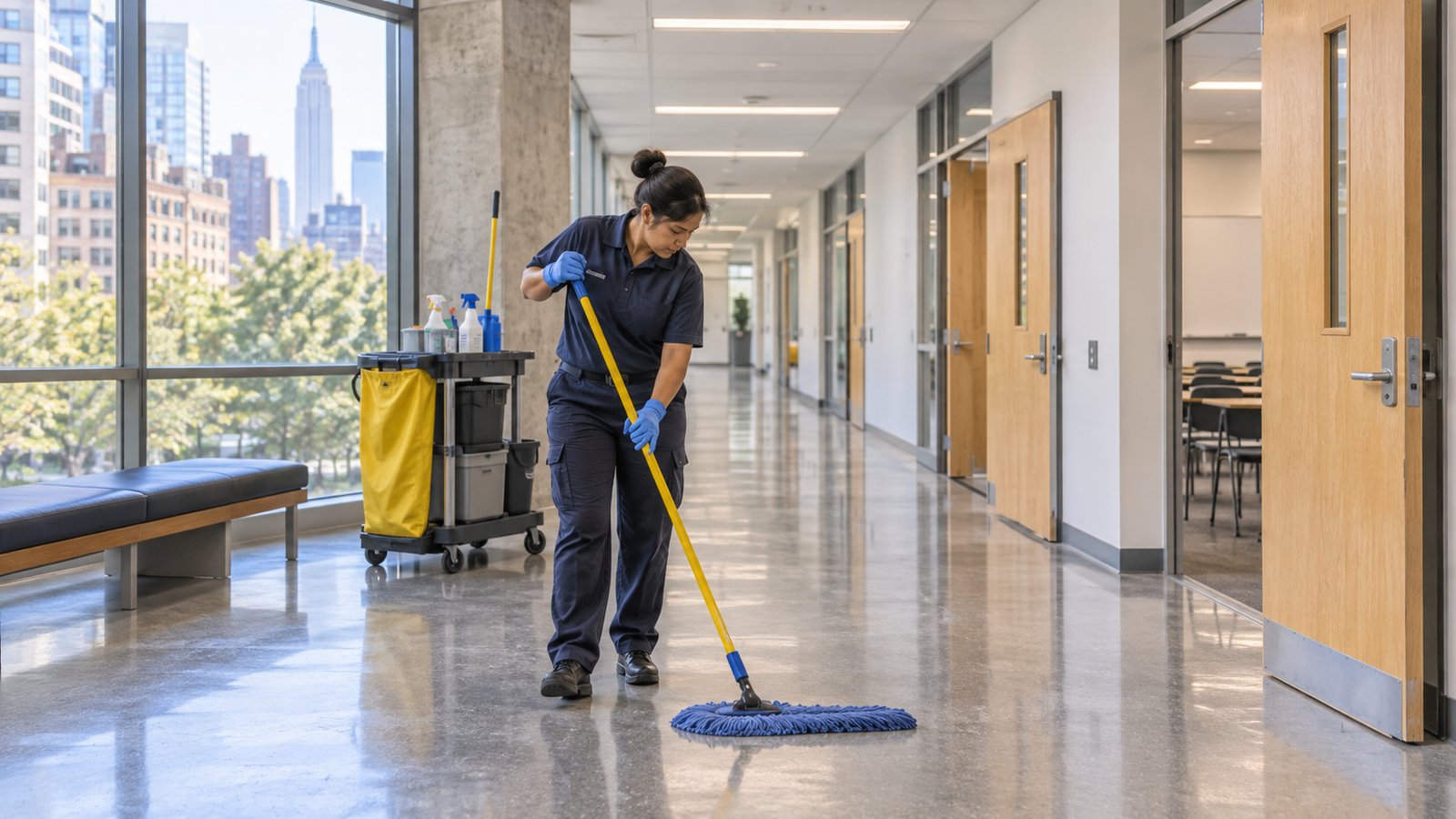
College campus janitorial services in New York City must work around classes, residence life, laboratories, libraries, events, and secure spaces, not just a square-foot total. A useful vendor scope translates those different uses into service frequencies, access rules, inspection evidence, and a fixed monthly price. GreenPoint Maintenance Services helps campus and facilities teams map that work before a contract starts. For an initial scope review, call GreenPoint at 347-332-9348 or schedule a walkthrough; the walkthrough is where room types, occupied hours, and high-risk areas can be verified rather than guessed.
Start with campus zones, not one blended square-foot number
A 100,000-square-foot campus can contain low-traffic offices, crowded lecture halls, residence bathrooms, food-service areas, and a 24-hour library. Applying one frequency to every room hides the labor drivers. Split the plan into public entrances, classrooms, administrative suites, libraries, residence common areas, athletic facilities, dining spaces, and specialized rooms. Record usable area, flooring, occupancy, access window, and peak days for each zone. A campus map and room schedule provide a stronger estimating basis than a building-wide average.
Use a room inventory to identify inclusions and exclusions explicitly. Decide whether the vendor is responsible for interior glass, high dusting, event resets, restocking, recycling, periodic floor work, and emergency response. GreenPoint Maintenance Services can show how the scope ties each task to a location and inspection method. That specificity makes bids comparable and prevents a low headline price from concealing a large list of extras. For evaluation criteria beyond scope, campus buyers can also review how to choose a commercial cleaning company and cleaning frequency standards by facility type.
Match campus schedules to the academic calendar
Campus service demand changes by hour and by semester. A practical draft schedule should distinguish between teaching days, weekends, examination periods, summer sessions, move-in, move-out, and major events. For planning, identify the daily service window, the minimum lead time for event resets, and who can authorize additional work. A one-hour post-event reset, for example, should be priced and staffed as a defined service level rather than assumed to fit inside nightly routine cleaning.
NYC campuses around Columbia in Morningside Heights, NYU near Washington Square, Fordham's Rose Hill campus, and CUNY locations face different subway arrivals, delivery patterns, and pedestrian volumes. Access can be shaped by the 116 St–Columbia University subway station, the 8 St–NYU station, or Fordham Metro-North station, depending on campus. Building-specific fire-safety and egress rules also affect where carts can stage. GreenPoint recommends a walkthrough at more than one time of day when access is uncertain. Call 347-332-9348 to schedule one and confirm whether a proposed shift aligns with class changes, campus security procedures, and building operations.
Set task frequencies around use and observable conditions
Frequency should be a service decision, not a promise that every surface receives identical attention. A planning matrix may call for daily litter removal and touchpoint cleaning in busy entrances, daily restroom cleaning with replenishment checks, classroom reset after scheduled use, and weekly detail work in lower-traffic offices. Residence common areas and dining-adjacent corridors may need multiple checks per day during peak periods. Treat these as starting points to verify against occupancy, complaints, inspection results, and the institution's own standards.
Define what a completed task looks like. 'Clean the lecture hall' is vague; 'remove visible litter, wipe accessible desk surfaces, spot-clean doors, empty waste, and report a spill or damage' can be inspected. Colleges that receive public funding or operate affiliated schools should distinguish their campus rules from school-district requirements. NYC Department of Education custodial materials can be a useful reference for schools under DOE oversight, but they do not automatically govern a private or independent college. GreenPoint uses room-level task definitions to keep the contract measurable.
Protect specialized spaces with access and safety controls
Laboratories, clinics, athletic training rooms, workshops, and research suites should not be treated as ordinary offices. Identify spaces requiring training, escort, restricted entry, or facility-provided procedures. Cleaning staff should never handle unknown samples, sharps, chemicals, or equipment outside their approved duties. The campus should define who reports a spill, who isolates an area, and which emergency contact responds. OSHA Hazard Communication requirements call for employers to communicate chemical hazards and make applicable safety data sheets available to workers.
Specify product approval, dilution, labeled containers, PPE, and storage locations before service begins. GreenPoint uses Green Seal certified products where appropriate and can document product lists for client review; product choice still needs to match the surface, the institution's policy, and any room-specific restrictions. Include accessible routes, elevator rules, fire exits, and waste-stream separation in training. To schedule a walkthrough, call 347-332-9348 and identify any labs or controlled spaces in advance so the right campus representative can join.
Require verification that connects a complaint to a correction
A strong quality plan names the inspection locations, cadence, scoring method, response time, and person responsible for closing a deficiency. A campus dashboard is useful when it shows evidence tied to a room and service date rather than a generic monthly score. GreenPoint's JaniTrack verification can capture timestamped, GPS-tagged photos and record inspection findings; ATP testing may be used as a supplementary indicator on selected surfaces, not as proof that a space is sterile or free of every pathogen.
Set a practical baseline such as inspecting a rotating sample of rooms each week, reviewing repeat failures monthly, and agreeing on a correction window based on severity. Separate routine appearance checks from safety incidents, supply shortages, and damage reports, because each needs a different response. GreenPoint reports a 98% client retention rate as a company performance measure; it is context, not a substitute for service-level evidence at a prospective campus. Ask for sample reports and walk through how a missed task becomes a documented resolution.
Compare complete costs, staffing assumptions, and inclusions
Ask how the vendor covers call-outs, semester peaks, and late-day changes without silently reducing routine tasks. A staffing table should show scheduled hours by shift and who supervises each building, while the service calendar should identify holidays and campus closures. Procurement can then distinguish a temporary event assignment from a permanent scope expansion. For a multi-building campus, group buildings by access window and use type so the buyer can compare both total cost and the service level delivered in each zone.
A janitorial quote should identify labor hours, shift coverage, supervision, supplies, equipment, taxes where applicable, periodic tasks, and assumptions about room access. BLS occupational data can help procurement teams understand the labor market, but local wage rates, benefits, paid leave, and prevailing-wage terms vary by employer and contract. Avoid relying on a single national wage figure to judge whether a NYC proposal is viable. Request a fixed monthly price with a written list of included tasks and a change-order process for new areas or event work.
For illustration only, a 20,000-square-foot academic wing might require different weekly hours depending on carpet, restroom count, building hours, and daily traffic; there is no universal square-foot-per-cleaner ratio that replaces a site survey. Ask every bidder to disclose its staffing model and supervisor coverage. GreenPoint offers fixed pricing without hourly billing or hidden fees when the agreed scope supports it. Call 347-332-9348 to review a campus plan, or compare the cost drivers in commercial cleaning cost per square foot.
Use a campus-specific selection and mobilization checklist
The first month is also the right time to compare the map to reality: locked rooms, construction barriers, unusually busy corridors, and unavailable closets all change the route. Record these constraints in the mobilization log and assign a decision-maker for changes. A written transition record helps the campus avoid asking individual cleaners to make policy decisions about access, products, or extra duties. GreenPoint can review the first inspection results with the facilities contact and document corrective actions.
Before award, verify insurance, references for comparable institutions, background-screening expectations, training records, escalation contacts, backup staffing, and the reporting format. Confirm MBE or MWBE documentation if the procurement includes participation goals. GreenPoint Maintenance Services is MBE-certified and registered in SAM.gov, and can provide applicable certification details for buyer verification. Request certificates and registration evidence directly rather than relying on a marketing statement. A vendor's proposal should also explain how it handles vacancies, weather disruptions, supply replenishment, and a failed inspection.
Use a mobilization plan with named owners for keys and badges, room access, product approval, custodial closets, waste routes, emergency contacts, and the first inspection. A 30-day transition checkpoint is a useful management target: compare actual access, complaint categories, and labor assumptions with the bid, then document any agreed adjustment. GreenPoint can hold a walkthrough and quote review at 347-332-9348. Before signing, campus leaders should ensure the scope distinguishes routine cleaning from construction cleanup, regulated waste, infection-control work, and other specialized services that need separate qualifications.
Frequently asked questions about NYC campus janitorial services
Q: How often should a college classroom be cleaned? A: Set the frequency from the room timetable, enrollment, food use, flooring, and observed condition. Many campuses use a daily reset for rooms used throughout the day and a documented detail rotation for less-used rooms; verify the schedule with inspections rather than assuming all rooms need the same service.
Q: Does a college cleaning contract have to follow NYC DOE rules? A: Not simply because the site is in New York City. DOE requirements apply to DOE facilities and contracts as specified by the agency. Colleges should follow their own policies, applicable laws, contract terms, and any requirements tied to a particular affiliation or funding source.
Q: Can a janitorial vendor clean laboratories? A: Only within a clearly approved scope. The institution should define training, access, PPE, products, and prohibited tasks for each lab type. Cleaning staff should not handle research materials, sharps, or unknown spills unless a separate qualified protocol specifically authorizes that work.
Q: What should campus buyers ask GreenPoint for before award? A: Request a room-level scope, staffing assumptions, sample inspection records, insurance and certification evidence, product list, escalation plan, and a fixed-price schedule. Call GreenPoint Maintenance Services at 347-332-9348 to schedule a walkthrough and receive a site-specific quote.
Plan campus cleaning with verifiable room-level tasks, JaniTrack reporting, and fixed pricing. Call GreenPoint Maintenance Services at 347-332-9348 to schedule a walkthrough. GreenPoint reports 98% client retention and holds MBE certifications; request documentation and a campus-specific quote.