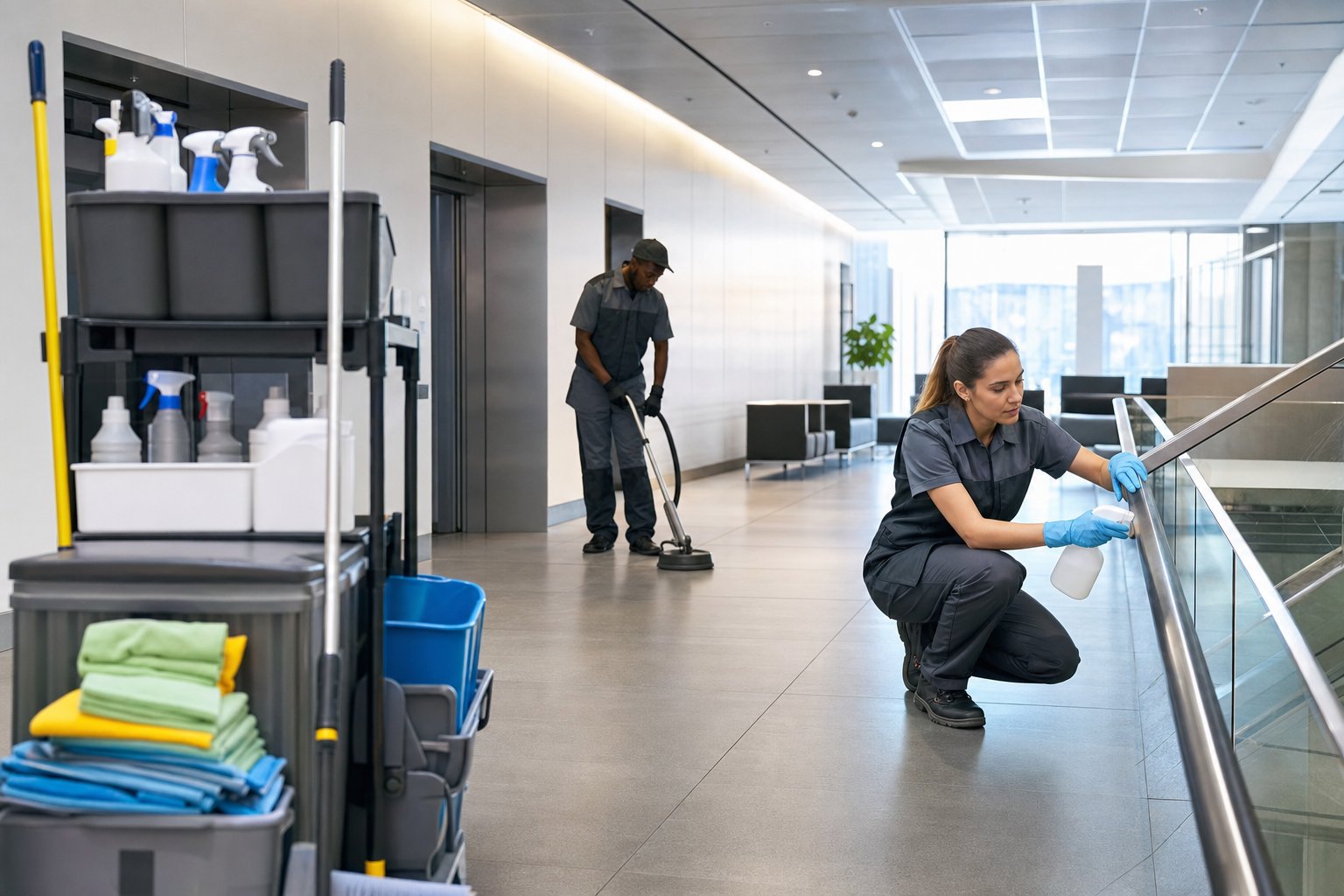
Choosing commercial cleaning in Bridgeport, CT is an operating decision, not a cosmetic purchase. A Bridgeport building may move from commuter rush to event traffic to evening occupancy in one day, so the cleaning vendor has to manage changing demand rather than simply dispatch a nightly crew. For a property manager comparing commercial cleaning Bridgeport CT providers, the right question is whether the vendor can document scope, staffing, safety, and results at the promised frequency. GreenPoint Maintenance Services approaches that decision with a site-specific scope, trained staff, measurable inspections, and a clear escalation path. The goal is not a glossy promise; it is a repeatable cleaning system that a property manager can verify every week.
What Bridgeport businesses should expect from a local cleaning partner
Bridgeport buyers should define what “clean” means in the lobby, restrooms, elevators, tenant suites, loading areas, and waterfront-facing spaces. A downtown office by the Transportation Center has a different risk profile from a Black Rock restaurant or a Seaside warehouse. Ask bidders to identify staffing by zone, response times during occupied hours, and exactly which tasks are included at each frequency. If you want to compare the property with a real service plan, call 844-814-0810 and ask GreenPoint for a walkthrough conversation before collecting final bids.
A strong local partner also understands the difference between a one-time reset and a recurring program. GreenPoint Maintenance Services serves commercial properties across New York, New Jersey, Connecticut, Pennsylvania, and Florida, and GreenPoint builds the operating plan around occupancy, soil load, surfaces, and access rather than selling the same checklist everywhere. Facility leaders comparing vendors can use the [commercial cleaning cost per square foot guide](/blog/commercial-cleaning-cost-per-square-foot/) to normalize proposals before they compare totals.
Start with a documented site walk and scope map
Use the site walk to trace people and materials from the front door to the service closet. Record badge requirements, elevator controls, after-hours parking, dock rules, public restrooms, and any areas shared with event guests at Harbor Yard or the arena. GreenPoint Maintenance Services turns those observations into a room-by-room plan, an access matrix, and a supply list so the proposal can be audited before signing.
Ask for the site-walk notes before you sign. They should name the person responsible for keys, alarms, restocking, incident reporting, and approval of extra work. GreenPoint gives the client a point of contact, a baseline scope, and a walkthrough summary that can be updated when a floor opens, a tenant moves, or a production area changes. GreenPoint also schedules a walkthrough and quote at no charge so the final number reflects the actual building.
Match frequency to traffic, surfaces, and risk
An effective Bridgeport program has visible daily controls and scheduled deep work. Daytime attendants may handle restroom checks and spill response near busy corridors, while the evening team completes vacuuming, hard-floor care, waste removal, and touchpoint cleaning. Weekly detail should reach corners, ledges, glass, and break-room appliances. Quarterly work can include carpet extraction, high dusting, and machine scrubbing based on inspection data.
Frequency should be evidence-led. ISSA appearance-level thinking helps teams describe whether a space is merely orderly or consistently presentable, while ATP testing can identify whether a high-touch zone needs a process change. GreenPoint reviews inspection trends and can adjust a route after a measured problem instead of adding random labor. The same discipline applies to carpet, VCT, tile, sealed concrete, glass, and resilient flooring.
For a manager who is evaluating office cleaning Bridgeport, a useful service calendar has daily, weekly, monthly, and quarterly rows with an owner and acceptance standard. GreenPoint can pair routine work with periodic floor care and high dusting, and GreenPoint records completed work through StockPoint so a supervisor can see where the team was, what was checked, and when a correction closed.
Build a pricing model that survives budget review
A Bridgeport RFP should make clear whether the price includes daytime porter coverage, consumables, event resets, floor finish, exterior entry care, and emergency response. Compare a fixed monthly price with an hourly quote only after normalizing scope. For a 40,000-square-foot mixed-use building, a low headline price can become expensive if restrooms, elevators, and event-day labor are treated as add-ons.
Do not let a low bid hide a thin scope. Compare labor assumptions, frequency, restroom counts, consumable allowances, floor-care intervals, supervision, and response time. GreenPoint uses fixed pricing with no hourly billing and no hidden fees when the scope is defined, which gives finance teams a stable monthly number and gives operations a written basis for change requests. The proposal should still explain exclusions, emergency rates, and client-provided utilities. Call 844-814-0810 when an estimate needs a site-specific answer instead of a generic rate card.
A practical buyer can model three scenarios: baseline service, seasonal demand, and a high-traffic event or occupancy change. Record square footage, number of floors, restrooms, kitchens, entrances, elevators, and special surfaces. GreenPoint can turn those inputs into a walkthrough quote, and a manager can compare it against the [calculating true cleaning cost TCO guide](/blog/calculating-true-cleaning-cost-tco/) rather than choosing on sticker price alone.
Use verification that a property manager can audit
The Metro-North station and Route 8/25 approaches create predictable surges, while waterfront wind can carry grit into entrances. Build a service window that can flex around those conditions and around arena or university events. GreenPoint can document a primary route, alternate parking or staging instructions, and a supervisor check when unusual traffic changes the expected workload.
GreenPoint differentiates its service with StockPoint verification: timestamped, GPS-tagged photos, ATP testing where appropriate, and a live dashboard. That evidence answers practical questions: Was the assigned zone reached? Was the restroom checked during the requested window? Did a supervisor see the issue? Is the correction documented? GreenPoint’s 98% client retention is a proof point, but the day-to-day value is the transparent record a client can review without chasing a text message. The [digital cleaning verification systems guide](/blog/digital-cleaning-verification-systems/) explains why timestamped evidence is more useful than an unverified completion claim.
Quality assurance should include scheduled inspections, trend reporting, and a corrective-action loop. A GreenPoint supervisor can record the finding, assign the fix, verify completion, and discuss a root cause when the same issue repeats. Managers can compare that process with the [cleaning audit checklist for facility managers](/blog/cleaning-audit-checklist-facility-managers/) and set a monthly review cadence.
Protect people, surfaces, and compliance obligations
OSHA-aligned chemical communication, PPE selection, wet-floor controls, and bloodborne-pathogen procedures belong in the operating plan, not only in a certificate folder. Specify how SDS information is available on every shift and who approves substitutions. GreenPoint uses Green Seal certified products where they fit the surface and exposure, color-codes microfiber, and trains staff to prevent cross-contamination between restrooms, food areas, and offices.
The safest program is specific about labels, dilution, PPE, SDS access, storage, ventilation, and wet-floor communication. CDC guidance is a useful reminder that cleaning and disinfection depend on the right product and contact time, not on spraying more chemical. GreenPoint trains staff to follow product directions, use color-coded microfiber, and keep restroom tools separate from office or food areas. GreenPoint can also coordinate client-specific OSHA, health, privacy, or building rules before the first shift.
Ask who handles a spill, bodily-fluid event, broken glass, damaged surface, or suspected cross-contamination. Ask where incident notes live and who gets called at 2 a.m. GreenPoint provides a defined escalation path and can schedule a walkthrough so the team understands the response before an emergency. For regulated or sensitive environments, pair this plan with the [OSHA cleaning chemical safety GHS SDS guide](/blog/osha-cleaning-chemical-safety-ghs-sds/) and the client’s own safety manual.
Plan around Bridgeport access, neighborhoods, and transit
Local logistics are part of quality. Bridgeport sites need practical loading, key-control, and shift plans that account for dense downtown traffic and waterfront weather. A vendor should know how the building interacts with Metro-North New Haven Line, Route 8/25, I-95, and the Bridgeport bus network, and should document parking, loading, keys, elevators, alarms, and alternate staging. GreenPoint can create arrival instructions for teams serving Downtown, Black Rock, the Hollow, North End, and the Seaside corridor and can sequence noisy or chemical-intensive work so it does not collide with tenant arrival, deliveries, school traffic, or public events.
Landmarks such as Bridgeport Transportation Center, Harbor Yard, the University of Bridgeport, and the Webster Bank Arena help explain the local operating context, but the service plan should stay property-specific. Ask for a primary route, a backup contact, and a contingency for rain, snow, salt, transit delays, bridge congestion, or an unexpected occupancy surge. GreenPoint’s local supervisor and StockPoint records give the client one accountable trail even when multiple buildings share a contract.
Score the RFP on evidence, not adjectives
Bridgeport bidders should be scored on documented local coverage, supervisor presence, event flexibility, key control, quality audits, insurance, references, and price structure. Ask to see a sample inspection report and an example of a missed-task correction. A vendor that can show the corrective loop is more useful than one that only promises a polished first week.
A useful bid table assigns points to scope completeness, local coverage, staffing continuity, safety training, green-product documentation, quality assurance, technology, insurance, references, and cost. Require at least two references for comparable occupied facilities and ask what the vendor does after a missed task. GreenPoint Maintenance Services is MBE-certified, MWBE-certified through NYS, NYC, and NYC DOE programs, SAM.gov registered, and prepared to provide the documentation a public, institutional, or private buyer needs. For a deeper quality framework, review the [quality assurance commercial cleaning program guide](/blog/quality-assurance-commercial-cleaning-program/), then ask each bidder to show how its inspections work in the field.
Before award, ask for a sample weekly report, a sample corrective action, a list of included supplies, and a service-level contact tree. GreenPoint can schedule a walkthrough and quote, explain the fixed-price assumptions, and show how GreenPoint measures follow-through. If a bidder cannot explain who checks the checker, the proposal is not complete. Buyers who want a procurement checklist can also use [questions to ask a commercial cleaning company](/blog/questions-to-ask-commercial-cleaning-company/) before inviting final pricing.
Frequently asked questions about commercial cleaning in Bridgeport
Q: How often should a Bridgeport office be cleaned? A: Daily service is a starting point for occupied offices, restrooms, kitchens, and high-touch areas, but frequency should follow occupancy, traffic, surface type, and inspection results. GreenPoint can build a daily, weekly, and periodic schedule after a walkthrough.
Q: What should a local cleaning quote include? A: It should state square footage, room and restroom counts, frequencies, labor assumptions, supplies, floor care, supervision, response time, exclusions, and price basis. GreenPoint provides fixed pricing with no hourly billing and no hidden fees when the scope is defined, then documents any approved scope change.
Q: Can GreenPoint clean a mixed-use or industrial property? A: Yes. GreenPoint Maintenance Services can separate office, public, restroom, warehouse, dock, medical, or sensitive zones and assign the required tools, PPE, access rules, and frequencies. The site walk determines which areas need special handling.
Q: How does StockPoint help a facility manager? A: StockPoint can provide timestamped GPS-tagged photos, inspection records, ATP testing where appropriate, and a live dashboard. Those records let a manager verify service, spot trends, and close corrective actions without relying on an informal completion message.
Q: How do I request a walkthrough or quote in Bridgeport? A: Call GreenPoint at 844-814-0810 or email info@greenpointms.com with the property address, approximate size, service window, and priority areas. GreenPoint will schedule a walkthrough, confirm the scope, and explain the next step without requiring an hourly-billing commitment.
Schedule a Bridgeport, CT commercial-cleaning walkthrough with GreenPoint Maintenance Services at 844-814-0810 or info@greenpointms.com. You will receive a documented scope and fixed-price quote with no hidden fees. Proof point: GreenPoint reports 98% client retention and uses StockPoint verification with timestamped GPS-tagged photos, ATP testing where appropriate, and a live dashboard.