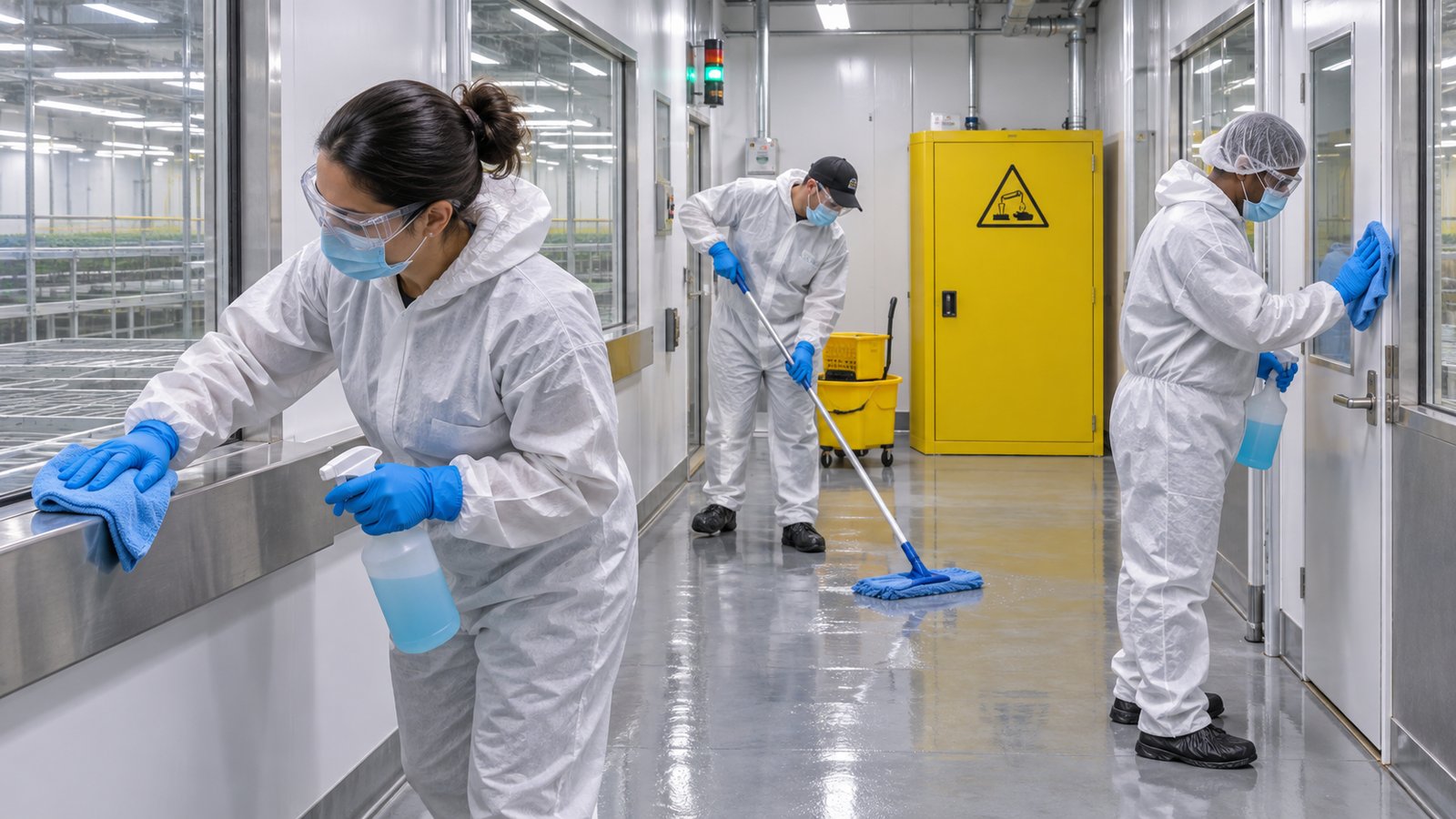
Cannabis cultivation facilities need a cleaning plan that protects the licensee's sanitation program, room controls, crop zones, and records. A vendor should not improvise products, enter restricted rooms, or treat production surfaces like an ordinary office. Buyers in New York and New Jersey should define approved spaces, staff access, chemical storage, handwashing facilities, and who signs off on cleaning logs. GreenPoint Maintenance Services Corp provides commercial facility cleaning with fixed scopes and documented checks. To discuss a walkthrough for eligible support areas, call 347-332-9348.
Start with the licensee's written sanitation program
Before requesting a price, ask the licensee's compliance lead to classify rooms as production, drying, storage, packaging, office, restroom, or shared support space. For each area, record whether a third-party cleaner may enter, which tasks are allowed, which tools are dedicated, what product is approved, and who reviews the record. New York's Adult-Use Cultivator Compliance Welcome Packet summarizes sanitation obligations under 9 NYCRR 125.7, but it is guidance and does not replace the binding rules. The licensee remains responsible for the regulatory program and current site procedures.
A general janitorial contractor may be a fit for designated offices, corridors, and amenities, while crop-contact surfaces, process equipment, and rooms with exposed product may require licensee staff or a separately qualified sanitation provider. GreenPoint will not assume that a request for cleaning grants permission to enter a controlled area. The scope should include an approved-zone map, badge requirements, escort rules, clothing changes, handwashing points, photography restrictions, and a named person who can stop the work if conditions change.
Separate tools, chemicals, and clean-to-dirty routes
Create separate equipment sets for offices, restrooms, production-adjacent corridors, and any area the licensee authorizes for outside service. Label carts, mop heads, cloths, buckets, and reusable bottles so a tool used in a restroom cannot migrate into a cultivation or packaging zone. Use a written route that begins in the cleanest approved area and ends at the least clean area, with a defined changeover step between zones. Keep carts out of crop aisles unless the site plan explicitly permits them.
Cleaning compounds, detergents, sanitizers, caustics, acids, and other chemicals should be selected and stored only under the licensee's product-approval process. New York's Adult-Use Cultivator Compliance Welcome Packet summarizes guidance that toxic or poisonous materials and cleaning compounds must be separated from cannabis and stored in distinctly labeled containers; it also calls for routine cleaning and sanitization records. Confirm the correct label use, dilution, contact time, rinse requirement, and storage location before the first shift. GreenPoint can maintain an approved product list for its assigned tasks, but the licensee determines what is acceptable in production.
Store only the quantity needed for the shift in a designated, labeled cabinet; keep original labels legible and never transfer a product to an unmarked bottle. The licensee should tell the vendor which secondary containers are allowed and how empty packaging is handled. If a product is replaced, suspend its use until the revised label and safety data sheet have been reviewed and the affected workers have received any required training. These simple controls make it easier for a compliance manager to trace what was used in a room and reduce the chance that an unapproved chemical appears beside cultivation supplies.
Protect cultivation, drying, and packaging environments
Cultivation spaces can include irrigation lines, grow lights, fans, humidity controls, floor drains, and delicate equipment. Drying rooms may require stable airflow and humidity. A janitorial crew should avoid adjusting HVAC settings, moving plants, handling cannabis, touching irrigation controls, or using products that could contaminate product or alter the room environment. The site should explain how to report condensation, standing water, visible debris, pest evidence, or a failed seal without requiring the cleaner to diagnose the cause.
The licensee should identify which environmental alarms or indicators a vendor may see and who receives an immediate call if a reading is outside the site's acceptable range. A cleaner should never change a set point or silence an alert to complete a task. If a room is under a special drying or harvest schedule, mark its cleaning window on the access calendar and require release from the room owner before entry. These steps keep routine upkeep from disrupting environmental controls that the licensee uses to protect product quality.
For packaging rooms, document the separation between ordinary floors and product-contact surfaces. A vendor should clean only the approved surfaces and should not wipe utensils, equipment, contact surfaces, or containers unless the licensee has authorized the method and validated its procedure. Keep waste removal, floor cleaning, and touchpoint tasks in separate steps, and protect packaging materials from splash or chemical drift. In a 30,000-square-foot facility, zoning and access are more important cost drivers than the gross area because a few controlled rooms can have entirely different service rules.
Set worker access, hygiene, and safety expectations
A site orientation should cover visitor sign-in, badges, cameras and phones, personal protective equipment, handwashing, gowning, traffic routes, emergency exits, and prohibited items. The licensee's plan may specify whether outside workers change footwear or garments before entering certain areas. OSHA's Hazard Communication Standard requires employers to communicate workplace chemical hazards through a program, labels, safety data sheets, and training. Coordinate the host's information about site chemicals with the vendor's training for products brought on site, and keep the current SDS accessible to authorized staff.
Define a stop-and-report path for suspected pests, mold-like growth, standing water, a broken container, chemical odor, injured staff, or a possible contamination event. The cleaner should not make a product-safety determination or resume work without release from the site's compliance lead. GreenPoint can train assigned employees on a written route and use JaniTrack for timestamps and agreed service photos, subject to the licensee's confidentiality and photography rules. Request a walkthrough or quote at 347-332-9348 and ask the compliance manager to join.
Make sanitation records useful to the licensee
A complete record should identify the approved room, task, date and time, assigned worker, product, exception, corrective action, and supervisor review when the licensee requires those fields. Use room codes rather than sensitive crop details in routine vendor reports. If a task is skipped because a room was occupied or a production activity was underway, log the reason and reschedule it through the authorized contact. Records should be stored according to the client's retention policy and made available to the designated reviewer.
Agree in advance whether a record is a service log, a sanitation record, or both, and who is allowed to approve it. A cleaner can attest to the task performed and the time, but only the licensee can decide whether that work satisfies its written program or a regulator's request. Set a weekly review for the first month, then move to a monthly cadence if the process is stable. GreenPoint can assign a supervisor to close open exceptions and send a summary that separates completed tasks, deferred access, and corrective actions instead of presenting one undifferentiated completion percentage.
JaniTrack can provide timestamped GPS-tagged photos and a live dashboard for agreed tasks, but photographs are not a substitute for the licensee's sanitation documentation or an inspection record unless the site has approved that use. ATP readings can help trend surface residue on selected non-product-contact points, yet they do not identify a microorganism or prove that a crop or room is free of contamination. For more context on objective checks, see what ATP bioluminescence testing can and cannot show and the digital cleaning verification systems guide.
Budget the scope without pricing from square footage alone
Build a monthly estimate from approved rooms, service days, labor hours, access and gowning time, supervision, dedicated equipment, consumables, training, and documentation. A 10,000-square-foot office and amenity wing might require a simple evening route; the same area split across cultivation rooms with gowning and zone transitions may require more labor and separate equipment. Use square footage to organize the walkthrough, then price the actual task list. GreenPoint offers fixed pricing rather than hourly billing and can state what is included, what is excluded, and how added zones are priced.
BLS reports a May 2025 national median wage of $17.71 per hour for janitors and building cleaners in its occupational outlook data, but that is not a contract rate and does not reflect a specific local market, benefits, supervision, training, insurance, or the higher controls of a regulated site. Ask for a transparent labor and supply assumption, not a fabricated industry average. GreenPoint Maintenance Services can prepare a quote after the site compliance lead confirms the authorized rooms. Call 347-332-9348 to schedule the walkthrough.
A useful proposal also separates launch costs from monthly service. Initial badge processing, site orientation, color-coded tools, dedicated storage, and training may be one-time mobilization items, while labor and consumables recur each month. State whether the client or vendor supplies paper products, liners, and replacement mop heads. If the site adds a new room or shifts operating hours, define the written change process and effective date. This approach helps a procurement team compare proposals and makes it clear whether a quoted monthly amount includes the setup needed for safe, controlled work.
Cannabis cultivation cleaning FAQs
Who is responsible for sanitation compliance at a licensed cultivation site? The licensee retains responsibility for its compliance program and records. A cleaning vendor can perform agreed tasks, but the contract does not transfer the licensee's regulatory oversight.
Can a general janitorial contractor clean grow rooms or product-contact surfaces? Only if the licensee expressly approves the room, product, procedure, training, and recordkeeping. Some tasks may need to remain with licensee employees or a specialist under the licensee's validated process.
What should a New York or New Jersey buyer ask a cleaning vendor? Ask about restricted-area controls, approved chemical records, separate tools, hand hygiene, worker orientation, documentation, incident escalation, insurance, and whether the vendor can work within the site's security and photography rules.
How do I request a GreenPoint quote? Call 347-332-9348 or email info@greenpointms.com to arrange a walkthrough with the licensee's compliance lead. GreenPoint reports 98% client retention and can document agreed janitorial checks in JaniTrack, subject to the site's records and access policy.
Need a clearly bounded cleaning plan for a cannabis cultivation facility in New York or New Jersey? Schedule a walkthrough with GreenPoint Maintenance Services Corp at 347-332-9348. Proof point: GreenPoint reports 98% client retention and offers JaniTrack timestamps, GPS-tagged photos, and live-dashboard visibility for approved tasks; the licensee retains sanitation and compliance oversight.