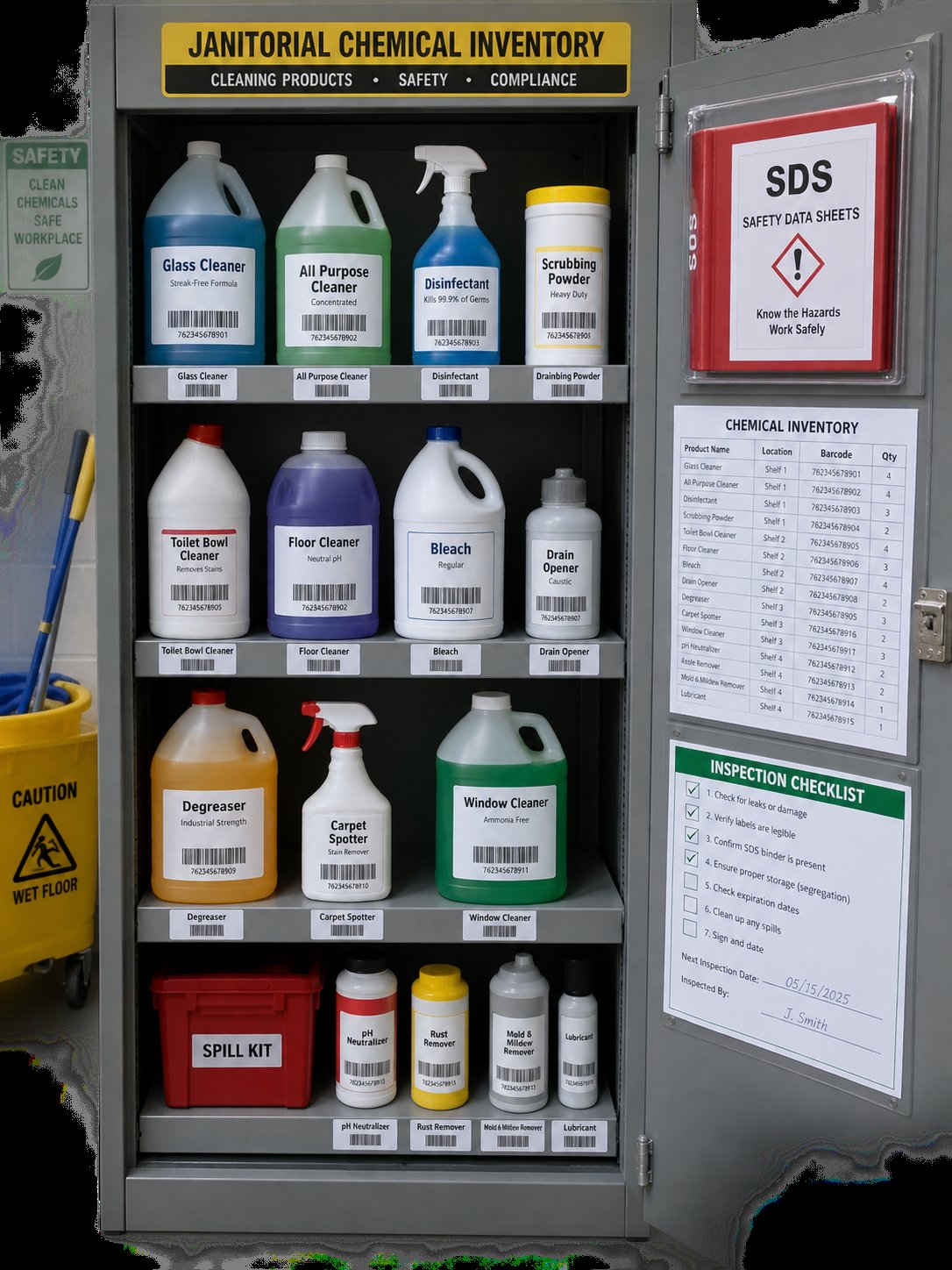
A commercial cleaning chemical inventory is more than a list of bottles in a closet. It should tell a facility manager what products are approved, where they are stored, who may use them, which SDS is current, what dilution and PPE apply, and how expired or damaged containers are removed. GreenPoint Maintenance Services builds chemical controls into cleaning scopes for offices, schools, medical practices, warehouses, and public facilities across NY, NJ, CT, PA, and FL. The result is a safer, more auditable program that supports OSHA hazard communication without pretending a janitorial inventory replaces the client's broader safety system.
Why Inventory Accuracy Matters
An inaccurate inventory creates several risks at once: an employee may use the wrong product on a floor, a manager may not find an SDS during an incident, a school may store chemicals where children can reach them, or a vendor may bring an unapproved disinfectant into a medical office. Start with a physical count by location and compare every container to the approved product list. The [OSHA cleaning chemical safety guide](/blog/osha-cleaning-chemical-safety-ghs-sds/) explains the hazard-communication foundation; inventory is the operational layer that makes it usable.
Record product name, manufacturer, intended use, active ingredient where relevant, container size, location, owner, SDS date, dilution, PPE, and disposal or return method. GreenPoint's supervisor should review the list after a product substitution, renovation, tenant request, or change in floor finish. Call 347-332-9348 to schedule an inventory walkthrough before a compliance visit or new contract starts.
Separate Approved, Quarantined, and Waste Products
Use clear status categories. Approved products are in service and within shelf-life or site rules; quarantined products are awaiting review because of damage, missing labels, or uncertain ownership; waste products are prepared for an approved disposal or return route. Do not place an unknown bottle back on the active shelf. Photographing labels may help the record, but the physical container and current SDS remain the source to verify.
A 100,000-square-foot office may have janitor closets on 20 floors, while a 15,000-square-foot school may have one central room with strict access. GreenPoint maps every storage point and identifies who holds the key. GreenPoint Maintenance Services can consolidate duplicate products when the client approves, reducing training burden and the chance that a cleaner grabs a stronger chemical simply because it is nearby.
Labeling, Dilution, and Secondary Containers
Every secondary container should be labeled according to the product and facility procedure, with enough information for an employee to understand the hazard and safe use. Never rely on color alone or an unlabeled spray bottle left on a cart. Dilution control matters because an overly concentrated product can damage a floor or expose a worker, while an under-diluted product may fail its intended task. GreenPoint documents the dispenser or measuring method and trains staff on the approved sequence.
Separate cleaning tools from food-contact and restroom workflows. Store concentrates below eye level where practical, keep caps closed, and never mix products unless the manufacturer procedure explicitly allows it. OSHA requirements, local fire rules, and the product SDS govern storage details. JaniTrack can record a supervisor's checklist review, but the physical label and SDS access must remain available to the worker.
Store Chemicals for the Facility You Actually Have
Storage design should account for ventilation, temperature, spill containment, incompatible products, ignition sources, drains, and unauthorized access. A Manhattan high-rise closet near a freight elevator has different constraints from a Bronx school basement, a Long Island warehouse, or a humid Florida campus. Keep access paths clear and coordinate with the building engineer when a room shares mechanical or electrical space. GreenPoint does not move chemicals into an unapproved area just to simplify a route.
Inspect shelves, secondary containment, door hardware, and signage on a schedule. Record leaks, corrosion, missing caps, and blocked access as exceptions with an owner. If a facility needs a fire-code review or hazardous-materials decision, escalate to the qualified building or safety professional. GreenPoint's role is to keep the cleaning inventory controlled and to flag conditions that exceed the cleaning scope.
SDS and Training That Workers Can Use
An SDS program should be accessible at the point of work, current for the products in use, and understandable to the people who need it. Training should cover labels, pictograms, exposure routes, PPE, first aid, spill response, storage, prohibited mixing, and how to report a new product. A binder in a locked office does not help a night cleaner facing a spill at 11 p.m. GreenPoint provides an agreed access method and reviews it during onboarding.
Refresh training when a product changes or when an incident or near miss shows a gap. Include temporary staff, day porters, supervisors, and anyone who may enter a closet. BLS data can provide context for occupational exposure discussions, but the site-specific SDS and risk assessment govern the task. Call 347-332-9348 if the current vendor cannot explain who owns training and document control.
Green Products Still Need Controls
Green Seal certified products can support a facility's environmental objectives, but “green” does not mean harmless, interchangeable, or exempt from label and SDS controls. Product selection should consider surface compatibility, dwell time, ventilation, fragrance sensitivity, wastewater, packaging, and the actual cleaning outcome. GreenPoint offers Green Seal certified options when they fit the scope and records the approved product rather than substituting informally.
A product change should trigger a small review: update the inventory, retrieve the SDS, revise the dilution and PPE field, train affected staff, and remove the old product. Keep the purchasing list synchronized with the closet count. The [green cleaning commercial buildings guide](/blog/green-cleaning-commercial-buildings-guide/) can help a procurement team define environmental requirements without leaving safety controls vague.
Audit the Inventory With Evidence
A monthly spot check can sample high-risk or high-turnover closets, while a quarterly review can reconcile the entire approved list. Check product identity, label, SDS access, cap condition, storage compatibility, quantity, and expiration or manufacturer guidance. JaniTrack can store the checklist, approved timestamped GPS-tagged photos where allowed, corrective action, and supervisor closure. Photos should never expose patient records, student information, or private tenant documents.
Use inventory exceptions to improve purchasing. If a product appears in five closets but is approved for only two, consolidate or retrain. If a disinfectant runs out every Friday, adjust par levels or delivery timing. GreenPoint's 98% client retention is supported by closing these small operational loops before they become an incident, complaint, or failed inspection.
Write the Chemical Inventory Clause
A contract or RFP should identify the approved-product process, SDS ownership, training responsibility, storage rooms, replenishment, spill and incident escalation, disposal, substitution approval, and audit cadence. State whether the client or contractor owns the chemicals and who pays for periodic floor-care products. The [commercial cleaning contract key terms guide](/blog/commercial-cleaning-contract-key-terms/) offers a useful structure for assigning those responsibilities.
Do not let the inventory become a static spreadsheet. Set a change trigger and a named owner. GreenPoint can provide a fixed-price walkthrough and a documented cleaning scope at 347-332-9348, including JaniTrack checks when the client approves. A clear system protects the worker, the building, the tenant, and the budget.
A useful operating record is concise enough to review and detailed enough to act on. GreenPoint uses a zone map, approved scope, supervisor review, and an exception owner so the client does not have to reconstruct a service event from scattered texts. For a multi-floor Manhattan office, a Bronx campus, or a New Jersey distribution site, the record should identify the exact area, time, task, condition, and next action. GreenPoint Maintenance Services keeps the service conversation tied to evidence instead of vague assurances.
Review the first 30 days as a pilot, even when the contract is intended to run for years. Compare planned labor with actual minutes, look at repeat exceptions, ask occupants which areas fail first, and verify that supplies and access are adequate. If the facility changes its hours, tenant mix, floor finish, or event calendar, schedule a walkthrough rather than asking the crew to absorb new work. Call 347-332-9348 or email info@greenpointms.com when a scope needs to change.
GreenPoint can also separate routine cleaning from periodic work such as carpet extraction, VCT maintenance, high dusting, glass, post-event recovery, and emergency response. That distinction protects the budget and helps a facility manager compare vendors on the same basis. Fixed pricing means the agreed scope is visible, with no hourly billing and no hidden fees. GreenPoint's MBE/MWBE certifications, SAM.gov registration, and Green Seal certified product options can be documented during procurement.
For quality assurance, GreenPoint uses JaniTrack where the site approves it: timestamped GPS-tagged photos, selected ATP testing, checklist completion, supervisor review, and a live dashboard. The system is not a substitute for a trained person or a manufacturer instruction, but it gives a manager a practical way to see exceptions and closure. GreenPoint's 98% client retention is supported by this feedback loop and by correcting recurring conditions instead of merely closing tickets.
Frequently Asked Questions
What belongs in a commercial cleaning chemical inventory? List each approved product, manufacturer, use, container size, location, SDS access, dilution, PPE, owner, status, and disposal or return method. Include secondary containers and products awaiting review.
Who is responsible for SDS access? The contract should assign ownership, but workers need practical access at the point of work. GreenPoint can document the agreed method and review it during onboarding and audits.
Are Green Seal products exempt from chemical rules? No. Green Seal certification supports environmental criteria, but labels, SDS, training, dilution, PPE, storage, and safe use still apply.
How often should chemical closets be audited? A monthly spot check plus a quarterly full reconciliation is a useful starting point, adjusted for turnover, facility risk, product volume, and regulatory requirements.
How can GreenPoint build an inventory program? Call 347-332-9348 or email info@greenpointms.com. GreenPoint will map storage points, reconcile products, define SDS and training ownership, and provide a fixed-price scope.
Call GreenPoint Maintenance Services at 347-332-9348 or email info@greenpointms.com to schedule a facility walkthrough and fixed-price quote. GreenPoint combines trained local teams, Green Seal certified product options, and JaniTrack verification with a 98% client retention rate.