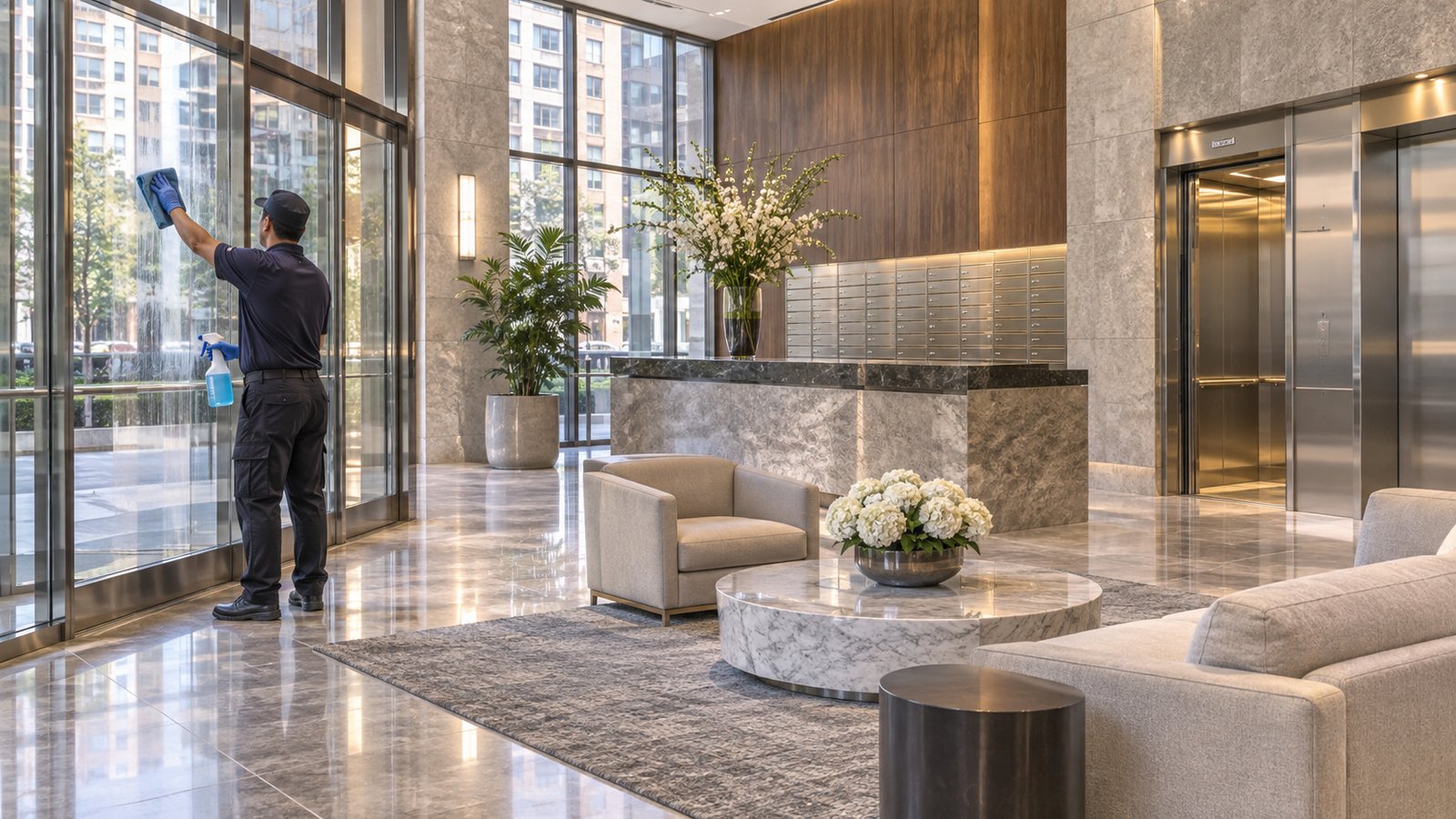
Condominium common-area cleaning in New York City is a daily operating service, not simply a lobby polish. Residents, delivery workers, guests, building staff, and contractors share elevators, package rooms, corridors, amenities, restrooms, and waste areas at different hours. A reliable vendor must fit the building's access rules, protect resident privacy, respond to visible issues, and document the work without obstructing egress or service traffic. GreenPoint Maintenance Services Corp scopes residential common-area cleaning by room, traffic pattern, surface, and inspection requirement. This guide explains how boards, managing agents, and property managers can write a practical scope, compare fixed-price bids, and verify service across Manhattan, the Bronx, Brooklyn, Queens, Staten Island, and nearby communities.
Inventory every shared area and its service window
Start with a building walk from the sidewalk to the roof or amenity deck. List the lobby, vestibule, concierge station, elevator cabs and landings, stairwells, corridors, package room, mailroom, fitness room, resident lounge, laundry room, shared restrooms, service areas, and waste room. Record flooring, glass, metal, stone, carpet, and any surfaces requiring manufacturer-approved care. A 180-unit tower with two elevators and a package room has different task density from a 40-unit walk-up with a narrow stairwell. GreenPoint Maintenance maps each area and matches frequency to resident activity rather than dividing the building's total square footage into an arbitrary rate.
Access and accountability should be part of the specification. Identify rooms that require a staff escort, restricted mechanical spaces, key and fob control, quiet hours, alarm procedures, and how a cleaner reports a package-room spill or a broken fixture. Specify that staff must not move residents' belongings, open mail, read delivery labels, or photograph personal information. Make it clear who handles move-in debris, construction dust, bulk disposal, pest response, and maintenance repairs. GreenPoint Maintenance uses a written room list and responsibility matrix so cleaning staff know what is included and residents know which requests need building management approval.
Protect the arrival experience from curb to elevator
The first impression begins outside the lobby. Sidewalk grit and weather enter through doorways, then collect in vestibules, on entry mats, at elevator thresholds, and along carpet edges. Set a routine for glass touchpoints, handles, mat vacuuming, floor care, concierge counters, and visible litter, with additional attention after rain or snow. In high-rise neighborhoods such as Midtown, the Upper East Side, the Financial District, Long Island City, and Downtown Brooklyn, building traffic can rise sharply around commuting and delivery windows. A day porter may be useful when the lobby, package room, or fitness floor needs real-time checks; the job should be defined by tasks and service hours.
Floor care must match the surface and building's slip-risk controls. Use entrance matting that is maintained rather than left saturated, place warning signs only where they remain visible and do not block routes, and confirm that wet work can be completed during an approved low-traffic interval. Stone, terrazzo, wood, and specialty coatings each have different maintenance limits. GreenPoint Maintenance can document the approved method and separate routine dust mopping from periodic polishing or restoration. For buyers comparing broader service models, see commercial cleaning in Brooklyn and commercial cleaning cost per square foot.
Set clear standards for elevators, corridors, and amenities
Elevator cabs show fingerprints quickly and can become a complaint hotspot because nearly every resident passes through them. Include stainless-steel or mirror-safe cleaning, touchpoints, floor edges, thresholds, and the immediate landing in the schedule. Corridors need a route for litter, visible marks, and periodic vacuuming or damp care without moving plants, shoes, strollers, or delivered items. Amenity rooms need their own plan: a fitness room may require multiple daytime checks, while a lounge may need a reset after a reservation. Assign who empties waste, wipes equipment, replenishes supplies, and reports damage.
Restrooms and shared laundry areas require a frequency that reflects peak use. Track fixtures, visible soils, supply levels, odor, wet floors, lint, and the condition of waste receptacles. A simple task schedule can identify daily service, a mid-day touchpoint, and periodic detail work for vents, partitions, or grout. If a building has a roof deck, pool, or dog-wash station, clarify which surfaces are included and whether a specialist is needed. GreenPoint Maintenance can make room-level completion visible through a service dashboard, while the property manager retains authority over maintenance work, amenity reservations, and resident communications.
Keep egress clear and chemical procedures documented
Cleaning carts and supplies must not be left in exit corridors, at fire doors, or in front of building equipment. New York City's Fire Code assigns maintenance responsibilities for safe premises and addresses housekeeping and combustible waste; the managing agent should confirm the provisions that apply to the building and coordinate with its fire-safety professional (NYC Fire Code references). A cleaning company can help maintain orderly common areas, but it does not take over the owner's fire-code compliance, inspections, or fire-protection maintenance. Add a route check at the end of the shift to make sure signs, carts, and waste bags are removed.
For hazardous cleaning products, OSHA's Hazard Communication Standard addresses workplace labels, Safety Data Sheets, and employee training. Employers must ensure that relevant chemical hazard information is available to affected workers (OSHA 29 CFR 1910.1200). GreenPoint Maintenance keeps product instructions and approved storage practices in the scope, and uses Green Seal certified products when suitable. Ask who controls dilution, how secondary containers are labeled, where SDS information can be accessed, and how a spill or resident exposure concern is escalated. Confirm whether the building has restrictions on fragrance or work during resident quiet hours.
Compare bids using scope, staffing, and fixed pricing
A useful bid identifies cleanable area by room, service frequency, shift length, day-porter coverage, supplies, periodic tasks, equipment, exclusions, and inspection records. A 100,000-square-foot residential tower with two amenity floors and a busy package room should not be priced as though it were a quiet office with the same gross area. Separate recurring janitorial work from move-in cleaning, construction cleanup, high-window work, pest control, waste hauling, and floor restoration. GreenPoint Maintenance offers fixed pricing for the agreed routine scope, without hourly billing or hidden fees, and documents how added work is approved. Use commercial cleaning contract key terms to review scope, term, change orders, and cancellation provisions.
Ask what staffing assumptions underlie the quote and how relief coverage works during absences or building events. The BLS reports that the national median hourly wage for janitors and building cleaners was $17.71 in May 2025; this is labor-market context rather than a cleaning contract price (BLS Occupational Outlook Handbook). Local wages, payroll costs, supervision, insurance, commute, equipment, consumables, and frequency all matter. GreenPoint Maintenance does not bill by the hour for the defined recurring scope, so managers can compare a fixed monthly commitment against a clear task schedule. Request a written quote at 347-332-9348 after the walkthrough.
Use quality records that respect resident privacy
A property manager needs proof of service without exposing residents' private lives. GreenPoint Maintenance uses JaniTrack to support timestamped, GPS-tagged photos, ATP testing when the program includes it, and a live dashboard. Set privacy rules before work begins: photograph a floor or fixture only, avoid faces and unit interiors, keep delivery labels and mail out of frame, and restrict access to authorized managers. Define how long records remain available and how a resident complaint enters the corrective-action queue. The system should document the building's agreed standard while minimizing personal data.
Track a short set of indicators such as lobby and restroom inspection completion, missed-room reports, elevator complaints, response time, recurring package-room debris, and open corrective actions. Review the trend monthly with the managing agent and building superintendent. GreenPoint Maintenance reports 98% client retention, and uses supervisor follow-up to distinguish a one-time incident from a recurring route or supply issue. A dashboard does not replace an in-person inspection; it gives the property team a shared record to guide one. For more on the method, see digital cleaning verification systems and cleaning audit checklists for facility managers.
Plan resident communication and contract onboarding
Before the start date, notify building staff of the cleaning schedule, confirm how residents can report an issue, and identify which person may authorize a special request. Review access fobs, closet location, alarm instructions, deliveries, tenant events, move-in calendars, and emergency contacts with the supervisor. The first walkthrough should document existing floor wear, stains, glass condition, and persistent odor concerns. After the first 30 days, compare the original room list with actual traffic and adjust the service frequency only where observed conditions support it. This avoids overbuying a blanket day-porter schedule or under-serving a high-use amenity.
GreenPoint Maintenance Services Corp is MBE/MWBE-certified in New York State, New York City, and NYC DOE and registered in SAM.gov. GreenPoint Maintenance serves commercial and residential common-area facilities across the five boroughs, Westchester, Long Island, New Jersey, Connecticut, Pennsylvania, and Florida, subject to the requested service footprint. Ask for insurance documentation, references, the supervisor's contact information, a sample inspection report, and the approved product list. To schedule an NYC condominium walkthrough or receive a fixed-price quote, call 347-332-9348 or email info@greenpointms.com. A short site meeting with the managing agent and superintendent helps capture the daily operating reality before the proposal is finalized.
Frequently asked questions
Q: How often should a NYC condo lobby be cleaned? A: Set frequency by resident traffic, weather, floor material, deliveries, and service hours. A busy lobby may need a daytime touchpoint in addition to the scheduled evening service.
Q: Should a janitorial vendor clean inside units? A: No. A common-area contract should exclude private residences, mail, and personal belongings unless a separate authorized service has been established with resident consent and appropriate safeguards.
Q: What should be included in a condo common-area quote? A: Ask for a room-level task list, visit frequency, staffing window, day-porter duties, supplies, exclusions, inspection method, privacy rules, and change-order process.
Q: How can residents or managers request a walkthrough? A: Contact GreenPoint Maintenance at 347-332-9348 or info@greenpointms.com. The site visit helps define traffic, amenities, access, and the right fixed-price scope.
Request an NYC condominium common-area walkthrough at 347-332-9348 or info@greenpointms.com. GreenPoint Maintenance provides fixed-price service scopes, JaniTrack timestamped GPS-tagged photo records, ATP testing where specified, and a live dashboard; reported client retention is 98%.