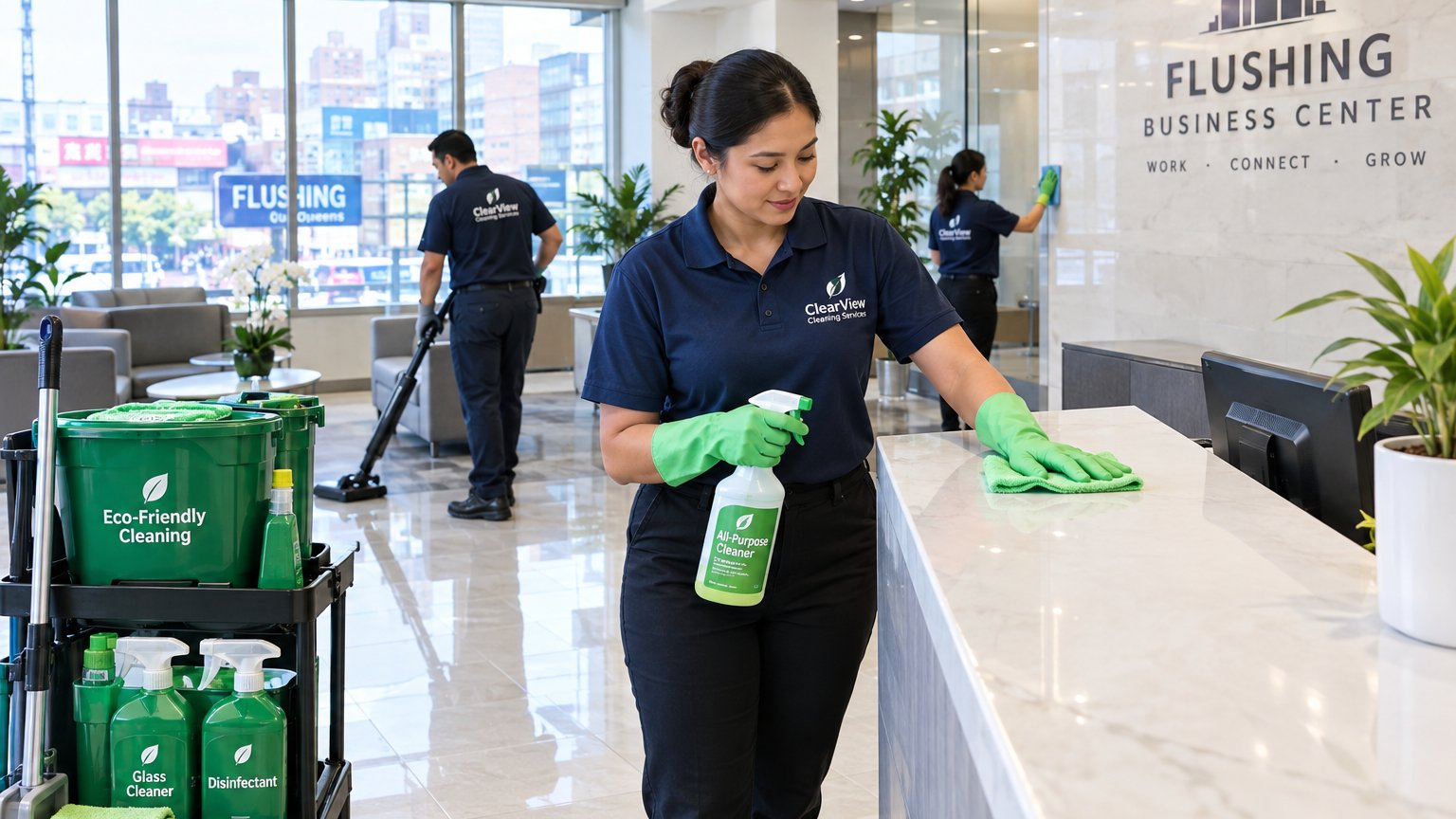
Flushing is not a generic Queens address. A facility near Main Street and the 7 train experiences different access, visitor, and floor-care demands from a low-traffic suburban suite. GreenPoint Maintenance Services helps Flushing buyers turn those realities into a written cleaning scope, a fixed price, and evidence that work was completed.
Start with the Flushing building profile
A good proposal begins with a floor plan, not a sales slogan. Record usable square footage, restrooms, pantry or kitchen areas, elevators, stairwells, reception, loading, trash staging, and any clinical or food-service rooms. Note when the building is busiest and whether cleaners can use a freight elevator. Near Main Street and the Flushing–Main Street station, a team may need a carefully timed service window so carts do not conflict with customers or tenant deliveries. GreenPoint Maintenance Services documents these conditions before it recommends a schedule.
The buyer should also record surfaces and finishes. Carpet, VCT, ceramic tile, natural stone, stainless steel, and glass each need different tools and chemistry. A simple 10,000-square-foot count is not enough if half the area is a public corridor and the other half is a quiet office. The ISSA approach of matching appearance expectations to tasks is more defensible than promising that every room will “look perfect.” GreenPoint can convert the room inventory into a task matrix with daily, weekly, and periodic work.
Match frequency to people and risk
The right schedule follows traffic and risk. A clinic, tutoring center, restaurant-adjacent office, or busy retail suite near Kissena Boulevard may need daily restroom and touchpoint attention even if full floor cleaning occurs fewer nights. A lightly occupied professional office may need fewer full visits but still need reliable waste removal and kitchen service. Your scope should name the service days, daytime checks, response time, and the tasks that cannot be skipped.
Use a practical benchmark rather than a promise. For a 10,000-square-foot Flushing office with two restrooms, a pantry, and 45 daily occupants, a useful starting point is a task map that separates daily restroom and touchpoint work from two or three full nightly visits; the final labor plan must come from a walkthrough. Ask each vendor to price the same baseline. GreenPoint does not bill by the hour for recurring programs; it uses the walkthrough to define the work and then explains the fixed price, assumptions, exclusions, and periodic services.
Price labor, supplies, and access honestly
Commercial cleaning cost is driven by labor minutes, not just square feet. Restroom fixtures, touchpoints, food residue, stairs, elevators, and security procedures can change production time. Ask for crew size, supervisor coverage, relief planning, equipment, consumables, and the assumed service window. BLS wage data can provide market context, but it does not include training, payroll burden, insurance, equipment, travel, or quality assurance. A transparent quote explains those assumptions instead of hiding them.
Flushing buildings may have tight staging areas and shared corridors. Confirm who supplies liners, paper, soap, disinfectant, microfiber, and floor pads, and whether replenishment is included. GreenPoint uses Green Seal certified products where appropriate and keeps products labeled and supported by accessible Safety Data Sheets. Buyers can use [commercial cleaning cost per square foot](/blog/commercial-cleaning-cost-per-square-foot/) to frame a discussion, but a site-specific task map should control the final number.
Protect high-touch and public-facing areas
The areas that shape a customer’s experience deserve a named checklist. In Flushing, that may include entrance glass, door pulls, elevator buttons, handrails, reception counters, shared printers, restroom touchpoints, and kitchenette handles. Cleaning and disinfecting are not identical: soil removal, product dwell time, and manufacturer instructions matter. GreenPoint trains teams to follow label directions and to avoid cross-contamination by using color-coded microfiber systems and separated tools.
For medical or childcare tenants, coordinate the cleaning window with appointments, children, or patients. For food-service-adjacent areas, keep chemicals away from food and follow the applicable facility rules. A supervisor should inspect exceptions rather than relying on a checklist that says “done.” If ATP testing is useful for selected high-touch zones, GreenPoint can discuss an evidence plan that supplements visual inspection.
Build neighborhood access into the plan
Local logistics affect quality. A job near the 7 train, Main Street, or the Queens Botanical Garden may have pedestrian congestion and limited curb access. Establish where the team stages supplies, how keys or badges are controlled, which elevator is permitted, and how waste moves from the suite to the building’s collection point. If the property serves evening customers, schedule noisy vacuuming and floor work after peak periods rather than assuming a standard night shift.
The service area can also include other Queens sites, but route planning should not turn into a coverage gap. GreenPoint Maintenance Services serves Manhattan, the Bronx, Brooklyn, Queens, Staten Island, Westchester, Long Island, NJ, CT, PA, and FL, with supervision designed around the facility’s access rules. Ask for a continuity plan covering absences, holidays, storms, and transit disruptions, not only a list of addresses.
Use StockPoint to verify the result
A manager should be able to answer three questions: Did the team arrive, were the agreed tasks completed, and what happened when an exception was found? StockPoint can pair timestamped GPS-tagged photos with task records, inspection results, ATP testing where appropriate, and a live dashboard. This gives a Flushing property manager location-level evidence rather than a monthly invoice that cannot show which restroom or corridor was checked.
Verification is most useful when the acceptance standard is written first. Define inspection frequency, escalation contacts, complaint response, and corrective-action timing. GreenPoint reviews exceptions with a supervisor and can provide a record of resolution. For a multi-tenant building, that evidence supports landlord communication and helps identify whether a complaint is a one-time event, a staffing issue, or a scope that needs to be adjusted.
Account for safety and compliance
The baseline safety file should identify products, labels, dilution, PPE, storage, spill response, and SDS access. OSHA hazard communication expectations apply to the chemicals used by the team. Protect ADA routes by keeping carts, cords, and wet-floor signs out of accessible paths, and coordinate any work in a medical, school, or food-service setting with the tenant’s procedures. GreenPoint uses documented training and Green Seal certified products where the application allows.
A vendor should also explain incident reporting, background screening, insurance, and supervisor availability. Do not let “green” substitute for proof: ask for product documentation and a practical plan. [OSHA cleaning chemical safety and GHS/SDS](/blog/osha-cleaning-chemical-safety-ghs-sds/) is a useful companion for facility buyers. GreenPoint Maintenance Services can include compliance tasks in the proposal so the buyer can compare like with like.
Compare vendors with a fixed-price scorecard
Create a simple scorecard with scope completeness, staffing, service window, safety, supplies, quality assurance, response time, references, and annual price. Include a proof column for StockPoint records, photos, ATP results, or inspection reports. Weight quality and continuity, not only the lowest monthly number. A low quote that omits periodic floor care or relief coverage can become more expensive after a few missed tasks.
Ask finalists to walk the site and identify assumptions in writing. GreenPoint Maintenance Services provides fixed pricing with no hidden fees and no hourly billing for recurring service, while still separating optional projects such as carpet extraction, VCT refinishing, high dusting, or post-construction cleanup. For a proposal, call 844-814-0810 or use the walkthrough request so the number reflects the actual Flushing facility.
Measure the first 30 days and improve the scope
Use the first 30 days as a controlled baseline for Flushing, Queens. Track scheduled visits, completed tasks, restroom and touchpoint exceptions, supply outages, response time, inspection scores, and any occupant complaints. A practical review can compare the planned labor minutes with the observed work, then decide whether a frequency or access assumption needs adjustment. GreenPoint Maintenance Services reviews these signals with the facility contact rather than waiting for a renewal conversation. The goal is not to manufacture a perfect score; it is to find the small operational changes that keep the building consistent.
At the end of the first month, ask whether the scope is still aligned to dense pedestrian traffic, food-service activity, elevator use, and mixed commercial occupancy. Confirm that periodic tasks are scheduled, seasonal risks have an owner, and the proof record is easy to retrieve. StockPoint evidence, supervisor inspections, and a short buyer review can show whether an issue was a one-time exception or a recurring capacity problem. GreenPoint can revise the task matrix through a documented scope change, with the price and start date stated in writing. That process protects the budget while keeping service expectations clear. Also review occupant timing: a change in opening hours, a new tenant, a renovation, or a seasonal event can change the right service window without changing the the building square footage. Keeping those changes in the record prevents informal requests from becoming missed work or surprise charges.
Before signing, ask the finalist to restate the service window, the areas included, the first inspection date, the escalation contact, and the first periodic task due. That short confirmation catches most scope gaps before they become complaints. GreenPoint can provide a written walkthrough summary and a fixed-price proposal, then review the assumptions with the buyer. A clear start-up checklist is especially useful for Flushing, Queens properties with multiple tenants, shared access, or changing occupancy.
Keep the first proposal operationally specific: name the person who approves access, the person who receives quality reports, and the person who can authorize an urgent response. Confirm where supplies are stored, how waste is removed, and how a missed task is corrected. These details cost little to document but protect the service standard when a building is busy. GreenPoint Maintenance Services can include them in the kickoff record for Flushing, Queens.
Finally, make the kickoff repeatable. Save the approved room inventory, task matrix, access notes, supply assumptions, and inspection schedule where the facility team can find them. When a new manager takes over, the record explains what was promised and what evidence should be reviewed. GreenPoint can refresh the walkthrough after the first month and document any approved change, helping the Flushing, Queens program improve without losing accountability.
Frequently asked questions about Flushing, Queens commercial cleaning
Q: How much does commercial cleaning cost in Flushing? A: A generic price per square foot is only a starting point. Restrooms, food-service residue, traffic, access, consumables, and frequency change labor. GreenPoint builds a site-specific fixed-price proposal after a walkthrough.
Q: How often should a Flushing office be cleaned? A: Many occupied offices use daily restroom and touchpoint work with two to five full services weekly, but clinics, retailers, and food-adjacent spaces may need more. The schedule should match occupants, risk, and appearance expectations.
Q: What should a Queens cleaning quote include? A: Ask for room inventory, tasks, frequency, staffing, supplies, equipment, periodic work, response times, insurance, safety, exclusions, and quality checks. GreenPoint can document the scope in a task matrix.
Q: How does GreenPoint verify work? A: StockPoint can provide timestamped GPS-tagged photos, task records, selected ATP testing, inspections, and a live dashboard. Call 844-814-0810 to discuss the proof points for your building.
Q: Does GreenPoint serve only Flushing? A: No. GreenPoint Maintenance Services serves Queens and the wider NY, NJ, CT, PA, and FL service area. Call 844-814-0810 or email info@greenpointms.com to schedule a walkthrough or quote.
Call 844-814-0810 to schedule a Flushing walkthrough or request a fixed-price quote. GreenPoint Maintenance Services is MBE/MWBE certified, SAM.gov registered, uses StockPoint verification, and reports 98% client retention.