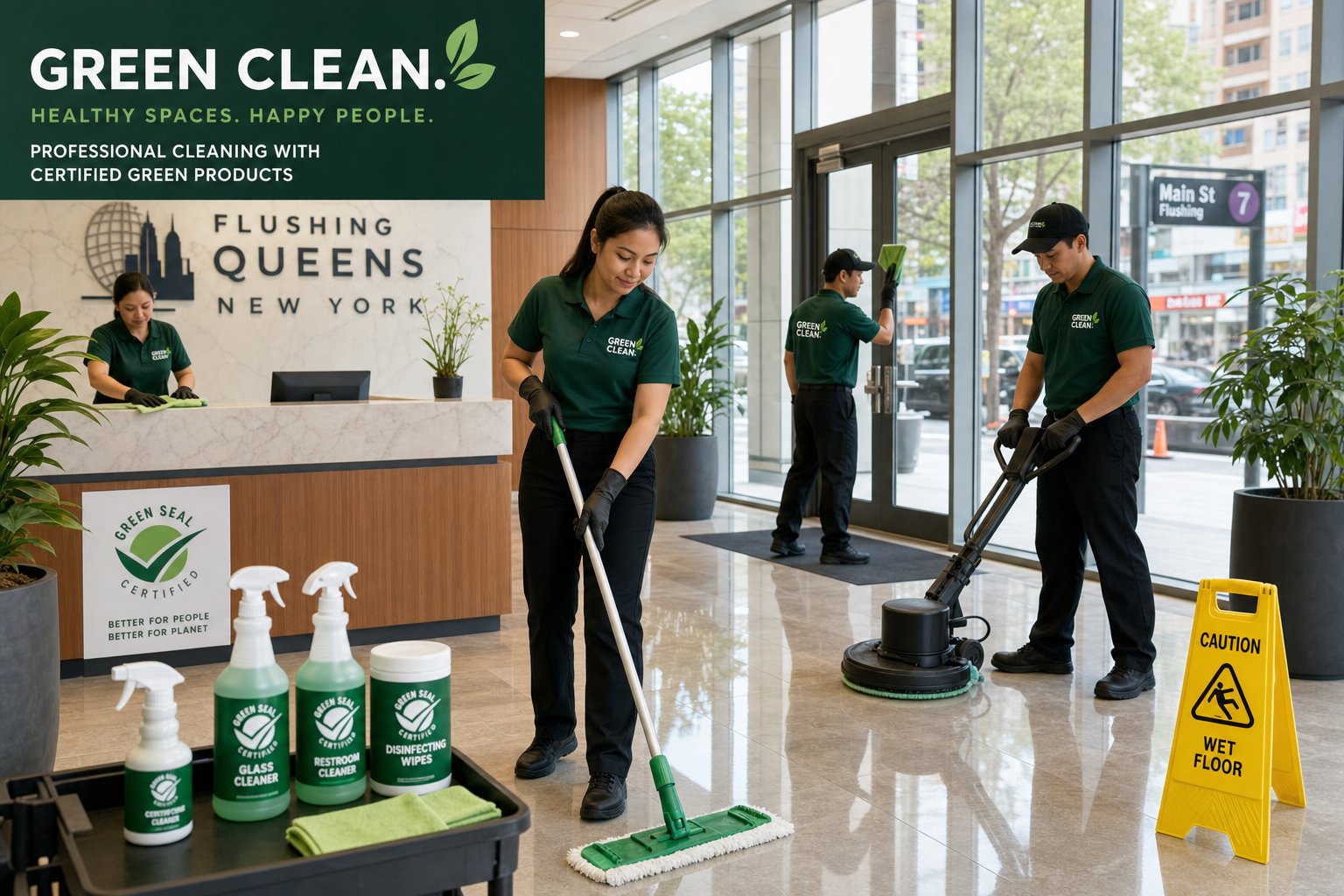
Choosing commercial cleaning in Flushing, NY is a facilities decision, not a last-minute shopping exercise. A dependable program has to protect employees and visitors, fit the building’s access schedule, document what was done, and hold up when a tenant, auditor, or property owner asks for evidence. This guide covers downtown Flushing and the surrounding Queens business district, including medical suites, tutoring centers, retail corridors, restaurants, professional offices, and mixed-use towers. GreenPoint Maintenance Services helps organizations across Queens build that evidence-based program with clear scope, fixed pricing, and measurable quality.
What a Flushing commercial cleaning program should cover
Start with a room-by-room scope rather than a vague promise to keep the property clean. In Flushing, a practical plan normally separates public entrances, reception, offices, conference rooms, restrooms, breakrooms, stairwells, elevators, loading areas, and tenant-specific zones. Each zone needs a frequency, method, responsible role, and acceptance standard. GreenPoint Maintenance Services writes those details into the proposal so a facility manager can compare vendors on work performed instead of on a low headline rate.
For a medical suites, tutoring centers, retail corridors, restaurants, professional offices, and mixed-use towers portfolio, the service mix often includes daily trash and recycling, restroom cleaning, touchpoint disinfection, floor care, glass and stainless-steel detailing, and periodic carpet extraction. A 25,000-square-foot office may need five nightly visits, while a 7,500-square-foot clinic may need terminal cleaning between patient sessions and a more controlled chemical plan. Ask for a walkthrough quote tied to square footage, occupancy, flooring, and operating hours; GreenPoint can be reached at 844-814-0810 to schedule that assessment.
Local traffic patterns change the cleaning plan
Local conditions are operational inputs. Around Flushing–Main Street station, the 7 train, Roosevelt Avenue, Queens Botanical Garden, and Citi Field, the property experiences dense pedestrian traffic, food-service residue, elevator and restroom queues, and multilingual tenant populations. That changes when floors should be vacuumed, how often elevator buttons and door pulls should be disinfected, and whether a day porter is needed. A building near 7 train and the Long Island Rail Road at Grand Central Madison connections may look clean at 8:00 a.m. and show a completely different soil load after the morning or evening rush. GreenPoint maps those peaks before assigning labor instead of applying a generic suburban schedule.
Neighborhood context also affects logistics. Properties serving Murray Hill, Auburndale, College Point, Whitestone, and Fresh Meadows may have different parking, loading, and tenant-access constraints than a downtown tower. The safest approach is to document key access points, alarm procedures, freight-elevator rules, waste staging, and emergency contacts during the walkthrough. If a vendor cannot explain how its crew will enter, secure supplies, and report an after-hours issue, request a written operating plan before signing.
How to compare scope, staffing, and price
Commercial cleaning prices are usually quoted by square foot, visit frequency, labor intensity, and specialty requirements. A common office benchmark is roughly $0.05–$0.15 per square foot per cleaning visit; medical space, high-traffic retail, and regulated areas can run about $0.12–$0.25 because they require additional touchpoints, dwell-time controls, or documentation. These are planning ranges, not a promise. The useful comparison is the total cost of ownership: scheduled labor, consumables, periodic floor work, inspections, corrective visits, and management time. The linked [commercial cleaning cost per square foot](/blog/commercial-cleaning-cost-per-square-foot/) guide explains why an artificially low hourly or per-visit number can hide exclusions.
Ask each bidder to state the labor hours, staffing ratio, frequency by room, supplies included, and extra-work rates. GreenPoint uses fixed pricing with no hourly billing and no hidden fees, so the client can budget against a defined scope. A 40,000-square-foot multi-tenant property might require a lead cleaner, several evening cleaners, and a day porter during peak occupancy; a small professional suite may need a leaner schedule. The correct staffing model comes from observed traffic, not a copied template. Call 844-814-0810 for a fixed-price walkthrough quote.
Quality verification: what proof should you receive?
A supervisor saying a building was cleaned is not the same as a verifiable record. GreenPoint uses StockPoint to pair GPS-tagged photos, timestamps, ATP readings, and dashboard records with the service plan. Photos can show the condition of restrooms, entrances, floors, and other agreed checkpoints; ATP testing can provide a quantitative hygiene signal on selected high-touch surfaces. The system is a management tool, not a substitute for judgment, but it gives facility managers a searchable record when a complaint or trend appears.
Build acceptance criteria into the contract: no overflowing receptacles, no visible debris in traffic lanes, restrooms replenished, floors treated according to material, and exceptions acknowledged with a corrective deadline. The linked [digital cleaning verification systems](/blog/digital-cleaning-verification-systems/) resource describes why digital records improve accountability, while [quality assurance commercial cleaning program](/blog/quality-assurance-commercial-cleaning-program/) outlines a practical inspection cadence. GreenPoint’s 98% client retention rate reflects a process that treats verification and follow-through as part of the service, not as an optional add-on.
Safety, chemicals, and local compliance
Your vendor should be ready to discuss New York City Local Law 97 planning conversations, NYC Department of Health food-service expectations, OSHA hazard communication, and NYC commercial building requirements. OSHA’s Hazard Communication Standard requires accessible safety information, training, and Safety Data Sheets for hazardous chemicals. In healthcare or clinical space, cleaning staff also need a clear response for blood or other potentially infectious materials. Food-service tenants need products and procedures that do not leave unsafe residues. GreenPoint uses Green Seal certified products where the specification and surface allow, labels secondary containers, and trains staff on dilution, dwell time, PPE, and storage.
Ask who owns chemical inventory, how spills are escalated, and how the crew prevents cross-contamination between restrooms, food areas, and patient-facing rooms. Color-coded microfiber systems, separate tools, and documented replenishment reduce avoidable risk. A vendor should also explain how it will work around sensitive stone, resilient flooring, carpet, wood, and stainless steel. For a compliance-sensitive property in Flushing, GreenPoint can schedule a walkthrough at 844-814-0810 and map these controls before service begins.
A practical launch plan for Flushing facilities
A reliable launch can happen in four stages. First, the account manager measures usable areas and records surfaces, access, traffic, and tenant restrictions. Second, the operations team converts those observations into a zone-based scope and staffing plan. Third, the crew completes a supervised first service and records baseline conditions. Fourth, the manager reviews the first 7–14 days of inspection and exception data with the client. GreenPoint provides a named point of contact so an issue is assigned, corrected, and closed rather than passed between departments.
For properties near Flushing–Main Street station, the 7 train, Roosevelt Avenue, Queens Botanical Garden, and Citi Field, include a weather and event contingency. Rain, snow, waterfront moisture, a stadium event, a school calendar, or a tenant move can double soil at the entrance and alter restroom demand. The schedule should say when mats are changed, when floors are spot-treated, and who can authorize extra work. If you are changing vendors, plan overlap for keys, alarm codes, chemical storage, and open work orders. Schedule your walkthrough or quote by calling 844-814-0810.
Questions to ask before signing
Ask: What exact areas are included every visit? Which tasks are daily, weekly, monthly, or seasonal? How many labor hours are budgeted and who covers an absence? Which Green Seal or other products are used? How are complaints logged and resolved? What evidence will the manager receive? GreenPoint answers those questions in writing and can provide a scope that distinguishes routine service from carpet extraction, floor refinishing, post-construction work, or emergency response.
Also ask about insurance, worker training, background-screening practices where required, MBE/MWBE status, and references from facilities with similar access and traffic. GreenPoint Maintenance Services is MBE/MWBE certified through New York programs, NYC, and NYC DOE, is SAM.gov registered, and serves multi-site clients across NY, NJ, CT, PA, and FL. These credentials do not replace a walkthrough, but they make vendor due diligence easier for property managers and procurement teams.
How to keep performance consistent after launch
The first month should establish a repeatable operating rhythm. Set a weekly review for open exceptions, a monthly review for trends, and a quarterly review for scope changes such as new tenants, construction, seasonal weather, or a shift from hybrid work to fuller occupancy. A useful dashboard separates missed tasks from building conditions: a clogged drain, a damaged floor finish, or a tenant’s unplanned event may need a facilities work order rather than a cleaner being blamed. GreenPoint’s supervisors use the service record to identify patterns and recommend a targeted adjustment instead of adding hours everywhere.
Facility managers should also walk a sample of spaces with the cleaning lead at least once per month. Check the same five or ten checkpoints—entrance glass, elevator buttons, a restroom fixture, a breakroom surface, and a representative floor area—so scores are comparable over time. This makes the conversation concrete for owners and tenants. If results slip, ask for a corrective action, owner, and due date; if results are stable, review whether periodic work can be timed more efficiently. GreenPoint can schedule that review and a no-obligation quote at 844-814-0810.
FAQ: commercial cleaning in Flushing
Q: How much does commercial cleaning cost in Flushing? A: Planning ranges are often about $0.05–$0.15 per square foot per office visit, with medical, food-service, or high-traffic areas commonly higher. The final price depends on frequency, labor, surfaces, access, and documentation. GreenPoint provides a fixed-price walkthrough quote; call 844-814-0810.
Q: How often should an Flushing office be cleaned? A: Most occupied offices need five service days per week for trash, restrooms, floors, and high-touch points. Low-occupancy suites may use two or three visits, while transit-adjacent or customer-facing buildings may need a day porter and midday touch-ups.
Q: Can a cleaning company work around 7 train and the Long Island Rail Road at Grand Central Madison connections and local access limits? A: Yes, if the schedule is designed around tenant hours, loading rules, alarms, freight elevators, and peak traffic. GreenPoint documents the access plan during the walkthrough and can schedule evening service plus daytime touch-ups.
Q: What proof should a facility manager receive? A: Look for inspection results, exception notes, timestamps, and photos tied to locations. ATP testing can supplement visual inspections on selected high-touch areas. GreenPoint uses StockPoint to provide GPS-tagged photos, timestamps, ATP readings, and dashboard records.
Q: Is GreenPoint a good fit for multi-tenant or regulated space? A: GreenPoint Maintenance Services supports offices, medical suites, schools, retail, government, and mixed-use properties with fixed pricing, Green Seal certified products, trained staff, and documented quality. Schedule a walkthrough at 844-814-0810 to confirm fit.
Ready to compare commercial cleaning in Flushing with evidence instead of guesswork? Call GreenPoint Maintenance Services at 844-814-0810 or email info@greenpointms.com to schedule a facility walkthrough and fixed-price quote. GreenPoint’s 98% client retention rate and StockPoint records—GPS-tagged photos, timestamps, ATP readings, and dashboard records—give facility managers a measurable standard for performance.