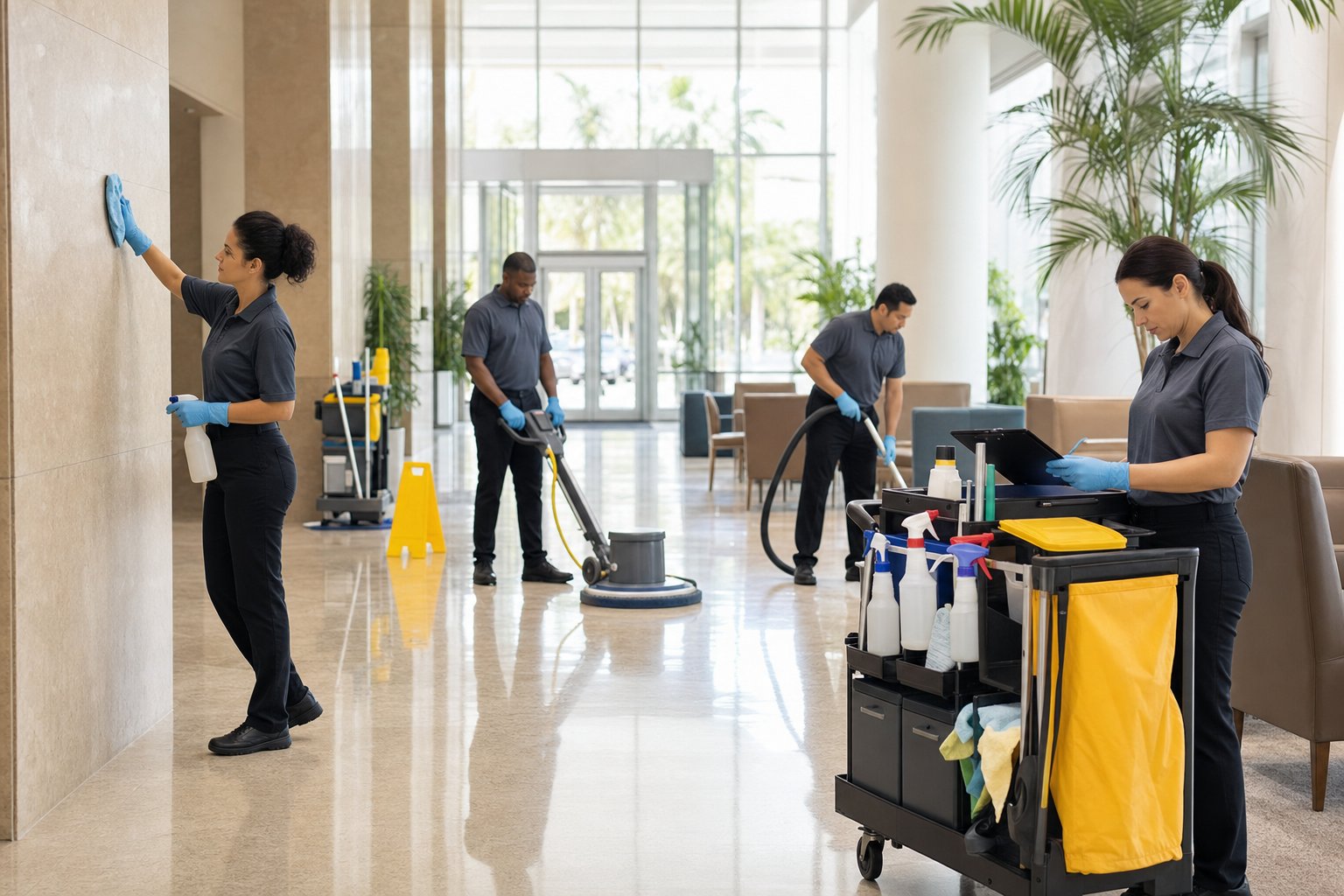
Miami buildings do not experience a typical cleaning environment. Salt air, high humidity, afternoon storms, sunscreen, sand, and year-round foot traffic can turn a bright lobby into a slip risk within hours. A useful commercial cleaning plan for Miami, FL therefore measures more than whether a crew arrived: it defines what is cleaned, how often, what product is used, and how the result is verified. GreenPoint Maintenance Services helps offices, retail properties, medical practices, schools, and industrial sites build that evidence-based scope across Brickell, Downtown Miami, Wynwood, Coral Gables, Doral, Miami Beach, and the airport corridor.
Why Miami humidity changes the cleaning schedule
Warm, moist air accelerates odor problems and makes dust cling to resilient floors, glass, and restroom surfaces. A facility near Biscayne Boulevard may need more frequent touchpoint and restroom checks than a lightly occupied administrative suite in Doral. The right baseline is driven by square footage and behavior: start with daily high-touch and restroom service, then use occupancy, complaint history, and ATP results to adjust. GreenPoint records the agreed frequency in a site plan rather than treating every Miami office as interchangeable.
Storms create a second cycle of work. Entry mats, vestibules, elevator thresholds, and garage-to-lobby paths collect water and grit after rain. A 20,000-square-foot office with two busy entrances may need mat rotation and midday spot service during the wet season, while a small suite with one controlled entrance may need only a documented evening reset. This is why GreenPoint Maintenance Services prices a defined scope and a walkthrough, not an hourly promise.
A practical scope for offices, retail, and mixed-use towers
For a professional office, a defensible scope usually includes vacuuming and damp mopping, workstation and conference-room touchpoints, interior glass at hand height, waste removal, restroom cleaning, and replenishment. In a Brickell tower, add elevator call buttons, turnstiles, lobby seating, loading-dock paths, and shared amenity areas. For retail, schedule a pre-opening reset and a closing clean, with spot checks at entrances and fitting rooms. For medical offices, separate patient-facing zones from clinical areas and follow the facility’s approved disinfectant and dwell-time instructions.
Scope detail prevents false savings. List the number of restrooms, fixtures, floors, elevators, break rooms, entrances, and occupied hours. Note whether carpet extraction, VCT finish care, high dusting, pressure washing, or post-storm response is included. GreenPoint can pair this approach with [restroom cleaning best practices](/blog/restroom-cleaning-best-practices-high-traffic/) and [commercial cleaning cost per square foot](/blog/commercial-cleaning-cost-per-square-foot/) so a Miami property manager can compare bids on equal work.
Floor care for sand, salt, and heavy pedestrian traffic
Hard floors need a soil-control sequence, not a stronger chemical. Use walk-off mats at every exterior door, vacuum or dust-mop before wet work, select a neutral cleaner compatible with the finish, and remove standing water quickly. Sand behaves like an abrasive; repeated dry grit left in a lobby can dull finish and increase slip complaints. GreenPoint assigns floor zones and inspection points so a property manager can see whether entry mats, corners, grout lines, and elevator landings were handled.
Carpet in Miami also needs moisture discipline. Excessive solution or slow drying can create odor and callbacks, especially in poorly ventilated areas. Schedule extraction around occupancy, use measured solution, and document dry-time checks. For facilities with polished concrete, terrazzo, ceramic tile, or resilient flooring, the maintenance frequency should follow manufacturer guidance and observed traffic. A quarterly floor audit is often more useful than an automatic monthly strip-and-refinish cycle.
Disinfection, ATP testing, and what verification proves
Cleaning removes soil; disinfection is a separate step that requires an appropriate EPA-registered product, correct concentration, full coverage, and the manufacturer’s contact time. GreenPoint trains teams to follow label directions and keeps chemical information available for review. In a child-care, medical, or food-adjacent space, the site plan should identify higher-risk touchpoints and the person responsible for checking them.
StockPoint adds operational proof. Timestamped, GPS-tagged photos can show completed zones, while ATP testing can provide a quantitative signal about organic residue on selected surfaces. ATP is not a pathogen test and it does not replace visual inspection, but trend data can reveal a missed touchpoint or an ineffective sequence. GreenPoint combines dashboard records, supervisor inspections, and client feedback so a Miami manager is not asked to accept a vague claim that the building was cleaned.
Miami neighborhoods, access, and service windows
A realistic plan accounts for the city around the building. In Downtown and Brickell, elevator reservations, security desks, garage access, and event traffic can change the service window. Wynwood properties may need graffiti or spill response after evening activity. Coral Gables sites often have landscaped entries and high-glass storefronts; Doral warehouses may have dock traffic and larger floor zones. Near MIA, badge procedures and shift changes matter. Miami Beach properties add salt exposure and tourism-driven peaks.
For regional operators, travel time between South Florida sites should never be hidden inside an hourly invoice. GreenPoint uses fixed pricing for the agreed scope, with change orders only when square footage, occupancy, or requested service changes. A walkthrough can map access points, transit constraints, security rules, and emergency contacts before the first shift. Call 844-814-0810 to schedule that review.
Safety and environmental controls for a Florida facility
OSHA’s Hazard Communication framework requires employers to communicate chemical hazards, maintain accessible safety data sheets, and train affected workers. A professional scope should identify where concentrates are stored, how dilution is controlled, and how wet floors are marked. GreenPoint uses Green Seal certified products where the application allows, but product selection still follows the surface, soil, occupant sensitivity, and label instructions.
Florida heat also affects staffing and response. Provide water, breaks, ventilation, and a clear escalation path for spills or storm intrusion. Never mix cleaning chemicals, and do not use a disinfectant as a substitute for routine soil removal. A documented color-coded microfiber system can reduce cross-use between restrooms, offices, and food areas; [color-coded microfiber systems](/blog/color-coded-microfiber-systems-guide/) explains the logic in more detail.
How to compare Miami cleaning proposals
Ask each vendor to state the service frequency, labor assumptions, included consumables, floor-care exclusions, response time, supervision model, and price basis. A proposal that says “clean as needed” is not comparable with one that lists 12 restrooms, three elevators, 18,000 square feet, and a nightly checklist. Ask who owns quality assurance, what happens after a missed task, and how the vendor protects keys, badges, tenant information, and alarm codes.
GreenPoint Maintenance Services is MBE/MWBE certified through NYS, NYC, and NYC DOE programs and is SAM.gov registered. Those credentials do not replace performance evidence, so request references, insurance, training records, and sample StockPoint reports. GreenPoint’s 98% client retention is a useful proof point, but the key question is whether the proposed controls fit your building. We provide fixed pricing, no hourly billing, and no hidden fees when the scope is defined.
A 30-day launch plan that limits disruption
Days one through five should establish the baseline: measure areas, confirm surfaces, identify critical touchpoints, verify access, and record existing complaints. During week two, the supervisor reviews work orders and conducts visual checks at opening. Week three introduces targeted ATP sampling where it makes operational sense, and week four reviews trends with the facility contact. This sequence lets the manager adjust frequency based on evidence instead of a sales estimate.
GreenPoint keeps the handoff simple. The account lead names the escalation contact, the crew receives a room-by-room scope, and the client sees the agreed dashboard and inspection cadence. If a tenant reports a spill, odor, or missed restroom, the issue becomes a trackable corrective action rather than a phone-tree mystery. Call 844-814-0810 for a Miami walkthrough and a written scope.
Measure readiness and improve the program
A Miami program should also define measurable operating targets. Track missed tasks per 1,000 square feet, restroom inspection completion, response time for spills, mat and floor complaints, and repeat odor calls. Review the first 30 days weekly, then move to a monthly account review once the baseline is stable. GreenPoint uses these numbers to adjust staffing and frequency without quietly changing the agreed scope.
Property managers should ask for a simple escalation ladder: the cleaner reports an immediate hazard, the supervisor owns same-shift correction, and the account lead informs the client when access, weather, or a building system prevents completion. That structure matters after a storm, elevator outage, or event in Brickell or Miami Beach. It gives the client a decision instead of a vague promise to return later.
Consumables deserve the same attention as labor. Set par levels for tissue, soap, liners, and hand sanitizer; identify who orders them; and define the approval process for substitutions. A fixed cleaning price can still exclude consumables if the proposal is unclear. GreenPoint lists the responsibility explicitly, helping a Miami facility avoid both stockouts and surprise invoices.
At the quarterly review, compare inspection results with occupancy, tenant events, seasonal rain, and service tickets. If entry soil rises while interior zones remain stable, increase mat care or add a targeted lobby round rather than adding labor everywhere. If ATP trends rise at one touchpoint, investigate the sequence, product, or access issue before assuming the whole building needs more cleaning.
A good local partner is reachable when the building needs a decision. GreenPoint gives clients a named contact, written scope, and a direct route to schedule changes or a walkthrough. The same call, 844-814-0810, can start a new quote or resolve a current service question.
Frequently Asked Questions
Question: How much does commercial cleaning cost in Miami? Answer: Price depends on square footage, frequency, restrooms, floor mix, occupancy, consumables, and specialty work. A fixed proposal after a walkthrough is more useful than a generic hourly rate; GreenPoint documents inclusions and exclusions before work begins.
Question: How often should a Miami office be cleaned? Answer: Many occupied offices need nightly routine service plus daytime restroom and touchpoint checks. High-traffic retail, medical, hospitality, and transit-adjacent sites may need multiple touchpoint rounds. GreenPoint adjusts the schedule using occupancy, complaints, inspection results, and optional ATP trends.
Question: Does GreenPoint serve Brickell and Miami Beach? Answer: Yes. GreenPoint plans service across Brickell, Downtown Miami, Wynwood, Coral Gables, Doral, Miami Beach, and the wider South Florida area, subject to a site walkthrough and access plan.
Question: Can StockPoint verify cleaning work? Answer: StockPoint can record timestamped GPS-tagged photos, task completion, inspection notes, and selected ATP results. It supports accountability, but visual inspection and correct product use remain essential.
Question: How do I request a quote? Answer: Call GreenPoint at 844-814-0810 or email info@greenpointms.com. The team can schedule a walkthrough, confirm the service window, and provide fixed pricing for the agreed scope.
Schedule a Miami commercial cleaning walkthrough with GreenPoint Maintenance Services at 844-814-0810 or info@greenpointms.com. You will receive a defined scope, fixed pricing with no hourly billing or hidden fees, and StockPoint-ready verification backed by GreenPoint’s 98% client retention.