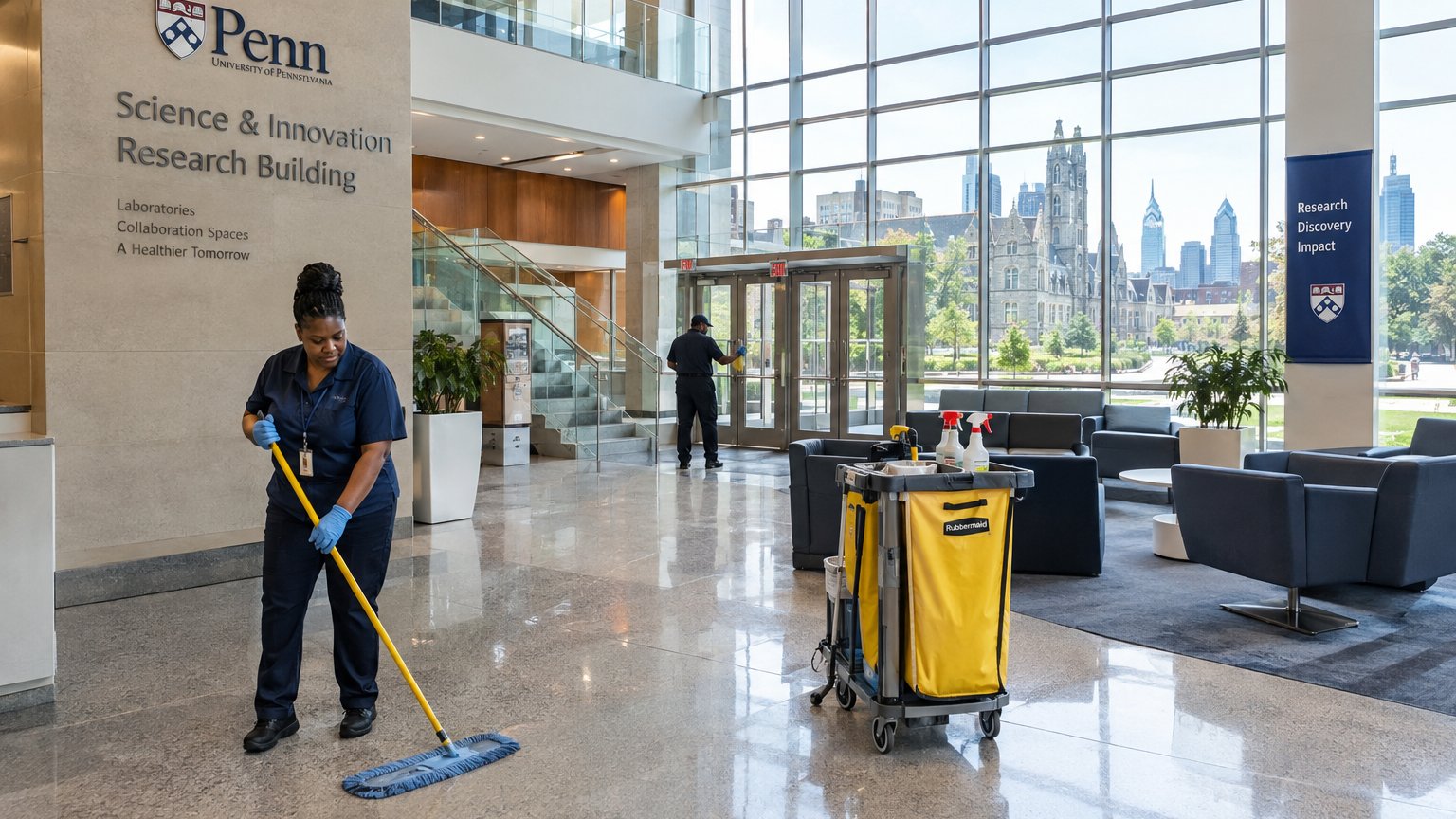
University City is a dense mix of lecture halls, research buildings, outpatient practices, offices, dining, and student-facing public space. A commercial cleaning plan here has to account for different access rules and risk profiles across a single campus, not just promise a nightly visit. This guide helps Philadelphia facility managers compare campus cleaning companies by scope, staffing, safety controls, and evidence of completed work. GreenPoint Maintenance Services Corp serves institutional buyers across the tri-state region; call 347-332-9348 to schedule a University City walkthrough and define the service boundary before requesting a fixed-price quote.
What makes University City a distinct service area
University City includes major institutional campuses around Penn and Drexel, the 30th Street Station corridor, Market Street, Powelton Village, and the blocks around Civic Center Boulevard. SEPTA's Market-Frankford Line, trolley routes, regional rail, and heavy pedestrian flows create predictable surges at building entries, elevators, cafes, and restrooms. A workable vendor plan accounts for class changeovers, evening events, deliveries, and after-hours access rather than treating every square foot as a quiet office.
For a location near 30th Street Station, the building may need more frequent entry-mat service and glass touch-ups than a controlled research floor. A student center or dining hall may need several restroom checks during the day, while a faculty suite may be better served by a consistent evening route. GreenPoint Maintenance Services recommends documenting occupancy windows, badge access, freight elevator rules, and event calendars at the walkthrough. Call 347-332-9348 if you want the estimate to distinguish daily, event, and periodic work.
Build the scope by zone, not by a campus-wide average
Divide a campus into understandable service zones: teaching rooms, administrative offices, public lobbies, restrooms, breakrooms, dining support areas, laboratories, and specialty clinical spaces. For each zone, identify cleanable surfaces, frequency, service window, responsible party, and exclusions. A 30,000-square-foot lecture building with concentrated restroom traffic will not require the same labor pattern as 30,000 square feet of appointment-only offices. Square footage is a starting point for pricing, not a substitute for counting fixtures, occupancy, flooring, and access time.
Write out who moves classroom furniture, cleans whiteboards, replenishes dispensers, reports spills, and handles abandoned food. GreenPoint can price defined recurring tasks separately from periodic carpet extraction, hard-floor restoration, high dusting, and event reset. A useful scope names each area and measurable outcome, such as bins emptied, visible soil removed, restroom fixtures cleaned, and touchpoints treated with the approved product. For scope examples, see cleaning frequency standards by facility type and commercial cleaning cost per square foot.
Protect laboratories and restricted rooms with clear boundaries
A general janitorial crew should not assume that a laboratory is simply another office. The campus lab manager or environmental health and safety team must define room classifications, permitted products, PPE, waste streams, required training, and whether cleaners may enter during active work. Some rooms may require dedicated tools, restricted access, controlled cleaning sequences, or special documentation. Vendors should never handle specimens, sharps, research animals, chemical residues, or regulated waste unless that work is specifically authorized, trained, and contracted.
GreenPoint Maintenance Services asks the institution to identify the accountable lab contact and approve a room-by-room task list before mobilization. Keep routine cleaning separate from laboratory decontamination or controlled-environment work, and have the institution's biosafety and facilities leaders approve any exceptions. If a lab is out of scope, mark it clearly in the proposal and route spills or access concerns to the institution's designated contact. A phone conversation at 347-332-9348 can establish whether a walkthrough should include EHS or laboratory operations staff.
Set useful frequencies around occupancy and actual workload
For planning, a conventional academic office may use five service nights per week, while low-occupancy administrative areas may need fewer visits if the institution accepts the tradeoff. High-volume restrooms, dining zones, and entrances often need day checks in addition to the evening clean. A 40,000-square-foot classroom building with several hundred daily users can require more touchpoint and restroom labor than a larger building used by a small research group. Treat these as scoping examples, not universal production rates: room layout, fixture count, soil load, event schedules, and access all change the labor plan.
Ask the vendor to describe how it covers absences, exams, commencement, conferences, and snow or rain tracked in from transit approaches. A day porter can address visible issues between full cleaning cycles, but should have a written route and escalation method rather than an undefined presence. GreenPoint uses the walkthrough to map service windows and periodic tasks to the campus calendar. Schedule a site review by calling 347-332-9348, then ask for the proposed frequency by room type instead of accepting a single blanket phrase such as nightly cleaning.
Choose measurable quality checks, not vague promises
The ISSA Clean Standards provide a framework for assessing cleaning effectiveness through both objective measurements and traditional inspection. For a campus, a practical quality plan can combine a rotating visual audit, documented corrective actions, periodic supervisor checks, and ATP testing on selected high-touch surfaces when the institution wants that added measure. ATP results indicate residual organic material on a sampled surface; they do not identify a pathogen or prove that an area is sterile. Use results to improve process and compare like-for-like surfaces, not to make unsupported infection claims.
GreenPoint's JaniTrack program can provide timestamped, GPS-tagged task photos, selected ATP readings, and a live dashboard for review. The buyer should specify which tasks require a photo, which exceptions require a notification, who can view the dashboard, and how long records are retained. GreenPoint Maintenance Services treats evidence as a quality-control tool, not a replacement for an agreed scope or campus inspection. Ask for a sample verification workflow during the walkthrough and call 347-332-9348 to request a proposal that states the inspection cadence.
Coordinate product, worker, and building safety
Cleaning chemicals should be selected for the surface and intended use, approved by the institution, labeled, and used according to the product directions. EPA-registered disinfectants must remain wet for the label's stated contact time; wiping a surface dry too soon can defeat that direction. GreenPoint uses Green Seal certified products where appropriate and compatible with the campus specification, but no single product is right for every laboratory, floor finish, or food-contact area. The EPA's disinfectant guidance is a useful starting point for label and contact-time questions.
OSHA's Hazard Communication requirements address chemical hazard information, labels, safety data sheets, and employee training. The campus and contractor should agree on how building-specific hazards are communicated, where SDS access is maintained, and what PPE applies to each task. Philadelphia properties also have building and fire-code obligations that remain with the property owner and qualified professionals; routine janitorial work must not obstruct exits, fire doors, or equipment. GreenPoint can document its assigned cleaning work, while facilities staff retain responsibility for building systems and regulated operations.
Compare proposals using a transparent procurement checklist
A competitive request for proposal should identify floor plans, square footage by zone, hours of access, expected occupancy, event support, consumable responsibilities, supply closets, floor types, and any restricted rooms. Ask each bidder to separate base janitorial from periodic projects and optional day porter hours. Require a staffing plan, supervisor coverage, background-screening process, insurance documents, worker training outline, incident reporting path, and service-level targets. A campus with multiple buildings should also ask how the vendor will maintain consistent standards while assigning one accountable contact.
GreenPoint Maintenance Services Corp is MBE/MWBE certified in New York programs and is SAM.gov registered; Philadelphia buyers should confirm the specific supplier eligibility rules for their procurement. GreenPoint offers fixed pricing based on an agreed scope rather than hourly billing, with exclusions and change-control terms listed in writing. Its reported 98% client retention rate is a company-wide figure, not a promise that every site will achieve a particular outcome. To request a walkthrough and quote, call 347-332-9348 or email info@greenpointms.com.
Frequently asked questions about University City campus cleaning
How much does commercial cleaning in University City cost? There is no reliable flat price per square foot without a site scope. Building type, service frequency, restroom count, access constraints, floor care, and lab exclusions all affect a fixed monthly quote. GreenPoint can prepare a site-specific estimate after a walkthrough; call 347-332-9348.
Can a janitorial contractor clean a university laboratory? Only when the institution has approved the access, training, products, PPE, room boundaries, and tasks. A routine cleaner should not touch research materials, sharps, specimens, chemical waste, or controlled equipment. Have EHS or the lab manager approve the written scope.
How often should a campus restroom be cleaned? Frequency depends on fixture count, traffic, operating hours, and service expectations. A high-use restroom may need multiple checks each day, while a low-occupancy office restroom may need fewer. Set the schedule from observed demand and inspection results, then adjust it.
What proof should a campus cleaning vendor provide? Ask for completed task records, exception reporting, inspection results, and corrective-action closure. GreenPoint can demonstrate JaniTrack timestamped photo and dashboard workflows, with ATP readings available for selected verification points when agreed in advance.
Does GreenPoint serve Philadelphia from New York? GreenPoint Maintenance Services Corp serves institutional customers in its stated tri-state and broader service area; confirm the specific University City address, staffing window, and procurement requirements during a walkthrough. Call 347-332-9348 or email info@greenpointms.com to check availability.
For a campus cleaning plan in University City, call GreenPoint Maintenance Services at 347-332-9348 to schedule a walkthrough and fixed-price quote. GreenPoint supports quality review with JaniTrack timestamped, GPS-tagged photos and a live dashboard, and reports 98% client retention across its overall client base.