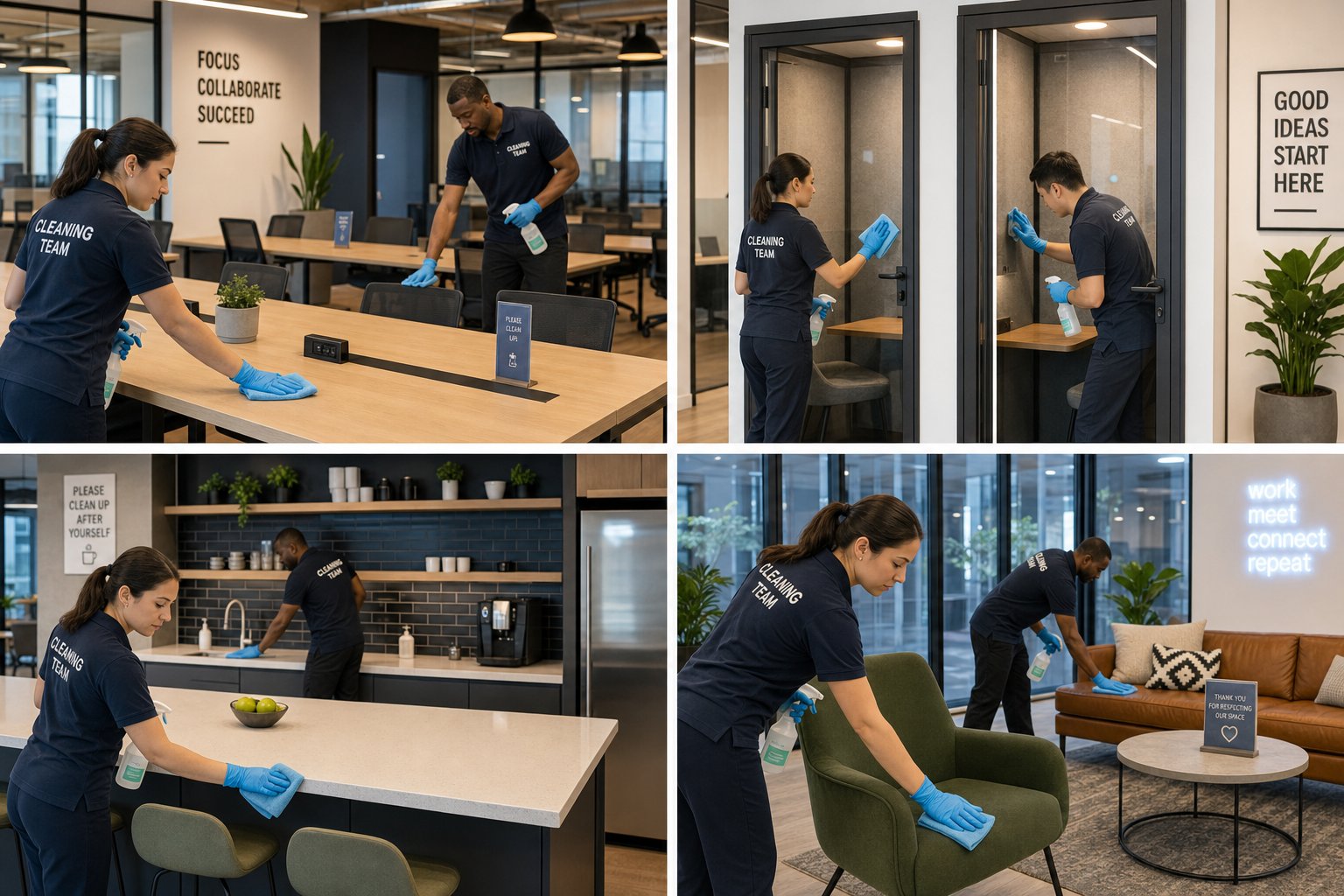
Coworking space cleaning in NYC has to protect two things at once: the member experience and the operator’s proof that every shared surface was serviced. A desk in a Flatiron hot-desk row, a phone booth near Union Square, and a kitchen serving a Long Island City floor do not carry the same traffic pattern. GreenPoint Maintenance Services builds the route around those differences instead of treating a flexible office like a lightly used private suite. Our MBE-certified commercial cleaning team combines zone-based service, Green Seal certified products, and StockPoint records so managers can see what happened after the crew leaves. If you are comparing a shared office cleaning vendor, call GreenPoint at 844-814-0810 to schedule a walkthrough and receive a fixed-price scope.
Why coworking spaces need a different cleaning plan
A conventional office may have one team’s predictable schedule; a coworking site changes occupants throughout the day. Members bring food into lounges, take video calls in enclosed booths, and touch elevator buttons, printer controls, refrigerator handles, and coffee equipment repeatedly. ISSA’s cleanability framework emphasizes both visible appearance and the removal of soil and contamination; in a flex office, a polished lobby cannot compensate for a sticky shared keyboard or an overflowing restroom bin. GreenPoint starts with a map of touchpoints, occupancy peaks, and access rules.
That map turns service into measurable work. For a 20,000-square-foot coworking floor, the scope may separate reception, open desks, meeting rooms, phone booths, pantry areas, restrooms, and support corridors. The GreenPoint Maintenance Services supervisor then assigns frequencies: daily cleaning for common touchpoints and restrooms, after-use resets for premium rooms when requested, and weekly detail work for edges, vents, upholstery, and high dusting. This structure helps an operator buy the outcome rather than an undefined number of labor hours.
NYC traffic, neighborhoods, and building access
A coworking operator in Midtown faces different logistics from one in DUMBO or Astoria. Penn Station and Grand Central bring heavy commuter flow, while a site near the Brooklyn Navy Yard may have freight elevators and loading windows that limit evening access. In the Financial District, security desks and tenant elevator rules can add handoffs; in Long Island City, a building may coordinate several tenants around one service elevator. GreenPoint documents these constraints during the walkthrough so the cleaning plan works with the property instead of creating missed rooms.
Weather is part of the local soil load. Rain tracked from the 7 train, salt from winter sidewalks near Atlantic Terminal, and summer dust around construction corridors can change entry-mat and hard-floor needs within hours. A practical NYC scope identifies entrance matting, vestibules, elevator cabs, and stair rails as their own zones. GreenPoint can schedule a morning touch-up or a second restroom check for high-volume days, and facility managers can call 844-814-0810 when an event or move-in requires an adjusted route.
Daily service by zone: desks, booths, and meeting rooms
Open desks require a consistent reset without disturbing member property. Crews should clear only approved waste, clean the work surface and chair touchpoints, dust monitor stands and cable channels, and use a product compatible with the desk finish. Phone booths need special attention because small enclosed spaces collect skin oils and stale air at the same time. A useful checklist records glass, door pulls, seat surfaces, ledges, floor edges, and ventilation grilles rather than relying on a generic “office cleaned” line.
Meeting rooms should be reset between the final scheduled use and the nightly close: table edges, presentation remotes, whiteboard trays, door hardware, credenzas, and floor debris all affect the next client impression. The site lead can mark a room as serviced in StockPoint with a timestamp and GPS-tagged photo. GreenPoint’s live dashboard gives an operator a fast way to verify coverage without interrupting a member or asking a cleaner to reconstruct the route from memory. For a deeper staffing discussion, see [commercial cleaning staffing ratios by square footage](/blog/cleaning-staffing-ratios-square-footage/).
Kitchens, coffee bars, and food-contact surfaces
Shared kitchens create concentrated risk because food residue, moisture, and high touch frequency meet in a small footprint. A nightly kitchen sequence should include counters, sink basins, faucet levers, refrigerator pulls, microwave buttons, dishwasher handles, cabinet pulls, tables, chair backs, and floor corners. Products and cloths should be controlled so a restroom tool never enters the pantry zone. GreenPoint uses color-coded microfiber systems to reduce cross-zone transfer and can align contact times with the product label instead of wiping disinfectant away immediately.
The scope should also name what is not included. Members’ personal dishes, food stored in refrigerators, and equipment interiors may require a house rule or a separate add-on. Clear ownership prevents a cleaner from moving a member’s property and prevents a manager from assuming an unpriced task is covered. GreenPoint records exceptions in the service notes, and the operator can ask for a walkthrough quote at 844-814-0810 when a second pantry, catered event, or larger appliance package changes the workload.
Restroom and high-touch controls
Restrooms are the fastest way for a member to judge whether a shared office is managed. A high-traffic NYC site generally needs a documented sequence for fixtures, partitions, dispensers, mirrors, floors, waste, and odor control, with a daytime inspection when occupancy warrants it. The [restroom cleaning best practices for high-traffic facilities](/blog/restroom-cleaning-best-practices-high-traffic/) guide explains why frequency should follow usage rather than a one-size-fits-all calendar. GreenPoint’s supervisor can set inspection intervals around lunch and evening peaks.
High-touch work extends beyond obvious handles. Elevator call buttons, stair rails, entry intercoms, payment terminals, shared pens, lockers, printer panels, and amenity controls should appear on the route card. Cleaning is not a substitute for hand hygiene, ventilation, or member behavior; the CDC’s [hand hygiene guidance](https://www.cdc.gov/clean-hands/) supports pairing a clean facility with visible handwashing supplies. GreenPoint can verify a sample of touchpoints with ATP testing when a client wants quantitative trend data instead of an appearance-only inspection.
StockPoint verification for coworking operators
A flexible-office manager may oversee several floors while also answering member requests, so proof has to be easy to retrieve. StockPoint captures timestamped GPS-tagged photos, task completion, notes, and exception records. GreenPoint uses that evidence to show whether a restroom inspection occurred, whether a meeting-room reset was completed, or whether a spill was routed to the right person. The dashboard is useful in weekly operations reviews because a manager can look for patterns by zone rather than debate a single anecdote.
Verification should improve the program, not become paperwork for its own sake. If ATP readings trend higher around a coffee bar, GreenPoint can adjust dwell time, cloth changes, or midday frequency. If photos show repeated clutter at a printer wall, the operator can change signage or add a small-bin pickup. This closed loop supports the [digital cleaning verification systems](/blog/digital-cleaning-verification-systems/) approach and gives members a more dependable experience without promising that a shared workplace can be sterile.
Products, safety, and tenant communication
GreenPoint specifies Green Seal certified products where they fit the surface and soil, while still following each disinfectant label for dilution, contact time, and personal protective equipment. OSHA’s [Hazard Communication Standard](https://www.osha.gov/hazcom) requires employers to communicate chemical hazards and maintain accessible safety information; a coworking operator should know where SDS documents are kept and how after-hours staff are protected. The plan also includes ventilation and dry-time expectations so a newly cleaned room is safe to reoccupy.
Communication is part of the service. A small sign can tell members when a floor is wet, when a room is being reset, or how to report a spill without blaming the person who used the space. GreenPoint’s crew follows the building’s loading, security, and waste rules and can brief front-desk teams on escalation. Fixed pricing, no hourly billing, and no hidden fees make it easier to budget a recurring route; call 844-814-0810 if the building needs a revised scope for a new amenity.
Budget benchmarks and staffing decisions
Budgeting begins with square footage but should not end there. A 10,000-square-foot private office with one pantry is not equivalent to a 10,000-square-foot coworking site with 40 phone booths, six conference rooms, and two kitchens. Operators should model daily labor, consumables, restroom inspections, periodic floor care, and event resets separately. The [commercial cleaning cost per square foot](/blog/commercial-cleaning-cost-per-square-foot/) explainer is a useful starting point, but a walkthrough is needed to price traffic, access, and service windows accurately.
Ask for a fixed monthly scope that names frequency, response time, consumables, periodic tasks, and the quality-assurance process. GreenPoint can price a core nightly route and list optional midday coverage rather than hiding a second visit inside an hourly allowance. A 98% client-retention record is a useful proof point, but the decision should still rest on documented tasks, insurance, trained staff, and a clear escalation path. GreenPoint Maintenance Services can review a floor plan and return a quote after a walkthrough scheduled through 844-814-0810.
How to choose an NYC coworking cleaning company
Interview vendors with the questions an operator will need to answer after a complaint: Which zones are inspected? How are member belongings protected? Who covers an absence? Can the manager see time-stamped evidence? What happens after a spill between nightly visits? A vendor that cannot describe the route, supervisor, and response standard is selling labor rather than a managed service. GreenPoint provides a written scope, named points of contact, and StockPoint visibility so the building team knows what “complete” means.
Certification and contracting readiness matter for multi-tenant portfolios. GreenPoint is MBE/MWBE certified in New York programs, registered in SAM.gov, and experienced with sites across Manhattan, Brooklyn, Queens, the Bronx, Staten Island, Westchester, Long Island, New Jersey, Connecticut, Pennsylvania, and Florida. That footprint can simplify standards for operators with multiple locations, while local route planning keeps the plan practical. Start with [questions to ask a commercial cleaning company](/blog/questions-to-ask-commercial-cleaning-company/) and then call 844-814-0810 for a site-specific walkthrough.
Frequently asked questions
How often should a NYC coworking space be cleaned? Nightly full service is a baseline for many sites, with daytime restroom and touchpoint checks scaled to occupancy. GreenPoint sets the frequency after reviewing member counts, kitchens, events, and building access rather than assigning the same schedule to every address.
Can cleaning happen without disrupting members? Yes. GreenPoint can split noisy or chemical-intensive work into after-hours windows, use quiet daytime touch-ups for restrooms and spills, and coordinate meeting-room resets with the booking calendar. The route and exceptions are recorded in StockPoint.
What does StockPoint prove? StockPoint can show task completion, timestamps, GPS-tagged photos, notes, and selected ATP results. It does not claim that a room is sterile; it gives an operator evidence to review service coverage and improve recurring problem zones.
How is coworking cleaning priced? A fixed monthly price usually considers square footage, room count, traffic, restroom and kitchen frequency, consumables, access windows, and periodic floor work. GreenPoint provides a written scope with no hourly billing or hidden fees after a walkthrough.
How do I request a quote for coworking space cleaning in NYC? Call GreenPoint at 844-814-0810 or email info@greenpointms.com with the address, approximate square footage, operating hours, and desired start date. GreenPoint will schedule a walkthrough and map the service zones.
Need a cleaner, more accountable coworking floor? Call GreenPoint Maintenance Services at 844-814-0810 to schedule a walkthrough and fixed-price quote. GreenPoint pairs Green Seal certified products with StockPoint verification and has retained 98% of clients.