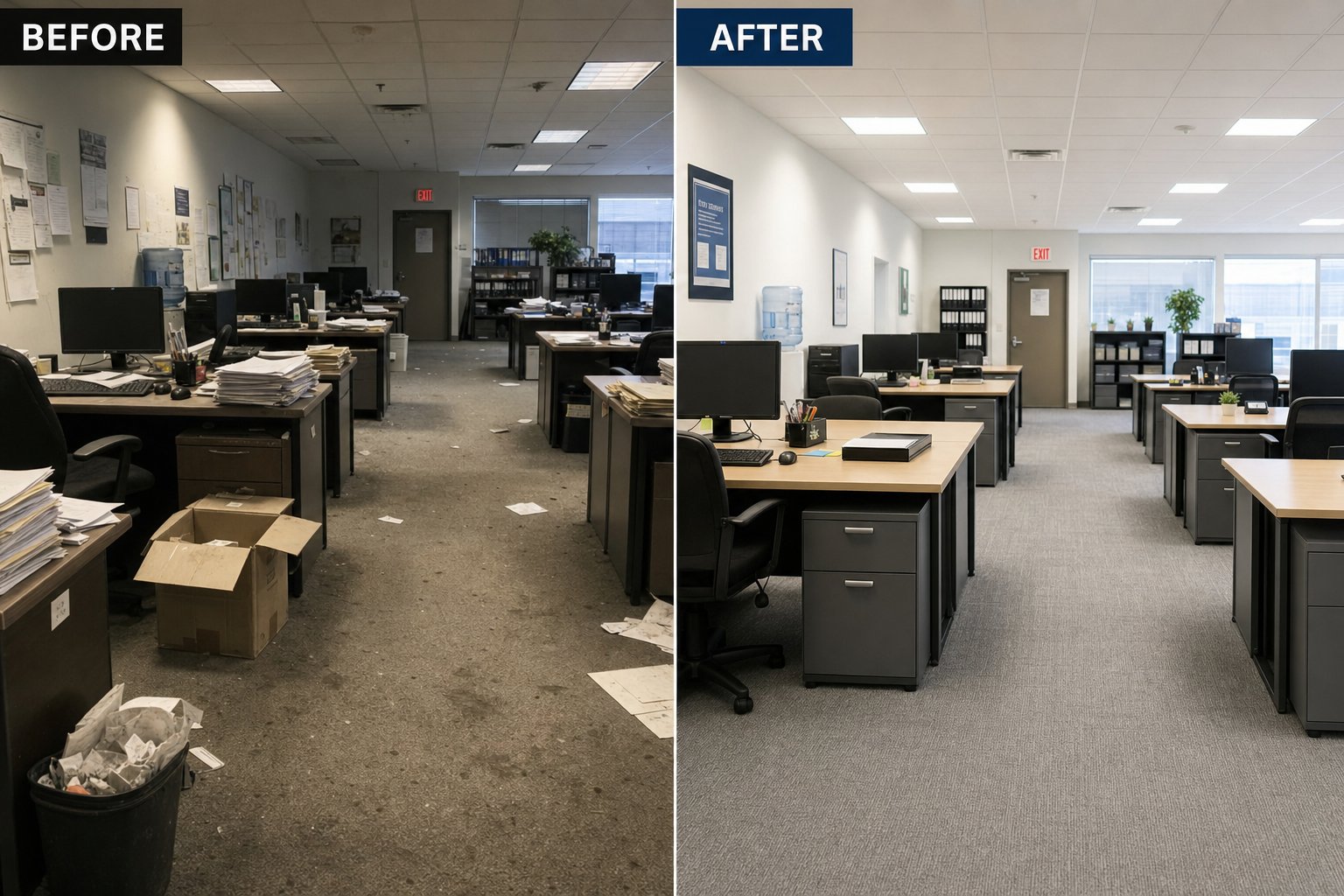
Deferred maintenance shows up in the same places every time: ground-in soil at entryways, sticky floors, dust on vents and ledges, restroom odor, and breakrooms that look "used up." When a facility falls behind, routine janitorial can’t catch up—you need a recovery clean that resets the baseline, reduces risk, and then transitions into a sustainable program. GreenPoint Maintenance Services specializes in phased recovery cleaning across NYC, NJ, and CT, using fixed pricing (no hourly billing), documented inspections, and optional JaniTrack verification with timestamped photos and ATP testing. If you’re dealing with a neglected facility, call 347-332-9348 to schedule a walkthrough and build a recovery plan.
How to tell you’re past "deep clean" and into recovery territory
A standard deep clean focuses on detail work. Recovery cleaning is different: it corrects accumulated neglect that affects operations and perception. Signs include persistent odor despite cleaning, repeated complaints, visible dust layers, bio-buildup in restrooms, and floors that never look clean even right after service. Another indicator is "scope creep"—the cleaning team is constantly reacting to emergencies instead of completing a predictable checklist. GreenPoint begins with an assessment that scores conditions by area and identifies the minimum work required to reach a stable baseline.
The assessment walkthrough: documenting baseline condition and defining "done"
Recovery starts with documentation. During a walkthrough, identify the highest-risk zones (restrooms, breakrooms, high-touch points, entryways) and the highest-visibility zones (lobbies, conference rooms, glass). Capture baseline photos, note floor types, measure approximate square footage, and list special conditions (construction dust, water intrusion, pest activity). GreenPoint can use JaniTrack-style documentation to create an evidence trail from "before" to "after" so leadership sees progress and the cleaning team has clarity. If you’re building standards, use appearance levels as a reference point: [ISSA Clean Standards appearance levels](/blog/issa-clean-standards-appearance-levels/).
Phase 1: safety-first reset (restrooms, breakrooms, touchpoints, and waste)
Start where health and complaints originate. Phase 1 typically includes restroom descaling and disinfection, drain treatment, trash and recycling reset, breakroom degreasing, and high-touch disinfection protocols. In some environments, targeted disinfection may be warranted based on risk, but it must follow EPA label contact times and surface compatibility. If your team is unclear on the difference between routine cleaning and scheduled disinfection, align terminology early to prevent mismatched expectations: [Electrostatic disinfection explained](/blog/electrostatic-disinfection-explained/). GreenPoint’s supervisors build a checklist that prioritizes risk reduction first.
Phase 2: floors and surfaces — the visual turnaround that changes perception
After the safety reset, tackle the big visual drivers: floors, glass, and high surfaces. For VCT, scrub-and-recoat or strip-and-wax can restore shine and improve lighting reflection. For tile and grout, machine scrubbing and grout line attention removes embedded soil. For carpet, extraction removes accumulated soil that vacuuming can’t. High dust (vents, ledges, light fixtures) often requires a "top-down" approach so cleaned floors aren’t re-contaminated by falling dust. GreenPoint sequences work to avoid rework and sets clear pass/fail criteria for each zone.
Phase 3: verification and quality assurance (why proof matters after a reset)
Once you reset a facility, you need to prevent backsliding. That requires verification. Visual inspections catch obvious misses, but objective tools can strengthen trust—especially in medical-adjacent or high-occupancy buildings. ATP bioluminescence testing provides a numeric indicator of organic residue on a surface and can be used selectively to validate cleaning technique. GreenPoint can incorporate ATP sampling into the recovery phase and then reduce frequency as the building stabilizes. For an overview of how ATP testing works in commercial cleaning, see: [What is ATP bioluminescence testing?](/blog/what-is-atp-bioluminescence-testing-cleaning/).
Transition to routine: designing a maintenance cadence that keeps the building stable
A common failure mode is doing a reset and then returning to an under-scoped routine that can’t maintain the new baseline. After recovery, re-estimate the true staffing ratios and frequencies. A practical way to size the program is to combine square footage with restroom counts, occupancy density, and special-use areas. If you’re benchmarking labor assumptions, start here: [Cleaning staffing ratios by square footage](/blog/cleaning-staffing-ratios-square-footage/). GreenPoint Maintenance Services builds fixed pricing around the right cadence so the building stays stable without hidden add-ons. Call 347-332-9348 to review options.
Local tri-state notes: NYC building rules, compliance expectations, and tenant relations
Neglected facilities often have tenant relationship damage. In NYC, that can show up as repeated complaints to building management, heightened scrutiny of service logs, or stricter access rules for vendors. Some buildings require COIs, security sign-ins, and off-hour scheduling to avoid disrupting tenant operations. In NJ and CT suburban sites, loading dock access may be simpler, but expectations around parking-lot cleanliness and entryway matting can be higher due to weather. GreenPoint works across these environments and aligns the plan with real-world building constraints.
How to scope a deferred-maintenance cleaning recovery accurately the first time
The single biggest mistake in deferred-maintenance recovery cleaning is underscoping. A facility that’s been under-cleaned for 18 months is not 1.5x dirtier than a normal facility—it’s often 4-8x dirtier in measurable terms (ATP readings, particulate counts, microbial swabs), with embedded dirt in carpet, fixtures, and grout that won’t come out with standard cleaning chemicals. GreenPoint Maintenance Services scopes recovery cleanings using a structured walkthrough that maps every space into one of four condition categories—Light, Moderate, Heavy, or Restoration—each with a defined cleaning protocol and time-per-square-foot estimate. The walkthrough typically takes 60-90 minutes for a 50,000 sq ft facility and produces a fixed-price recovery proposal.
Common surprises that should be priced upfront: VCT floors that need full strip-and-recoat rather than just buff-and-burnish (5-8x the cost per square foot); carpet that needs extraction plus encapsulation rather than just bonnet cleaning; restroom grout that needs acid restoration; HVAC return vents and supply diffusers that need deep cleaning; and accumulated high-dust on light fixtures, ceiling tiles, and ductwork. For floor-specific guidance, see [VCT floor care: strip, seal, wax guide](/blog/vct-floor-care-strip-seal-wax-guide/) and [carpet cleaning methods compared](/blog/carpet-cleaning-methods-compared/).
Phased recovery: the right way to sequence work in a facility that can’t shut down
Most facilities can’t close for a full reset, so recovery cleaning has to be sequenced. GreenPoint’s standard phased approach: Week 1—high-dust and restroom deep clean; Week 2—VCT strip and recoat in zones (typically nights/weekends); Week 3—carpet extraction in zones; Week 4—glass, fixtures, and detailing; ongoing—new daily/weekly maintenance schedule that prevents re-deferment. Sequencing this way means the facility never has more than one zone offline at a time, and visible improvement compounds week over week, which matters when leadership is watching. For schools and healthcare facilities, phased sequencing also avoids contamination of clean zones with restoration dust and chemicals; see [healthcare-associated infections: environmental cleaning](/blog/healthcare-associated-infections-environmental-cleaning/).
Pricing benchmarks for tri-state deferred maintenance recovery
Recovery cleaning is priced as a one-time project on top of the recurring contract, typically $0.50-$1.50 per square foot depending on condition and scope. A 50,000 sq ft Moderate-condition facility might run $35,000-$55,000 for full recovery; a Heavy-condition facility of the same size could run $60,000-$95,000. Restoration cases (post-fire, post-flood, severe biological contamination) are priced separately and usually require IICRC-certified restoration specialists. Recurring contracts that follow recovery work are typically priced at standard market rates ($0.08-$0.18/sq ft/month for tri-state Class A commercial)—GreenPoint Maintenance Services explicitly does not charge a premium going forward because the facility is now in good shape and shouldn’t cost more to maintain than any other Class A property.
Why a one-time deep clean isn’t enough: preventing re-deferment
About 40% of facilities that complete a one-time deep recovery clean slip back into deferred condition within 12-18 months. The cause is almost always the same: no real change to the recurring contract scope, frequency, or accountability. To prevent re-deferment, the recovery project should be paired with three permanent changes: (1) a written SLA with measurable thresholds and consequences; (2) a monthly walkthrough cadence with the facility owner; and (3) verification technology like JaniTrack timestamped photos and ATP testing on critical surfaces. GreenPoint includes all three in our standard tri-state commercial contracts at no additional charge. For SLA structure, see [commercial cleaning contract: key terms](/blog/commercial-cleaning-contract-key-terms/).
How to present a recovery cleaning proposal to ownership or the board
Facility managers and asset managers often need to defend a recovery cleaning spend to ownership. The strongest framing isn’t 'we need to deep clean'—it’s asset preservation. A neglected VCT floor that should last 15-20 years often needs replacement at 7-10 years if not maintained; carpet life drops by roughly 30-50%. Restoring a 50,000 sq ft facility now for $45,000 may preserve $150,000-$300,000 in flooring asset value over the next 5-7 years. GreenPoint Maintenance Services prepares written recovery proposals with photo evidence of current condition, estimated remaining asset life under current versus restored maintenance, and a sequenced recovery plan. Call 347-332-9348 to schedule a no-cost recovery assessment.
FAQ: Deferred maintenance recovery cleaning
Q: How long does a recovery clean take? A: Small offices may stabilize in 1–3 days; larger facilities often need a phased plan over 1–3 weeks to avoid disrupting operations. Q: Will routine janitorial catch up if we just increase frequency? A: Usually no. You need a reset first (floors, buildup, dust) and then a right-sized cadence to maintain. Q: How do you prevent the building from reverting? A: Clear scope, correct staffing ratios, inspections, and evidence-based verification (JaniTrack photos and selective ATP testing). Q: Is recovery cleaning safe for occupied spaces? A: Yes when sequenced properly and when chemical safety and ventilation practices are followed. Q: Can you price recovery work without hourly billing? A: Yes. GreenPoint typically prices recovery as a fixed project scope plus a fixed monthly maintenance plan afterward.
Ready to bring a neglected facility back to standard? GreenPoint Maintenance Services can deliver a phased recovery clean, verified with JaniTrack documentation and optional ATP testing, then transition you to fixed-price routine service. Call 347-332-9348 or email info@greenpointms.com to schedule a walkthrough.