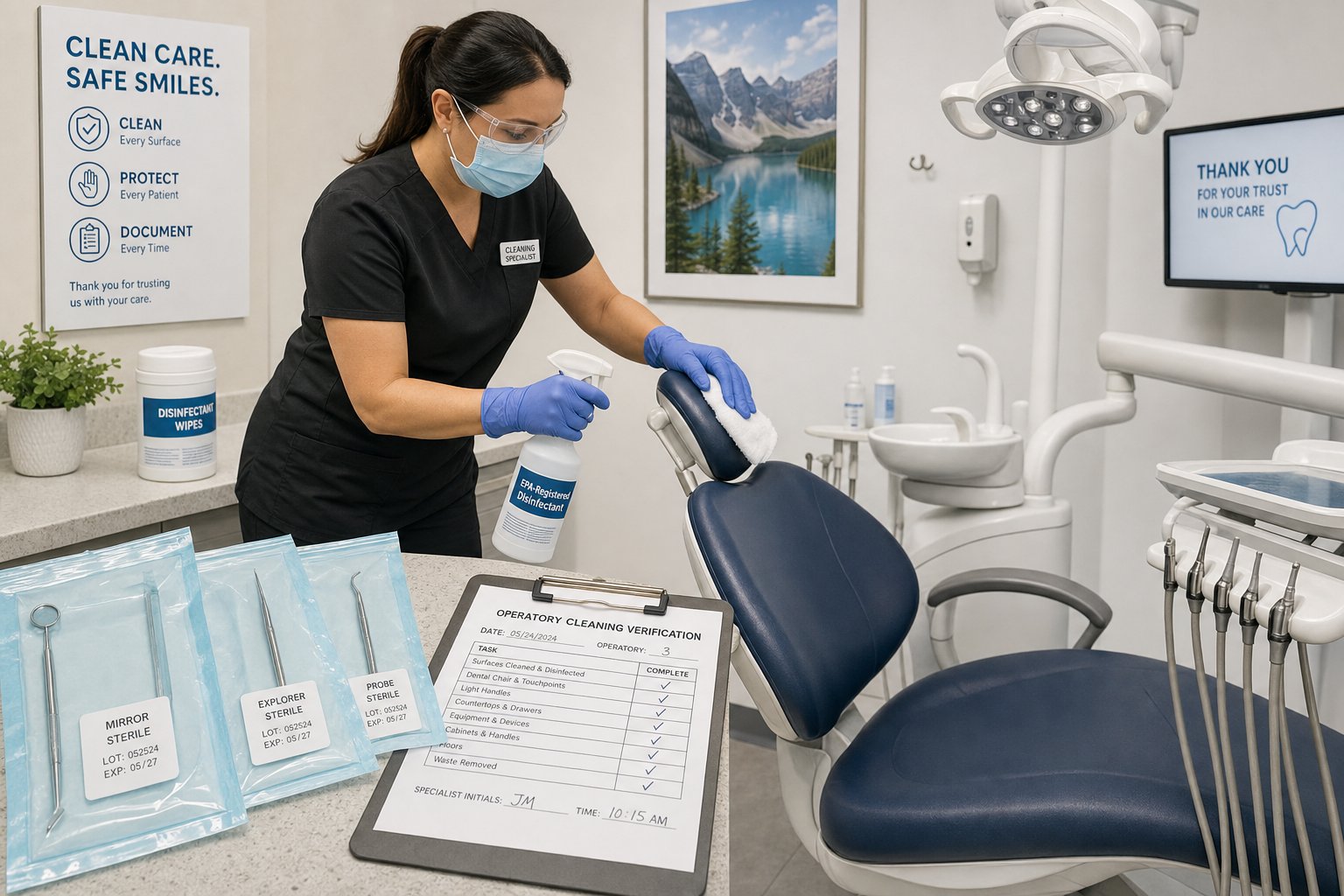
Dental office cleaning in NYC is a workflow problem as much as a janitorial problem. A clinic near Harlem Hospital, a multi-chair practice in Forest Hills, and a specialist office in Downtown Brooklyn all need visibly clean rooms, but their turnover, instrument pathways, waste rules, and patient schedules differ. GreenPoint Maintenance Services provides MBE-certified commercial cleaning with zone separation, Green Seal certified products, and StockPoint documentation for managers who need to verify service without entering a treatment room at the wrong time. Call GreenPoint at 844-814-0810 to schedule a walkthrough and receive a fixed-price scope tailored to the clinic.
Why dental practices need an infection-control-aware scope
A dental practice contains public areas, clinical operatories, sterilization support rooms, laboratories, staff areas, and regulated waste streams. The janitorial scope must be coordinated with the dental team’s instrument reprocessing and clinical disinfection procedures; a commercial cleaner should never improvise around sharps, blood, or clinical devices. GreenPoint begins by identifying clean and dirty pathways, hand hygiene points, splash-prone surfaces, and the exact boundary between environmental cleaning and staff-only clinical protocols.
The CDC’s [dental infection prevention guidance](https://www.cdc.gov/oralhealth/infectioncontrol/) distinguishes environmental surfaces from patient-care equipment and emphasizes written policies, training, and routine cleaning. GreenPoint translates that principle into a repeatable route: remove waste safely, clean from higher to lower surfaces, use dedicated cloths by zone, respect label contact times, and document exceptions. The result is a clinic that can explain who cleaned what, when it happened, and which tasks remain the responsibility of licensed clinical staff.
Local scheduling for NYC dental clinics
Clinic access is rarely simple in New York. A practice near the 125th Street subway hub may have patient volume from early morning through evening, while a Gramercy office may share a freight elevator with other tenants. A Queens clinic on Queens Boulevard may need a precise loading window, and a Brooklyn practice near Atlantic Terminal may see rapid turnover around commuter hours. GreenPoint’s walkthrough records security procedures, elevator reservations, parking limitations, and the quietest route for patient-facing work.
Scheduling should protect both privacy and clinical rhythm. A nightly close can cover reception, waiting rooms, corridors, restrooms, staff kitchens, floors, and approved environmental surfaces after the final patient leaves. A daytime technician can handle restrooms, lobby touchpoints, and spills without entering an occupied operatory. If the clinic adds Saturday hours or a second hygienist, call 844-814-0810 so GreenPoint can revise the service window and staffing plan instead of stretching a fixed route beyond its capacity.
Operatory turnover and environmental surfaces
Dental staff generally manage between-patient operatory turnover under the practice’s infection-control policy. A janitorial team can support the wider environment by cleaning operatory floors, doors, light switches, cabinetry exteriors, sinks, and other surfaces explicitly assigned by the clinic. The written scope should list exclusions such as handpieces, intraoral instruments, suction lines, and clinical equipment controls unless the practice has separately approved a trained protocol. GreenPoint uses color-coded microfiber and separate tools for clinical-adjacent, restroom, and public areas.
The route should make high-touch points visible: waiting-room arms, check-in counters, pens, payment terminals, door pulls, elevator buttons, restroom dispensers, and staff refrigerator handles. A simple checklist is stronger when it includes frequency and acceptance criteria, such as no visible soil, dry floors, stocked dispensers, and waste removed to the approved location. For more context, review [medical office cleaning requirements and OSHA considerations](/blog/medical-office-cleaning-requirements-osha/) before finalizing a vendor scope.
Waste, sharps, and chemical boundaries
A dental cleaner must know what not to touch. Sharps containers, regulated medical waste, amalgam materials, and containers with blood or other potentially infectious material belong in the clinic’s approved handling process, not an ordinary office trash route. OSHA’s [bloodborne pathogens standard](https://www.osha.gov/laws-regs/regulations/standardnumber/1910/1910.1030) sets requirements for exposure-control plans, training, and protective measures. GreenPoint documents the waste boundary during onboarding and escalates an unidentified or leaking container to the clinic contact.
Chemical safety is equally specific. Products should be labeled, stored away from patient supplies, and used with the required dilution, contact time, gloves, eye protection, and ventilation. OSHA’s [Hazard Communication Standard](https://www.osha.gov/hazcom) supports accessible SDS information and clear staff communication. GreenPoint favors Green Seal certified products where appropriate, but certification never replaces the product label or the clinic’s infection-control approval. Schedule a compliance-minded walkthrough at 844-814-0810.
StockPoint evidence and patient privacy
Dental managers need proof without creating a privacy problem. StockPoint gives GreenPoint a way to record task completion, timestamps, GPS-tagged photos of approved environmental areas, notes, and exceptions. Photo rules are set with the clinic so images exclude patient names, charts, screens, radiographs, and any protected information. A dashboard that shows a clean supply closet or an empty corridor can be more useful than a generic signature because the manager can connect the evidence to a zone and time.
Verification should be sampled intelligently. GreenPoint can audit reception touchpoints daily, review restroom photos, and use ATP testing on agreed non-clinical surfaces when a clinic wants a quantitative trend. ATP results are an operational signal, not a diagnosis and not a replacement for clinical disinfection. The [what is ATP bioluminescence testing](/blog/what-is-atp-bioluminescence-testing-cleaning/) explainer describes that distinction. GreenPoint’s 98% client retention reflects a focus on feedback loops, not a promise that every measurement will be identical.
Floor care, air quality, and patient experience
A dental office’s floor plan often combines resilient flooring, carpet in waiting areas, and grout or slip-resistant surfaces near sinks. The cleaning plan should select methods that remove soil without leaving residue, excess moisture, or a strong odor during patient hours. For example, a hard-floor scrub may belong after closing, while a low-moisture spot treatment can address a lobby mark before the first appointment. GreenPoint uses product dwell times and drying checks so a clean floor does not become a slip hazard.
Indoor air also influences comfort. Ventilation is a building-system responsibility, but cleaning can reduce settled dust around returns, ledges, and high surfaces when those tasks are included. The [HEPA filtration and commercial cleaning](/blog/hepa-filtration-commercial-cleaning/) guide explains why filtration and source control should be treated as complementary measures. GreenPoint can coordinate with the property manager and the practice’s facilities lead, and the clinic can reach 844-814-0810 for an after-hours deep-cleaning quote.
Cost drivers for dental office janitorial service
Square footage is only one cost input. A 4,000-square-foot dental office with six operatories, two sterilization support rooms, three restrooms, and extended hours needs a different route from a 1,500-square-foot single-chair practice. Quotes should separate nightly environmental cleaning, daytime restroom checks, consumables, periodic floor care, interior glass, and any clinical-adjacent tasks that require special training. GreenPoint uses fixed pricing and no hourly billing so the practice can compare scopes rather than vague labor estimates.
Ask whether the quote includes supervisor inspections, absence coverage, documentation, and response to spills. Ask also where waste ends and whether the vendor’s insurance, training records, and chemical documentation are current. GreenPoint Maintenance Services is MBE/MWBE certified in New York programs, registered in SAM.gov, and serves Manhattan, the Bronx, Brooklyn, Queens, Staten Island, Westchester, Long Island, New Jersey, Connecticut, Pennsylvania, and Florida. Call 844-814-0810 for a written walkthrough proposal.
How to choose a dental cleaning partner
Interview the provider with the infection-control coordinator or office manager present. Request a sample zone map, escalation policy, cleaning checklist, photo privacy rule, and explanation of how a missed task is corrected. A reliable vendor will be comfortable describing boundaries around sharps and clinical equipment. GreenPoint provides named supervision, documented routes, and StockPoint visibility so the clinic does not have to rely on a cleaner’s memory or a monthly paper checklist.
The best fit is the company that can integrate with the practice without pretending to replace its clinical program. Review [questions to ask a commercial cleaning company](/blog/questions-to-ask-commercial-cleaning-company/) and then test the vendor on one defined area before expanding. GreenPoint can schedule a walkthrough at 844-814-0810, explain the fixed monthly price, and identify which tasks are handled nightly, periodically, or by the dental team.
Before signing, the practice should run a short pilot or mock route with the office manager present. Note how long it takes to reach each room, whether the cleaner can identify the clinical boundary, and how quickly a missed dispenser or spill is escalated. GreenPoint uses the pilot conversation to refine task order, not to promise an unrealistic “hospital-grade” label. The deliverable is a written, repeatable environmental service that supports the clinic’s own infection-control program.
A good handoff includes a room list, access contacts, supply locations, reporting cadence, and a plan for holidays or emergency schedule changes. GreenPoint’s supervisor can review StockPoint trends with the practice monthly and identify a small number of corrective actions, such as an extra lobby check or a different floor-care window. That operating rhythm helps a busy dental team maintain consistency without turning every cleaning question into an ad hoc call.
Frequently asked questions
Can a commercial cleaner disinfect dental operatories? GreenPoint can clean environmental surfaces that the clinic assigns, but dental staff must retain control of clinical equipment and patient-care turnover unless a separately approved protocol says otherwise. The scope names the boundary so no one assumes a janitorial visit replaces clinical infection-control work.
How does StockPoint work in a dental office? StockPoint records task completion, timestamps, GPS-tagged photos of approved areas, notes, and exceptions. GreenPoint configures privacy rules so photos do not capture patient charts, names, screens, or radiographs.
Does GreenPoint handle sharps or regulated dental waste? The clinic’s approved regulated-waste process governs sharps and potentially infectious materials. GreenPoint documents the boundary, removes only the waste categories included in the contract, and escalates unknown, leaking, or incorrectly placed containers.
How often should a dental office be cleaned? Most clinics need nightly environmental cleaning, with daytime checks scaled to patient volume and operating hours. GreenPoint sets the route after reviewing operatories, restrooms, waiting-room traffic, waste points, and the clinic calendar.
How can an NYC dental practice get a quote? Call GreenPoint at 844-814-0810 or email info@greenpointms.com. A walkthrough lets the team map rooms, access, clinical boundaries, and desired verification before issuing a fixed-price proposal.
For a documented dental office cleaning plan, call GreenPoint Maintenance Services at 844-814-0810 for a walkthrough and fixed-price quote. GreenPoint combines zone controls, StockPoint evidence, and a 98% client-retention record.