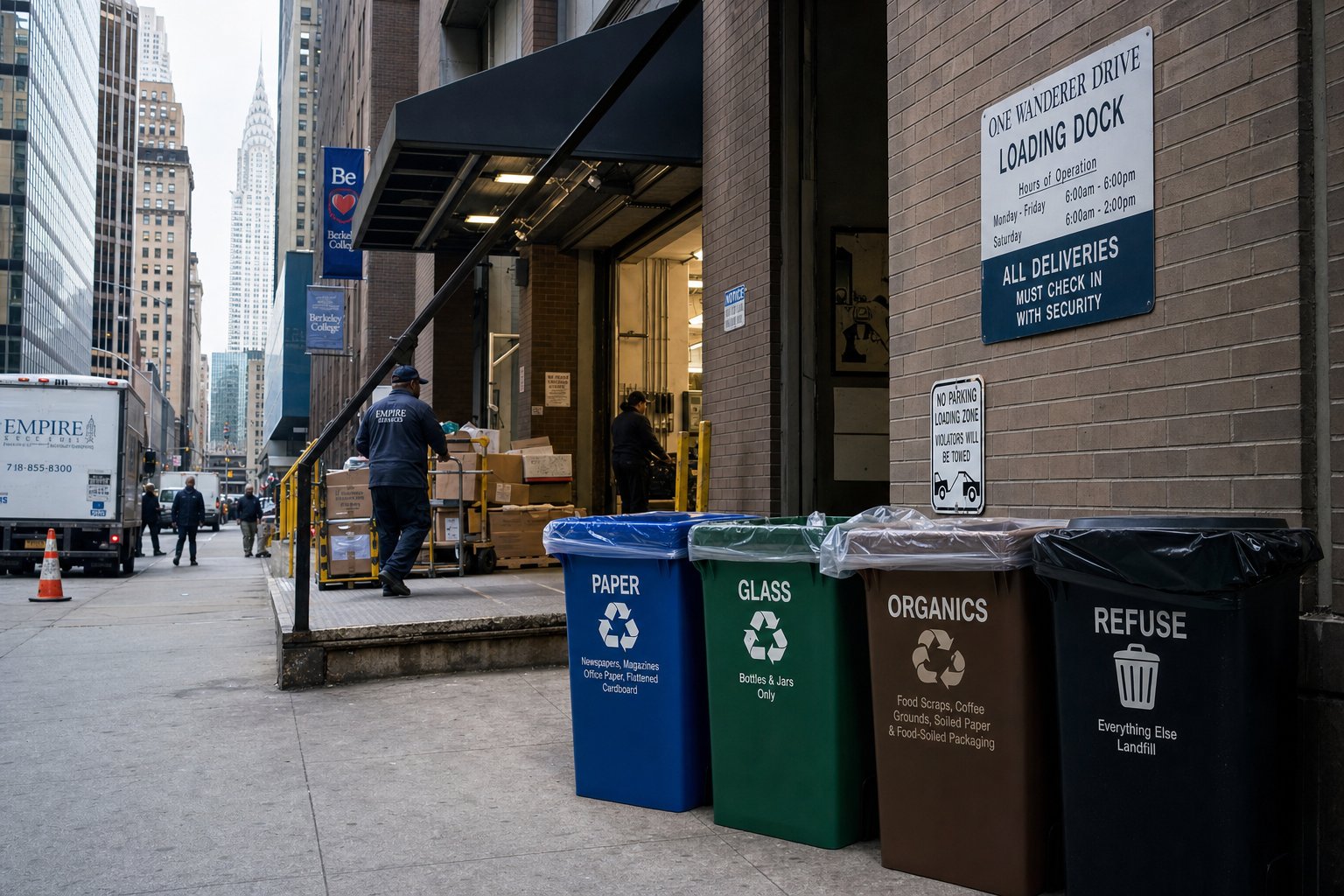
NYC commercial waste is not just a housekeeping issue—it’s a compliance and operational risk. When trash and recycling are mishandled, facility teams face loading dock congestion, contamination, tenant frustration, and in some cases fines or enforcement attention. If you’re searching for "NYC commercial trash recycling compliance" or "DSNY commercial waste" requirements, the big question is: what should your cleaning vendor actually be doing day-to-day to keep you compliant? GreenPoint Maintenance Services supports tri-state commercial facilities with fixed-price janitorial programs, documented processes, and JaniTrack verification for critical tasks. For a walkthrough, call 347-332-9348.
Why waste compliance is a vendor-performance issue, not just a tenant issue
In multi-tenant NYC buildings, tenants generate waste—but building operations live with the consequences. Overflowing compactors, contaminated recycling, and incorrect staging create safety hazards and reputational problems in lobbies and loading docks. A strong cleaning partner does more than "empty bins": they help enforce the system by maintaining bin placement, labeling, and back-of-house staging standards consistently. GreenPoint approaches waste as part of a broader compliance mindset—similar to how we manage scope clarity in [commercial cleaning contract key terms](/blog/commercial-cleaning-contract-key-terms/) so responsibilities don’t become "nobody’s job."
The three failure points: source separation, internal transport, and staging
Most office recycling programs fail at one of three points. First, source separation: tenants don’t know what goes where, or bins are unlabeled or inconsistent across floors. Second, internal transport: bags leak, carts are not cleaned, and routes cross clean public corridors during peak times, creating odor and appearance issues. Third, staging: loading docks become cluttered, cardboard is not broken down, and waste is staged incorrectly for pickup. GreenPoint designs operating procedures for each point so recycling isn’t a "poster on the wall"—it’s a repeatable process.
What your cleaning vendor should do nightly (minimum compliant baseline)
A compliant baseline program typically includes: (1) consistent desk-side and pantry bin emptying to designated collection points; (2) replacing liners and preventing leaks; (3) breaking down cardboard to reduce volume; (4) keeping waste carts and staging areas clean to avoid odors and pest attraction; and (5) ensuring loading dock doors and compactor areas remain free of loose debris. In practice, the difference between an average vendor and a high-performing vendor is documentation and consistency. GreenPoint uses JaniTrack verification for critical back-of-house tasks so property managers can confirm performance without walking the dock every night. Call 347-332-9348 to scope the right baseline.
How to reduce recycling contamination (the hidden cost driver)
Contamination is the silent budget killer: when recycling is contaminated, it may be rejected or treated as refuse, increasing haul costs and undermining sustainability goals. The operational fixes are surprisingly practical: standardize bin colors and labels across floors, place bins in pairs (trash + recycling) to reduce incorrect disposal, and run periodic ‘bin audits’ to identify trouble areas. GreenPoint can integrate these checks into a quality-assurance program like the one described in [quality assurance commercial cleaning program](/blog/quality-assurance-commercial-cleaning-program/), with documented findings and corrective actions.
Local NYC realities: loading docks, curb access, and high-rise logistics
NYC buildings face constraints suburban sites don’t: limited dock space, restricted curb access, tenant move-in/out traffic, and tight freight elevator windows. In Midtown and FiDi towers, waste staging competes with deliveries, mailrooms, and contractor activity. That’s why the cleaning vendor’s internal transport routes matter—moving waste through public corridors at the wrong time can create immediate tenant complaints. GreenPoint builds a building-specific plan and schedules waste runs to minimize public exposure, especially in high-traffic lobbies near transit hubs like Grand Central, Penn Station, Fulton Center, and PATH-connected districts in Jersey City.
Compliance-minded documentation: how to prove what happened
If you ever have a dispute about dock condition, missed pickup readiness, or repeated contamination, you need documentation. GreenPoint’s JaniTrack system provides timestamped, GPS-tagged photos and a live dashboard that can capture key checkpoints: dock swept, cardboard staged, compactor area clean, recycling separated, and bins labeled. This approach aligns with broader verification practices in [digital cleaning verification systems](/blog/digital-cleaning-verification-systems/). It also supports vendor consolidation decisions; see [vendor consolidation one cleaning company](/blog/vendor-consolidation-one-cleaning-company/) for how unified accountability reduces gaps.
What to include in an RFP or scope of work for waste & recycling
To avoid "scope drift," your RFP should define: collection points by floor, bin types and labeling requirements, frequency of waste runs, cardboard breakdown expectations, staging instructions, and who is responsible for reporting contamination issues to tenants or property management. You can use [how to write an RFP commercial cleaning](/blog/how-to-write-rfp-commercial-cleaning/) as a starting template, then add a dedicated waste section. GreenPoint’s fixed-price proposals translate these requirements into clear tasks—no hourly billing, no hidden fees, and fewer end-of-month surprises. Call 347-332-9348 for a walkthrough.
What NYC commercial trash and recycling law actually requires
Commercial buildings in New York City are required by NYC Department of Sanitation rules to separate four streams: (1) paper—including office paper, newspapers, magazines, and cardboard; (2) metal, glass, plastic, and beverage cartons (MGP)—mixed together in a designated bin; (3) organics (food waste)—required for buildings with food-handling tenants and for many commercial categories under the Commercial Organics Law; (4) refuse—everything else. Non-compliance carries summonses, with fines that can scale into the thousands per violation per building per inspection. Most building managers know the rules at a high level but rely on their cleaning vendor to execute the day-to-day separation correctly. GreenPoint Maintenance Services treats waste compliance as a defined scope item in every NYC commercial contract, not as a courtesy. For broader NYC compliance context, see [NYC local law building maintenance](/blog/nyc-local-law-building-maintenance/).
Where the compliance failures actually happen in commercial buildings
Five common failure modes we see when taking over NYC commercial accounts from prior vendors: (1) cleaning crew consolidates separated tenant waste back into a single bag at the freight dock 'for convenience'—an instant violation that voids tenant compliance; (2) cardboard not flattened and bundled, which NYC DSNY can refuse to collect; (3) organics streams contaminated with non-organic items (plastic utensils, coffee cup lids), which can trigger rejection of the entire bin; (4) MGP bins contaminated with food-soiled paper or wrong plastics; (5) recyclables placed out without the proper bin or label, leading to refused collection and a summons. Each of these is a process issue, not an information issue—the rules are public, but the on-the-ground execution drifts. GreenPoint corrects these systematically with crew training and daily supervisor checks.
What a cleaning vendor should do at end-of-day to keep the building compliant
GreenPoint Maintenance Services follows a six-step end-of-day waste protocol for NYC commercial accounts: (1) collect each waste stream separately at the tenant suite; (2) consolidate by stream (paper to paper, MGP to MGP, organics to organics, refuse to refuse) in the building’s freight dock or designated waste room; (3) flatten and bundle cardboard with twine or banding; (4) inspect each consolidated stream for visible contamination and correct before placement; (5) place streams at the curb (or in the building’s pickup area) per the scheduled collection day and time window; (6) photograph the placed waste with JaniTrack for the building file. This six-step process is what separates a competent waste protocol from a 'we just take out the trash' approach. Call 347-332-9348 to schedule a free waste compliance walkthrough.
Documentation: the part that protects the building when DSNY issues a summons
When NYC DSNY issues a summons, the building’s defense often comes down to documentation of process. Buildings with photographic evidence of correctly separated, bundled, and placed waste—and a vendor with documented training procedures—have a far stronger case than buildings without. GreenPoint’s JaniTrack system provides timestamped photos of each end-of-day waste placement, which means when a summons is contested at the Environmental Control Board, the building’s representative has concrete evidence rather than a verbal recollection. We have seen this evidence successfully overturn or reduce summonses multiple times across tri-state commercial accounts.
Organics: the law most buildings still aren’t set up for
NYC’s Commercial Organics Law expanded over multiple phases to cover progressively more business categories. Many buildings with covered tenants still don’t have a working organics program—either no organics bin, or an organics bin contaminated weekly. The fix is straightforward: a dedicated bin, clear signage in English and Spanish (and other languages relevant to the tenant base), a designated organics hauler contracted by the building, and training of the cleaning crew on what counts as organics. GreenPoint Maintenance Services helps buildings set up organics programs as part of standard onboarding, including bin sourcing, signage, hauler coordination, and crew training. The compliance and avoided-summons math typically pays for the setup within months.
What to ask any cleaning vendor about NYC waste compliance
Five questions every NYC building manager should ask a cleaning vendor before signing: (1) Do your crews have documented training specifically on the NYC commercial waste rules, and when was the last refresher? (2) Do you provide photographic documentation of end-of-day waste placement? (3) How do you handle contamination found in a tenant’s separated waste—do you re-sort or just consolidate? (4) Are you familiar with the Commercial Organics Law, and how do you handle organics streams? (5) Can you provide references from at least three NYC commercial buildings where you handle waste compliance? GreenPoint Maintenance Services answers yes to all five and provides references on request. For more on vetting cleaning vendors, see [how to choose a commercial cleaning company](/blog/how-to-choose-commercial-cleaning-company/) and [questions to ask a commercial cleaning company](/blog/questions-to-ask-commercial-cleaning-company/).
FAQ: NYC commercial trash and recycling compliance
Q: Why does our recycling keep getting contaminated? A: Inconsistent bin labeling/placement and lack of paired bins are common causes; audits and standardization usually reduce contamination quickly. Q: Should the cleaning vendor enforce recycling rules with tenants? A: Vendors can’t police every desk, but they can maintain bin systems, report recurring issues, and support building management communications. Q: How often should loading docks be cleaned? A: High-traffic docks often need daily sweeping and spot cleaning, with periodic deep cleans depending on volume and pest risk. Q: What proof should we keep? A: Time-stamped photos of staging and dock condition, plus logs of contamination issues and corrective actions; GreenPoint can provide JaniTrack verification. Q: Can fixed pricing work for waste programs? A: Yes—when scope is defined (touchpoints, frequencies, staging tasks) fixed pricing is often more predictable than hourly billing for buildings.
Need a compliant, predictable trash and recycling program for your NYC building? GreenPoint Maintenance Services delivers fixed-price janitorial scopes with JaniTrack verification so you can prove dock and staging performance. Call 347-332-9348 or email info@greenpointms.com to schedule a walkthrough and get a quote.