NYC flu season is not just a health issue—it is an operations and attendance problem. When one floor has a spike in respiratory illness, the hidden cost shows up in call-outs, delayed client work, and reduced tenant satisfaction. GreenPoint Maintenance Services builds flu-season cleaning protocols that are measurable and repeatable: defined touchpoint lists, documented dwell times, and verification (including ATP testing where it matters). If you want a walkthrough and fixed-price quote, call 844-814-0810 and we will map a seasonal plan to your square footage, shift schedules, and building rules.
Why flu/RSV season hits NYC offices differently (density, transit, shared surfaces)
Manhattan, Downtown Brooklyn, and Long Island City offices combine high occupant density with frequent “surface mixing” from transit commutes, shared elevators, and visitor traffic. High-touch surfaces are not only door hardware—think turnstiles, elevator call buttons, pantry appliance handles, shared printer keypads, and conference room AV remotes. GreenPoint starts by identifying your actual touch network and building a cleaning route that matches traffic patterns around hubs like Grand Central, Penn Station, Fulton Center, and major bus terminals.
Flu-season protocols should be coordinated with building management, especially in multi-tenant towers where cleaning staff can only access certain areas at certain times. We often align “after-peak” disinfection runs with lobby rush windows and incorporate security desk surfaces and mailroom counters, which are frequently missed. For a site walkthrough in Midtown, FiDi, or Brooklyn Tech Triangle, call 844-814-0810—GreenPoint Maintenance Services will produce a written seasonal scope with verification points.
Set a flu-season baseline: what changes from your standard program
A flu-season addendum is not “spray more disinfectant.” It is a change in frequency, chemistry, dwell time, and documentation—without breaking daily production cleaning. A typical baseline upgrade includes (1) increased disinfection cycles for high-touch points, (2) a defined response plan for symptomatic areas (conference rooms after large meetings, wellness rooms, restrooms), and (3) verification to prove the plan was executed. GreenPoint uses StockPoint to capture timestamped, GPS-tagged photos and route completion data so facilities teams can audit what happened and when.
Operationally, the most common failure is overloading night staff and creating “paper compliance” without real coverage. We build checklists that match labor reality and use inspection scoring to keep standards stable as volume rises. If you are evaluating vendors, compare programs using objective criteria like appearance standards and measurable verification—see our guides on [digital cleaning verification systems](/blog/digital-cleaning-verification-systems/) and [quality assurance commercial cleaning programs](/blog/quality-assurance-commercial-cleaning-program/).
High-touch disinfection map for NYC offices (pantry, restrooms, conference rooms, shared tech)
During peak respiratory season, we recommend a written high-touch map that includes: lobby turnstiles, visitor badge kiosks, elevator interiors (rails, buttons), suite entry hardware, conference room touchpoints, pantry and coffee equipment, shared refrigerator handles, microwaves, water dispensers, shared keyboards/mice (where allowed), and restroom fixtures. In Class A buildings near Bryant Park, Hudson Yards, and the Flatiron District, we also include fitness center touchpoints and package room surfaces if the tenant controls them.
Restrooms are the single most important “signal area” because traffic is high and surface contact is frequent. We standardize a disinfection sequence that prevents cross-contamination, supported by color-coded microfiber systems (see [color-coded microfiber systems guide](/blog/color-coded-microfiber-systems-guide/)) and a documented chemical program aligned to SDS/GHS labeling (see [OSHA cleaning chemical safety](/blog/osha-cleaning-chemical-safety-ghs-sds/)).
Cadence and staffing math: daily, mid-day, and “surge” coverage
A practical NYC office cadence usually includes: nightly full-service cleaning, a mid-day portering run for restrooms/pantry, and an optional “surge” disinfection pass during known spikes (after large events, peak illness weeks, or when absenteeism rises). For a 25,000–50,000 sq ft floor with 150–300 occupants, mid-day coverage often focuses on 10–20 minutes per restroom plus pantry touchpoints, not full vacuuming. That keeps labor efficient while addressing the highest risk surfaces.
GreenPoint uses fixed pricing with transparent scope so you are not surprised by “extra hours” charges during flu season. We measure outputs (touchpoint completion, inspection scores, and where requested ATP readings) instead of billing by the hour. To plan your staffing model for September–March, call 844-814-0810 for a walkthrough and a seasonal pricing option.
Chemistry and dwell time: disinfectant selection without shortcuts
Disinfectants work when the surface stays wet for the product’s labeled contact (dwell) time. In busy offices, the common error is wiping a sprayed surface immediately, which can reduce efficacy. GreenPoint trains teams to match chemistry to surface type (stainless, laminate, touchscreens) and to follow label directions. For higher-risk touchpoints, we use EPA-registered disinfectants and maintain documentation suitable for audits. For an overview of how product registrations work, see [EPA disinfectant registration guide](/blog/epa-disinfectant-registration-guide/).
We also avoid “over-disinfecting” where it can damage finishes. Electronics are handled with approved wipes, and we coordinate with tenant IT policies for shared devices. If your building requires green products, GreenPoint Maintenance Services can align the program with Green Seal-certified products while still meeting disinfection requirements for high-touch points.
Ventilation coordination: cleaning is not a substitute for IAQ controls
Cleaning reduces contamination on surfaces, but respiratory viruses are strongly influenced by ventilation and filtration. Facilities teams should coordinate cleaning schedules with HVAC run times and filter changes, especially in conference rooms and training spaces. GreenPoint often works alongside property engineering teams to ensure that cleaning events don’t conflict with after-hours HVAC shutdowns. For deeper context, read our article on [indoor air quality and commercial cleaning](/blog/indoor-air-quality-commercial-cleaning/).
In practical terms: if your office hosts high-volume meetings, ensure those rooms get both a touchpoint reset and adequate air exchange. If a tenant is adding portable HEPA units, cleaning routes should include filter pre-cleaning around units and safe dust control. GreenPoint can include HEPA vacuuming protocols as part of your seasonal plan—ask for a walkthrough at 844-814-0810.
Verification that stands up to scrutiny: StockPoint, inspections, and ATP testing
“We cleaned it” is not a proof standard. GreenPoint’s differentiator is verification: StockPoint provides timestamped, GPS-tagged photos of completed tasks, plus route data that can be reviewed by managers and clients. Where appropriate, we also deploy ATP bioluminescence testing to quantify surface cleanliness and track improvement over time. If you want the science behind ATP testing, see [what is ATP bioluminescence testing](/blog/what-is-atp-bioluminescence-testing-cleaning/).
Verification is also how you control vendor consistency. In NYC’s tight labor market, turnover can cause quality drift unless the program is tightly managed. GreenPoint maintains a 98% client retention rate by pairing training with auditing and corrective action plans—documented in a way that makes sense for facility managers and property teams.
Flu-season “rapid response” for confirmed cases (what to do within 24 hours)
When a confirmed illness cluster is reported, the goal is targeted risk reduction—not panic. A 24-hour plan typically includes: isolating high-use shared spaces, increasing touchpoint disinfection frequency for 3–5 days, focusing on restrooms and pantries, and communicating the plan to occupants. GreenPoint can deploy an enhanced disinfection crew for conference rooms, reception, and high-traffic zones while maintaining normal nightly cleaning.
We recommend keeping an on-call “surge scope” pre-approved so you can activate it quickly without a procurement delay. If you manage multiple NYC locations, we can standardize the scope and reporting format across Manhattan, Brooklyn, Queens, and the Bronx. Call 844-814-0810 to set up a seasonal response plan with clear triggers and pricing.
FAQ: Flu season office cleaning in NYC
Q: How often should high-touch surfaces be disinfected during flu season? A: In most NYC offices, nightly disinfection plus a mid-day touchpoint run for restrooms, pantry, and elevator-suite entry hardware is a practical baseline; add a surge pass during spikes or large events.
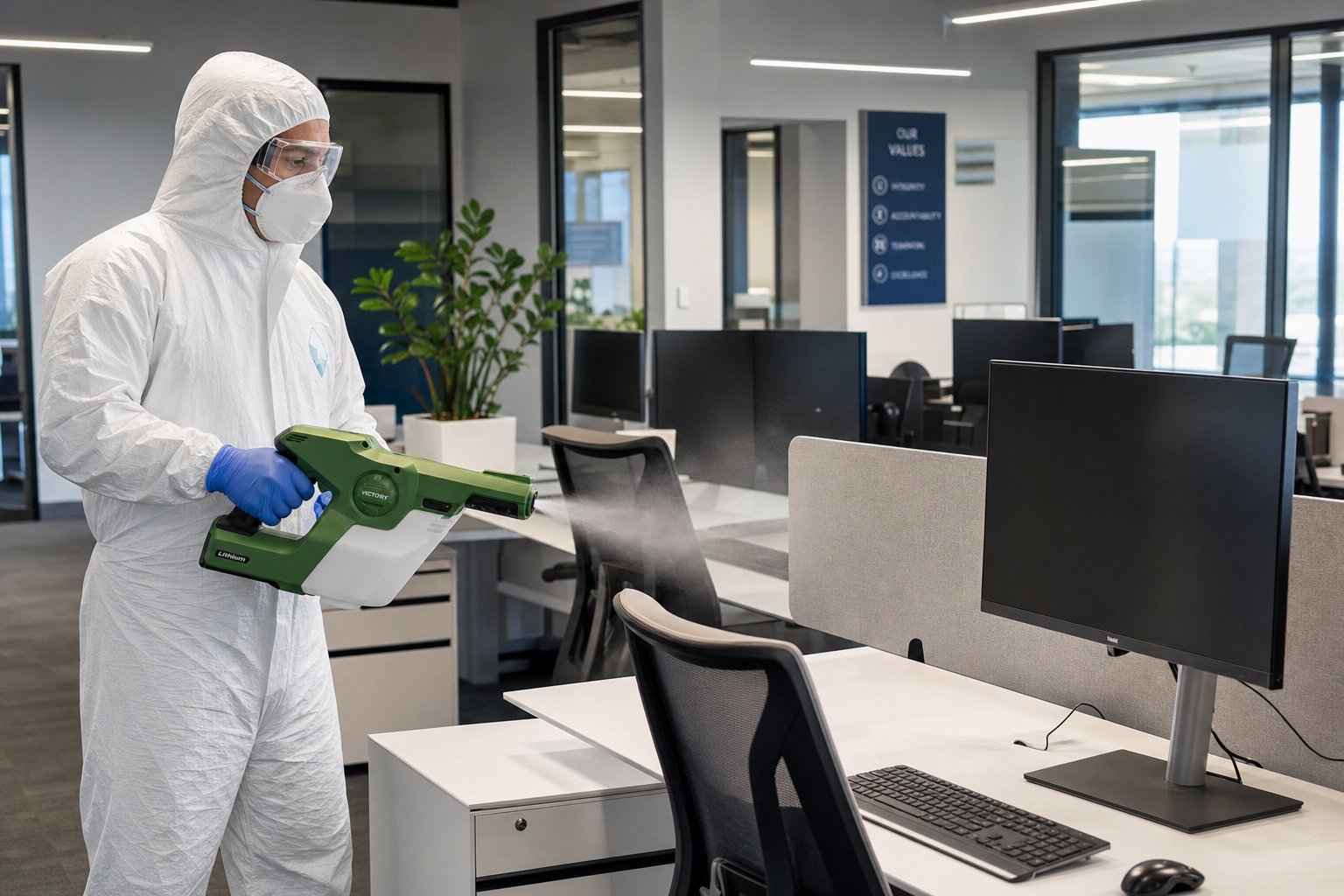
Q: Is electrostatic disinfection necessary for offices? A: It can be useful for rapid coverage of complex surfaces, but it should supplement—not replace—manual wipe disinfection where contact time and soil removal matter. Learn more in [electrostatic disinfection explained](/blog/electrostatic-disinfection-explained/).
Q: Can green products still meet disinfection needs? A: Yes, when the program uses appropriate EPA-registered disinfectants for high-touch points while maintaining Green Seal-aligned cleaners for routine tasks; the key is correct dwell time and training.
Q: How do we prove the vendor actually disinfected? A: Use verification tools such as timestamped photos, route completion tracking (StockPoint), inspection scoring, and ATP testing for periodic checks.
Q: What should we ask in an RFP for flu-season cleaning? A: Ask for a seasonal scope addendum, defined touchpoint maps, product/SDS documentation, verification method, and a fixed-price option—see [how to write an RFP for commercial cleaning](/blog/how-to-write-rfp-commercial-cleaning/).
Need a flu-season cleaning protocol you can audit? GreenPoint Maintenance Services will walk your NYC office, build a high-touch disinfection map, and verify execution with StockPoint reporting (and ATP testing when requested). Call 844-814-0810 for a walkthrough and fixed-price quote—proof-driven cleaning with no hidden fees.