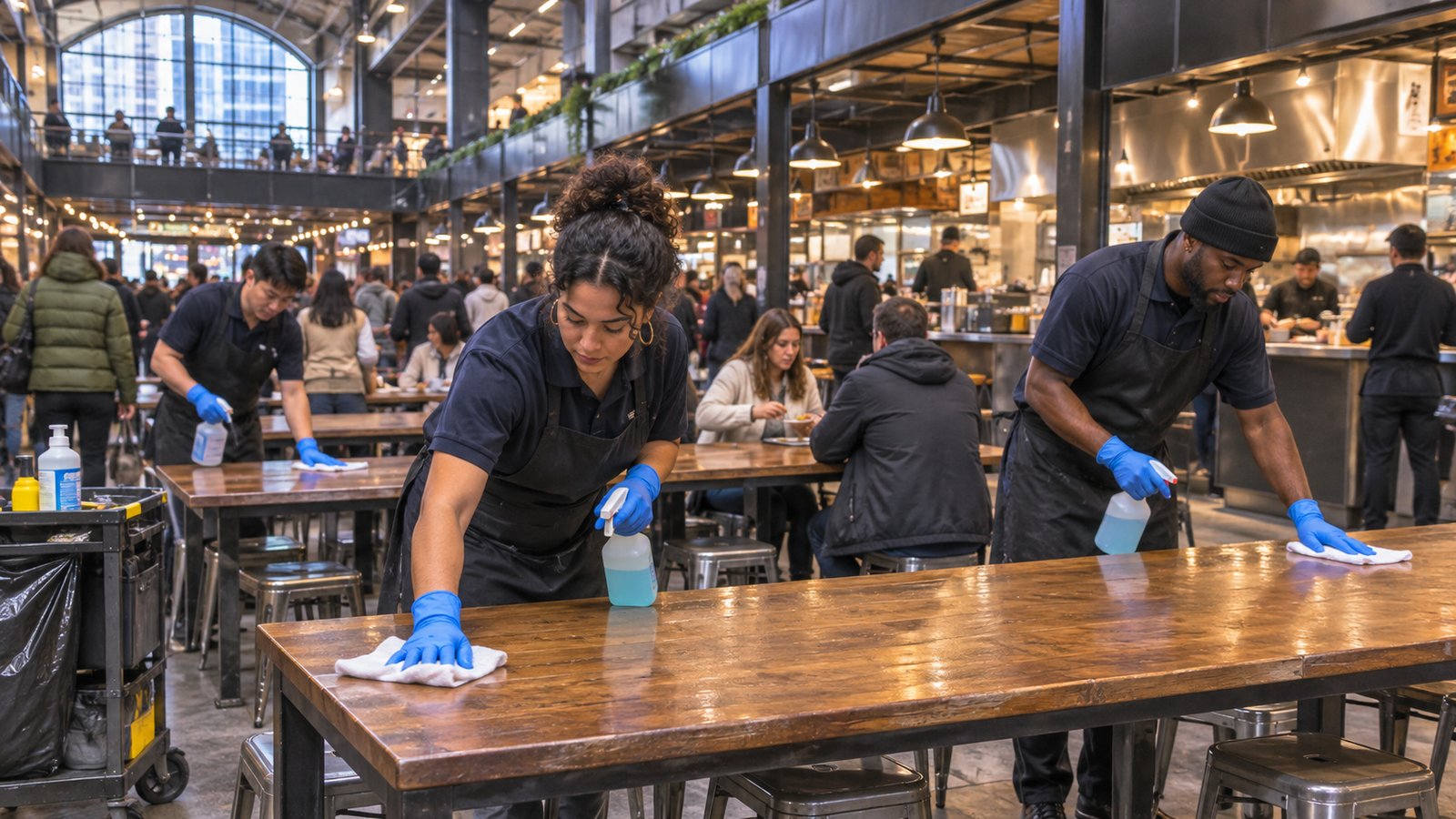
Food hall cleaning contractors in NYC have to coordinate shared dining tables, public restrooms, vendor boundaries, waste routes, and busy event periods without interrupting food service. A hall’s common-area cleaner is not automatically responsible for a tenant’s food-contact surfaces or kitchen sanitation. GreenPoint Maintenance Services Corp helps property operators and food-hall managers define work zones, response times, and service proof. From Chelsea Market and Essex Market to DeKalb Market Hall, Industry City, and seasonal Queens food events, the operating details vary by building and crowd pattern. Call 347-332-9348 to book a walkthrough or request a fixed-price quote.
Map Public Areas and Vendor Responsibilities
Begin with a floor plan that separates common areas from each vendor’s leased or licensed space. Shared zones may include entrances, corridors, seating, public restrooms, elevators, stairs, waste stations, and event areas. Vendor areas may include stalls, counters, prep equipment, and back-of-house storage. Write down who cleans each surface, who responds to a spill, who supplies consumables, and who closes or releases an area. GreenPoint conducts a walkthrough with the operator to identify shared boundaries so that the contract does not leave a dining table, corridor, or restroom between multiple owners.
The operator’s food-safety lead should control cleaning and sanitizing of food-contact surfaces and food preparation equipment. NYC Health Code Article 81 addresses cleaning of food establishments, premises, equipment, and utensils; the precise responsibilities depend on the establishment and task. A hall cleaner should not enter a vendor kitchen, move food, clean equipment, or handle regulated waste unless the operator has defined and authorized that work. GreenPoint marks each restricted zone and builds a handoff process into the service plan. Review Article 81 of the NYC Health Code and EPA disinfectant registration guidance as the operator develops its procedures.
Design a Service Plan for Peak and Off-Peak Hours
Food halls have pronounced peaks: lunch, dinner, weekends, school holidays, festivals, and special events can all shift demand. A practical plan separates pre-opening readiness, daytime porter rounds, rapid spill response, post-rush resets, and overnight detailing. Set inspection intervals for tables, floors, waste stations, and restrooms based on observed traffic rather than a vague promise of “continuous cleaning.” For a hall with 20 vendor stalls and 300 public seats, the cleaner’s route and staffing need to reflect seating turnover, table capacity, restroom count, and total operating hours. GreenPoint can price a baseline plan and list event support separately.
Clarify service windows for equipment and floor work. Machine scrubbing, glass cleaning, and high dusting may need to happen before vendors open or after the last guest leaves. A daytime porter should know which tools can be used near guests, where wet-floor signs are stored, and how to keep accessible routes open. GreenPoint sets the approved work sequence, contact tree, and escalation threshold during startup. For a buyer comparing frequencies, see cleaning frequency standards by facility type and restroom cleaning best practices for high-traffic buildings.
Control Spills, Floors, and Public Access
The highest-priority service risk in a dining hall is often an uncontained spill, not a scheduled dusting task. Specify who sees the alert, how quickly the area is isolated, who retrieves a spill kit, and how the floor is confirmed safe before guests return. A cleaner should have a clear route to wet-floor signs, absorbents, and approved tools without crossing through food prep. Keep aisles, exits, tactile or accessible routes, and fire equipment clear while cleaning. GreenPoint can define response roles and document the reported condition and correction, but the facility’s emergency and life-safety procedures remain in effect.
Floor care should account for mixed materials, grease, beverage residue, crumbs, and outdoor soil. Dry pickup before wet cleaning can reduce slurry, while the choice of cleaner must be compatible with the finish and safe for the planned use. Establish whether vendor mats, entry mats, and under-table zones are included and how heavy items are moved. For a hall near Delancey Street-Essex Street, Atlantic Avenue-Barclays Center, 14th Street, or Queensboro Plaza, commuter and visitor traffic can affect the entrance’s service interval. GreenPoint can create a high-traffic route map for each shift and revise it after complaints and inspection data show where soil accumulates.
Build a Restroom and Waste Program
Public restrooms need a documented cycle for fixtures, partitions, mirrors, floors, touchpoints, soap, paper, and odor or leak reporting. Define the check frequency during peak periods, a restocking minimum, and who receives an alert for broken dispensers or plumbing issues. A restroom inspection should identify the time, condition, action, and next check rather than only a signature. GreenPoint can use JaniTrack to support timestamped rounds and dashboard reporting. The operator should compare service logs with guest complaints and foot traffic so that high-volume periods get additional attention rather than relying on an overnight clean alone.
Waste arrangements require coordination among the hall, vendors, landlord, and collection provider. State who empties public bins, who handles vendor food waste, where full bags are staged, and how spills or overflowing containers are escalated. Keep waste routes separate from guest circulation where the building layout allows, and follow the property’s recycling and commercial waste rules. Do not ask a cleaner to handle broken glass, sharps, unknown chemicals, or heavy equipment without a defined safety procedure. GreenPoint’s scope can specify bin liners, sorting tasks, staging, and what is excluded so that shared responsibility is visible to every tenant.
Choose Products and Tools for a Shared Environment
Product selection should match the surface, task, and label directions. A general-purpose cleaner does not make a surface disinfected, and a disinfectant claim does not mean the product is approved for every food-contact use. EPA’s registered disinfectant guidance says a treated surface must remain wet for the labeled contact time and users should follow label directions. For vendor food-contact surfaces, the tenant’s approved procedures and product labels determine whether rinsing or other steps are required. GreenPoint can provide its product inventory, safety data sheets, dilution controls, and Green Seal-certified options for appropriate common-area tasks.
Tool segregation reduces cross-use between public restrooms, dining areas, and waste rooms. Specify color-coded cloths and mop heads, clean storage, laundry handling, and replacement rules. OSHA’s Hazard Communication standard addresses chemical hazard communication through labels, safety data sheets, and training; the operator should verify that the contractor’s workers know site-specific storage and spill procedures. GreenPoint reviews where products are kept, how carts are secured, which surfaces are excluded, and how to report a product concern. See color-coded microfiber systems and green cleaning for commercial buildings for relevant procurement considerations.
Use Quality Evidence to Manage a Multi-Tenant Site
A shared facility needs one operating record that makes responsibility clear. Use a location list for each table zone, restroom, corridor, entrance, and waste point; then connect the task to a shift, time, and assigned party. Define visual acceptance criteria and a complaint pathway that tells the operator whether the issue belongs to the hall cleaner, a vendor, or building maintenance. GreenPoint’s JaniTrack workflow supports timestamped service records, GPS-tagged photos where appropriate, ATP testing when included, and a live dashboard. Photos should avoid guest faces, payment information, and vendor confidential material.
Review issue patterns weekly during launch and monthly after service stabilizes. If a dining area repeatedly misses the standard at 1 p.m., the correct fix may be an additional porter round rather than a reprimand for the night crew. Use corrective actions with a named owner and a recheck time. ATP testing can indicate organic residue on sampled surfaces but does not identify a pathogen or establish food safety. GreenPoint reports a 98% client retention rate as a company-reported figure; ask how it is calculated and over what period. A service provider should offer evidence of the work it controls without claiming to replace operator inspection or regulatory records.
Compare Food Hall Contractor Proposals
Request a scope that lists every common area, scheduled and on-call tasks, staffing by shift, response time, supplies, equipment, event coverage, waste boundaries, and exclusions. Ask for insurance, supervision, backup staffing, training, safety data sheets, inspection forms, references, and sample reports. Require bidders to price the same number of service hours and identify optional event or deep-cleaning work separately. GreenPoint Maintenance Services uses fixed pricing for an agreed scope rather than hourly billing and documents additional work for approval. For multi-tenant sites, ask who can submit a complaint and who approves a billable change.
Local venue context affects access and service design. Chelsea Market has dense visitor flows around the Meatpacking District; Essex Market is connected to the Lower East Side and Delancey-Essex transit; DeKalb Market Hall sits in the Downtown Brooklyn transit and retail environment; Industry City draws visitors through a large Sunset Park campus; Queens seasonal food events may have temporary layout and weather considerations. Treat each site individually: confirm loading access, security, event calendar, public hours, and waste arrangements rather than assuming a standard schedule. GreenPoint can prepare a site-specific walkthrough and quote across NYC boroughs. Call 347-332-9348 to begin the vendor review.
Frequently Asked Questions
Question: Does a food hall cleaning contractor clean each vendor’s kitchen? Answer: Not unless the operator and vendor explicitly define the work, approved products, training, access, and records. Shared-area cleaning and food-contact sanitation are separate responsibilities and should be separated in the contract.
Question: How often should food hall tables and restrooms be checked? Answer: Use observed guest volume and complaint patterns to set inspection rounds, then add coverage for lunch, dinner, weekends, and events. A single overnight visit is not a daytime spill-response plan.
Question: What should a food hall cleaning proposal include? Answer: It should identify common areas, tasks by shift, response times, vendor boundaries, supplies, waste roles, event rates, verification, and exclusions. GreenPoint can prepare a fixed-price scope after walking the site; call 347-332-9348 to arrange the visit.
Question: Can JaniTrack prove a food hall is food-safe? Answer: No single dashboard, photo, or ATP reading proves food safety. JaniTrack can support time-stamped records and visual verification for contracted tasks; the operator retains food-safety controls, inspections, and required records. Use the dashboard to identify repeat misses and assign follow-up, not to replace the operator’s own checks.
Book a food hall cleaning walkthrough with GreenPoint Maintenance Services at 347-332-9348 or info@greenpointms.com. GreenPoint provides fixed-price scopes and JaniTrack reporting, with a company-reported 98% client retention rate; each proposal separates common-area service from vendor-controlled food-safety work.