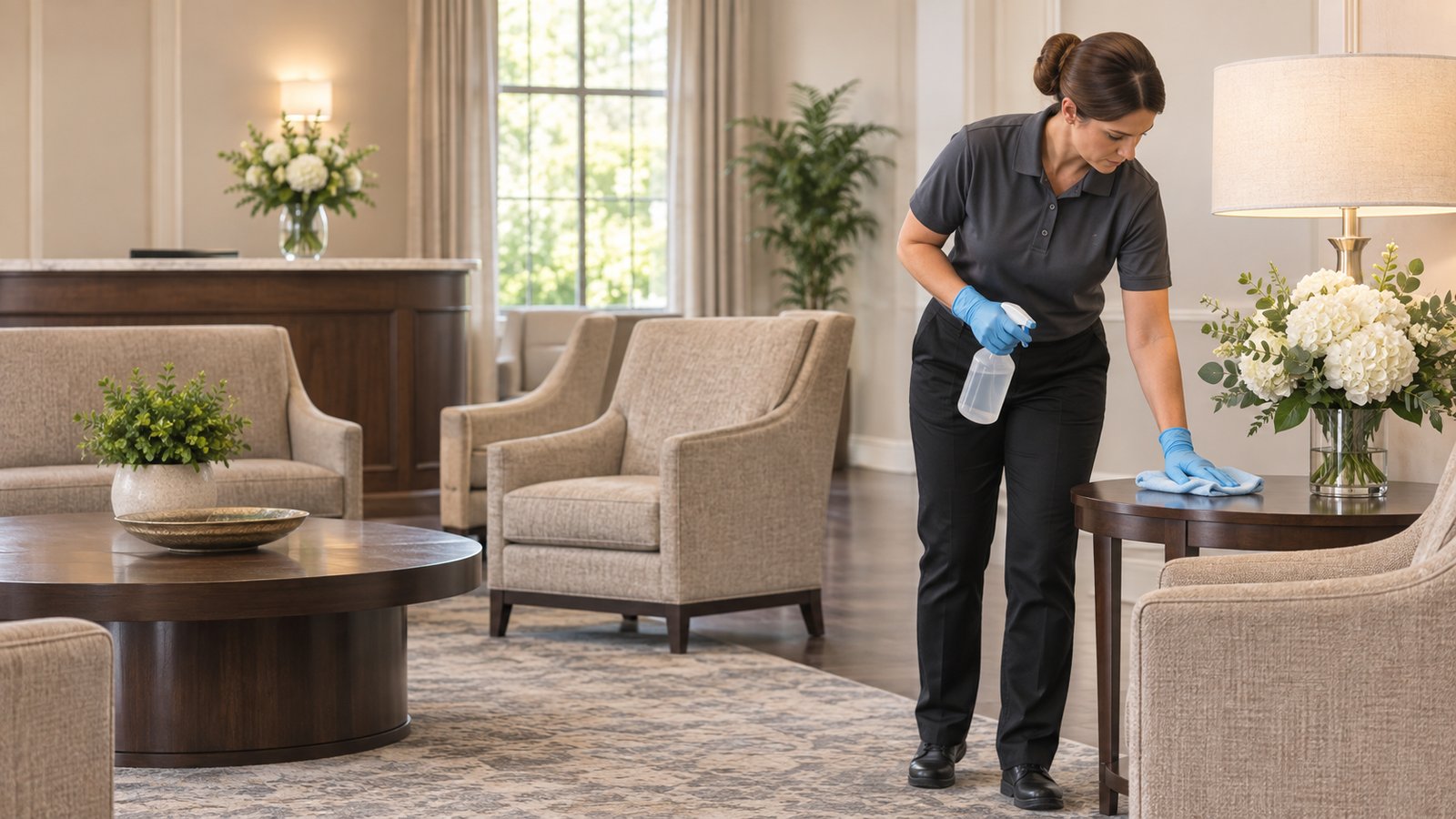
Funeral home cleaning services must preserve a calm, respectful environment while keeping public rooms, restrooms, offices, and staff areas ready for families and scheduled services. The best funeral parlor janitorial contractor understands discretion, quiet work, privacy, secure access, and the limits of routine commercial cleaning. A janitorial scope is not embalming-room sanitation, medical waste handling, or remediation of a biological incident unless separately qualified and specifically authorized. GreenPoint Maintenance Services serves commercial facilities across New York, New Jersey, Connecticut, Pennsylvania, and Florida. This guide helps funeral directors and property managers compare service providers for facilities in the Bronx, Queens, Manhattan, Brooklyn, Westchester, Nassau County, Newark, Jersey City, Stamford, and other tri-state communities.
Set a respectful scope for public and staff areas
Inventory the lobby, arrangement rooms, chapels, visitation rooms, family lounges, reception areas, restrooms, offices, kitchens, corridors, elevators, and exterior entrances. Identify rooms that may be occupied during service and those that are restricted or excluded. List floor types, upholstery, high-touch points, glass, fixtures, service hours, and the person who authorizes access. A funeral home near the Grand Concourse or Fordham Road may have narrow arrival windows and frequent family use; a Queens Boulevard or Nassau County facility may have larger parking and entry areas. GreenPoint schedules work to avoid disrupting a visitation and uses a low-profile uniform, quiet equipment, and a named site contact when the client requests it.
Build a variable schedule around the calendar. A routine day may require morning readiness, restroom checks, and closing service, while a memorial or funeral can add seating, entry, and post-event resets. The contract should say how much notice is needed for an added service, which tasks are included, and how a late schedule change is priced. Include an immediate path for spills or visible soil in a family room, but never ask janitorial staff to interrupt a private service without permission. GreenPoint can prepare a discrete checklist for each room and record completion without capturing guests or sensitive information. Call 347-332-9348 to schedule a walkthrough that includes the director or manager who controls service timing.
Protect privacy, dignity, keys, and family information
A cleaning team may work near guest books, service schedules, family documents, religious materials, photographs, payment records, and personal belongings. Define a no-touch list and explain how staff should report a found item without moving it. Set rules for locked offices, arrangement rooms, records storage, computers, and keys; limit access to only assigned workers and maintain a sign-in record where the facility requires one. Do not take photos that show a family, a deceased person, paperwork, or memorial details. GreenPoint’s JaniTrack can document a room check with a time, location, and exception note while omitting sensitive images. The funeral director remains the authority on room availability and any special request.
Use calm, neutral communication. Staff should know when to pause equipment, redirect a route, or wait outside a room if a service is underway. A simple protocol can designate a discreet signal from the attendant, an alternate route through the building, and a private contact method for reporting an issue. GreenPoint trains supervisors to handle requests without discussing family information in public spaces. The contract can prohibit staff from sharing names, service details, photographs, or schedules and require immediate reporting of a lost key or privacy concern. This is operational confidentiality rather than a claim that a janitorial provider is automatically subject to every health privacy rule. For broader vendor terms, see commercial cleaning contract key terms and how to choose a commercial cleaning company.
Draw a clear line around bloodborne and biohazard work
The written scope must distinguish ordinary cleaning from blood, body-fluid, sharps, embalming-room, and regulated medical-waste tasks. If employees can reasonably anticipate occupational exposure to blood or other potentially infectious materials, OSHA’s Bloodborne Pathogens Standard may apply to the employer’s program, including exposure-control planning, training, PPE, and follow-up requirements (OSHA Bloodborne Pathogens). A routine janitorial crew should not be told to handle a body-fluid incident outside its training, equipment, and contract authority. The facility needs an escalation contact and a qualified response path for work outside ordinary cleaning.
For New York funeral directors, the state’s sanitary-code resources identify provisions including duties of undertakers and rules for disinfection when required; specific obligations depend on the circumstance and the licensed facility’s work (New York State Funeral Director Law Access Guidelines). A commercial cleaning proposal should not interpret those requirements for the funeral director or replace required professional procedures. GreenPoint can handle agreed public-area and office tasks, document observed conditions, and notify the facility manager when a task falls outside the approved boundary. Confirm with the applicable state authority and legal or infection-prevention advisor if the scope includes regulated spaces. Call 347-332-9348 for a walkthrough to mark restricted rooms and escalation steps.
Choose appropriate products, tools, and cleaning methods
List approved cleaners and disinfectants by room and surface. A polished stone lobby, wood pew, brass fixture, upholstered chair, and restroom counter need different product compatibility and application. Follow product label directions, including dilution, surface approval, ventilation, and contact time when disinfection is required. OSHA’s Hazard Communication Standard requires labels and Safety Data Sheets for hazardous workplace chemicals and worker training (OSHA Hazard Communication). GreenPoint uses Green Seal certified products where they fit the task and the client approves them. Certification does not mean every product suits every surface, so keep an approved-product list and require advance approval for substitutions.
Use color-coded microfiber or separate tools for restrooms, public spaces, and staff areas to reduce cross-contamination. Specify when to damp-dust, vacuum, extract upholstery, or polish floors, and who may move furniture or memorial items. Do not use strong fragrance to mask odors or apply a disinfectant as a substitute for removing soil. CDC guidance explains that cleaning removes dirt and impurities, while disinfecting uses chemicals to kill germs on surfaces; the product must be used as directed (CDC When and How to Clean and Disinfect a Facility). GreenPoint can include a periodic detail schedule for carpets, hard floors, glass, and high ledges. See OSHA cleaning chemical safety and GHS/SDS guidance for procurement questions.
Set staffing, timing, and event-readiness standards
Staffing depends on room count, service frequency, opening hours, event calendar, floor finishes, restroom fixtures, and how much work can occur while the building is occupied. Build a task list for opening readiness, between-service checks, closing work, and periodic maintenance. Include an alternate worker for illness or schedule overlap, a supervisor inspection, and a contact for last-minute requests. The BLS reports about 2.43 million janitor and building-cleaner jobs in 2025, underscoring the value of a vendor’s training and continuity plan rather than assuming staffing will always be effortless (BLS Janitors and Building Cleaners). GreenPoint uses defined routes and relief planning to avoid a gap when the assigned cleaner is absent.
Specify service windows in relation to family arrivals and scheduled ceremonies, not just a generic evening shift. A Bronx chapel may need a morning reset and a rapid post-service turnaround; a Westchester location may need weekend coverage; a New Jersey facility may have several arrangement rooms active simultaneously. State how staff receive schedule updates and who can approve additional labor. GreenPoint offers fixed pricing with no hourly billing or hidden fees for the confirmed scope; added events or extra frequency are separately approved in writing. The proposal should state what happens if a scheduled room is occupied and how the missed task is rescheduled. A site walkthrough at 347-332-9348 can identify the right team size and service windows.
Verify service discreetly and correct issues quickly
Create a small, practical inspection scorecard: readiness of public rooms, restroom condition, floor safety, supply levels, odor concerns, missed tasks, response time, and corrective-action closure. Use a supervisor’s visual checks and client feedback, with ATP testing only if the facility selects an approved sampling plan and understands the limits of the result. GreenPoint’s JaniTrack records timestamps, GPS-tagged service evidence, inspection exceptions, and closure notes in a live dashboard. Photos should be limited to empty rooms or approved surfaces and should never expose family identities, service schedules, records, or personal effects. A system should make service easier to verify, not turn a funeral home into a public display.
Set a private escalation path for missed readiness, a damaged finish, a lost item, a privacy concern, or a suspected biohazard. Identify who is contacted first, when the cleaner stops work, and who may authorize a specialist. Review incidents monthly and look for recurring schedule conflicts or material failures. GreenPoint reports 98% client retention, but a buyer should use references and a sample checklist to test fit for a sensitive environment. The company is MBE/MWBE certified in specified New York programs; procurement should verify the exact certification and scope required by the buyer. Call 347-332-9348 or email info@greenpointms.com to review documentation and arrange a discreet walkthrough.
Frequently asked questions about funeral home cleaning
Q: Can a standard janitorial company clean a funeral home? A: It can provide defined public-area, office, restroom, and staff-area services when access and task limits are clear. Embalming, body-fluid, sharps, and regulated waste work require separate authorization and appropriate qualifications.
Q: How does a cleaner avoid disrupting a service? A: The facility should share the event calendar, restricted-room list, quiet hours, and a staff contact. GreenPoint uses discreet routes and pauses work when the director or attendant requests it.
Q: Should funeral home cleaning include disinfecting every surface? A: No. Clean and disinfect based on the surface, risk, facility protocol, and product label. Disinfection is not a replacement for soil removal or a reason to use an incompatible chemical.
Q: Can JaniTrack photos be used in a funeral home? A: Only with facility approval and privacy safeguards. GreenPoint can rely on timestamps, checklists, and exception notes instead of images in sensitive or occupied areas.
Q: How do I get a tri-state funeral home cleaning quote? A: Call GreenPoint Maintenance Services at 347-332-9348 to schedule a discreet walkthrough. The fixed-price scope will define rooms, schedule, access, products, exclusions, and escalation.
Call GreenPoint Maintenance Services at 347-332-9348 to schedule a discreet funeral home walkthrough. Get a fixed-price scope with clear biohazard boundaries and privacy-conscious JaniTrack records; GreenPoint reports 98% client retention.