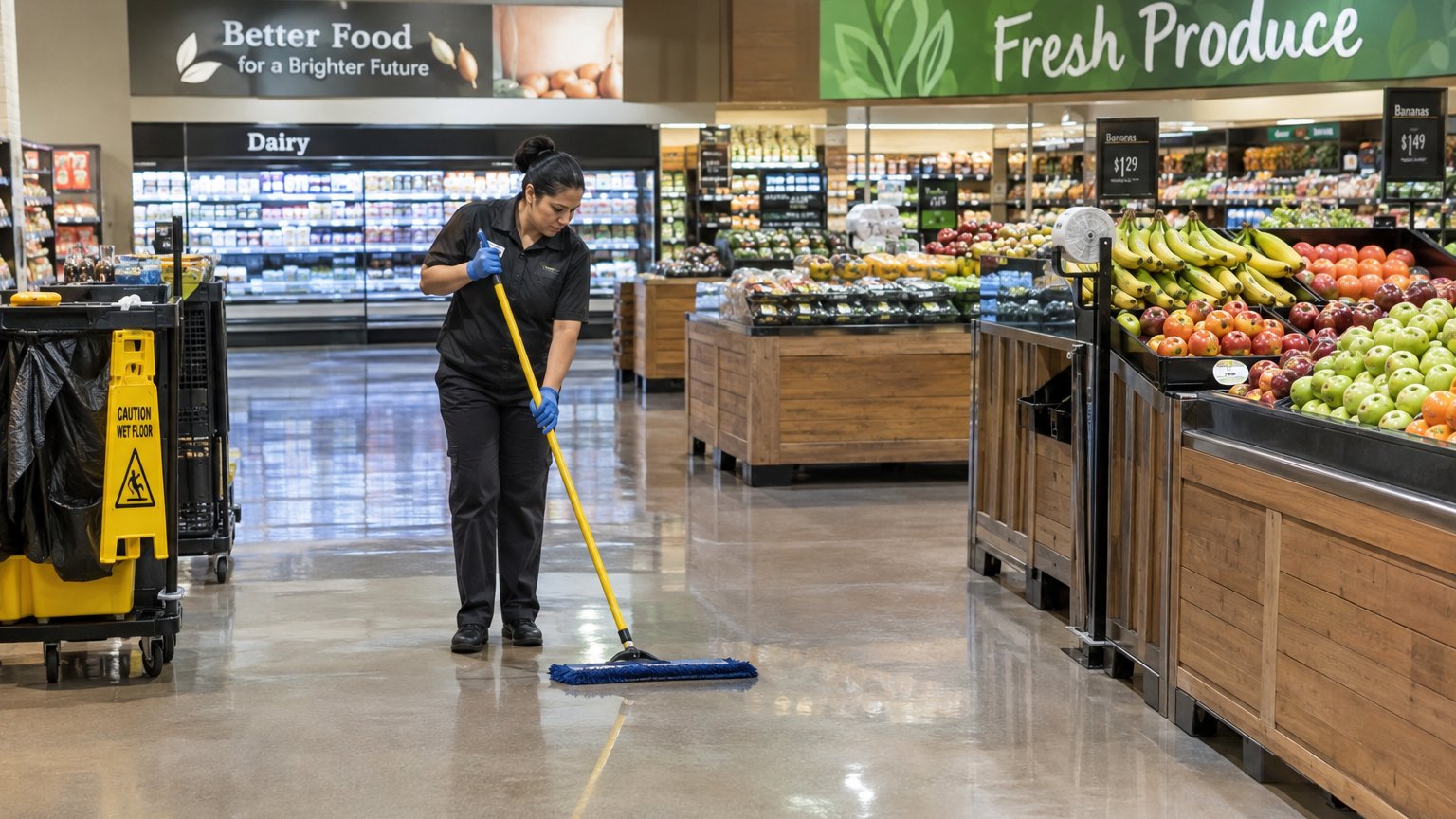
Grocery stores need cleaning that supports customer confidence without disrupting receiving, stocking, food preparation, or checkout. A supermarket is not one uniform room: produce misting, cart traffic, deli and bakery operations, loading docks, restrooms, and polished sales aisles create different soils and risks. This buyer guide explains how to scope grocery store cleaning services in New York, New Jersey, and Connecticut, what to verify in a proposal, and where the store’s own food-safety team must retain control. GreenPoint Maintenance Services works with commercial and institutional facilities on fixed-price plans, documented quality checks, and green cleaning options. To discuss a store walkthrough, call 347-332-9348.
What a Grocery Cleaning Contract Should Cover
A dependable scope separates customer-facing areas from back-of-house work. The front-of-house list usually includes entry glass, vestibules, cart and basket touchpoints, floor soil removal, checkout lanes, customer restrooms, waste stations, break areas, and periodic high dusting. Back-of-house tasks may include corridors, offices, staff restrooms, receiving zones, and non-food-contact surfaces around coolers. Each task needs an owner, frequency, method, and acceptance check; “clean the store” is not an auditable specification.
The retailer’s food-safety manager should define any work in food preparation, display, or product-contact areas. Cleaning contractors should not assume that a general janitorial scope authorizes them to wash slicers, food-contact counters, produce equipment, or utensils. GreenPoint documents the boundary between its janitorial tasks and store-controlled sanitation procedures before service starts. For a 30,000-square-foot neighborhood market, a useful scope map can divide public aisles, checkout, restrooms, receiving, and staff areas into separate zones rather than relying on one undifferentiated checklist.
Build Frequencies Around Store Traffic
Frequency should follow soil load, operating hours, and risk, not a generic “daily” label. A busy entrance may need inspection and spot response several times during a shift, while a low-traffic office may need nightly service. Restrooms require a stated cleaning cycle plus a replenishment and inspection plan; carts, baskets, handles, and checkout touchpoints should be addressed on a schedule approved by the retailer. For a 12-hour operation, management can test a day-porter pass every 2 to 3 hours against actual traffic and complaint data, then adjust.
Use a task matrix that identifies nightly, weekly, monthly, and seasonal work. Nightly work might include trash, restroom cleaning, floor dust mopping, and spot mopping; weekly work could include edges and accessible shelving bases; planned periodic work can include machine scrubbing, floor finish maintenance, and high dusting. GreenPoint can turn those frequencies into a site-specific fixed-price quote after a walkthrough. To compare service levels by room type, see cleaning frequency standards by facility type and restroom cleaning best practices for high-traffic buildings.
Food Safety Boundaries and Tri-State Rules
Retail food rules differ by jurisdiction, and the store operator remains responsible for its food-safety program. New York City’s Health Code Article 81 addresses cleanliness of food-contact and non-food-contact surfaces; New Jersey’s N.J.A.C. 8:24 sets sanitation requirements for retail food establishments; Connecticut adopted FDA Food Code provisions through state regulations. The FDA Food Code page explains that the model code is implemented through jurisdictional rules. A contractor should ask the store’s person in charge which local code, inspection authority, and written sanitation procedures apply.
Food-contact surfaces may have cleaning and sanitizing frequencies tied to use, contamination, product label directions, and the facility’s adopted code. The FDA Food Code text includes a four-hour cleaning interval for specified food-contact equipment used with time/temperature-control-for-safety food, subject to stated exceptions; that is not a rule for every sales-floor surface or a janitorial contractor’s blanket schedule. GreenPoint keeps its general cleaning scope separate from retailer-controlled food sanitation and does not substitute a cleaning log for the store’s required food-safety records. NYC operators can review Health Code Article 81, and NJ buyers can review N.J.A.C. 8:24 guidance.
Choose Chemicals, Tools, and Floor Methods Carefully
A product’s purpose matters as much as its brand. A general-purpose cleaner is not automatically a sanitizer, and a sanitizer is not automatically approved for every food-contact use. The contractor should provide current safety data sheets, dilution controls, labeled containers, training records, and a clear storage plan. GreenPoint uses Green Seal-certified products where appropriate to the site specification and checks whether the retailer requires additional approved-product lists. EPA’s Safer Choice label guidance describes a voluntary program that evaluates product ingredients and performance; it does not replace a food-contact label or local code requirement.
Floor choices should reflect surface type, drainage, slip risk, and how quickly the aisle can reopen. Dry soil removal before wet cleaning reduces slurry and helps prevent tracked residue. Schedule machine work outside peak shopping periods, use signs and barriers, clean one lane at a time, and confirm the floor is ready before restoring customer access. For produce mist zones and entrances, specify frequent response to water and organic debris. GreenPoint can document the procedure and designate escalation points for broken tiles, loose mats, leaks, and other defects that a cleaning crew should report rather than conceal.
Plan the Building by Neighborhood and Access
Tri-state logistics affect staffing and start times. Manhattan stores near Union Square, Harlem, or the Port Authority corridor may have limited loading windows and elevator access. In the Bronx, a Hunts Point-area market may need a distinct receiving and dock plan; Brooklyn operators near Atlantic Terminal or Downtown Brooklyn may need tighter pedestrian route controls. Queens locations in Jackson Heights, Flushing, and Long Island City often combine heavy foot traffic with curbside deliveries. A walkthrough should record entrances, freight access, water points, floor transitions, alarm procedures, and the exact route from storage to each service zone.
New Jersey accounts in Newark, Jersey City, and Hoboken can have different parking, access, and municipal inspection arrangements from Connecticut stores in Stamford, Bridgeport, or Norwalk. That variation is why GreenPoint asks who controls access, who signs off on a task, and how to handle special events or delayed deliveries before quoting. A site-specific plan can include a map for each shift and a short contact tree. Call GreenPoint at 347-332-9348 to schedule a walkthrough or request a written quote for a New York, New Jersey, or Connecticut location.
Price and Contract Terms Buyers Can Compare
A credible quote shows the assumptions behind the monthly price: cleanable area, number of operating days, service windows, restroom count, floor materials, day-porter coverage, consumables, periodic projects, and exclusions. Ask bidders to state whether they bill a fixed recurring amount or by labor hours, how changes in scope are approved, and whether supplies or emergency response are extra. Avoid comparing a low nightly rate with a broader multi-shift program. GreenPoint provides fixed pricing rather than hourly billing, with scope and service frequency written into the proposal.
For labor context, the U.S. Bureau of Labor Statistics reported 2,199,900 U.S. janitors and cleaners, excluding maids and housekeeping cleaners, in May 2024, with a national annual mean wage of $37,460. Those national figures are not a local bid rate and do not include every employer cost; they do illustrate why a proposal built on implausibly few labor hours deserves scrutiny. See the BLS May 2024 occupational data. For an apples-to-apples comparison of service costs and assumptions, review commercial cleaning cost per square foot and request a walkthrough from GreenPoint at 347-332-9348.
Verify Work With Evidence, Not Just a Visual Pass
A useful quality program combines routine visual inspection with corrective actions and a record of what was checked. ISSA’s Clean Standard for institutional and commercial facilities uses both objective and subjective elements, including ATP-based ranges and audits; the standard is a measurement framework, not a promise that one score proves a space is risk-free. See ISSA’s Clean Standard overview. GreenPoint’s JaniTrack workflow can attach time-stamped, GPS-tagged photos to assigned tasks and provide a live dashboard so a store manager can review completion, exceptions, and follow-up without chasing paper logs.
ATP testing is useful only when the sampling location, timing, baseline, and corrective-action rule are defined. It measures organic residue as an operational indicator and is not a pathogen test or a substitute for regulatory inspection. A manager might select a rotating sample of 10 to 20 high-touch points per location, review trends monthly, and investigate repeated misses instead of treating one result as a pass/fail certificate. GreenPoint also reports hazards and access problems, protects store information, and escalates open issues. Ask for a sample dashboard and a site walkthrough by calling 347-332-9348.
Before launch, run a short service pilot that includes one ordinary weekday and one high-volume period such as Friday evening or a holiday weekend. The store manager should review the task matrix, access route, product approvals, and escalation contacts with the supervisor. Record baseline issues such as entry salt, restroom restocking, and debris at checkout rather than judging the vendor from a single opening-day impression. Agree on who can approve an added task, who receives an urgent spill call, and how the next shift sees an incomplete item. GreenPoint can use the pilot to refine the fixed scope and dashboard so the monthly service review is based on the same locations and acceptance criteria each time.
FAQ: Grocery Store Cleaning Services
Q: Does a janitorial contractor clean deli equipment or food-contact surfaces? A: Only when the contract, training, product labels, and retailer’s food-safety procedures expressly authorize that work. The store’s person in charge retains control of food safety and applicable local requirements.
Q: How often should a grocery store floor be cleaned? A: The schedule depends on traffic, spills, floor type, and store hours. Define routine dry soil removal, scheduled wet cleaning, and an immediate spill-response process, then adjust from inspection and incident records.
Q: Can a single vendor serve stores in New York, New Jersey, and Connecticut? A: Yes, if the vendor can staff each market and adapt documentation to the applicable local rules and each store’s access and food-safety procedures. GreenPoint serves tri-state commercial facilities and scopes each site separately.
Q: What should a grocery cleaning quote include? A: A room-by-room task schedule, frequency, service windows, staffing assumptions, products, quality checks, exclusions, periodic work, and a clear recurring price. Schedule a GreenPoint walkthrough by calling 347-332-9348.
Q: What does ATP testing prove? A: ATP is a rapid indicator of organic residue on a sampled surface. It does not identify a specific pathogen or certify food safety, so results need a documented sampling plan and corrective action.
Request a grocery-store walkthrough and fixed-price quote from GreenPoint Maintenance Services at 347-332-9348 or info@greenpointms.com. GreenPoint’s JaniTrack verification provides time-stamped, GPS-tagged task photos and a live dashboard, while the retailer retains control of food-contact sanitation and required food-safety records.