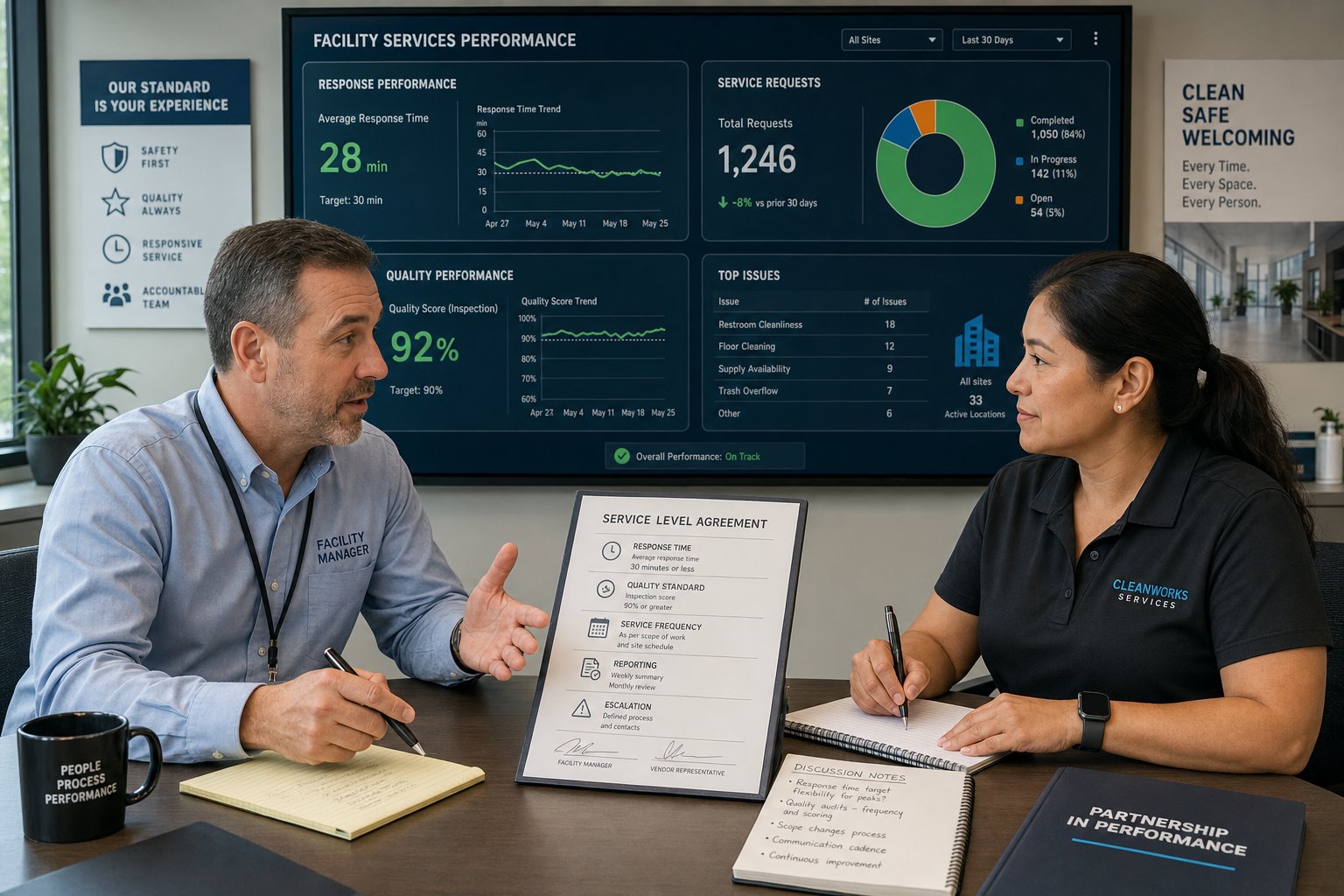
A janitorial service-level agreement should answer a practical question: what happens when the building needs something different from the normal route? Without defined response times, quality metrics, and escalation rules, a contract can look complete while leaving restroom spills, missed rooms, supply outages, and event requests open to interpretation. GreenPoint Maintenance Services helps facility managers set SLAs that are measurable without turning every interaction into a dispute. The framework below applies to offices near Wall Street and Grand Central, Bronx schools, Brooklyn residential-commercial buildings, Queens industrial sites, Westchester and Long Island campuses, New Jersey and Connecticut corporate parks, Philadelphia properties, and Florida facilities.
Define Service Classes Before Setting the Clock
Start by separating requests into service classes. Critical safety issues include bodily fluids, sewage backup, sharps, hazardous spills, blocked egress, and active slip hazards. Urgent appearance or supply issues include an empty public restroom, overflowing waste, or a high-visibility spill. Routine requests include a missed detail, extra meeting-room setup, or a noncritical touch-up. Project requests include carpet extraction, floor restoration, post-construction cleaning, and event support. Each class should have a response target and a completion target.
A single 'respond within two hours' promise is not operationally useful. A safety issue may require immediate phone escalation while a project receives a next-business-day estimate. GreenPoint records the request time, location, priority, owner, and resolution. This makes the SLA understandable for both the client and the service team. Link the [quality assurance commercial cleaning program](/blog/quality-assurance-commercial-cleaning-program/) and [cleaning audit checklist](/blog/cleaning-audit-checklist-facility-managers/) guides in the contract administration playbook.
Use Response and Resolution Metrics Together
Response time is when the vendor acknowledges and starts action; resolution time is when the condition is corrected or safely controlled. Track both. For example, a restroom spill might require acknowledgement within 10 minutes, arrival within 20 minutes, and a documented safe release within 30 minutes, subject to access and building conditions. A supply request may have a same-shift response, while a damaged dispenser requires a temporary workaround and a repair ticket. GreenPoint proposes targets after reviewing traffic, staffing, elevators, security, and geography.
Do not penalize a vendor for a building-controlled delay without documenting it. Midtown elevator holds, school lockdowns, badge issues, storm closures, and loading-dock restrictions affect completion. StockPoint can provide timestamped, GPS-tagged photos and a live dashboard for the work record, while a client-side exception field explains access constraints. Call 844-814-0810 to design response tiers that match the actual site rather than copying an SLA from another property.
Set Quality Metrics That Users Can See
A quality SLA should combine inspection score, complaint recurrence, critical failures, supply availability, and documentation. A 100-point audit might weight visible cleanliness at 30%, touchpoint and fixture hygiene at 25%, supplies at 20%, condition and safety at 15%, and reporting at 10%. Set a normal pass threshold, such as 90, and define automatic corrective action below 85. Healthcare, childcare, and high-public-use environments may set a higher threshold or stricter critical-failure rules.
Use ISSA appearance levels to describe acceptable presentation, but avoid treating an appearance score as a microbiological guarantee. For selected programs, ATP testing can provide an objective trend; it should supplement, not replace, trained inspection and appropriate disinfection. GreenPoint's [digital cleaning verification systems](/blog/digital-cleaning-verification-systems/) workflow connects scores to evidence, corrective actions, and supervisor review so the metric leads to better service instead of only a monthly report.
Write Escalation and Credit Terms Carefully
Every SLA needs an escalation ladder: cleaner, site supervisor, account manager, operations leader, and client contact. State which issues require a phone call, which can use a ticket, and what information must be included. A missed room should trigger correction and trend review; a repeated missed room may trigger a route redesign. Credits should be proportionate and tied to verified service failures, not used as a substitute for correction. Exclude events outside reasonable control when the vendor documents the response and communication.
GreenPoint favors corrective action before invoice debates. A client should know who answers 844-814-0810 after hours, when the account manager reviews an exception, and how a recurring issue changes the work plan. The [commercial cleaning contract key terms](/blog/commercial-cleaning-contract-key-terms/) guide covers notice, change control, insurance, termination, and renewal language that should align with the SLA. Keep the contract readable enough for a building manager to use at 7 a.m.
Account for Local Traffic and Facility Rules
Response targets must reflect the building's location and use. A Financial District lobby has commuter peaks and security procedures; a Bronx or Queens school has arrival, dismissal, and visitor controls; Downtown Brooklyn and Long Island City properties may share loading zones; Westchester and Long Island sites can involve multiple buildings; New Jersey, Connecticut, and Philadelphia campuses may have long travel routes; Florida sites may need storm-related response planning. The same target can be easy in one facility and unrealistic in another.
Include holiday calendars, event schedules, weather triggers, transit restrictions, and access windows in the SLA appendix. For NYC DOE-related work, list school protocols and approved-vendor requirements. GreenPoint is MBE/MWBE certified through NYS, NYC, and NYC DOE programs and SAM.gov registered, so documentation can be aligned with public-sector procurement. GreenPoint Maintenance Services can map the response route during a walkthrough before committing to a target.
Negotiate Staffing, Relief, and Coverage Terms
An SLA is only credible when staffing supports it. Ask for the normal shift roster, supervisor coverage, relief plan, call-out process, and event or storm surge capacity. Define what happens when a cleaner is absent, a machine fails, or a building opens an additional floor. GreenPoint bases staffing on cleanable square footage, traffic, fixtures, floor types, and service windows. The [janitorial employee turnover impact](/blog/janitorial-employee-turnover-impact/) guide explains why training and continuity should be part of the performance discussion.
Include service continuity in the scorecard: percentage of scheduled tasks completed, percentage of requests resolved within target, inspection pass rate, and repeat complaint rate. A 98% client-retention operating model depends on resolving patterns, not swapping staff without explanation. GreenPoint uses supervisor checks and StockPoint evidence to identify whether a failure came from route design, training, access, supplies, or an unusual event. Call 844-814-0810 to review coverage before signing.
Make Pricing and Change Control Match the SLA
The SLA should state what is included in the fixed price, what counts as extra work, and how a change is approved. List consumables, periodic floor care, emergency response, event cleaning, porter coverage, and holiday schedules. No one benefits when a vendor wins with a low base number and then invoices every realistic response as an extra. GreenPoint proposals state assumptions, use fixed pricing, and avoid hidden fees or hourly-billing ambiguity.
Set a review cadence—often monthly for the first 90 days and quarterly afterward—with a short scorecard and action list. If occupancy rises by 25%, a new tenant adds 10,000 square feet, or a school changes its calendar, use the change process rather than pretending the original route still fits. Email info@greenpointms.com or call 844-814-0810 to schedule a walkthrough and receive a scope that connects SLA targets to cost.
Pilot the SLA and Baseline the First Thirty Days
Do not set a penalty schedule before measuring the starting condition. During the first 30 days, GreenPoint and the client can record request volume, access delays, response times, resolution times, inspection scores, supply outages, and repeat complaints. That baseline shows whether the proposed target is achievable and where the route needs redesign. A Midtown tower, school, warehouse, and Florida facility will produce different patterns.
After the baseline, agree on the target, exception codes, escalation contacts, and monthly review format. Keep the first scorecard short enough to read in ten minutes. GreenPoint can walk the property and build the baseline plan at 844-814-0810, then use StockPoint evidence and supervisor notes to explain trends instead of arguing over isolated timestamps.
Write the Monthly SLA Review in Plain Language
A monthly review should fit on one page: service requests received, percentage acknowledged on time, percentage resolved on time, inspection pass rate, critical failures, repeat complaints, open repairs, and agreed actions. Use plain exception codes such as access, weather, client change, supply, staffing, or equipment. GreenPoint can explain an outlier without hiding it, and the client can see whether the same issue is recurring.
End each meeting with an owner and date for every action. If the same restroom, floor, or access point appears three months in a row, change the work plan rather than merely noting it again. GreenPoint Maintenance Services can provide this review structure through 844-814-0810 and align it to StockPoint reports, supervisor inspections, and the client's own ticketing system.
Janitorial SLA FAQ
Q: What is a reasonable cleaning response time? A: It depends on priority, occupancy, access, and risk. Define separate targets for critical hazards, urgent appearance or supply issues, routine requests, and projects. GreenPoint can calibrate response classes after a site review.
Q: Should SLAs include inspection scores? A: Yes, if the score has clear criteria, a sampling method, a pass threshold, and corrective action. Use visual standards and evidence rather than an unexplained monthly percentage.
Q: What is the difference between response and resolution? A: Response is acknowledgement and start of action; resolution is correction or safe control. Track both, and document client-controlled delays such as access restrictions.
Q: Can StockPoint be required in a cleaning contract? A: It can be specified as a verification method when the scope, privacy expectations, photo rules, and reporting cadence are clear. GreenPoint uses timestamped GPS-tagged photos, dashboards, and selected ATP testing appropriately.
Q: How do I negotiate a janitorial SLA? A: Call GreenPoint at 844-814-0810 or email info@greenpointms.com. GreenPoint Maintenance Services can walk the property, map priorities, and propose fixed-price terms that are practical for NY, NJ, CT, PA, or FL.
Q: How often should an SLA be revisited? A: Review it monthly during mobilization and at least quarterly after the account stabilizes. Revisit it sooner after occupancy, access, floor area, operating hours, seasonal conditions, or regulatory requirements change. GreenPoint documents the reason for each adjustment and shares it with the client team promptly today.
Set a janitorial SLA you can manage. Call GreenPoint Maintenance Services at 844-814-0810 for a walkthrough covering response tiers, quality metrics, escalation, staffing, and StockPoint proof. GreenPoint offers fixed pricing, Green Seal certified products, and a 98% client-retention record.