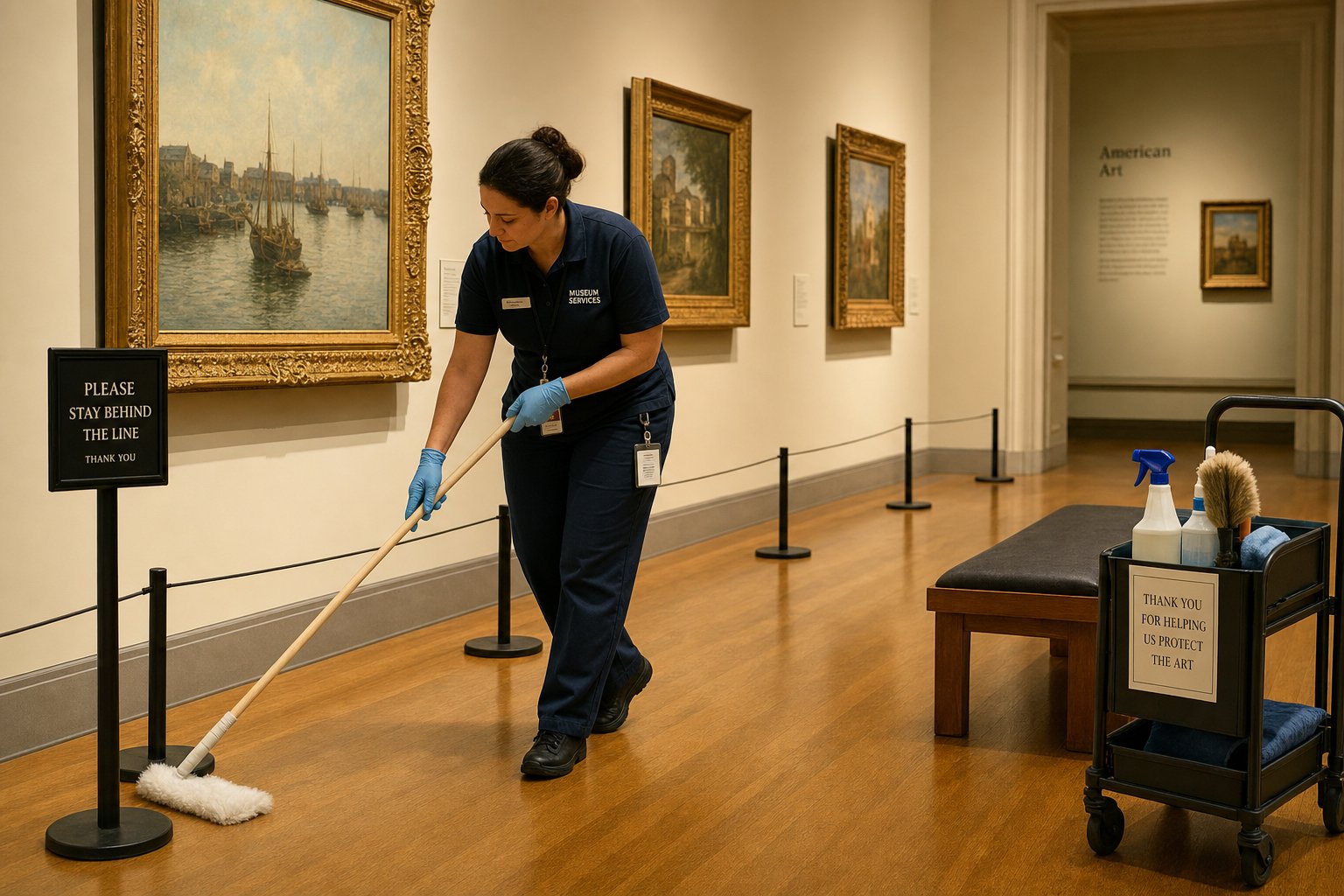
Museum and gallery cleaning in New York is a preservation-support service, not a generic office wipe-down. A Chelsea gallery, a museum near Central Park, and an exhibition space in DUMBO may each contain fragile finishes, high-value works, public queues, and strict climate or security controls. GreenPoint Maintenance Services builds a zone-based plan around exhibit boundaries, visitor paths, dust sources, and approved products. StockPoint provides timestamped evidence for appropriate areas, while Green Seal certified products and fixed pricing help the facility manage both stewardship and budget. Call GreenPoint at 844-814-0810 for a walkthrough and quote.
Why exhibit environments need a different cleaning plan
The visible floor is only one part of a museum’s cleaning risk. Dust can settle on ledges and plinths, humidity can interact with soil, and an incorrect product can damage a finish that looks durable. The janitorial scope should distinguish public floors, staff offices, galleries, storage, loading areas, restrooms, and exhibit surfaces that require conservator approval. GreenPoint begins with a do-not-touch map and a chain of communication so cleaners never treat artwork, frames, mounts, or cases as ordinary office furniture.
ISSA appearance standards can help define public-facing cleanliness, but preservation decisions belong to the museum’s conservation and facilities teams. GreenPoint can target a Level 3 appearance in the visitor path while using low-disturbance methods around exhibits and a different schedule in back-of-house spaces. A walkthrough at 844-814-0810 creates a written scope with access rules, product approvals, and escalation points.
NYC neighborhood traffic and visitor logistics
A museum near Fifth Avenue may manage tour buses, school groups, and security queues; a gallery in Chelsea may coordinate openings and art handlers; a DUMBO space may face freight deliveries and uneven cobblestone approaches. GreenPoint records public hours, member events, loading windows, elevator restrictions, and the quietest route for vacuuming or floor work. That local planning is important because a disruption during opening hours can be as damaging to visitor experience as a visible spill.
Seasonal conditions change the entrance load. Salt, rain, pollen, and construction dust travel through doors and collect at mats, thresholds, stair rails, and elevator cabs. GreenPoint can add pre-opening checks, mat care, and event resets when the facility needs them. Call 844-814-0810 before an opening, exhibition change, or holiday schedule so the service plan accounts for visitors instead of treating the event as an exception after the fact.
Dust control without disturbing art
The safest sequence is to control dust at the floor and building surfaces without creating air movement that carries particles onto exhibits. GreenPoint uses approved vacuum equipment, microfiber, high-to-low work, and protected routes, while keeping a clear boundary around frames, plinths, cases, pedestals, and mounts. Cleaning staff do not dust artwork or conservation-sensitive surfaces unless the museum has separately authorized and trained that task. A floor plan should identify the minimum distance and equipment restrictions around each exhibit zone.
High dusting of vents, ledges, and architectural details can reduce settled soil over time, but it must be scheduled with the museum’s climate and conservation teams. The [HEPA filtration in commercial cleaning](/blog/hepa-filtration-commercial-cleaning/) guide explains why filtration is one control among several. GreenPoint can log a protected case, blocked aisle, or visible construction dust in StockPoint and call 844-814-0810 when a corrective cleaning needs approval.
Visitor safety and accessible paths
Visitor safety begins with dry, unobstructed paths. Lobby floors, ramps, stair rails, elevator thresholds, restroom approaches, and gallery transitions should be checked for debris, moisture, and trip hazards before opening and after weather events. GreenPoint uses warning signs and controlled work zones, then removes them when the surface is safe. The [ADA compliance and facility maintenance](/blog/ada-compliance-facility-maintenance/) article is a useful reference for keeping routes, door clearances, and accessible restrooms usable during service.
A museum may also need a quiet, low-odor process for visitors with sensory sensitivities. GreenPoint schedules stronger chemical or floor-care work outside public hours, follows product contact time, and confirms ventilation before reopening. The team can document an entrance inspection, restroom check, or event reset without photographing visitors. A manager can request a high-traffic schedule at 844-814-0810.
Galleries, cases, floors, and restrooms by zone
A useful checklist breaks the building into gallery floors, walls and architectural ledges, cases and plinth exteriors, public seating, reception, restrooms, staff areas, loading, and waste. The cleaner’s permission level should be explicit for each zone. GreenPoint can vacuum and damp-mop approved floors, clean exterior glass when allowed, empty waste, and service touchpoints while leaving mounts, labels, artwork, and case interiors to museum-approved specialists.
Restrooms and reception still need ordinary commercial discipline: fixtures, partitions, mirrors, dispensers, high-touch handles, floors, and odor control. Kitchens and staff rooms require color-coded tools so a restroom cloth does not enter a food area. For frequency benchmarks, see [cleaning frequency standards by facility type](/blog/cleaning-frequency-standards-by-facility-type/). GreenPoint can set a nightly route plus pre-opening inspection and can be reached at 844-814-0810 for an event-based adjustment.
StockPoint and preservation-friendly documentation
Museum managers need evidence that supports accountability without exposing collection information. StockPoint can record task completion, timestamps, GPS-tagged photos of approved floors or service areas, notes, and exceptions. GreenPoint configures photo restrictions so artwork, labels, collection numbers, security screens, and visitors are not captured. A dashboard entry can confirm that a gallery path was serviced while the museum retains control over exhibit documentation.
Documentation should also reveal patterns. If entrance photos show recurring salt, the route can add a mat check; if ATP trends rise on a public counter, the team can review frequency; if a construction area remains inaccessible, the supervisor can log the exception and notify facilities. ATP testing is a cleaning trend tool, not a conservation or sterility certification. GreenPoint’s 98% client retention reflects this habit of reviewing evidence and correcting the program.
Products, conservation boundaries, and chemical safety
GreenPoint uses Green Seal certified products where appropriate for the approved surface, but no product is applied near art simply because it is labeled green. The museum or gallery should approve products for floors, glass, metals, and painted architectural surfaces and identify materials that require a conservator. OSHA’s [Hazard Communication Standard](https://www.osha.gov/hazcom) supports SDS access, labeling, worker training, and communication about chemical hazards. The scope records storage locations and spill contacts.
Cleaners should never mix products, move an unknown container, or handle a leak without the facility’s incident protocol. GreenPoint trains staff on dilution, contact time, gloves, eye protection, wet-floor controls, and ventilation. Fixed pricing, no hourly billing, and no hidden fees make a recurring program easier to forecast; periodic exhibition-change cleaning can be listed separately. Call 844-814-0810 to review a product and access matrix.
Budgeting museum and gallery cleaning
The cost of museum cleaning depends on public hours, gallery count, security constraints, floor types, restroom volume, events, loading, exhibit boundaries, and the amount of work that must happen quietly after close. A 15,000-square-foot gallery with one restroom block is not equivalent to a 15,000-square-foot museum with school groups, multiple galleries, café traffic, and back-of-house storage. The [commercial cleaning cost per square foot](/blog/commercial-cleaning-cost-per-square-foot/) guide provides broad context, but a walkthrough is essential.
GreenPoint separates nightly cleaning, pre-opening inspections, event resets, floor restoration, glass, and approved periodic work in the proposal. That lets a museum manager compare a fixed monthly program with add-ons without hidden labor. GreenPoint Maintenance Services serves Manhattan, Brooklyn, Queens, the Bronx, Staten Island, Westchester, Long Island, New Jersey, Connecticut, Pennsylvania, and Florida and can standardize documentation across a portfolio. Request a quote at 844-814-0810.
Selecting an exhibit-safe cleaning company
Ask a vendor for its exhibit boundary process, training, insurance, background screening, absence coverage, product list, photo policy, and incident escalation. Ask who approves a new surface or a spill near a case. A generic janitorial company may be able to clean a restroom but still lack the discipline required around high-value work. GreenPoint provides named supervision, do-not-touch maps, StockPoint visibility, and a written route for each zone.
Use [questions to ask a commercial cleaning company](/blog/questions-to-ask-commercial-cleaning-company/) as a starting point, then invite the final vendors to walk the facility with operations and conservation representatives. GreenPoint is MBE/MWBE certified in New York programs and registered in SAM.gov. Call 844-814-0810 for a walkthrough that respects both the visitor experience and the collection.
Frequently asked questions
Can a cleaning company dust artwork? Only if the museum has explicitly approved the task and provided the required training. GreenPoint normally cleans approved environmental surfaces and leaves artwork, mounts, case interiors, and labels to museum-authorized staff or specialists.
How often should a museum be cleaned? Public paths, restrooms, and reception usually need daily service, with pre-opening checks and event resets scaled to visitor volume. Gallery, storage, and high-dusting frequencies should follow the facility and conservation plan.
How does StockPoint protect museum privacy? GreenPoint limits photos to approved floors and service areas and excludes artwork, labels, collection numbers, visitors, security screens, and confidential documents. The dashboard still records timestamps, tasks, notes, and exceptions.
Does GreenPoint use green cleaning products? GreenPoint uses Green Seal certified products where suitable, but product approval remains surface-specific. Staff follow labels, SDS information, contact time, ventilation, and protective-equipment requirements.
How do I request a gallery cleaning quote? Call 844-814-0810 or email info@greenpointms.com. GreenPoint will schedule a walkthrough with facilities and conservation contacts and return a fixed-price scope with access and exhibit boundaries.
Keep the galleries visitor-ready and the collection protected. Call GreenPoint Maintenance Services at 844-814-0810 for an exhibit-aware walkthrough and fixed-price quote backed by StockPoint verification and 98% client retention.