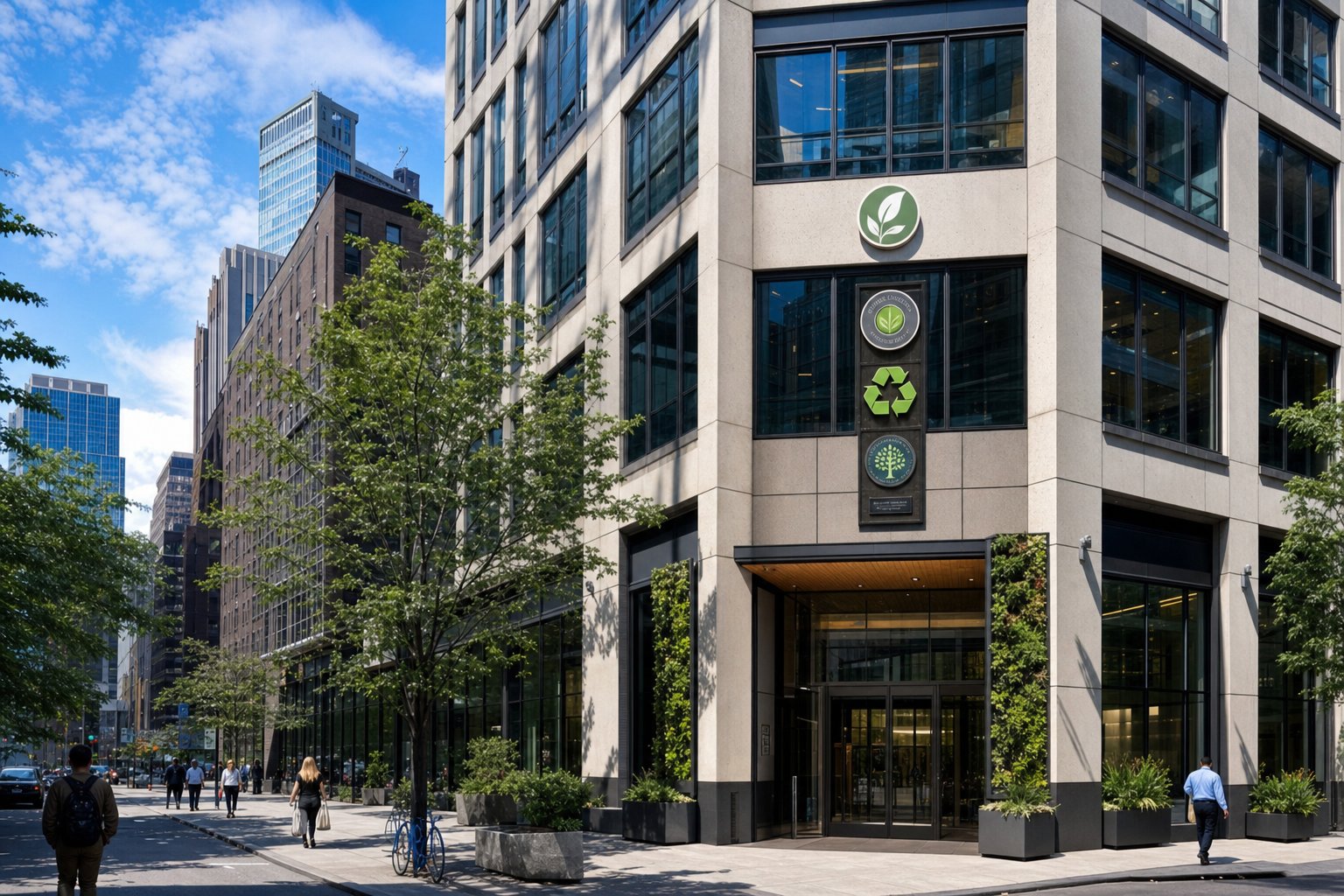
NYC Local Law 26 and Local Law 97 are often discussed as “building compliance” issues, but they also change what sophisticated owners and property managers expect from their cleaning vendor. The result is a higher bar for documentation, green product selection, waste handling practices, and coordination with building engineers—especially in Class A offices, mixed-use towers, and buildings pursuing sustainability targets. GreenPoint Maintenance Services supports compliance-minded cleaning programs across Manhattan, Brooklyn, Queens, the Bronx, Staten Island, Westchester, and the broader tri-state region with proof-driven QA (including StockPoint verification). For a compliance-focused walkthrough, call 844-814-0810.
What Local Law 26 and 97 are (in plain language)
Local Law 97 is NYC’s building emissions law that sets greenhouse-gas limits for many large buildings and introduces financial penalties when buildings exceed their limits. Local Law 26 is connected to sustainability requirements and is often discussed alongside operational practices that reduce environmental impact. While neither law is “about janitorial” specifically, both push owners toward better tracking, greener operations, and vendor accountability—because building operations are under more scrutiny than they used to be.
For facility teams, the takeaway is simple: your cleaning program needs to support sustainability and documentation goals without increasing complaints or degrading appearance. GreenPoint approaches this as an engineering problem—define the outcome, select the right tools and chemistry, verify the work, and document it. If you want help translating building policy into a cleaning scope, call 844-814-0810.
Where cleaning practices intersect with building emissions goals
Cleaning influences energy and emissions indirectly through indoor air quality, HVAC load, and product choices. Excessive fragrance or harsh chemical use can trigger occupant complaints that lead to ventilation changes; poorly controlled dust increases filter loading; and certain floor care methods can require longer equipment run times or repeated passes. A modern janitorial program should aim for effective results with fewer reworks and fewer chemical oversprays—because rework is wasted labor and wasted energy.
GreenPoint standardizes microfiber systems, HEPA filtration where appropriate, and documented dilution controls to reduce waste. If your building has IAQ goals, start with a baseline of where dust accumulates, how frequently filters load, and whether cleaning methods are causing airborne issues. A helpful primer is [Indoor Air Quality and Commercial Cleaning](/blog/indoor-air-quality-commercial-cleaning/).
Documentation: what owners should require from a “compliance-ready” cleaning vendor
When compliance becomes board-level, “trust us” is not enough. Owners increasingly expect proof of service: completed tasks, exception handling, and inspection evidence. GreenPoint provides StockPoint verification with timestamped, GPS-tagged photos, ATP testing options for high-risk touchpoints, and a live dashboard that supports audits and stakeholder reporting. That audit-ready posture is one reason GreenPoint has a 98% client retention rate.
If you want to understand how digital verification systems are changing vendor accountability, see [Digital Cleaning Verification Systems](/blog/digital-cleaning-verification-systems/). The goal is not paperwork for paperwork’s sake—it’s operational control: what was cleaned, what wasn’t, and what corrective action was taken.
Green cleaning: what “certified products” actually protects you from
A common misconception is that “green products” are automatically weaker. In practice, the biggest risk is using the wrong product for the surface or the soil load, which leads to residue, odors, or rework. GreenPoint uses Green Seal certified products where they are a fit and maintains clear SOPs so staff do not improvise with incompatible chemicals. This reduces both performance risk and occupant sensitivity complaints—important in dense NYC offices.
If your building has sustainability reporting, you may also need to track product categories, dilution rates, and usage patterns. GreenPoint can support that process so your cleaning program becomes a contributor to compliance goals rather than an uncontrolled variable.
Waste and recycling practices that matter in NYC buildings
Even if your hauling contract is separate from janitorial, your cleaning team touches waste systems every day. That includes correct liner use, keeping recycling streams clean (to avoid contamination), and managing cardboard, pantry waste, and e-waste collection points. In mixed-use buildings, BOH waste routes need to avoid cross-contaminating public elevators and lobbies, especially during peak occupant traffic.
GreenPoint builds waste and recycling steps into the scope by zone, and documents exceptions through StockPoint so you can demonstrate operational controls when tenants complain about odors, pests, or overflowing compactor rooms.
Safety and labor risk: OSHA-aligned chemical controls are non-negotiable
Compliance conversations often focus on sustainability, but safety is equally important. Your vendor should run a chemical safety program that aligns with OSHA expectations: GHS labeling, up-to-date SDS access, training on dilution and mixing, and appropriate PPE. These controls reduce incident risk and support your broader compliance posture.
Use [Fire Code Cleaning Chemical Storage](/blog/fire-code-cleaning-chemical-storage/) and [OSHA Cleaning Chemical Safety (GHS/SDS)](/blog/osha-cleaning-chemical-safety-ghs-sds/) as checklists when you evaluate vendors for NYC sites. The goal is consistent safe behavior at 2:00 AM, not a binder that looks good at 2:00 PM.
How to bake Local Law readiness into your RFP and KPIs
To make Local Law readiness real, write it into your procurement documents. Your RFP should require: green product approach (including Green Seal where appropriate), verification reporting (photos, inspections, corrective actions), training documentation, and a plan for coordination with building engineering (off-hours access, HVAC zones, event schedules). You should also require a defined quality assurance cadence, not “we inspect sometimes.”
If you need a starting point for building a tighter scope and better vendor accountability, review [How to Write an RFP for Commercial Cleaning](/blog/how-to-write-rfp-commercial-cleaning/) and [Quality Assurance Commercial Cleaning Program](/blog/quality-assurance-commercial-cleaning-program/). If any of those links contain underscores when you paste them into a doc, replace underscores with hyphens so they work in most CMS paths.
Why MBE/MWBE certification can matter in NYC procurement
Many NYC organizations—including public and quasi-public entities—have supplier diversity requirements or goals, and cleaning is often a meaningful spend category. GreenPoint Maintenance Services Corp is MBE/MWBE certified (NYS, NYC, and NYC DOE) and SAM.gov registered, which can simplify documentation when your procurement policy requires diverse vendor participation.
Supplier diversity should not come at the cost of operational rigor. GreenPoint pairs certification with proof-driven execution: fixed pricing, documented SOPs, and StockPoint verification so performance stays consistent after award. For a procurement-ready proposal package, call 844-814-0810.
If Local Law 26/97 and sustainability reporting are raising the bar for your building operations, your cleaning vendor should help—not add risk. Schedule a compliance-focused walkthrough with GreenPoint Maintenance Services and get a fixed-price scope with StockPoint verification and audit-ready reporting. Call 844-814-0810 or email info@greenpointms.com. Proof point: 98% client retention backed by documented inspections and corrective actions.