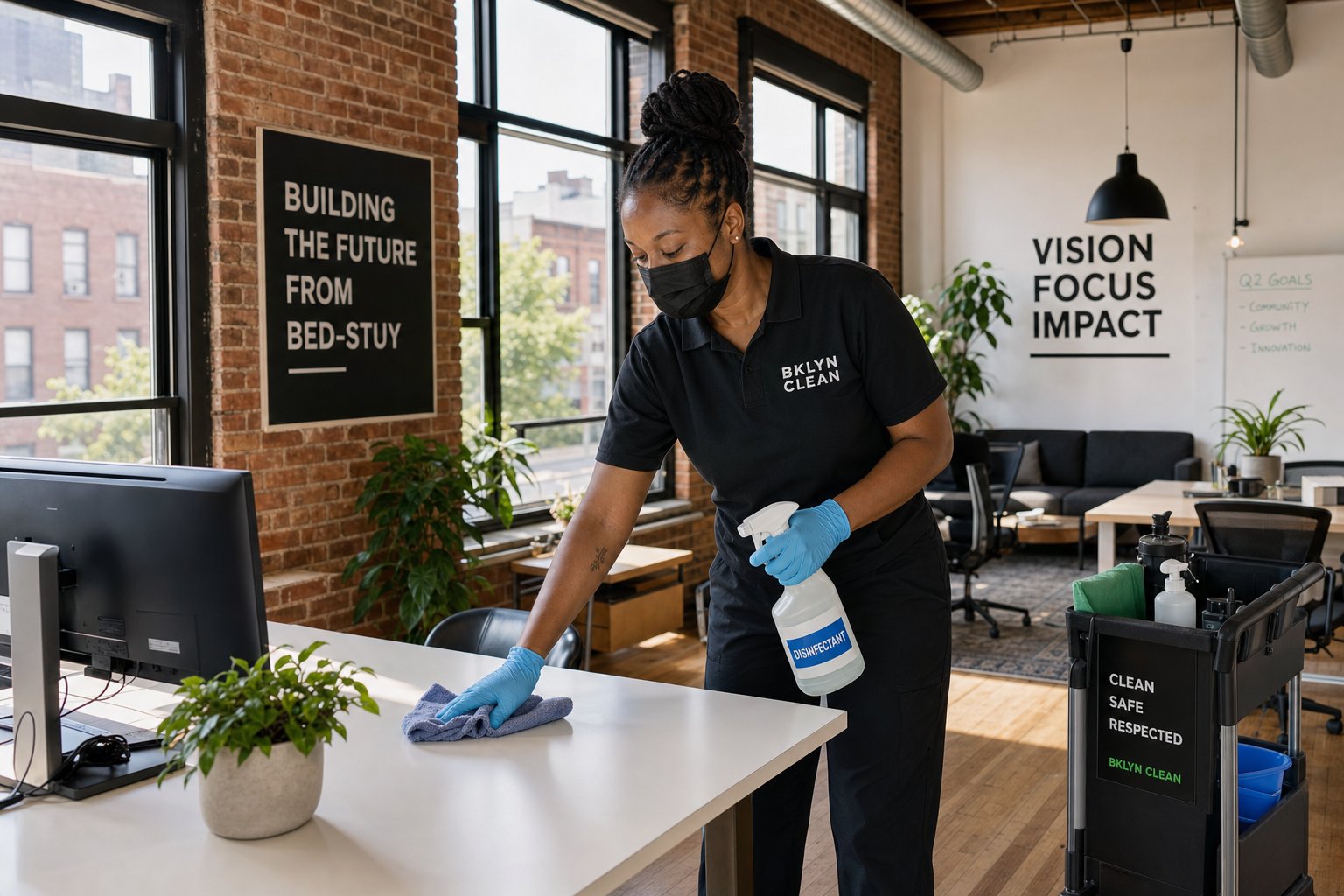
Choosing office cleaning in bed-stuy is an operating decision, not a race to the lowest nightly number. Bed-Stuy offices often combine older building layouts with modern occupancy, so a practical buyer's guide must price stairs, kitchens, shared touchpoints, and access—not just floor area. GreenPoint Maintenance Services helps facility managers turn square footage, occupancy, access windows, floor types, and compliance expectations into a written scope with measurable proof. This guide focuses on Bedford-Stuyvesant and nearby Brooklyn properties, including brownstone offices, nonprofit workspaces, professional suites, schools, and storefront businesses. A site visit should test the actual route through stairs, narrow corridors, shared kitchens, and tenant doors. Ask how replacement staff will learn the building without disturbing work. Clear staging and access instructions protect both productivity and cleaning consistency when a property has little back-of-house space. For a site-specific walkthrough, call 844-814-0810; GreenPoint can document the building before a quote is issued. Use this practical framework with our [office cleaning in Midtown Manhattan](/blog/office-cleaning-midtown-manhattan-tenants/) and [cleaning staffing ratios by square footage](/blog/cleaning-staffing-ratios-square-footage/) to compare vendors consistently.
Map the property before asking for a price
Start with a room and use inventory. Record gross and cleanable square footage, number of restrooms and fixtures, floor materials, stairs, elevators, kitchens, conference rooms, storage, loading areas, and any tenant-only zones. In Bedford-Stuyvesant, a brownstone offices, nonprofit workspaces, professional suites, schools, and storefront businesses building may have multiple entrances and different closing times. A vendor that prices only from a satellite image can miss a service elevator, a basement, or a second shift.
GreenPoint's walkthrough separates routine tasks from periodic work. Daily service may include trash, vacuuming, damp mopping, restroom cleaning, and high-touch disinfection; weekly or monthly work may include carpet extraction, machine scrubbing, high dusting, and interior glass. Ask the bidder to show labor assumptions and frequencies on the proposal. Call 844-814-0810 if you want a room-by-room scope before collecting bids.
Build a local access and traffic plan
Local conditions affect labor even when two buildings have the same area. Near Fulton Street, Nostrand Avenue, Malcolm X Boulevard, Herbert Von King Park, and the Atlantic Avenue edge, cleaners may need to work around commuter arrivals, deliveries, events, and limited curb access. the A, C, G, J, M, and Z lines, plus busy bus corridors on Fulton Street and Nostrand Avenue can create concentrated entry traffic that wears mats and moves grit into lobbies. The scope should identify key handrails, door pulls, elevator buttons, reception counters, and restroom touchpoints for each traffic period.
GreenPoint schedules crews around approved access windows and records exceptions instead of quietly skipping rooms. Confirm who provides keys, badges, alarm instructions, elevator reservations, and chemical storage. A written plan should also cover snow, rain, or construction dust at entries. GreenPoint can propose a daytime porter, split shift, or after-hours model when occupancy makes one nightly pass insufficient.
Choose a frequency that matches risk
Five visits per week is a common office baseline, but it is not a universal answer. A low-occupancy suite may need three detailed visits plus targeted touchups, while a public-facing or medical-adjacent facility may require daily service and daytime restroom checks. In Bedford-Stuyvesant, evaluate occupancy, visitor volume, food service, children or patients, delivery activity, and the time between the last cleaning and the first arrival.
ISSA appearance levels help translate vague language such as clean and professional into expectations. Use a lower appearance level for storage or back-of-house zones and a higher level for reception, public corridors, and client-facing rooms. GreenPoint writes the frequency beside each zone, then validates performance through supervisor inspections and StockPoint records. This approach avoids paying for a high level everywhere while protecting the areas people notice first.
Specify floors, restrooms, and high-touch surfaces
Floor care is often where a cheap proposal becomes an expensive contract change. Name carpet, VCT, ceramic tile, concrete, wood, or resilient flooring and identify finish history. Routine vacuuming and damp mopping do not replace scheduled extraction, scrub-and-recoat, or strip-and-refinish work. At entrances near the A, C, G, J, M, and Z lines, plus busy bus corridors on Fulton Street and Nostrand Avenue, mat vacuuming and edge work can matter more than a generic promise to mop nightly.
Restrooms need fixture cleaning, partition wiping, mirror and stainless-steel care, floor disinfection, odor control, and consumable checks. List dispensers, paper, soap, liners, and who buys them. High-touch surfaces should include switches, handles, railings, elevator controls, shared appliances, and payment or reception surfaces. GreenPoint uses color-coded microfiber systems and Green Seal certified products where the facility specification permits.
Set safety and compliance requirements
Ask for current Safety Data Sheets, chemical labels, employee training records, personal protective equipment procedures, and a plan for blood or bodily-fluid incidents. OSHA's Hazard Communication Standard requires workers to understand chemical hazards; the written scope should say how products are diluted, stored, transported, and disposed of. Facilities serving children, patients, or the public should add escalation steps and restricted-area controls.
New York buyers may also need vendor insurance, workers' compensation documentation, licensing or registration information, and public-agency purchasing requirements. GreenPoint Maintenance Services is MBE/MWBE certified through New York programs, NYC, and NYC DOE, and is SAM.gov registered. Those credentials do not replace performance proof, but they can simplify supplier qualification for public and institutional buyers. Request certificates and references before award rather than after the first missed service.
Compare fixed pricing with the true scope
Routine commercial cleaning commonly benchmarks around $0.08-$0.18 per square foot per visit for recurring office cleaning, depending on density, frequency, and detail level. A credible quote explains what drives the range: cleanable area, number of visits, crew hours, supplies, supervision, access, floor types, and periodic projects. A price that omits consumables, equipment, relief coverage, or quality control is not a lower total cost; it is an incomplete comparison. GreenPoint uses fixed pricing, no hourly billing, and no hidden fees so the operating assumption is visible.
Ask each bidder to price the same base term, frequencies, and exclusions. Separate recurring work from one-time construction cleanup, window washing, carpet extraction, and floor restoration. Also ask for the change-order formula if occupancy or square footage changes. For a total-cost review, compare our [cleaning staffing ratios by square footage](/blog/cleaning-staffing-ratios-square-footage/) with labor continuity, supply availability, response time, and the cost of rework. Call 844-814-0810 for a fixed-price walkthrough and proposal.
Require measurable quality evidence
Visual inspections are useful but incomplete. A proposal should define inspection frequency, sample rooms, pass criteria, correction deadlines, and the person who receives reports. GreenPoint uses StockPoint to attach timestamped, GPS-tagged photos, task completion records, exception notes, and live dashboard visibility to the service record. ATP testing can add an objective hygiene signal in selected high-touch or healthcare-adjacent areas; it should supplement, not replace, a complete cleaning process.
Use a simple scorecard: completion rate, inspection pass rate, repeat exceptions, response time, supply outages, and customer-request closure. Review results monthly for the first 90 days and quarterly once performance stabilizes. GreenPoint's 98% client retention reflects an operating loop of scope, service, inspection, correction, and documented follow-up. Ask to see a sample redacted report rather than accepting a verbal promise of quality.
Make the contract resilient for local operations
Include a primary contact, backup contact, emergency response window, holiday schedule, severe-weather plan, and escalation ladder. Tight stairs, occupied small offices, shared kitchens, tracked-in grit, and limited loading or storage space can affect a route, so the contract should state how missed access, building closure, or unsafe conditions are documented and recovered. Specify whether the vendor supplies equipment, where it is stored, and how replacement staff are trained before entering the site.
GreenPoint Maintenance Services supports facilities across New York, New Jersey, Connecticut, Pennsylvania, and Florida, with a consistent documentation model that can be adapted to local buildings. GreenPoint does not rely on a single checklist for every property. The final scope should include an initial deep-clean plan, a 30-day review, periodic floor and high-dust schedules, and a clear path to reach a manager at 844-814-0810.
Use a buyer scorecard before selecting the vendor
Score proposals across six categories: scope completeness at 25%, quality verification at 20%, staffing and supervision at 15%, safety and insurance at 15%, price transparency at 15%, and local references or relevant experience at 10%. Require written evidence for every score. A local company is not automatically the right company; the best fit can explain how it will clean your exact rooms, at your exact times, with proof.
GreenPoint recommends a short paid or no-cost pilot when the property is complex. Define the pilot area, target appearance level, service frequency, inspection method, and success threshold before work starts. Invite the facilities lead to review the dashboard and walk the result. If you need help writing the bid package, call 844-814-0810; GreenPoint can provide a scope that remains fair to competing vendors while making accountability concrete.
Frequently Asked Questions
How much does commercial cleaning cost in this area? Recurring service often falls near $0.08-$0.18 per square foot per visit for recurring office cleaning, depending on density, frequency, and detail level, but the actual fixed price depends on cleanable area, visits, floor types, restrooms, access, and compliance requirements. GreenPoint provides a site-specific quote after a walkthrough; call 844-814-0810.
How often should a local office be cleaned? Five visits per week is a common baseline, but three, five, or seven service days can be appropriate. GreenPoint ties frequency to occupancy, traffic, food service, public access, and the appearance level required for each zone.
What proof should a cleaning company provide? Request task completion records, inspection scores, exception closure, timestamped photos, and a named escalation contact. GreenPoint uses StockPoint GPS-tagged photos, live dashboard reporting, and selected ATP testing to make quality review more objective.
Should supplies be included in the contract? Yes, either include them with brands, par levels, and replenishment responsibilities or state that the client supplies them. GreenPoint can include restroom consumables and Green Seal certified products in a fixed-price scope when requested.
Why choose GreenPoint for this location? GreenPoint Maintenance Services combines fixed pricing, no hourly billing, MBE/MWBE certification, Green Seal products, StockPoint verification, and 98% client retention. Schedule a walkthrough at 844-814-0810 or email info@greenpointms.com.
Schedule a Bedford-Stuyvesant facility walkthrough with GreenPoint Maintenance Services at 844-814-0810 or info@greenpointms.com. Get a room-level scope, fixed pricing with no hourly billing or hidden fees, StockPoint proof, and a program backed by GreenPoint's 98% client retention.