Most office cleaning programs are designed around dust control, restrooms, and high-touch disinfection—but incidents happen: a first-aid response in the lobby, blood in a restroom, or a discarded needle in a stairwell near a transit hub. When there is potential exposure to blood or other potentially infectious materials (OPIM), OSHA’s Bloodborne Pathogens Standard (29 CFR 1910.1030) becomes relevant. GreenPoint Maintenance Services helps offices across NYC and the tri-state build cleaning programs that are practical and audit-ready: documented procedures, correct PPE, and proof of completion through StockPoint verification (timestamped GPS-tagged photos and optional ATP testing). For a compliance walkthrough and fixed-price proposal, call 844-814-0810.
What OSHA 1910.1030 covers in an office environment
OSHA 1910.1030 is often associated with hospitals, but offices can face bloodborne pathogen risks whenever employees might encounter blood or OPIM during job duties. In an office, that risk most commonly appears in restrooms, wellness rooms, security/concierge stations, loading docks, and stairwells—especially in high-traffic buildings near Penn Station, Port Authority, Fulton Center, or major bus routes where public access is common. The standard focuses on protecting workers through an Exposure Control Plan, training, recordkeeping, and specific work practice controls. GreenPoint aligns janitorial protocols with these requirements so you can show a defensible plan if questions arise.
The Exposure Control Plan: the document most offices are missing
A compliant program typically includes a written Exposure Control Plan (ECP) that identifies which job classifications have potential exposure, what tasks create risk, and what controls are used. For most offices, the goal is not to classify every cleaner as routinely exposed—it is to define incident response steps that prevent exposure, including escalation rules (when to stop work and call a specialized biohazard vendor). GreenPoint helps facility managers design realistic ECP language tied to actual site conditions: public restroom access rules, sharps container placement (if applicable), and who is authorized to handle regulated waste. When you schedule a walkthrough, we will map incident scenarios and build a scope that fits your building. Call 844-814-0810.
PPE and engineering controls: what should be on the cart
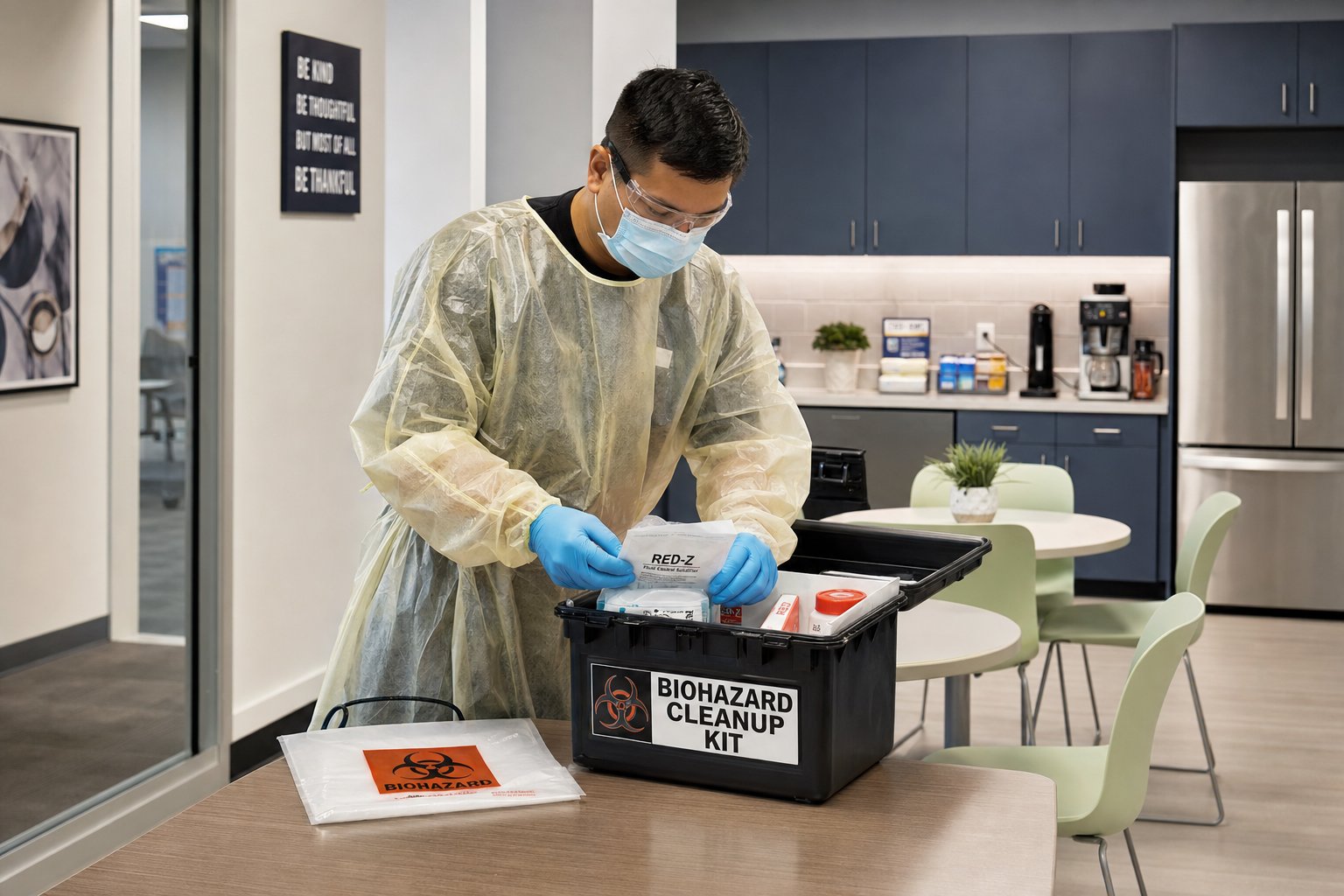
For blood or OPIM incidents, the right PPE and supplies matter. That typically includes disposable gloves, eye/face protection when splash is possible, and absorbent materials plus EPA-registered disinfectants used per label contact time. Engineering controls might include sharps containers in specific locations (common in some mixed-use properties and public-facing lobbies). Work practice controls include do-not-touch rules for loose sharps and a clear escalation process. GreenPoint standardizes carts and training so responses are consistent across Manhattan, Brooklyn, Queens, the Bronx, Staten Island, Westchester, and northern New Jersey sites.
Training and documentation: what to keep on file
OSHA expects training for employees with occupational exposure, and facility managers should also ensure vendors have documented training aligned to their scope. In practice, you should be able to produce: training records, incident response procedures, and chemical safety documentation (SDS). Hazard Communication overlaps here—your vendor should have proper GHS labels and SDS access for disinfectants and cleaners used in incident response (see: [OSHA cleaning chemical safety (GHS/SDS)](/blog/osha-cleaning-chemical-safety-ghs-sds/)). GreenPoint is proof-driven: we pair documentation with StockPoint verification so you can show both a program and evidence of execution.
What counts as regulated waste in offices (and how it should be handled)
Office buildings are not hospitals, but certain incident materials can still be treated as regulated waste depending on saturation and local disposal requirements. The key is consistency: define what the cleaning team is authorized to bag and remove, and what must be handled by a specialized service. A common failure mode is ad-hoc decision-making at 10:30 PM with no supervisor present. GreenPoint builds a site-specific decision tree so your team knows when to stop, isolate the area, and escalate. If you manage a property with public access near subway entrances (e.g., 34 St–Penn Station, Times Sq–42 St, Atlantic Ave–Barclays, or Jamaica Center), this planning is especially important.
Designing an incident response protocol that does not disrupt the whole building
Good incident response is about containment, speed, and documentation. The protocol should specify: who is notified (building management, security), what barriers/signage are used, which products are approved, and how the event is logged. GreenPoint can document response with StockPoint photos (appropriate to privacy rules) and task completion notes. For buildings with multiple tenants and late-night cleaning windows, we plan routes and response kits so a single restroom incident does not derail the entire nightly program.
How GreenPoint builds measurable quality into high-risk cleaning
Bloodborne pathogen compliance is not only about the emergency moment; it is about preventing repeat issues through better routine cleaning and verification. GreenPoint uses quality assurance checklists and can add ATP testing for targeted validation when clients want objective data on high-touch areas after an event (background: [what ATP testing measures](/blog/what-is-atp-bioluminescence-testing-cleaning/)). We also recommend aligning your overall QA approach with a documented program so your compliance posture is not dependent on one supervisor’s memory (see: [quality assurance commercial cleaning program](/blog/quality-assurance-commercial-cleaning-program/)).
Common office mistakes that create OSHA exposure risk
The most common mistakes we see in tri-state office environments are: unclear authority (who handles sharps), missing incident kits, using the wrong disinfectant or ignoring contact times, and lack of documentation when something happens. Another frequent issue is assuming that a standard janitorial scope includes biohazard cleanup—it often should not. GreenPoint Maintenance Services will clarify boundaries in writing, build a response plan, and keep verification records so you can demonstrate due diligence. If you want to reduce risk without overpaying, start with a walkthrough. Call 844-814-0810.
How to procure compliant office cleaning (questions to ask bidders)
When you send out an RFP or compare bids, ask vendors to describe their OSHA 1910.1030 approach: Do they have an Exposure Control Plan? What training do they provide and how is it documented? What PPE and incident kits are staged on-site? What is the escalation path for sharps or significant blood events? Do they have a digital verification system like StockPoint? GreenPoint answers these questions with specific documentation and fixed pricing, so you can make a defensible decision. For procurement tips and scope clarity, see: [how to choose a commercial cleaning company](/blog/how-to-choose-commercial-cleaning-company/).
Want an OSHA-ready office cleaning program with proof of execution? GreenPoint Maintenance Services will do a site walkthrough, define an incident response protocol aligned to OSHA 1910.1030, and deliver fixed pricing with StockPoint verification. Call 844-814-0810 or email info@greenpointms.com to schedule—our 98% client retention is built on documented results.