Preschools and early childhood centers operate under intense scrutiny: parent expectations, licensing requirements, and the reality that young children touch everything. A successful preschool cleaning program is not just “disinfect more.” It’s a documented system: correct products, correct contact times, clear toy-cleaning cadence, and proof that the work happened. GreenPoint Maintenance Services designs evidence-based cleaning and disinfection programs for early childhood facilities across NY/NJ/CT with fixed pricing and StockPoint verification. To schedule a walkthrough, call 844-814-0810.
What inspectors and parents notice first: restrooms, odors, and sticky touch points
In early childhood settings, the highest-risk and highest-visibility areas overlap: restrooms, diapering stations, food prep zones, and the surfaces children constantly touch (tables, chair backs, door pulls, railings). The most common parent complaint is odor—usually from restroom soil, diaper pails, or residue buildup from incorrect products. GreenPoint builds a plan around soil removal first, then disinfection where appropriate, with documented checklists so the essentials are never skipped. If you need a cleaning plan that can stand up to inspection and parent tours, call 844-814-0810.
Tri-state compliance basics: NY OCFS/DOHMH, NJ/CT licensing expectations
Licensing requirements vary by state and municipality, but the operational expectation is consistent: facilities must maintain sanitary conditions, control cross-contamination risk, and document procedures. GreenPoint recommends that early childhood centers maintain written cleaning and disinfection procedures, product lists with SDS, and a documented frequency schedule (daily/weekly/monthly) that covers classrooms, restrooms, and kitchens. If you want a reference point for daycare-style programs, see [Daycare cleaning health department inspection](/blog/daycare-cleaning-health-department-inspection/).
Toy and learning-material disinfection cadence (what to clean daily vs weekly)
The practical approach is to segment toys by “mouth contact” and “shared hand contact.” Items used by infants/toddlers or likely to be mouthed should be cleaned and disinfected daily (or immediately when soiled). Hard plastic toys with shared use should be cleaned at least weekly, and more often during illness spikes; soft toys and dress-up fabrics should be laundered on a scheduled cadence. GreenPoint helps centers set up labeled bins (clean/dirty/quarantine), color-coded microfiber systems, and a documented rotation so nothing relies on memory. For microfiber system guidance, see [Color coded microfiber systems guide](/blog/color-coded-microfiber-systems-guide/).
Classroom cleaning scope: tables, floors, nap mats, and high-touch surfaces
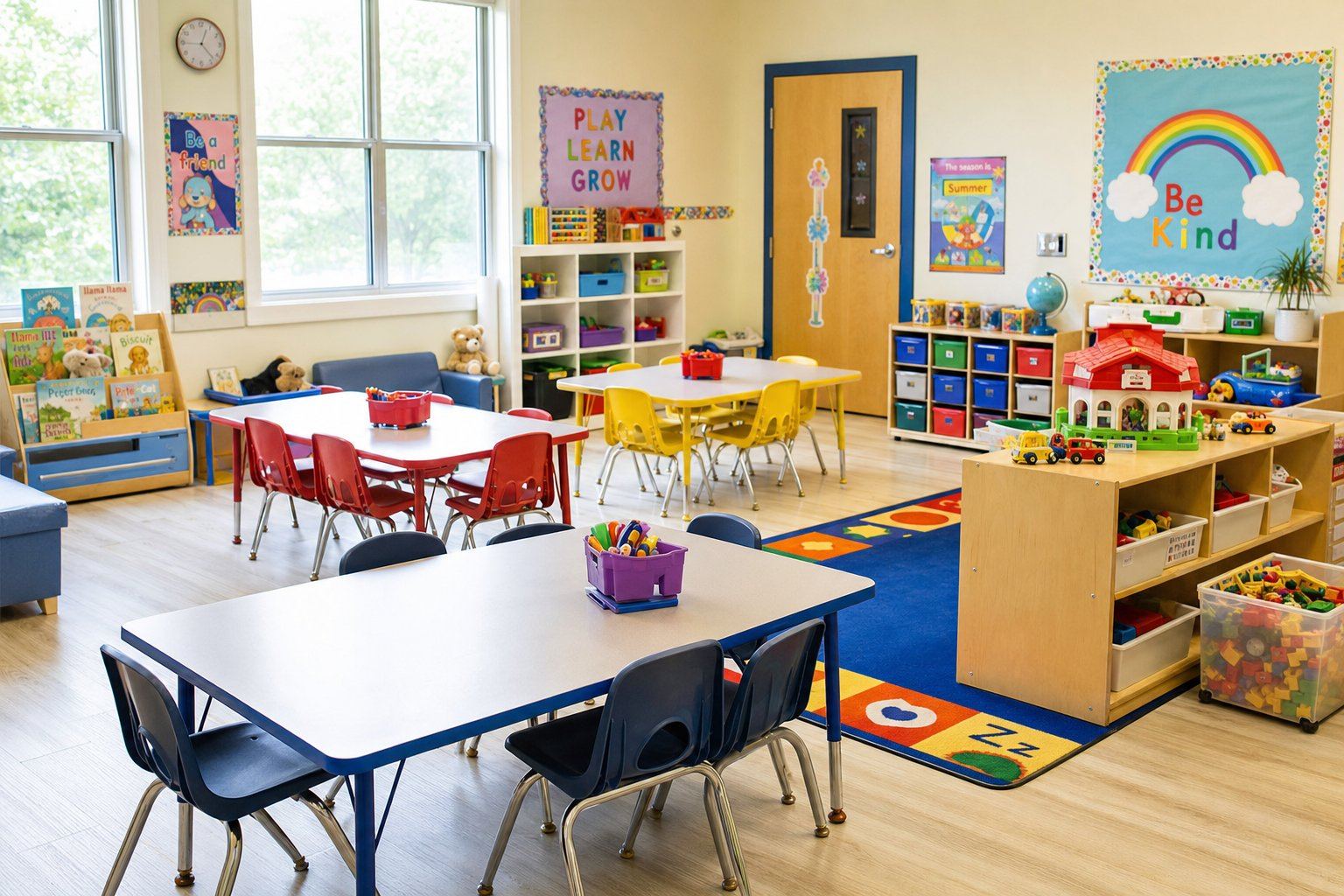
A preschool classroom scope should explicitly include: table and chair cleaning, high-touch disinfection of door pulls and shared surfaces, floor vacuum/mop based on traffic, and spot cleaning of walls at child height. Nap mats should be handled according to manufacturer instructions, with attention to storage and separation to reduce cross-contact. GreenPoint trains crews to avoid aerosol sprays around children’s materials and to use proper dwell times for EPA-registered disinfectants where required. To align expectations for cleaning vs disinfection, see [Scheduled disinfection vs routine cleaning difference](/blog/scheduled-disinfection-vs-cleaning-difference/).
Restrooms and diapering areas: protocols that reduce outbreaks
Restrooms and diapering stations are outbreak accelerators if cleaning is inconsistent. GreenPoint’s approach focuses on thorough soil removal, targeted disinfection of touch points, and strict separation of tools and cloths used in restrooms from those used in classrooms. We recommend documented daily checks for soap/towel dispensers, toilet/sink surfaces, floors, and waste containment. High-traffic restroom methods are detailed in [Restroom cleaning best practices high traffic](/blog/restroom-cleaning-best-practices-high-traffic/). If you need a walkthrough and a documented restroom plan, call 844-814-0810.
Food areas and kitchens: what cleaning vendors should (and shouldn’t) do
Early childhood centers often have snack prep or kitchen areas. Your cleaning plan should clearly define responsibilities: cleaning vendors can typically service floors, trash, and non-food-contact surfaces; food-contact sanitizing may require staff actions depending on local rules and center policies. GreenPoint will help you define boundaries so there’s no compliance gap, and we can document product lists and SDS for approval.
Proof-based cleaning for schools: StockPoint verification and objective QA
The best way to improve outcomes is to verify them. GreenPoint uses StockPoint verification (timestamped, GPS-tagged photos and service logs) and supervisor inspections to create an audit trail. For facilities that want measurable validation, ATP testing can be used on high-touch points to confirm cleaning effectiveness; see [What is ATP bioluminescence testing in cleaning](/blog/what-is-atp-bioluminescence-testing-cleaning/). This documentation is also useful if you need to demonstrate diligence to leadership or respond to parent concerns.
Pricing benchmarks for preschool cleaning (what drives cost)
Preschool cleaning cost is driven by restroom count, classroom count, and the intensity of high-touch and disinfection tasks. As a benchmark, many early childhood facilities budget roughly ($0.15–$0.30) per square foot per month for routine cleaning, with scheduled disinfection or enhanced verification adding cost. A 7,500 sq ft center with multiple restrooms and daily service may land around ($1,800–$3,200)/month depending on scope and consumables management. GreenPoint Maintenance Services quotes fixed pricing so you can plan budgets and avoid surprise add-ons. Call 844-814-0810 for a walkthrough-based quote.
FAQ: Preschool and early childhood cleaning
Q: How often should toys be disinfected? A: Items likely to be mouthed should be cleaned/disinfected daily (and immediately when soiled); shared hard toys are often rotated weekly, with increased cadence during illness spikes. Q: Do we need nightly cleaning? A: Many centers do best with nightly cleaning for restrooms, floors, trash, and touch points—especially during cold/flu season. Q: Can you provide proof for compliance? A: Yes—GreenPoint can use StockPoint verification and supervisor inspections, and can add ATP testing for objective validation. Q: Do you use kid-safe products? A: We align with Green Seal-certified products where appropriate and document SDS and dilution practices. Q: How do we start? A: Schedule a walkthrough and scope review; call 844-814-0810.
Want preschool cleaning that holds up to inspections and parent expectations—with proof? GreenPoint Maintenance Services provides fixed-price programs, Green Seal-aligned products, and StockPoint verification. Schedule a walkthrough: call 844-814-0810 or email info@greenpointms.com.