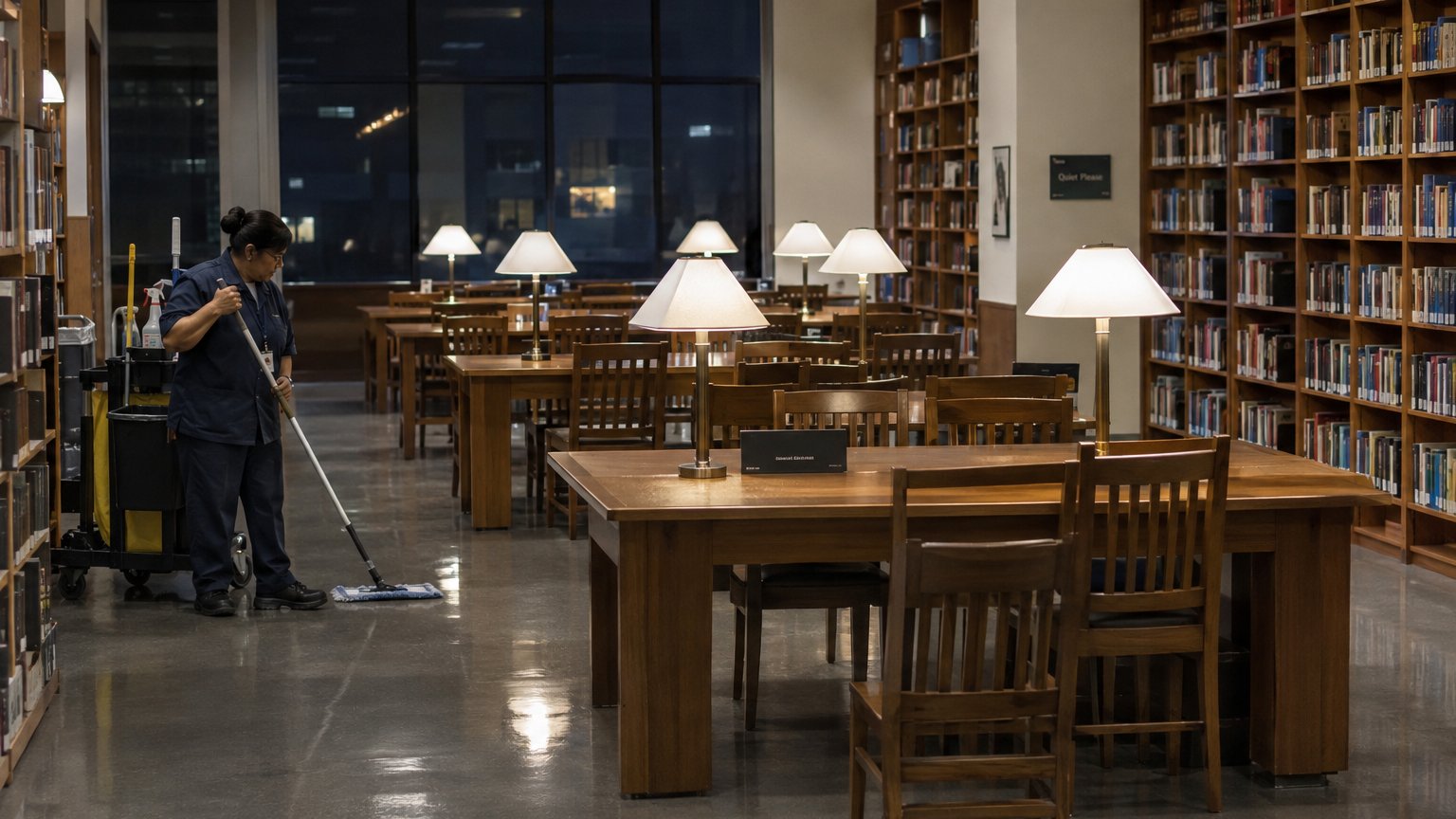
Public libraries are busy civic facilities with quiet reading rooms, children’s spaces, computer labs, public meeting rooms, restrooms, and collections that cannot be treated like ordinary office furniture. A cleaning plan must protect patron access, respect privacy, control noise, and work around public programs and branch hours. The Institute of Museum and Library Services tracks roughly 9,000 public libraries and 17,000 individual outlets nationwide, a reminder that library service is inherently distributed across many sites. GreenPoint Maintenance Services helps facility teams scope repeatable branch-level cleaning while documenting site-specific exceptions. This guide covers buyer questions for New York City and tri-state systems; call 347-332-9348 to request a walkthrough.
Treat Each Branch as Its Own Operating Site
A library system may standardize contract language, but each branch has its own floor plan, opening hours, room mix, staffing, and foot traffic. A compact neighborhood branch may need a small evening crew and targeted restroom checks; a central library with public events, meeting rooms, and extended hours may need day porter coverage and multiple shifts. Map each branch’s entrances, service desks, stacks, study tables, children’s room, computer area, staff offices, loading access, and public restrooms. GreenPoint records the differences in a branch schedule instead of assuming one checklist fits all.
Ask the library to identify quiet hours, story-time schedules, exam periods, public meetings, and areas that are closed to contractors. A branch near Fordham Road or the New York Public Library’s main branch on Fifth Avenue has a different visitor rhythm from a community branch near Jackson Heights, Downtown Brooklyn, or Newark Penn Station. In Connecticut, Stamford, New Haven, and Bridgeport branches may have different local procurement and access requirements. A walkthrough should confirm keys, alarms, staff escorts, after-hours contacts, and where supplies can be stored.
Separate Public, Staff, and Collection-Sensitive Areas
The scope should distinguish public touchpoints from collection handling. Janitorial teams can clean floors, accessible exterior surfaces, restrooms, tables, and approved work areas, but should not move books, media, archive boxes, or patron belongings unless the library expressly authorizes a controlled procedure. Avoid spraying cleaner near books, computer keyboards, scanners, and power strips. Use lightly dampened cloths on approved surfaces, and follow manufacturer directions for monitors and public computers. GreenPoint establishes these boundaries in writing and trains staff on the branch’s no-touch zones.
Plan high-dust tasks with collections staff because shelves, vents, and ceiling fixtures can release particles onto books and patrons. Use HEPA-filtered equipment where specified, maintain filters, and avoid compressed air or aggressive dusting that redistributes debris. For children’s rooms, provide separate tools and a sequence that avoids cross-use with restrooms. The library should approve any treatment of rare materials or special collections; that work may require a conservator rather than a general cleaning crew. See HEPA filtration for commercial cleaning and color-coded microfiber systems for supporting practices.
Set Frequencies Around Opening Hours and Programs
A branch-level cleaning schedule should begin with opening hours and room use. Daily tasks commonly include entry and lobby cleaning, restroom service, trash and recycling, touchpoint cleaning, floor attention, and staff-area service. Meeting rooms and public tables may need a reset after programs, while computer labs can require a scheduled wipe-down using manufacturer-approved methods. High-use branches may need midday restroom checks. A 15,000-square-foot branch might be divided into four or five task zones for auditability, but the number of zones should reflect the layout and access, not a universal formula.
Weekly or periodic tasks should be listed separately so the buyer can see what is included in the recurring price. Examples include chair legs, low ledges, partition glass, floor edges, and reachable vents. Seasonal project work may include carpet extraction, hard-floor refinishing, or high dusting during a planned closure. GreenPoint can make a one-page frequency matrix for every branch and indicate which duties occur only when a room is available. For general schedules by facility type, see cleaning frequency standards by facility type.
Protect Privacy, Accessibility, and Quiet Use
Library patrons may work with confidential applications, health information, legal research, or personal devices. Cleaning staff should not read screens or papers, photograph patrons, or include borrower records and computer displays in quality photos. The library should spell out its privacy policy, prohibited areas, and incident reporting path during orientation. Keep carts out of accessible routes, maintain access to service counters, and coordinate wet-floor work around public movement. GreenPoint’s service records can document task completion without recording patron information.
Accessible routes, restrooms, elevators, and seating are part of daily service, not optional extras. Ask the facilities team to identify door clearances, accessible restroom fixtures, tactile signage, and areas where temporary cones could create a barrier. OSHA requires exit routes to remain unobstructed in workplaces; public-building and accessibility duties can also arise under applicable building and accessibility requirements. The contractor should follow the owner’s approved route plan and report obstructions, leaks, loose mats, or damaged fixtures rather than attempting unauthorized repairs. These practices matter at a branch near Grand Central, Borough Hall, or any transit-linked entrance where pedestrian volume is high.
Use Safe Products and Collection-Aware Equipment
A library product list should address odor, ventilation, surface compatibility, and occupant sensitivities. EPA Safer Choice-labeled products can help purchasers identify products whose ingredients and performance have been reviewed, but a label does not mean every product is appropriate for every surface. Review EPA’s Safer Choice information, the product label, and library policy before selection. GreenPoint can provide safety data sheets and use Green Seal-certified products where the specification and task allow. Never mix chemicals, leave unlabeled secondary containers, or store products near books or public materials.
Vacuum and floor equipment should fit the branch’s flooring, electrical outlets, noise limits, and access rules. A backpack vacuum can reduce cord exposure in some layouts; a quiet machine may be preferable during public service hours. Use dust-control methods that protect books and computers, and schedule loud work when the library is closed. Keep equipment attended and out of egress paths. GreenPoint includes tool selection, storage location, and maintenance checks in its site plan, then adjusts when the library renovates or reconfigures an area.
Write a Procurement Scope That Can Be Audited
A public-library RFP should describe the branch list, cleanable areas, frequencies, required coverage windows, service-level expectations, consumables, periodic projects, background checks if required, training, insurance, and invoicing format. Ask vendors to disclose which tasks are excluded and how they handle a branch closure or emergency. For multi-branch contracts, define whether the vendor provides one systemwide supervisor, regional leads, or a named contact at each location. GreenPoint is MBE/MWBE-certified in New York programs and SAM.gov registered; procurement teams should verify the certifications and solicitation eligibility they actually need.
Compare proposals using the same branch inventory and task schedule. A low bid may omit midday restroom response, event resets, supply replenishment, floor projects, or service during school-year exam periods. The BLS reports a national May 2024 annual mean wage of $37,460 for janitors and cleaners, excluding maids and housekeeping cleaners; it is useful labor context, not a local contract price. The BLS employment and wage tables provide the source. For a comparable cost discussion, review commercial cleaning cost per square foot, then call GreenPoint at 347-332-9348 for a site walkthrough and fixed-price quote.
Measure Completion Without Over-Collecting Data
A library quality check can include visual condition, completion time, missed access, restroom readiness, supply exceptions, and work orders raised. ISSA’s commercial Clean Standard combines subjective and objective methods and describes ATP-based ranges alongside audit tools; see ISSA’s overview. ATP sampling should focus on agreed points such as a staff-selected table or touchpoint, and results should be interpreted as residue indicators, not pathogen identification or a guarantee of safety.
GreenPoint’s JaniTrack platform can show task status, time-stamped GPS-tagged photos, inspection notes, and follow-up in a live dashboard. Configure photo rules to show a cleaned space without patrons, screens, borrower records, or sensitive collection details. A branch manager can review exceptions and reassign work, while a monthly report reveals repeated access problems or high-complaint areas. GreenPoint’s 98% client retention is a company-reported operating metric, not a substitute for a library’s own pilot; ask for a sample dashboard and call 347-332-9348 to arrange a walkthrough.
Before contract award, ask branch managers to review one common template and identify exceptions that should remain local. A branch with a basement meeting room, a high-volume children’s area, or a public computer lab may need a different time window or tool restriction. Document these differences in a branch appendix so systemwide procurement remains consistent without erasing local operating needs. During the first month, compare inspection notes and service requests across branches, then adjust coverage with the contract administrator’s approval. GreenPoint can provide a named escalation contact and a monthly exception summary, helping a municipal buyer spot recurring access or building-maintenance problems across the portfolio. Set a process for branch closures, library holidays, election-day use, and after-hours community events, since each can affect keys, alarm schedules, and cleaning access. The contract should state who authorizes a change and how that change appears in the service log.
FAQ: Public Library Cleaning Services
Q: How often should a public library be cleaned? A: Set daily service for high-use public areas and restrooms, then add checks based on branch hours, programs, and measured soil. Collections and low-use rooms may need a different schedule.
Q: Can a cleaning contractor handle books or archives? A: Not as ordinary janitorial work. Collection handling should be defined by library staff, and rare or damaged materials may require a conservator.
Q: How can multi-branch systems verify service? A: Use branch-specific task lists, timestamps, exception logs, inspection scores, and a dashboard. Protect patron privacy by excluding personal information from photos.
Q: What should a library cleaning bid include? A: A branch inventory, task frequencies, coverage windows, service contacts, products, equipment, periodic projects, exclusions, and a clear price structure.
Q: Does GreenPoint serve New York, New Jersey, and Connecticut libraries? A: GreenPoint serves commercial and institutional sites across the tri-state region. Call 347-332-9348 to confirm coverage and request a branch walkthrough.
Schedule a public-library walkthrough and fixed-price proposal with GreenPoint Maintenance Services at 347-332-9348 or info@greenpointms.com. GreenPoint reports a 98% client-retention rate and can document branch tasks through JaniTrack while respecting patron privacy and collection boundaries.