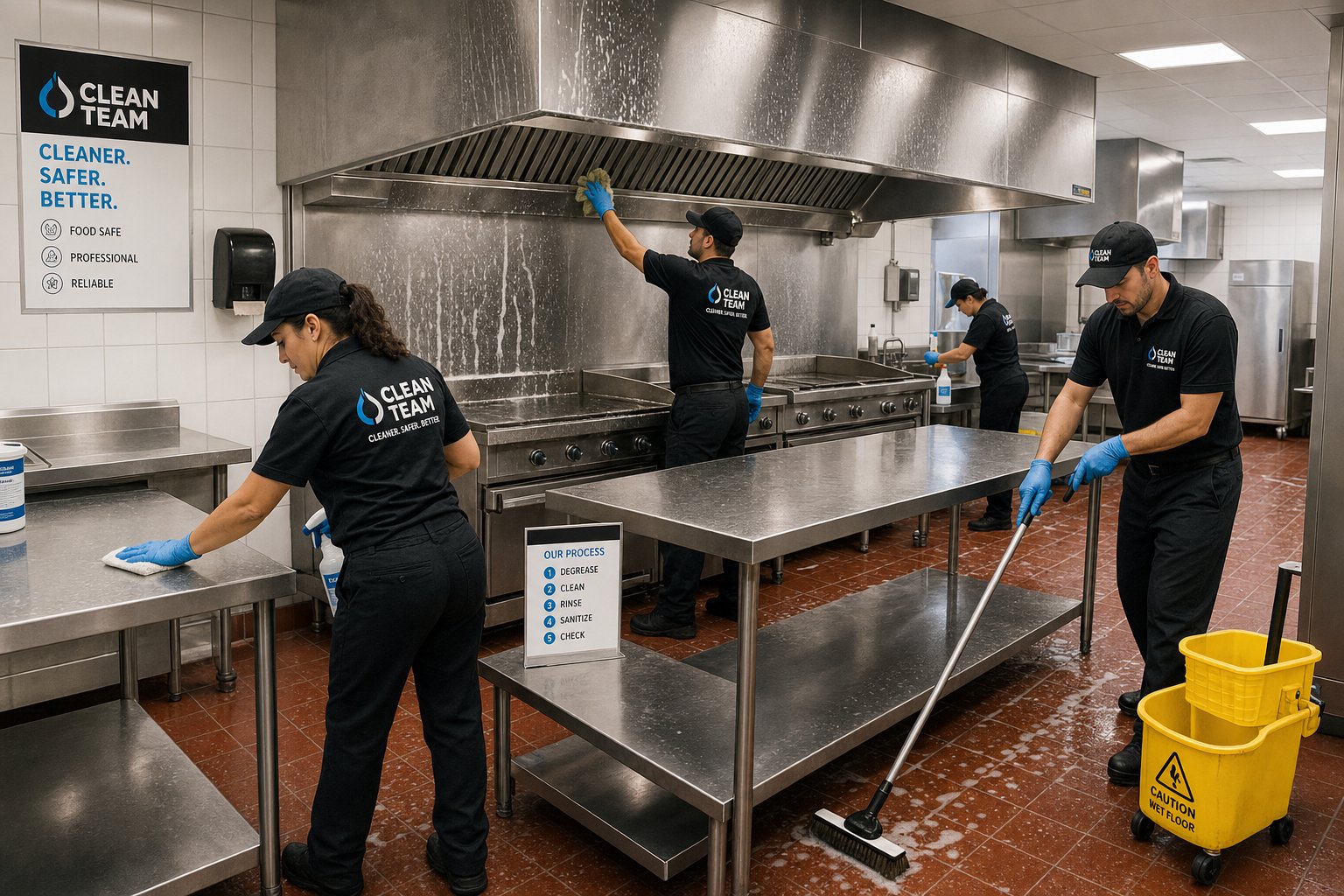
Restaurant kitchen cleaning must keep food-contact areas, floors, drains, hoods, restrooms, dining rooms, and waste paths under control while a business serves guests. A 24-hour diner in Queens, a busy Midtown restaurant, a Brooklyn brewery kitchen, or a catering operation in Westchester has different peaks and grease loads. This guide shows operators what to put in a commercial kitchen cleaning scope and how to compare vendors. GreenPoint Maintenance Services Corp offers trained crews, Green Seal certified product options, StockPoint verification, fixed pricing, and regional coverage across NY, NJ, CT, PA, and FL.
Divide the restaurant into cleanable zones
Map food preparation, cooking line, dish area, walk-ins, dry storage, receiving, dining room, bar, restrooms, staff areas, waste staging, and exterior service points. Record equipment type, floor finish, drains, grease accumulation, access windows, and which tasks belong to culinary staff. GreenPoint Maintenance Services creates the map with the chef, general manager, and facilities contact so janitorial staff do not move ingredients, open food containers, or clean equipment that requires a manufacturer-trained technician. Locations near Times Square, Union Square, Atlantic Avenue, Hoboken, Stamford, or King of Prussia may have late service windows and loading constraints that belong in the scope.
Separate daily close from periodic deep cleaning
A daily close should state who removes routine waste, sweeps and mops floors, cleans approved counters and splash zones, resets restrooms, wipes touchpoints, and reports leaks or damaged surfaces. Weekly work may include wall edges, under-equipment access, grout, shelving exteriors, and detailed drains where approved. Monthly or quarterly projects may include machine scrubbing, carpet extraction, high dusting, and hood or duct service by qualified specialists. GreenPoint quotes these layers separately so an operator does not mistake a nightly wipe-down for a full deep clean. The [cleaning frequency standards by facility type](/blog/cleaning-frequency-standards-by-facility-type/) guide can help managers turn traffic and soil into a defensible calendar.
Protect food-contact surfaces and chemical boundaries
The contract should list approved products, dilution, dwell time, rinse requirements, storage, PPE, and which food-contact surfaces are cleaned by the restaurant team or janitorial vendor. GreenPoint follows product labels, uses Green Seal certified options where appropriate, and never mixes chemicals. Staff must know where Safety Data Sheets are kept and how to respond to a splash or spill under OSHA Hazard Communication expectations. A sanitizer claim is not the same as cleaning; soil must be removed first. Ask the vendor how it prevents restroom tools, mop heads, and cloths from entering the kitchen. GreenPoint uses color-coded systems and supervisor checks to make the boundary visible.
Specify floors, drains, and grease-prone details
Kitchen floors need a method matched to tile, quarry tile, epoxy, concrete, or another finish. The scope should cover under-line edges, corners, thresholds, floor drains, wall bases, mats, and slip-hazard reporting. Do not push grease into a drain or flood an area that cannot dry before opening. GreenPoint trains crews to use the approved amount of product, control water, place wet-floor signs, and report a cracked joint or failed drain seal. A supervisor inspects the places guests rarely see but employees feel first: behind equipment, around dumpster routes, and under shelving. The [vct floor care strip seal wax guide](/blog/vct-floor-care-strip-seal-wax-guide/) explains why periodic floor work needs its own specification.
Coordinate the hood, exhaust, and high-level work
Cooking exhaust and hood systems may require specialized inspection and service beyond routine janitorial cleaning. A contract should state whether the vendor cleans accessible exterior surfaces, filters, surrounding walls, ceilings, and grease deposits, and should name the qualified party for internal hood or duct work. GreenPoint documents exclusions instead of implying that a nightly cleaner is a hood contractor. High dusting near sprinklers, lights, and ventilation also needs a method and a safe access plan. The [fire code cleaning chemical storage](/blog/fire-code-cleaning-chemical-storage/) guide gives facilities leaders useful questions about storage and fire-safety coordination. Schedule loud or wet projects outside food production and verify the area is ready before opening.
Build restrooms, dining rooms, and guest touchpoints into the same plan
Customers judge the whole restaurant, not only the cook line. Restrooms, entrance glass, door pulls, menus or tablet stands, chair backs, host stands, floors, and bar touchpoints need a frequency based on traffic. GreenPoint can provide a day porter for spills and restocks plus a closing crew for detail. In Manhattan, subway and nightlife traffic may create a different soil pattern from a suburban restaurant in Fairfield County or Long Island. Use approved materials and avoid spraying directly on electronics or food service equipment. The [restroom cleaning best practices for high-traffic facilities](/blog/restroom-cleaning-best-practices-high-traffic/) provides a practical model for high-use public areas.
Verify the work with inspections and a kitchen-safe record
A manager should be able to see which zones were serviced, when a missed task was reported, and who closed the correction. GreenPoint uses StockPoint timestamped GPS-tagged photos where approved, checklist completion, supervisor inspections, and live issue records. Photos must not show customer payment data, recipes, employee records, or food that should remain private. Track inspection pass rate, grease or odor incidents, spill response time, supply-outs, recurring floor areas, and pre-opening exceptions. ATP testing may be used on selected touchpoints as a trend signal, but it does not replace food-safety controls or a health department inspection. Evidence should make the next shift more prepared, not create a false claim of compliance.
Write local health, waste, and access responsibilities down
Restaurant operators should identify the local health department contact, waste pickup rules, grease interceptor ownership, pest-control vendor, chemical storage location, and emergency contacts. Requirements differ by jurisdiction, so the contract should require the operator and its regulatory advisers to confirm current local rules. GreenPoint follows the approved facility scope and reports leaks, pests, damaged surfaces, overflowing waste, and unsafe access. Service near NYC DOE sites, municipal buildings, or mixed-use properties may add landlord and loading restrictions. A walkthrough at 844-814-0810 can include the chef, GM, facilities lead, and security or landlord contact so the quote reflects the actual operating environment.
Compare fixed proposals by task, frequency, and exclusion
Require line items for nightly service, porter coverage, periodic floor work, consumables, emergency spill response, waste boundaries, high dusting, and specialty hood or duct contractors. GreenPoint Maintenance Services uses fixed pricing with no hourly billing and no hidden fees; the proposal states square footage, equipment assumptions, visit frequency, and change-order triggers. A low bid that excludes grease-prone details or restocking can shift cost to managers and kitchen staff. GreenPoint’s MBE/MWBE certifications, SAM.gov registration, Green Seal options, and 98% client retention support procurement, but the site-specific scope matters most. Call 844-814-0810 or email info@greenpointms.com for a no-obligation walkthrough.
Launch with a pre-opening baseline and review
Before service begins, GreenPoint documents the opening condition, approved products, equipment exclusions, cleaning sequence, access rules, waste path, and first-week inspection schedule. The supervisor should walk the kitchen after a representative close and before opening, not only during a quiet afternoon. At days 7, 14, and 30, review grease and odor trends, missed tasks, response time, supply incidents, and recurring repairs. If a drain, hood, floor joint, or refrigeration seal causes soil, assign the repair to the right owner instead of asking cleaners to compensate indefinitely. GreenPoint supports single restaurants and regional groups across NY, NJ, CT, PA, and FL with a common QA framework.
Kitchen cleaning is a partnership between operations and janitorial staff. Culinary employees secure food, equipment, knives, and active production; GreenPoint cleans the approved environmental surfaces, floors, public areas, and other assigned zones; facilities and specialty contractors own repairs and regulated or technical systems. Put that division in the written scope and train every relief worker against it. A useful monthly meeting reviews the closing checklist, pre-opening exceptions, drain or grease trends, inspection pass rate, and upcoming events. Call 844-814-0810 if your team needs to convert an informal closing routine into an auditable service plan.
For restaurants in Midtown, Williamsburg, Astoria, Jersey City, Newark, Stamford, White Plains, or Long Island, local delivery patterns and late-night access can affect the route. GreenPoint Maintenance Services can set a consistent core standard for a group while adding site-specific schedules for kitchens, bars, patios, and waste rooms. StockPoint gives managers a shared record of task completion and corrective action, while the chef retains control of food safety and production decisions. Re-approve the plan when the menu, equipment, hours, seating, or delivery volume changes.
GreenPoint’s 98% client retention, fixed pricing, Green Seal product options, MBE/MWBE certifications, and regional staffing make procurement easier to evaluate, but no certificate replaces a proper walkthrough. Ask for a proposal that names the areas cleaned, the areas excluded, the frequency, the products, the response time, the waste and hood boundaries, and the first-month review. Email info@greenpointms.com or call 844-814-0810 to schedule it.
FAQ: practical answers for facility and operations leaders
Does commercial kitchen cleaning include hood and duct cleaning? Not automatically. The contract must state whether routine staff clean accessible exteriors and filters or whether a qualified specialty contractor handles internal hood and duct work. GreenPoint writes the boundary, coordinates timing, and does not represent routine janitorial work as technical hood service.
How often should a restaurant kitchen be cleaned? Daily closing service is common, with weekly, monthly, or quarterly detail based on grease, traffic, equipment, floor type, and local requirements. GreenPoint maps the actual kitchen and separates recurring work from periodic projects in a fixed proposal.
How do cleaners protect food-contact surfaces? Use approved products, remove soil first, follow label dwell and rinse directions, avoid cross-use of restroom tools, and keep chemicals labeled and stored. GreenPoint uses color-coded tools, Green Seal options where appropriate, and supervisor inspections.
Can a restaurant verify overnight cleaning? Yes. StockPoint can record task completion, time, location, inspections, corrective actions, and approved photos. GreenPoint limits images to client-approved views and avoids payment data, recipes, employee records, and food privacy concerns.
How do I get a restaurant cleaning quote? Call GreenPoint Maintenance Services at 844-814-0810 or email info@greenpointms.com. We will review the kitchen, dining room, restrooms, hours, waste path, periodic work, and access rules before issuing fixed pricing with no hidden fees.
GreenPoint Maintenance Services Corp can scope a restaurant kitchen and guest-area cleaning program with a no-obligation walkthrough. Call GreenPoint at 844-814-0810 or email info@greenpointms.com for fixed pricing, StockPoint verification, and a contract built around opening readiness. [restroom cleaning best practices for high-traffic facilities](/blog/restroom-cleaning-best-practices-high-traffic/)