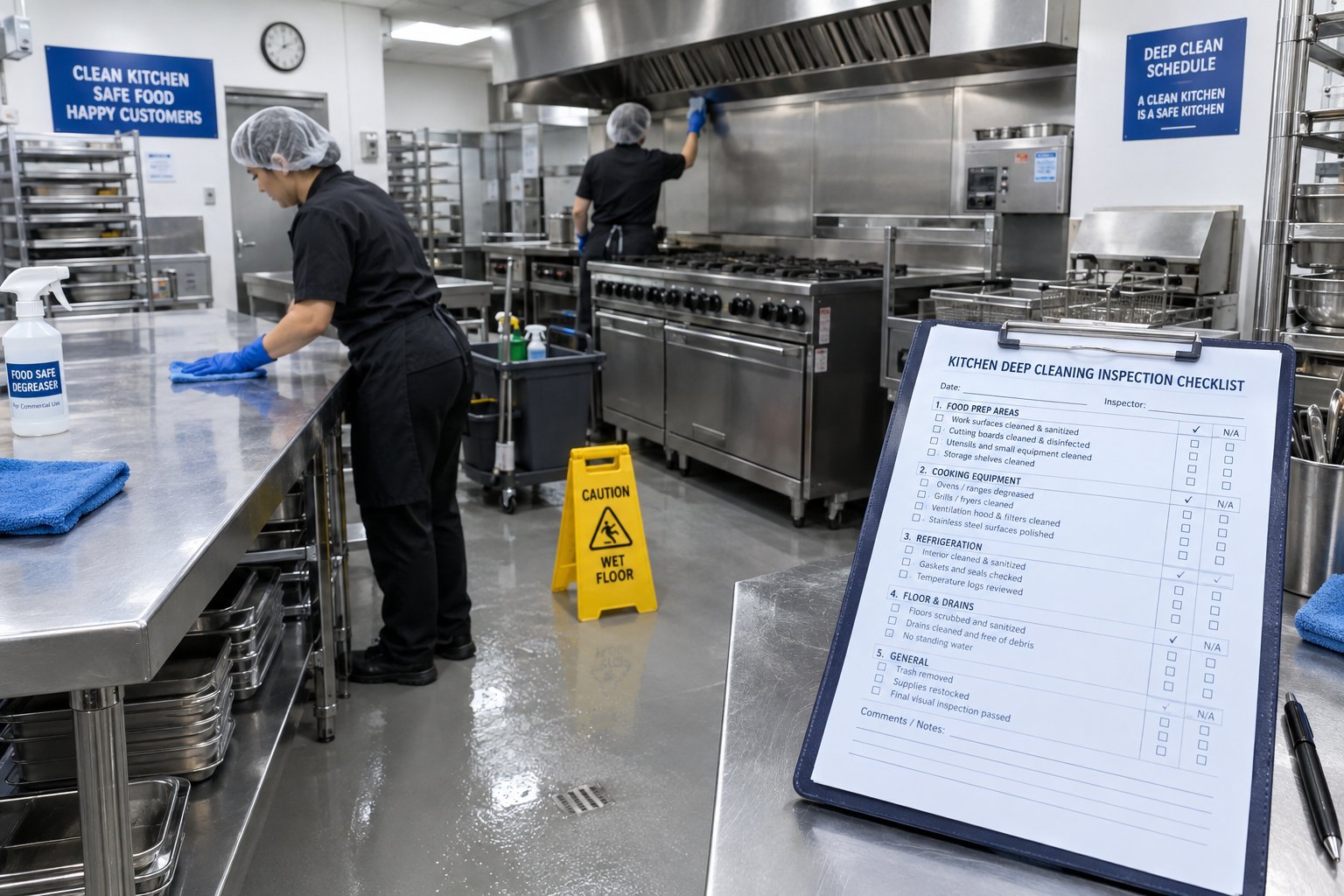
Restaurant and Catering Kitchen Cleaning RFP: A Scope That Holds Up requires more than a generic nightly checklist. The buyer needs a local facility map, measurable tasks, trained people, documented exceptions, and evidence that the work respected the building’s real risks. GreenPoint Maintenance Services helps restaurant owners, culinary directors, catering operators, franchise managers, and procurement teams convert those requirements into a fixed-price operating scope across restaurants, caterers, and commercial kitchens across Manhattan, Brooklyn, Queens, the Bronx, Staten Island, Westchester, Long Island, New Jersey, Connecticut, Pennsylvania, and Florida.
Map the building before choosing a product or frequency
Start with a room-by-room map for restaurants, caterers, and commercial kitchens across Manhattan, Brooklyn, Queens, the Bronx, Staten Island, Westchester, Long Island, New Jersey, Connecticut, Pennsylvania, and Florida. Record usable square footage, restrooms, kitchens or pantries, entrances, elevators, stairs, workstations, public areas, storage, waste points, flooring, glass, restricted rooms, and ventilation-sensitive zones. The map should identify the people who use each space and the times when cleaning can occur. GreenPoint Maintenance Services turns that inventory into a task matrix so the team is not asked to infer a scope from a single gross square-foot number.
For restaurant owners, culinary directors, catering operators, franchise managers, and procurement teams, local access patterns matter. Plan around restaurant corridors in Midtown, the Lower East Side, Astoria, Williamsburg, Downtown Brooklyn, Westchester, Long Island, Hoboken, Stamford, Philadelphia, and South Florida. Confirm loading, badges, alarms, freight elevators, supply storage, water access, waste staging, and the service window. A building near a subway or commuter rail hub can have a different lobby and restroom peak than a low-occupancy office. GreenPoint can walk the site with the facility contact and record assumptions before pricing.
Set measurable work by zone and frequency
Use a layered schedule: every-visit tasks, daily resets, weekly detail, monthly periodic work, quarterly projects, and event or incident response. The right schedule follows traffic and risk, not a generic package. For a 6,000-square-foot restaurant with a 1,500-square-foot kitchen, two restrooms, 120 seats, and a six-day operating week, price nightly surface resets separately from weekly detail work, monthly equipment-adjacent cleaning, and quarterly high-level or exhaust-area coordination. State which surfaces are cleaned, which are disinfected, which are inspected, and what happens when a task cannot be completed. ISSA appearance-level concepts can help describe the expected result without vague language such as premium or spotless.
For museums and galleries, separate public floors from collection-sensitive work. For kitchens, separate close-down sanitation from specialized equipment service. For safety training, separate routine cleaning from exposure response. For product plans and WELL operations, separate approved materials and documentation from general claims. GreenPoint Maintenance Services can model labor minutes, supervision, relief coverage, and periodic work around the actual facility.
Write a scope that a vendor can price
A credible scope lists rooms, fixtures, surfaces, service windows, access, supplies, equipment, staffing assumptions, inspections, consumables, periodic work, emergency response, and exclusions. Ask bidders to identify their square-foot assumptions and the tasks included in the base price. BLS wage data offers labor-market context, but delivered cost also reflects payroll burden, insurance, training, equipment, travel, supervision, and quality assurance. GreenPoint uses fixed pricing for recurring programs rather than hidden hourly billing.
List special boundaries in plain language. A gallery scope can prohibit contact with artwork; a kitchen scope can exclude hood and duct service unless specifically included; a bloodborne-pathogens plan can define sharps responsibility; a Green Seal or WELL plan can require an approved product list and records. Use [how to write a commercial cleaning RFP](/blog/how-to-write-rfp-commercial-cleaning/) as a related planning reference, then schedule a walkthrough to control the final number.
Train for surfaces, people, and exceptions
Training should show what the worker actually does in the building: tool selection, dilution, contact time, PPE, hand hygiene, color-coded microfiber, waste boundaries, slip prevention, privacy, and escalation. OSHA hazard communication and SDS access belong in the field routine. A trainer should use the facility’s zones and examples rather than relying on a generic slide deck. GreenPoint uses Green Seal certified products where appropriate and label-directed methods for any disinfecting claim.
Define exceptions before the first shift. A cleaner may find a needle, bodily fluid, unapproved chemical, artwork risk, food-production equipment, water leak, damaged flooring, or an occupied room that cannot be serviced. The response should identify who is authorized, what PPE or barrier is needed, how the area is protected, and how the event is recorded. GreenPoint Maintenance Services can put those decisions in the site playbook.
Protect occupants and local operating constraints
Keep ADA paths, fire egress, loading routes, and occupied work areas safe during service. Use wet-floor signs and barriers when appropriate, protect food and collection materials, and coordinate ventilation or odor-sensitive work with the facility. For restaurants, caterers, and commercial kitchens across Manhattan, Brooklyn, Queens, the Bronx, Staten Island, Westchester, Long Island, New Jersey, Connecticut, Pennsylvania, and Florida, local transit peaks, deliveries, events, and weather can change the best service window. The plan should identify a fallback when a badge, elevator, loading bay, or room is unavailable.
GreenPoint operates across NY, NJ, CT, PA, and FL, including Manhattan, the Bronx, Brooklyn, Queens, Staten Island, Westchester, Long Island, and regional business hubs. Regional coverage is useful only when supervision and local access are specific. Ask who covers an absence, how supplies are replenished, and how the facility is notified when an exception affects service.
Verify completion with useful evidence
A manager should be able to answer whether the team arrived, whether agreed tasks were completed, and what happened when an exception was found. StockPoint can connect timestamped GPS-tagged photos, task records, supervisor inspections, selected ATP testing in appropriate areas, and a live dashboard. GreenPoint uses that evidence to make conversations concrete: a missed restroom, a delayed reset, a product substitution, or a corrective action can be tied to a zone and time.
Set the evidence rules before launch. Decide which areas may be photographed, which require privacy or collection restrictions, how often a supervisor inspects, who receives alerts, and what closes a corrective action. [high-traffic restroom cleaning practices](/blog/restroom-cleaning-best-practices-high-traffic/) adds context for the operating issue. GreenPoint treats digital proof as a supplement to trained field supervision, not a substitute for it.
Manage products, storage, and documentation
Keep a current product list, labels, dilution method, PPE requirements, SDS access, storage map, approved surfaces, reorder points, and spill steps. For this topic, the compliance frame includes OSHA hazard communication, SDS access, food-safety procedures set by the operator and local health authority, slip-and-fall controls, fire-code access, grease and waste boundaries, and employee-only access rules. Do not assume a sustainability label, a training certificate, or a vendor promise answers every site requirement. The facility’s EHS, registrar, food-safety, quality, or WELL project team may control the final approval.
Review the file after a substitution, renovation, incident, or scope change. GreenPoint Maintenance Services can place product assumptions, access controls, training owners, escalation contacts, and inspection responsibilities into the written scope. That makes the program easier to audit and easier to hand to a new manager without losing the reasoning behind the original plan.
Compare proposals with a buyer scorecard
Score scope completeness, staffing, training, supervision, safety, products, periodic care, response time, verification, references, certifications, and total annual cost. Require finalists to list exclusions and assumptions. A lower monthly number is not comparable when it omits restrooms, supplies, relief coverage, special access, training, collection restrictions, food-area boundaries, or documentation. GreenPoint can provide a walkthrough summary so the buyer sees what the fixed price is based on.
For diligence, ask what happens on day one, after a missed task, during an absence, and when occupancy or service conditions change. GreenPoint Maintenance Services is MBE/MWBE certified, SAM.gov registered, and reports 98% client retention, but buyers should still request references and define the evidence format they need. Call 844-814-0810 or email info@greenpointms.com to schedule a walkthrough or quote for restaurants, caterers, and commercial kitchens across Manhattan, Brooklyn, Queens, the Bronx, Staten Island, Westchester, Long Island, New Jersey, Connecticut, Pennsylvania, and Florida.
Launch, review, and improve the writing a bid-ready scope for sanitation, degreasing, and downtime program
Use the first 30 days as a baseline for restaurants, caterers, and commercial kitchens across Manhattan, Brooklyn, Queens, the Bronx, Staten Island, Westchester, Long Island, New Jersey, Connecticut, Pennsylvania, and Florida. Track scheduled visits, completed tasks, inspection scores, exceptions, supply outages, response time, training completion, and stakeholder feedback. For a museum, kitchen, safety program, Green Seal plan, or WELL-oriented building, also track deviations from approved tools, products, zones, or access procedures. GreenPoint Maintenance Services reviews these signals with the facility contact instead of waiting for a renewal conversation.
At the monthly review, confirm that periodic work is scheduled, seasonal risks have an owner, and the evidence record is easy to retrieve. StockPoint photos, inspections, ATP results where appropriate, and corrective-action notes can show whether an issue was isolated or recurring. GreenPoint can revise the task matrix through a documented scope change with the price and start date stated in writing. That protects the budget while keeping expectations clear when occupancy, visitors, production volume, staff roles, product approvals, or project requirements change.
Before launch, ask the service team to restate the approved zones, service window, first inspection date, escalation contact, and evidence rules. Confirm where supplies are stored, how waste moves, and how an exception is corrected. GreenPoint Maintenance Services can include that kickoff record in the proposal. Call 844-814-0810 if a walkthrough is the fastest way to resolve an access, safety, product, or scope question.
Keep the record usable after the first manager changes roles. Save the floor plan, task matrix, product list, training records, access notes, inspection schedule, and approved change history together. That discipline helps a new facility contact understand what was promised and what evidence to review. GreenPoint can refresh the walkthrough when a new exhibit, menu, incident, product substitution, tenant, renovation, or occupancy pattern changes the right service window.
Frequently asked questions about writing a bid-ready scope for sanitation, degreasing, and downtime
Q: What should a restaurant kitchen cleaning RFP include? A: List equipment and surfaces, square footage, operating hours, service windows, grease and waste boundaries, chemicals, PPE, food-contact exclusions, frequency, periodic tasks, inspections, and response expectations.
Q: Does a janitorial contractor clean cooking equipment? A: Only when the scope, training, insurance, and operator approval specifically include it. A bid should distinguish routine surrounding-surface cleaning from specialized hood, duct, or equipment service that may require another qualified provider.
Q: How often should a commercial kitchen be deep cleaned? A: Daily close-down tasks, weekly detail work, and monthly or quarterly periodic work are common planning layers. The final schedule depends on menu, volume, grease load, equipment, health-department expectations, and the operator’s sanitation plan.
Q: Can GreenPoint work after restaurant closing? A: Yes. The walkthrough should document closing time, staff handoff, keys or alarms, wet-floor controls, food protection, waste removal, and the opening inspection. StockPoint can record completed tasks and exceptions.
Q: How do I request a kitchen cleaning quote? A: Call 844-814-0810 or email info@greenpointms.com. GreenPoint Maintenance Services will map the kitchen, dining room, restrooms, storage, and service windows before proposing fixed pricing.
Call 844-814-0810 to schedule a writing a bid-ready scope for sanitation, degreasing, and downtime walkthrough or request a fixed-price quote. GreenPoint Maintenance Services is MBE/MWBE certified, SAM.gov registered, uses StockPoint verification, and reports 98% client retention.