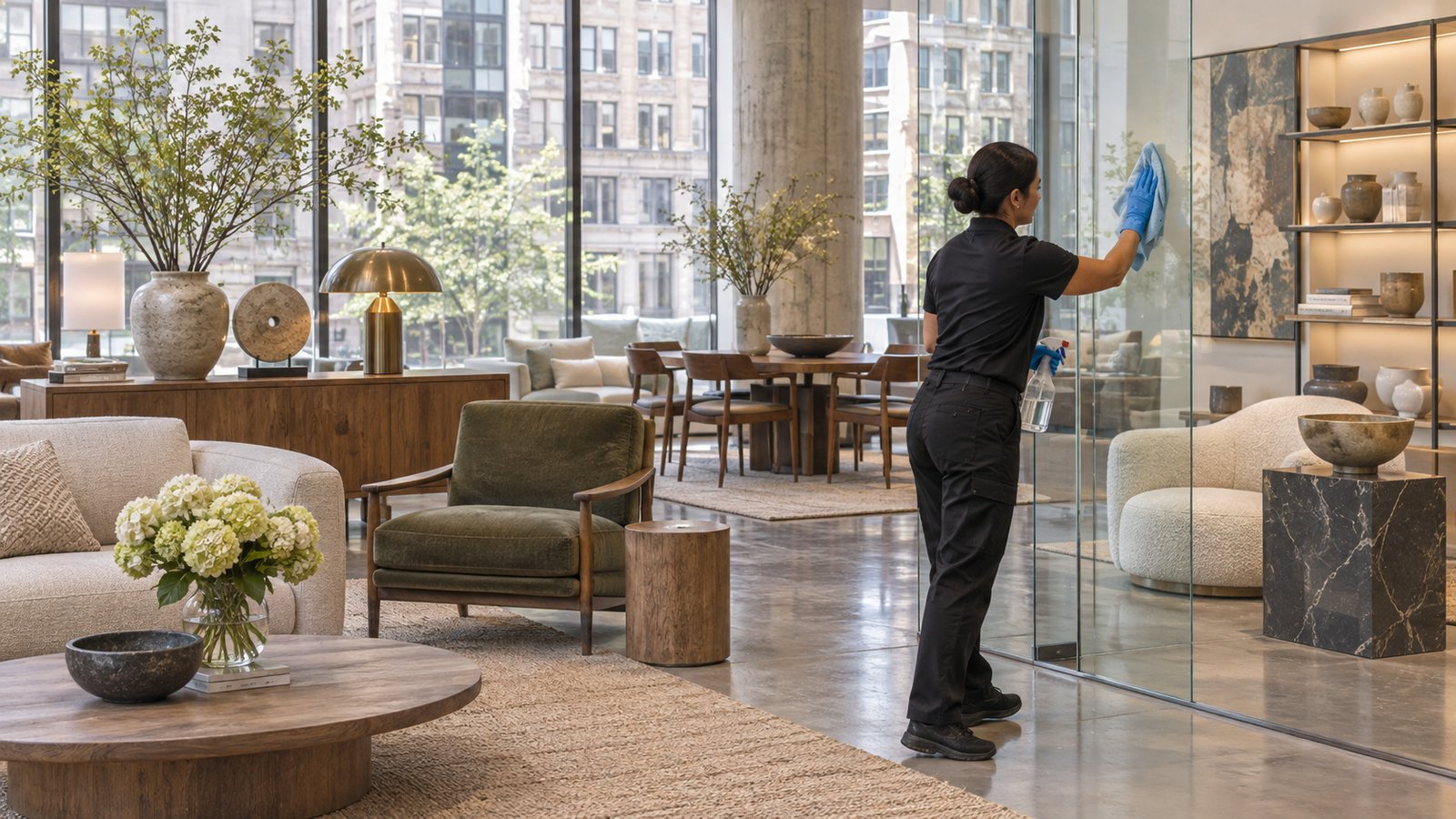
Retail showroom cleaning in Manhattan is part of the customer experience: fingerprints on glass, dust on display fixtures, streaks on stone, or debris at the entrance can distract from the product. A good vendor protects merchandise and finishes while working around appointments, deliveries, and public hours. GreenPoint Maintenance Services starts with a walkthrough and a written surface-by-surface plan. Call GreenPoint at 347-332-9348 to schedule a quote review for a showroom in Midtown, Flatiron, SoHo, Chelsea, or another Manhattan district.
Map display zones, finishes, and customer circulation
Divide the showroom into entry and reception, sales floor, display vignettes, consultation rooms, stockroom, staff areas, restrooms, and glass frontage. Record flooring and finish types, display materials, product sensitivity, security boundaries, and daily visitor volume. A 6,000-square-foot design showroom may include delicate samples and wide glass partitions, while a 20,000-square-foot auto or furniture gallery may have larger floor-care needs and more customer circulation. Neither footprint alone determines labor; the display layout and safe access matter just as much.
Create a surface inventory before allowing routine cleaners to touch products or fixtures. Specify which shelves can be dusted, which objects must remain in place, and which high-value or fragile displays require staff supervision. GreenPoint can identify exclusions in writing so a cleaner does not move merchandise, use an unapproved polish, or expose a finish to excess moisture. For broader vendor criteria, read how to choose a commercial cleaning company and the Manhattan commercial cleaning vendor guide.
Schedule service around appointments and Manhattan access
Showrooms can open early, close late, host evening events, or run appointment-only hours. Set the daily service window, alarm and key procedures, elevator reservations, loading-dock rules, and the time needed before displays are customer-ready. A proposal should explain how the team handles a last-minute event reset, a delayed delivery, or an extra visitor day. Midtown buildings may impose freight elevator windows near Grand Central Terminal or Penn Station, while SoHo and Flatiron storefronts can have limited rear access around Canal Street and 23rd Street transit stops. Keep NYC fire-code egress paths and building access rules clear during service.
A walkthrough should include a review of the building's service entrance, waste staging, water access, and storage closet. Agree whether cleaners may work while clients are present or only after closing. For high-touch public areas, identify whether daytime porter coverage is needed separately from nightly cleaning. GreenPoint uses a fixed scope so service hours and event add-ons are visible. Call 347-332-9348 to schedule a walkthrough that includes the showroom manager and building operations contact; do not assume the vendor can use a freight elevator without prior approval.
Choose cleaning methods that protect premium surfaces
Ask the showroom's finish supplier or maintenance manual to confirm care instructions for stone sealants, lacquer, wood veneer, and specialty glass. Record any warranty-sensitive product restriction in the site file and keep a small test area available for a newly approved method. This is especially useful after a seasonal display change, when a new material or finish may appear without the cleaning supervisor knowing. A documented approval avoids relying on a cleaner's guess about a surface they have not encountered before.
A showroom may combine polished concrete, natural stone, hardwood, carpet, glass, brushed metal, acrylic, leather, and textile samples. Each material needs an approved method and tool. Use microfiber for dust and fingerprints where appropriate, but confirm the cloth and solution will not scratch or leave residue. Document whether glass is cleaned daily, spot-cleaned during service, or handled by a separate high-access contractor. Never assume a product safe for one display finish is safe for another.
Keep a vendor-ready finish card with approved products, dilution instructions, prohibited chemicals, and a test-spot process. GreenPoint uses Green Seal certified products where appropriate, subject to client approval and the material's care instructions. Separate color-coded microfiber by task to reduce cross-use between restrooms and merchandise areas. For floor work, record traffic lanes, protective mats, furniture movement rules, and the time required for a surface to dry before guests arrive. Ask GreenPoint for a sample method statement at 347-332-9348.
Define daily presentation standards and periodic detail work
Write a visible standard for each zone. An opening-ready entry might require clean glass at hand height, a dry floor, empty waste, and no visible debris; a display floor might require dust-free accessible surfaces and straightened, undisturbed materials. Set daily, weekly, and monthly responsibilities separately. For example, high-touch glass can be spot-checked daily, baseboards detailed weekly, and carpet extraction or stone maintenance planned at a seasonal interval based on manufacturer guidance and traffic.
Include restrooms and staff areas in the same quality program so the customer-facing showroom is not the only inspected space. State who replenishes soap and paper, who reports low inventory, and whether supplies are included in the price. GreenPoint supervisors can turn these standards into location-specific checks, reducing subjective comments like 'make it look better.' Schedule a quote at 347-332-9348 and ask for task frequencies that fit the showroom's calendar, including trade events, product launches, holiday traffic, and after-hours receptions.
Verify completion without putting merchandise at risk
Service proof should confirm that a task occurred while respecting the client's privacy and security rules. GreenPoint's JaniTrack verification can record timestamped, GPS-tagged photos and inspection results for approved areas. Establish which locations may be photographed, since merchandise, customer information, or security equipment may be sensitive. For display surfaces, inspections should note condition and exceptions rather than move product to create evidence. Make a clear escalation route for damage, a missed task, a broken fixture, or an alarm issue.
Set a baseline during the first two weeks: inspect entrance glass, floor presentation, customer restrooms, consultation rooms, and one rotating sample of display zones. Track repeat findings and assign correction owners with deadlines. ATP testing is not usually necessary for a retail presentation program unless a specific client need justifies it; appearance checks and documented procedures are often the relevant measure. GreenPoint reports 98% client retention as a company-wide metric. Ask for sample reporting and references, then assess whether the evidence is useful for your Manhattan site.
Compare transparent pricing for the full showroom scope
Include the frequency of display resets and special-event work in the service calendar. A product launch might need a pre-event touch-up, a post-event waste pickup, and next-morning floor recovery, each at a different time. State whether these tasks are included in the monthly fee or require written approval as additional work. For a portfolio of Manhattan locations, compare the same task categories at each site, then list the location-specific access and finish exceptions rather than averaging them away.
Request a price that identifies nightly labor, supervision, supplies, equipment, periodic floor work, inside glass, event resets, and any daytime porter hours. Clarify whether the quote includes moving light furniture, cleaning under displays, replenishing consumables, or service after a product launch. A fixed monthly fee is easiest to compare when the task list and access window are identical across bids. Require written approval for extras so a team does not perform unpriced work or skip it without notice.
Square-foot comparisons can be misleading when one showroom has open polished concrete and another has many glass cases, delicate samples, and small rooms. Ask bidders to show the assumptions behind their labor plan rather than presenting a single rate as an industry standard. GreenPoint offers fixed pricing without hourly billing or hidden fees for an agreed scope. Call 347-332-9348 for a walkthrough and compare with commercial cleaning cost per square foot, treating any published range as an initial budgeting reference rather than a binding Manhattan quote.
Select a vendor with security, insurance, and response controls
Ask for a supervisor's response protocol when a cleaner notices a damaged display, water leak, alarm fault, or unsecured door. The cleaner should know how to preserve the area and notify the designated contact without photographing or moving merchandise. A showroom can test the protocol during mobilization using a non-sensitive scenario, then keep contact names current as store managers and building teams change. Documenting this simple escalation step helps the service stay discreet and predictable.
Verify general liability, workers' compensation, supervisor availability, staff screening if required, and procedures for keys, badges, alarms, and incident reporting. Showrooms may contain valuable goods and design samples; include restrictions on photography, product handling, visitor access, and after-hours doors. Confirm that the vendor can provide backup staffing and disclose who is authorized to approve a schedule or product change. GreenPoint Maintenance Services is MBE-certified and registered in SAM.gov; request current documents for procurement review and confirm any program requirements with the issuing authority.
Build mobilization around a site map, approved product list, alarm test, assigned closet, waste route, finish-care instructions, and a first-week supervisor inspection. A 30-day review can confirm whether the crew's timing and staffing match customer hours and delivery rules. GreenPoint can arrange a walkthrough at 347-332-9348 and provide a fixed-price proposal after confirming the work. Keep construction cleanup, high-rise window washing, specialty stone restoration, and post-event overnight resets separate unless the contract specifically defines their methods, qualifications, and price.
Frequently asked questions about Manhattan showroom cleaning
Q: How often should a retail showroom be cleaned? A: The entry, customer restroom, and visible floor often need daily attention, while detailed dusting and periodic floor care depend on traffic, materials, and event frequency. Set the schedule from observed conditions and review it through inspections.
Q: Can cleaners dust merchandise and display samples? A: Only if the contract clearly authorizes it and the showroom approves handling rules. Identify fragile, high-value, or customer-configured items that must remain untouched, and use a staff member for any display reset that could affect presentation.
Q: What should a Manhattan showroom cleaning quote include? A: Ask for the service window, room-level task list, glass and floor assumptions, supply responsibilities, supervision, event-reset pricing, insurance, and correction response time. Confirm elevator, loading, and alarm access before comparing bids.
Q: How do I request a GreenPoint showroom walkthrough? A: Call GreenPoint Maintenance Services at 347-332-9348. Bring the showroom manager and building contact so access, finishes, display restrictions, and preferred service times can be confirmed together.
Keep displays guest-ready with a finish-aware scope, protected access, and documented checks. Call GreenPoint Maintenance Services at 347-332-9348 to schedule a Manhattan showroom walkthrough. GreenPoint reports 98% client retention and offers fixed pricing for a defined service plan.