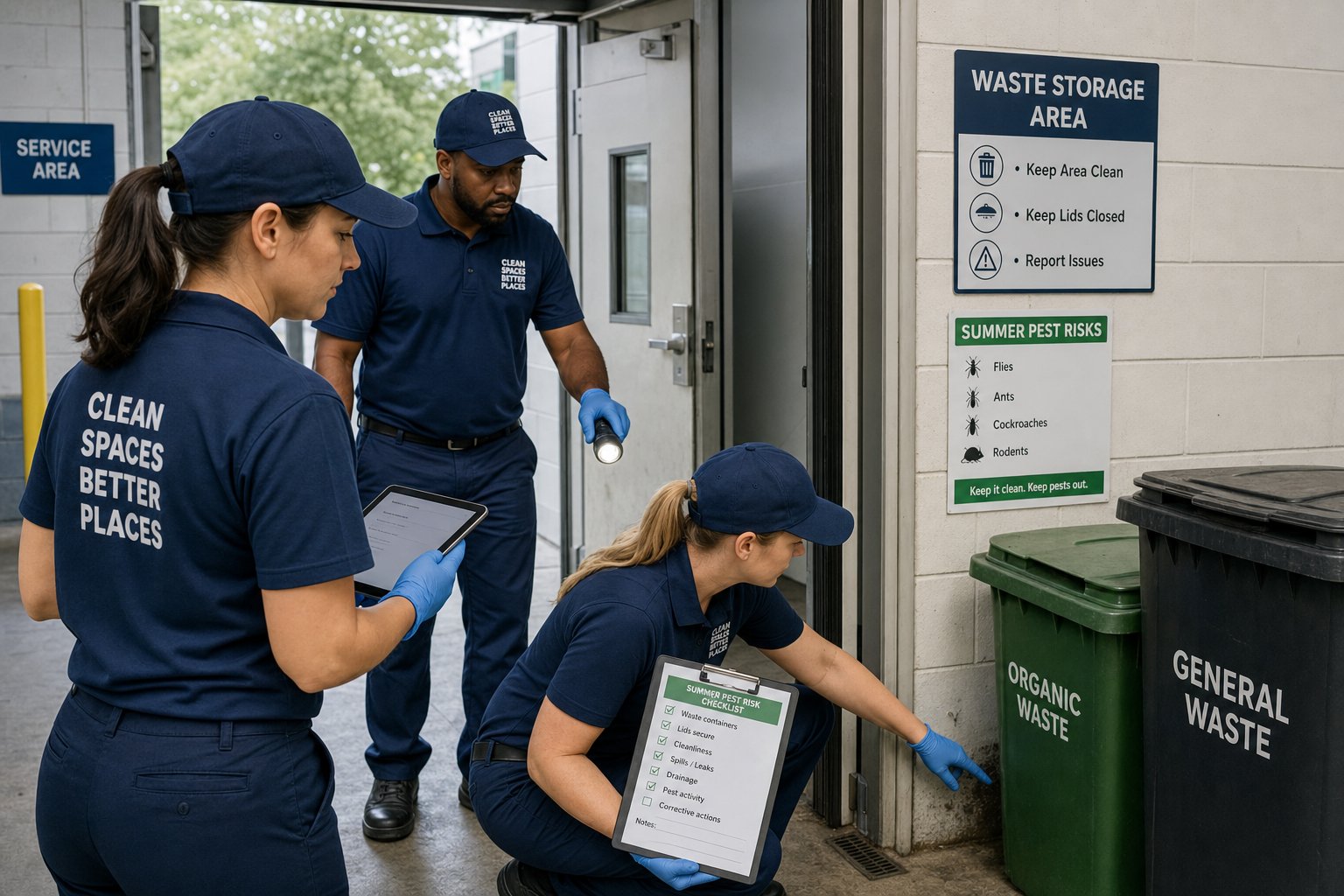
Summer pest prevention for a commercial property is a sanitation and waste-control program, not a last-minute spray. Heat accelerates food residue, moisture, and odor in restaurants, offices, schools, warehouses, and multifamily lobbies from Manhattan to Long Island and New Jersey. GreenPoint Maintenance Services Corp combines documented cleaning, drain and waste checks, Green Seal certified product options, and JaniTrack verification for buildings that need fewer pest attractants. GreenPoint serves New York, New Jersey, Connecticut, Pennsylvania, and Florida with fixed pricing and no hidden fees. Call 347-332-9348 to schedule a walkthrough and quote.
Map pest pressure by use, traffic, and neighborhood
A useful pest plan starts with a room-by-room map: kitchens, loading docks, dumpsters, compactor rooms, breakrooms, restrooms, roof drains, receiving doors, and exterior trash staging. A restaurant near Times Square or Atlantic Terminal may receive deliveries and food waste all day; a Queens warehouse near JFK may have dock doors open for long periods. GreenPoint Maintenance Services documents soil, moisture, gaps, and waste movement before changing frequencies.
Neighborhood conditions matter, but the building controls most attractants. A Bronx school near Fordham Road, a Brooklyn office near Downtown Brooklyn, or a Westchester campus with landscaped grounds needs different patrols from a quiet Midtown suite. The [commercial cleaning frequency standards](/blog/cleaning-frequency-standards-by-facility-type/) framework helps connect use and traffic to a practical schedule.
Control food residue before it becomes a pest signal
Pests find small, repeated food sources: grease under equipment, crumbs under banquettes, syrup near beverage stations, unwashed recycling, and residue on shared kitchen floors. GreenPoint separates food-contact cleaning from general floor work, follows the client-approved chemical and label directions, and cleans under movable equipment when the operator permits safe access. A five-minute closeout inspection can prevent a week of hidden buildup.
In offices, GreenPoint targets pantry sinks, refrigerator handles, vending areas, coffee stations, and desk-side bins. In schools, cafeteria and classroom snack zones need clear boundaries with food-service staff. GreenPoint does not claim janitorial cleaning replaces licensed pest control; it reduces attractants and records findings for the designated operator. Call 347-332-9348 when recurring residue is being missed.
Build a restaurant back-of-house sanitation route
Restaurant pest sanitation should name every zone and owner: cook line, prep tables, walk-in floors, dry storage, dish area, grease area, drains, mop sink, and waste exit. GreenPoint uses clean-to-dirty sequencing, color-coded microfiber, and a close checklist that records floors, edges, splash zones, and equipment exteriors. Hood cleaning, grease-trap service, and food-safety procedures remain specialized or operator-owned unless written into the contract.
New York City food-service operators should coordinate the cleaning scope with the NYC Health Department inspection process and their own HACCP or food-safety plan. New Jersey and Connecticut restaurants should confirm local health-department expectations. GreenPoint’s fixed proposal identifies frequencies, access windows, consumables, and exclusions so a low nightly rate does not conceal missed detail work.
Make waste rooms and dumpsters part of the cleanable scope
Waste controls are often where pest risk becomes visible. Keep lids closed, bags intact, cardboard flattened, leaks removed, and floors washed with a method suitable for the surface and drainage. GreenPoint schedules compactor-room checks, cleans around—not inside—equipment unless authorized, and reports broken drains, cracked curbs, leaking bins, or overflowing containers to facilities. JaniTrack can timestamp the inspection and the escalation.
For a Manhattan high-rise, loading access and pickup timing may determine whether bags sit inside overnight. A Long Island shopping center, Newark industrial site, or Stamford office may need exterior route checks after a collection. GreenPoint coordinates with the waste hauler and property manager rather than promising that janitorial labor can fix an undersized dumpster. Email info@greenpointms.com for a waste-area walkthrough.
Remove water sources and protect drains
Roaches and flies need moisture as well as food. Inspect mop sinks, leaking faucets, condensate lines, floor drains, ice-machine areas, restroom plumbing, and wet cardboard. GreenPoint dries floors, reports leaks, keeps mop heads laundered and stored correctly, and uses drain-care steps only when approved by the building and product label. Cleaning teams should never pour chemicals into a drain as an improvised pest treatment.
In Florida, humidity and stormwater can extend the season; in the tri-state area, summer heat and open loading doors create short windows for correction. GreenPoint records the condition, location, and responsible facilities contact in JaniTrack. The [restroom cleaning best practices for high-traffic buildings](/blog/restroom-cleaning-best-practices-high-traffic/) offers a useful model for checking fixtures, floors, supplies, and odor together.
Close entry points through a cleaning and facilities handoff
Cleaners often see the first evidence of a gap: droppings near a dock, gnaw marks beside a baseboard, flies at a door, or light under a service entrance. GreenPoint trains staff to document the observation, avoid disturbing suspected contamination, secure the area, and escalate it to the building manager or licensed pest professional. Do not ask a cleaner to seal an electrical or structural opening without authorization.
Facilities should maintain door sweeps, screens, seals, pipe penetrations, and waste-room doors. GreenPoint can add a monthly joint review with maintenance, food service, security, and pest control. That division of duties keeps a janitorial contract honest and gives procurement a measurable service level. Schedule a walkthrough at 347-332-9348 to create the handoff map.
Use products and documentation responsibly
GreenPoint uses Green Seal certified product options where compatible with the surface and sanitation requirement, but “green” is not a pest-control claim. Every chemical needs a label, dilution, contact time, storage method, and accessible Safety Data Sheet. Cleaners never mix products or create an unlabeled secondary container. The [OSHA cleaning chemical safety, GHS and SDS](/blog/osha-cleaning-chemical-safety-ghs-sds/) guide explains the documentation buyers should request.
Pest evidence should be privacy-safe and useful: date, zone, condition, action, and escalation. JaniTrack can record timestamped GPS-tagged photos of a non-sensitive waste room or floor condition when the client permits them. GreenPoint’s supervisor reviews trends such as repeat leaks, missed closeout tasks, waste overflow, and response time rather than treating one sighting as a vendor verdict.
Set service frequencies and storm-mode triggers
A practical summer schedule can combine nightly detail, daytime restroom and pantry checks, weekly waste-room inspection, and event-triggered response after a spill, delivery surge, heat wave, or power interruption. A 20,000-square-foot restaurant complex may need more labor per square foot than a 100,000-square-foot office because food soil and waste turnover are higher. GreenPoint sizes crews from soil load, hours, entrances, equipment, and risk—not a generic hourly promise.
Write a storm-mode trigger for heavy rain, flooding, or extended heat. For a Queens property near LaGuardia, a Jersey City tower by PATH, or a Florida retail site, weather can change waste pickup and door traffic quickly. GreenPoint provides fixed pricing with the assumptions visible, then uses JaniTrack records to adjust the route after 30 days. Call 347-332-9348 for a seasonal quote.
Measure results with inspections and corrective actions
Useful measures include pest-related observations per 10,000 square feet, waste-room pass rate, leak closure time, missed closeout tasks, supply-outs, complaint response, and repeat findings by zone. GreenPoint’s JaniTrack dashboard links a task to its timestamp, inspector, issue, and closure. ATP testing can trend selected cleaning surfaces, but it is not a pest inspection or a food-safety certification.
GreenPoint reviews the monthly pattern with the operator, property manager, and pest-control contact. If findings cluster at one dock, the answer may be a door sweep or pickup change; if they cluster under one piece of equipment, the answer may be access or a maintenance repair. The [quality assurance commercial cleaning program](/blog/quality-assurance-commercial-cleaning-program/) shows how to assign an owner and due date instead of merely noting a complaint.
Price a defensible summer pest-prevention program
A quote should list daily and periodic tasks, food-service boundaries, waste areas, drain and leak observations, porter coverage, emergency response, consumables, pest-control coordination, and exclusions. GreenPoint Maintenance Services offers fixed pricing with no hourly billing and no hidden fees. Our MBE/MWBE certifications, SAM.gov registration, Green Seal options, and 98% client retention support qualification, while the site walkthrough determines the actual labor.
Ask for a written scope that names square footage, service windows, waste pickup assumptions, access, photos, escalation contacts, and change triggers. GreenPoint can support offices, schools, restaurants, warehouses, and retail properties across Manhattan, the Bronx, Brooklyn, Queens, Staten Island, Westchester, Long Island, NJ, CT, PA, and FL. Call 347-332-9348 or email info@greenpointms.com.
GreenPoint’s pest-prevention approach is simple: remove food, control moisture, manage waste, report building defects, and verify each route. GreenPoint Maintenance Services does not replace a licensed exterminator or a restaurant’s food-safety program; we make the cleaning and waste controls reliable enough to support both. Ask for a no-obligation walkthrough, a JaniTrack sample, and a fixed proposal. Call 347-332-9348 when summer findings repeat.
GreenPoint’s 98% client retention reflects consistent operating follow-through. A supervisor can review kitchen edges, waste rooms, lobbies, and loading docks with the client, then set a 30-day baseline. Email info@greenpointms.com for a written scope with no hidden fees and no hourly billing.
A strong handoff keeps the janitorial team, operator, property manager, and licensed pest professional aligned. GreenPoint writes the escalation order into the account file, reviews it with the closing cleaner, and checks that a report reaches the right person before the next service window. The record should distinguish food residue, moisture, structural entry, waste overflow, and an actual pest sighting. That detail helps a restaurant manager correct a process, helps a landlord repair a door, and helps procurement evaluate recurring risk. GreenPoint Maintenance Services brings the evidence to the monthly review instead of using a vague promise of pest-free operations.
FAQ: practical answers for facility managers
Does commercial cleaning eliminate pests? No. It reduces food, moisture, and waste attractants while a licensed pest professional handles treatment and building exclusion. GreenPoint documents observations and escalates them to the owner and pest-control contact.
How often should a restaurant waste room be cleaned? At least on the agreed daily closeout schedule, with extra checks based on pickup timing, leaks, food soil, heat, and traffic. GreenPoint sets the route during a walkthrough and records exceptions in JaniTrack.
What should a summer pest-prevention cleaning quote include? It should identify kitchens, drains, waste rooms, loading docks, frequencies, food-service boundaries, products, porter checks, emergency response, and exclusions. GreenPoint provides fixed pricing after reviewing those conditions.
Can GreenPoint clean a NYC restaurant or school? Yes, subject to the client’s access, food-safety, product, and building requirements. GreenPoint supports NYC, Westchester, Long Island, NJ, CT, PA, and FL facilities and coordinates with the client’s health and pest-control plans.
How do I schedule a pest-prevention cleaning walkthrough? Call GreenPoint Maintenance Services at 347-332-9348 or email info@greenpointms.com. We will map attractants, waste flow, moisture, access, documentation, and staffing before preparing a quote.
GreenPoint Maintenance Services Corp can build a summer pest-prevention cleaning and waste-control program after a no-obligation walkthrough. Call 347-332-9348 or email info@greenpointms.com for fixed pricing, JaniTrack verification, Green Seal product options, and a documented plan backed by 98% client retention.