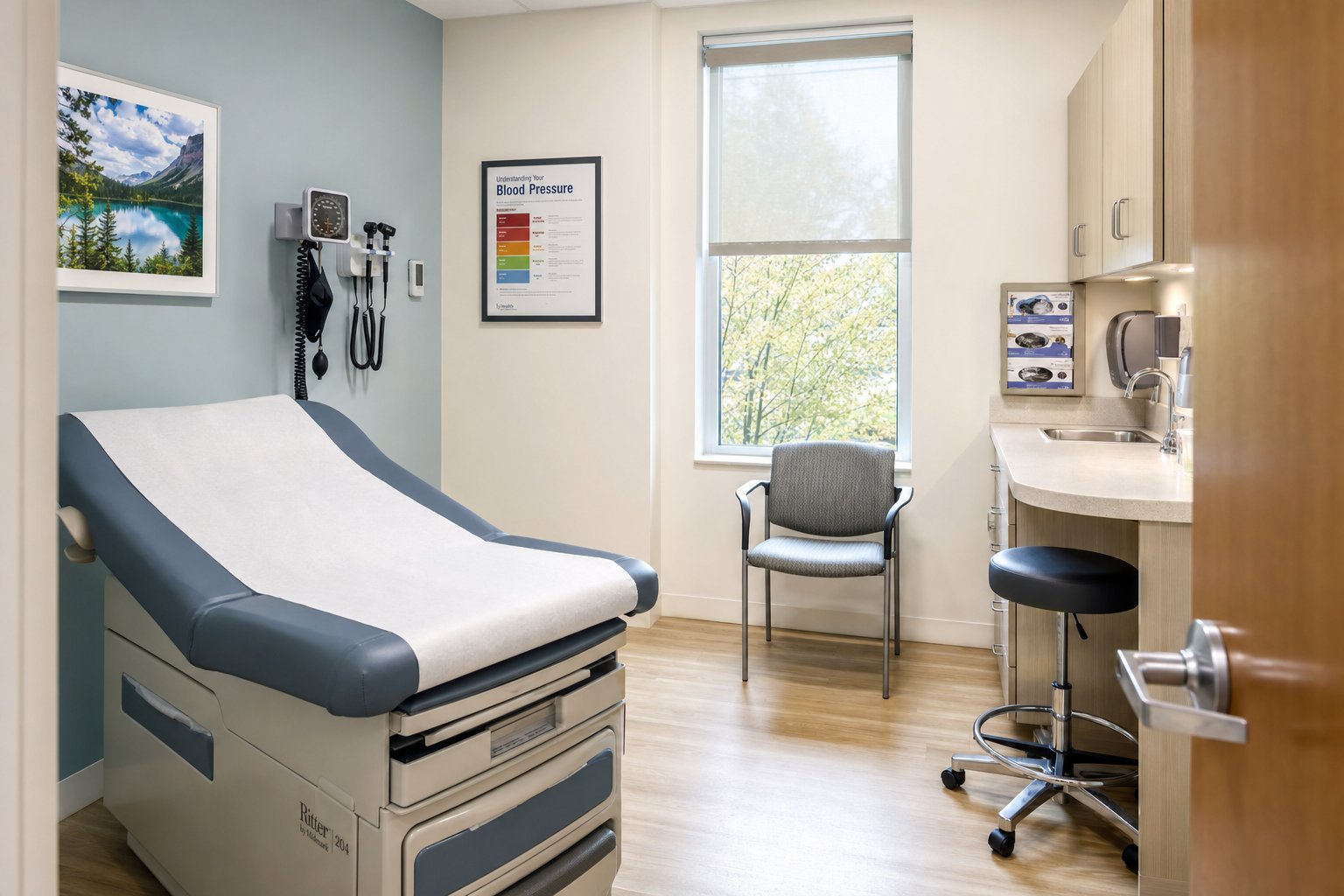
Urgent care clinics operate under constant time pressure: high patient throughput, unpredictable volumes, and continuous use of waiting rooms, exam rooms, and restrooms. In NYC and across the tri-state, urgent cares near transit hubs and retail corridors see high foot traffic and rapid contamination pathways. GreenPoint Maintenance Services supports urgent care environments with cleaning programs built around repeatable cadences, compliant chemical handling, and proof-driven verification—JaniTrack timestamped photo documentation and optional ATP surface testing. For a walkthrough and fixed-price quote, call 347-332-9348.
Urgent care vs. typical medical office: throughput changes everything
A standard medical office can schedule around cleaning; urgent care can’t. Rooms turn over continuously, and waiting rooms behave like a small transportation terminal during peak hours. That means your cleaning plan needs both a nightly deep reset and a daytime “keep up” strategy: trash control, restroom touch-ups, high-touch wipe-down, and quick floor spot response.
In the tri-state, urgent care sites often sit on busy corridors—Queens Boulevard, Atlantic Avenue, Fordham Road, Northern Boulevard, Newark’s Market Street—where outdoor soil and particulate enter constantly. GreenPoint mitigates this with entry-mat plans, HEPA vacuuming, and more frequent floor edge detail so the clinic looks and feels clean even when volume spikes. To scope a day+night cadence, call 347-332-9348.
Daytime touch-up service: the most cost-effective add-on
For many urgent cares, the best ROI is a short daytime touch-up (often 1–2 hours) focused on the highest-visibility and highest-risk areas: restrooms, waiting room high-touch, trash resets, and spot-mopping. GreenPoint scopes this as a defined checklist, not vague “maintenance,” and verifies completion with JaniTrack photos.
A typical touch-up might include: disinfecting door hardware and check-in devices, wiping seating arms, resetting trash at the reception and triage area, servicing restrooms, and cleaning any visible spills. This stabilizes appearance and reduces end-of-day buildup, often lowering the total cost of deep cleaning.
Exam room turnover: define what staff does vs. what janitorial does
Clinical staff typically handles procedure-level disinfection and biohazard processes; janitorial teams maintain the environment—floors, high-touch in public areas, and approved surfaces. The key is a written responsibility matrix so no one is improvising around sharps, blood-contaminated materials, or regulated waste.
GreenPoint helps urgent cares document those boundaries and align chemical handling with OSHA hazard communication expectations (labeling, SDS access, training). For chemical safety fundamentals, see [OSHA cleaning chemical safety (GHS/SDS)](/blog/osha-cleaning-chemical-safety-ghs-sds/).
Waiting room and front desk: high-touch surfaces that drive complaints
The waiting room is the “public face” of infection control. High-touch points include check-in kiosks, clipboards, pens, chair arms, side tables, and door hardware. GreenPoint builds a high-touch map and a consistent wipe sequence so these surfaces are disinfected reliably without slowing operations.
We also recommend operational tweaks: reduce clutter that traps dust, place sanitizer where it’s visible, and standardize trash can placement to prevent overflow. These changes help urgent cares maintain a professional appearance even when patient volume surges.
Restrooms: service levels for high-volume clinics
Restrooms are a high-frequency, high-visibility failure point. For urgent cares, a nightly clean alone may not be enough. GreenPoint often recommends a daytime touch-up for restrooms: disinfect touchpoints, spot-clean floors, reset trash, and verify stocking.
Stocking can be managed with min/max par levels (tissue, paper towels, soap). If you want a fixed-price service that includes consumables, call 347-332-9348 for a walkthrough and proposal.
Quality assurance you can defend: JaniTrack + ATP options
Healthcare-adjacent environments benefit from objective documentation. GreenPoint’s JaniTrack verification provides timestamped photo evidence of completed areas, and ATP testing can be added to spot-check high-touch surfaces for cleanliness. This evidence reduces disputes and supports internal audits.
If you manage multiple urgent care locations across NYC, Westchester, Northern NJ, or Southern CT, GreenPoint can standardize checklists and QA scoring so each site meets the same baseline. Call 347-332-9348 to discuss multi-site support.
FAQ: urgent care clinic cleaning
Q: Should urgent care clinics be cleaned during operating hours? A: High-volume sites often benefit from a short daytime touch-up focused on restrooms, waiting room high-touch, trash, and spills. Q: How often should high-touch surfaces be disinfected? A: Waiting room and front-desk high-touch surfaces should be disinfected multiple times daily during peaks, plus a nightly reset. Q: Can cleaners handle biohazard waste? A: Regulated waste and sharps should be managed by clinical staff or licensed services; janitorial should follow a written responsibility matrix. Q: How do you avoid harsh chemical odor? A: Proper dilution, microfiber technique, and product selection maintain effective disinfection without overwhelming odor. Q: How do we prove cleaning quality? A: GreenPoint provides JaniTrack verification photos and can add ATP testing for objective spot checks.
Need an urgent care cleaning partner built for high volume? GreenPoint Maintenance Services provides fixed-price janitorial across NYC and the tri-state, with JaniTrack verification photos and optional ATP testing. Call 347-332-9348 for a walkthrough and same-week proposal—GreenPoint is proof-driven, MBE-certified, and trusted with 98% client retention.