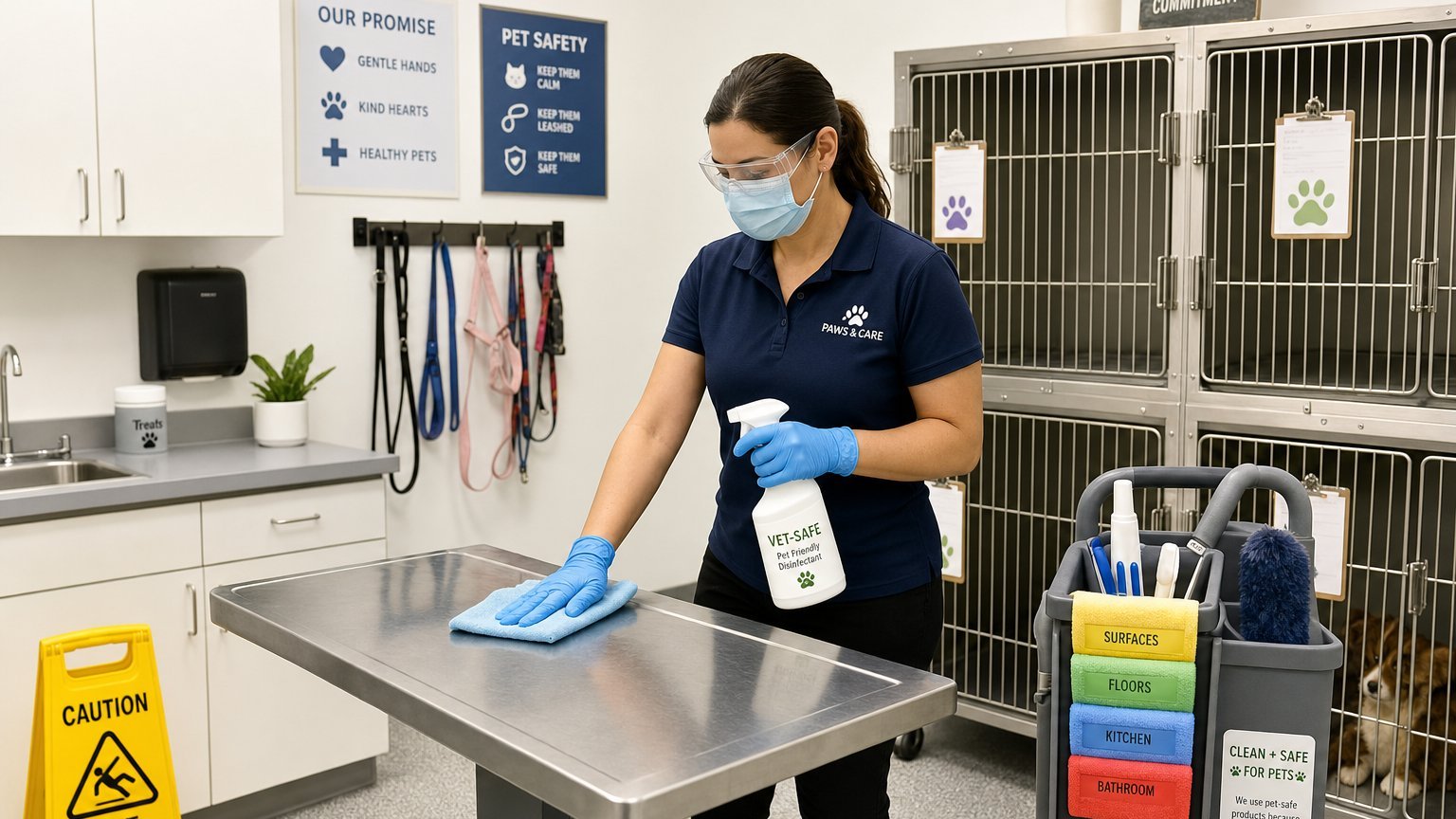
Veterinary practices in Manhattan, the Bronx, Brooklyn, Queens, Staten Island, Westchester, Long Island, New Jersey, and Connecticut clean around hair, dander, body fluids, surgical residue, and worried owners every day. A general office checklist is not enough. The right veterinary practice cleaning protocol separates patient-care zones, selects products that are effective without creating avoidable animal exposure, and leaves a record a practice manager can defend. GreenPoint Maintenance Services builds that operating system for clinics, animal hospitals, boarding areas, and specialty practices. Call 844-814-0810 or schedule a walkthrough so the scope reflects your actual exam rooms, runs, lobby, and waste flow.
Why veterinary facilities need a different cleaning plan
A veterinary facility has several risk profiles under one roof. A reception desk may need frequent touchpoint cleaning, while an isolation room requires controlled entry, dedicated tools, and a documented terminal-clean process. Treatment tables collect fur and organic soil; kennel floors see urine and feces; dental and surgical areas introduce additional splash and instrument-handling concerns. GreenPoint starts by mapping traffic from public entrance to exam, treatment, boarding, laundry, and waste areas instead of treating every square foot as interchangeable.
The plan should also account for the local operating context. A Queens practice near Jamaica Avenue, a Westchester animal hospital with overnight boarding, and a Hoboken clinic serving commuters will have different arrival peaks and loading constraints. GreenPoint Maintenance Services schedules work around appointments and boarding rounds, confirms chemical storage, and assigns color-coded microfiber by zone. Managers can request a fixed-price walkthrough at 844-814-0810 rather than accepting an hourly estimate that hides the work required.
Zoning, traffic flow, and color-coded tools
Zoning is the foundation of a defensible protocol. Establish at least public, clinical, isolation, kennel, food-preparation, and waste-handling zones; then document which staff and supplies may move between them. A clean-to-dirty route reduces accidental transfer: lobby and offices first, routine exam rooms next, treatment and kennel areas after, and isolation or visibly contaminated spaces last. GreenPoint uses separate labeled kits, fresh solutions, and dedicated mop heads so a tool used beside a kennel is not carried into a surgery-prep area.
A floor plan should show hand-hygiene points, PPE stations, drain locations, and the direction of waste removal. In Brooklyn or Stamford facilities where space is tight, vertical shelving and sealed containers can keep clean supplies above splash height. The [color-coded microfiber systems guide](/blog/color-coded-microfiber-systems-guide/) explains the logic behind separating cloths by task. GreenPoint documents exceptions, trains the assigned team, and reviews the map whenever the practice adds a new ward, dental room, or boarding run.
Pet-safe chemistry and contact time
Product selection must balance pathogen claims, surface compatibility, odor, and animal safety. The label is the controlling document: staff need the required dilution, wet contact time, ventilation instruction, and surface restrictions. A disinfectant that is effective only while a surface remains visibly wet for 10 minutes cannot be treated as a quick spray-and-wipe product. GreenPoint trains technicians to pre-clean organic soil, apply the labeled amount, respect contact time, and prevent animals from returning before the area is ready.
Veterinary managers should keep current Safety Data Sheets accessible and never mix products to chase a stronger result. OSHA's [Hazard Communication Standard] (https://www.osha.gov/hazcom) requires employers to communicate chemical hazards and maintain labels and safety information. GreenPoint Maintenance Services uses Green Seal certified products where the task and label allow, while escalating specialty disinfectant choices to the manager. At 844-814-0810, a walkthrough can identify odor complaints, sensitive species, ventilation limits, and surfaces such as rubber flooring, stainless steel, sealed concrete, or epoxy.
Hair, dander, and organic-soil removal
Hair is not merely a cosmetic nuisance: it carries oils and organic soil, clogs drains, loads filters, and can hide residue at baseboards or under kennel furniture. A reliable sequence is dry removal first, damp cleaning second, and disinfection after the surface is visibly clean. HEPA-filtered vacuuming, lint-free tools, and controlled waste collection are more useful than repeatedly wet-mopping a hair-covered floor. GreenPoint assigns frequencies by traffic: lobby touchpoints may need multiple checks per day, while low-use administrative offices can follow a different cadence.
Use the same inspection discipline for dander and dust on ledges, radiators, cage tops, and door closers. The [HEPA filtration commercial cleaning guide](/blog/hepa-filtration-commercial-cleaning/) covers why capture matters in occupied buildings. GreenPoint records exceptions such as a shedding patient surge, construction dust, or a broken vacuum seal in the shift log. The supervisor can then add a targeted detail visit instead of letting a practice pay for blanket, undocumented overtime.
Odor control without masking the source
Odor control begins with finding the source: a drain trap, porous grout, bedding cart, waste container, mop head, HVAC filter, or repeated accident beneath equipment. Fragrance can mask a problem while adding an irritant to a small waiting room. GreenPoint's team checks high-risk locations, removes soil, cleans the container or drain area, and reports maintenance conditions that cleaning alone cannot solve. In an Upper West Side clinic with limited ventilation, source removal and dwell-time discipline are safer than saturating the air with perfume.
A practical odor log records location, time, weather or humidity, animal-care activity, suspected source, action, and recheck result. That information helps a Bronx or Paramus practice distinguish a one-time accident from a recurring plumbing or waste-flow problem. GreenPoint Maintenance Services can coordinate the cleaning scope with the facility contact and schedule a walkthrough through 844-814-0810. Fixed pricing makes the recurring protocol visible without hidden fees or hourly billing.
Isolation rooms, surgery, and high-risk areas
Isolation and procedure rooms require written entry and exit steps, not just a stronger chemical. Post the required PPE, restrict traffic, stage dedicated supplies, and remove waste in sealed containers according to the practice's policy. Clean from higher to lower surfaces and from cleaner areas toward the exit; change gloves and cloths when the workflow says contamination has occurred. GreenPoint supervisors verify that the isolation sequence is followed and that a room is released only after the labeled contact time and drying requirements are complete.
For surgery, dental, and recovery spaces, the cleaning schedule should identify between-case resets, end-of-day cleaning, and periodic detail work on lights, casters, corners, and equipment bases. CDC's [environmental infection control guidance](https://www.cdc.gov/infection-control/hcp/environmental-control/) provides a useful framework for environmental surfaces, but the practice's veterinarian and infection-control policies remain essential. GreenPoint does not substitute a blog checklist for clinical direction; it converts the approved direction into repeatable assignments, sign-offs, and escalation notes.
Verification, ATP checks, and manager reporting
A completed checklist proves that someone checked a box; it does not always prove that the right surface was clean. GreenPoint uses StockPoint to pair timestamped, GPS-tagged photos with route completion, exception notes, and manager visibility. Where the scope calls for it, ATP testing can provide a rapid hygiene indicator on selected high-touch surfaces, with results interpreted as a trend and not as a replacement for the disinfectant label or microbiology testing. A manager can see whether a missed area was corrected and when.
Set a practical cadence: supervisor review every visit, trend review weekly, and a formal scope review monthly or after a complaint, remodel, or disease-control event. The [digital cleaning verification systems guide](/blog/digital-cleaning-verification-systems-guide/) shows how evidence turns quality conversations into corrective actions. GreenPoint Maintenance Services reports failed checks with owner, due time, and resolution rather than burying them in a generic satisfaction score. That proof-driven approach supports GreenPoint's 98% client retention rate.
Scheduling and local compliance readiness
Veterinary practices operate across tight urban schedules. A clinic near Grand Central may need a quiet overnight team; a Staten Island hospital may need loading coordination; a Long Island facility may need weekend kennel detailing; and a New Jersey or Connecticut hospital may need a route that avoids morning patient intake. GreenPoint builds a service matrix for daily, between-shift, weekly, and monthly tasks, then identifies who approves access and who receives exception alerts. Managers can call 844-814-0810 to schedule a no-obligation walkthrough.
The matrix should include sharps and regulated-waste boundaries, slip resistance, emergency spill response, PPE restocking, and communication with veterinary staff. GreenPoint is MBE/MWBE certified in New York, registered in SAM.gov, and familiar with vendor documentation expectations for institutional buyers. It provides fixed pricing with no hourly billing and no hidden fees. For a multi-site group, GreenPoint can standardize the protocol while allowing each location to retain its own isolation map, hours, and local contact.
Before launch, GreenPoint recommends a seven-day baseline: list every room, record traffic and visible trouble spots, observe one full cleaning route, and review the exceptions with the practice manager. Set a small number of measurable standards, such as exam-room release timing, kennel odor checks, restroom touchpoint completion, supply availability, and isolation-room sign-off. This turns a broad promise into a service that staff can evaluate.
At the 30-day review, compare complaints, repeat misses, ATP trends if included, photo evidence, and time spent by zone. If boarding volume rises or a new dental service opens, adjust the room matrix instead of asking technicians to improvise. GreenPoint documents the change, retrains the affected route, and keeps the prior record available for comparison. A manager who needs help can call 844-814-0810 for a scope review.
The most durable veterinary protocol is practical for the people who use it. It keeps clean supplies protected, keeps contaminated work last, gives staff a clear escalation path, and makes the result visible without interrupting patient care. GreenPoint Maintenance Services combines that discipline with StockPoint evidence and fixed pricing so a clinic can improve outcomes without guessing what the invoice represents.
Keep the handoff simple for veterinary staff: one current room map, one approved chemical list, one escalation number, and one dashboard view. GreenPoint reviews the operating reality with the practice manager and adjusts the service when patient volume, boarding, or clinical equipment changes.
That discipline gives a buyer something better than a generic service promise: a repeatable scope, a visible exception path, and a clear way to decide whether the program is working. GreenPoint Maintenance Services can walk through the details, answer questions about products and staffing, and provide a written fixed-price quote. Call 844-814-0810 to put the next step on the calendar.
Frequently Asked Questions
Q: How often should a veterinary exam room be cleaned? A: Clean and disinfect between patients when the practice protocol requires it, with a full end-of-day reset and periodic detail work. Frequency depends on patient volume, contamination, and the room's role; GreenPoint confirms the schedule during a walkthrough rather than guessing from square footage.
Q: Can GreenPoint use low-odor or environmentally preferable products? A: Yes, when the selected product's label, efficacy, surface compatibility, and veterinary policy support the choice. GreenPoint Maintenance Services uses Green Seal certified products where appropriate and documents any specialty chemistry required for a defined pathogen or material.
Q: How should an isolation room be cleaned? A: Use dedicated supplies, required PPE, a controlled clean-to-dirty sequence, labeled contact time, sealed waste handling, and a release check. The veterinarian's infection-control policy governs; GreenPoint operationalizes that policy and records completion in StockPoint.
Q: Does ATP testing replace disinfection? A: No. ATP can provide a rapid indicator for selected surfaces and help identify trends, but it does not replace pre-cleaning, a registered disinfectant label, contact time, or clinical judgment. GreenPoint treats ATP as one evidence layer in a broader quality program.
Q: What does a veterinary cleaning quote include? A: GreenPoint scopes zones, surfaces, frequencies, access windows, supplies, verification, and exclusions, then provides fixed pricing. Call 844-814-0810 to schedule a walkthrough for a clinic, animal hospital, boarding operation, or multi-site group.
Schedule a veterinary practice cleaning walkthrough with GreenPoint Maintenance Services at 844-814-0810. Get fixed pricing, pet-conscious protocols, StockPoint evidence, and a service plan backed by GreenPoint's 98% client retention rate.