New Jersey warehouses and distribution centers run on speed, safety, and inspection readiness. Whether you operate along the NJ Turnpike corridor, near Port Newark-Elizabeth, or around I-78 and I-287, your cleaning program impacts slip-and-fall risk, pest pressure, product integrity, and employee satisfaction. GreenPoint Maintenance Services delivers warehouse cleaning in NJ and the broader tri-state with a proof-driven approach: fixed pricing, documented SOPs, and StockPoint verification with timestamped GPS-tagged photos and optional ATP testing. To schedule a walkthrough and quote, call 844-814-0810.
What "Amazon-tier" warehouse cleaning really means
Many facility teams use "Amazon-tier" as shorthand for high expectations: consistent floor traction, clear aisles, controlled dust, clean restrooms, and documentation that proves standards are maintained. While every network has its own playbook, the theme is the same: audits reward repeatable systems, not one-time deep cleans.
GreenPoint treats warehouse cleaning as a production support service. We build a site-specific plan that keeps high-traffic zones stable (inbound, outbound, pack areas, pedestrian crossings) while keeping secondary areas (racking perimeters, mezzanines, dock edges) on a defined cycle. The goal is to make cleanliness predictable for managers, safety teams, and visiting customers.
5S and housekeeping: cleaning as part of operational discipline
Warehouse leaders who use 5S know that cleaning is not cosmetic; it is a way to expose problems early. Dust lines along racking, debris under conveyors, or sticky residues near pack stations can signal process issues. A strong janitorial program supports 5S by making it easy to see when something is out of standard.
GreenPoint aligns cleaning checklists to your 5S zones and safety markings: keeping pedestrian lanes clear, cleaning around floor tape without destroying it, and maintaining predictable standards at safety eyewash stations and first-aid points. We document completion with StockPoint so supervisors can verify zones without walking the entire building. If you want a walkthrough and a fixed-price scope, call 844-814-0810.
Floor care in distribution centers: ride-on scrubber programs that actually work
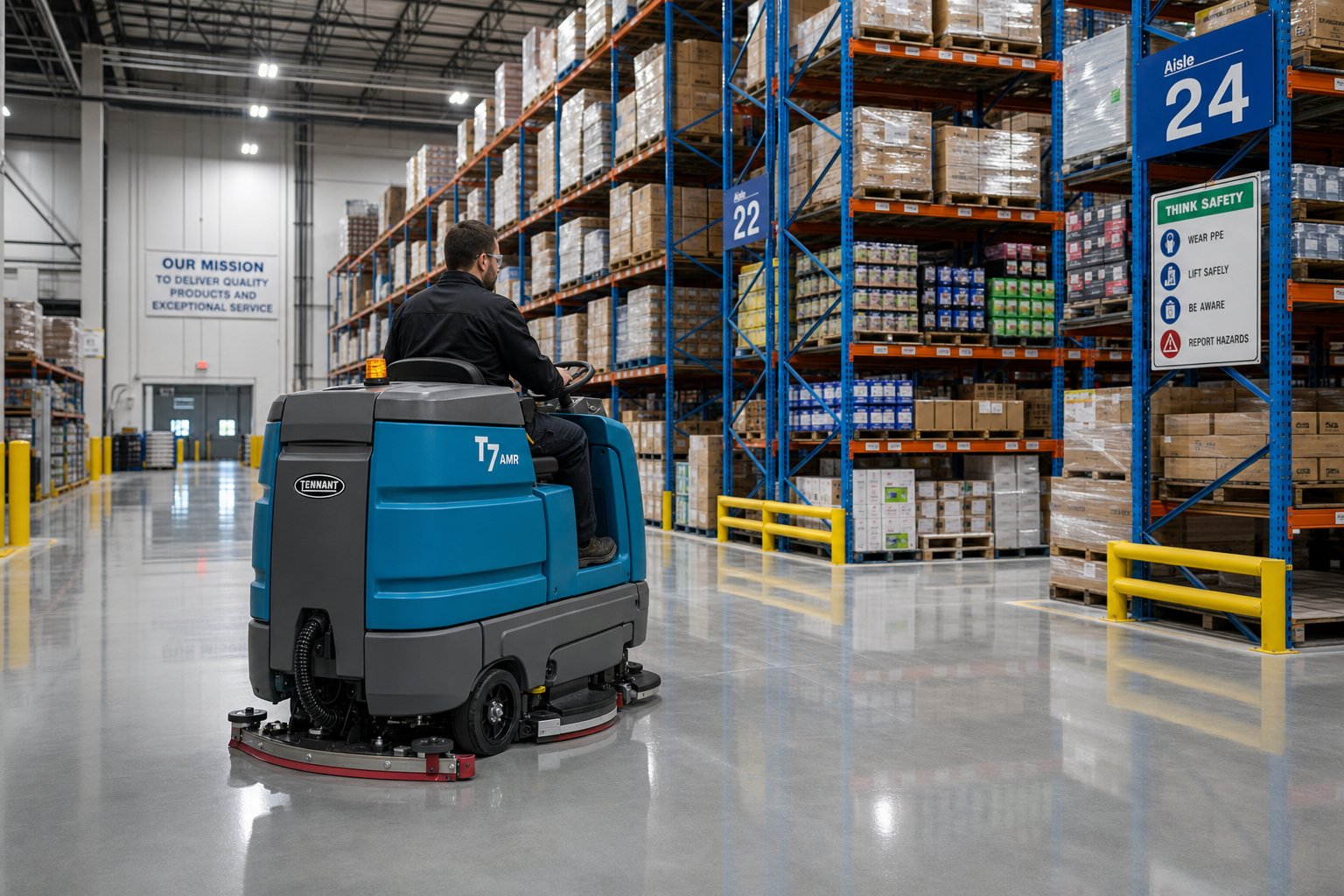
In NJ distribution centers, the floor is where risk concentrates: forklift tires track in grit, dock plates collect residue, and breakroom traffic brings spills. A ride-on scrubber program can be highly effective, but only if the schedule, chemistry, and recovery practices match the soil load and the floor type (sealed concrete, epoxy, VCT, or other).
GreenPoint plans floor care by zone: daily scrub in primary travel lanes, targeted degreasing near docks and maintenance areas, and periodic detail along racking edges and under pedestrian barriers. We also define winter procedures, because salt and slush tracked in from parking lots and loading yards can destroy traction and finish. For deeper detail on floor surfaces, see our buyer guide on [VCT floor care strip/seal/wax](/blog/vct-floor-care-strip-seal-wax-guide/) and our comparison of [carpet cleaning methods](/blog/carpet-cleaning-methods-compared/).
Restrooms and break rooms: the highest ROI cleaning zones
If you run multiple shifts, your restrooms and break rooms are the fastest place for dissatisfaction (and complaints) to spread. These areas also have higher microbial load and frequent touchpoints. Evidence-based cleaning means: proper dwell times for disinfectants, correct dilution, and consistent servicing frequency by headcount and shift schedule.
GreenPoint schedules restroom and break room standards to match your operations: higher frequency during peak shift changes, supply checks aligned to break times, and periodic deep detail (vents, baseboards, grout lines). For facilities that want objective proof, ATP testing can be used as a spot-check tool, and StockPoint photo logs provide an audit trail. To discuss the right service level for your headcount, call 844-814-0810.
Dust, debris, and product integrity: controlling contamination in high-volume sites
Dust control in warehouses is not only about appearance. Fine particulates can settle on packaging, migrate to sensitive areas, and increase maintenance burdens on equipment. Debris buildup under conveyor lines or near balers can also increase fire load and create safety hazards. Many facilities align housekeeping with OSHA-style expectations for keeping work areas orderly and minimizing trip hazards.
GreenPoint uses controlled microfiber systems, HEPA filtration where appropriate, and a defined cadence for high ledges, racking perimeters, and
Audit readiness: what you should be able to prove every month
Audits do not just ask if the building looks clean today; they ask whether you have a system that stays clean. That means logs, standardized checklists, and evidence. For warehouse cleaning, the most useful proof includes: photos of critical zones (docks, restrooms, lanes), floor care schedules, incident/response logs, and any test data used for verification.
GreenPoint delivers verification through StockPoint: timestamped, GPS-tagged photos tied to zones, supervisor review, and documented corrective actions when issues are found. If you want to build a KPI view, our article on [quality assurance commercial cleaning programs](/blog/quality-assurance-commercial-cleaning-program/) covers how facility teams should structure inspections and metrics.
NJ location details that affect cleaning scope and staffing
Local conditions drive soil load and staffing. Warehouses near Port Newark and Elizabeth often deal with heavier tracked-in grit and diesel residue near dock areas. Sites near Secaucus and Meadowlands hubs may have extreme peak volumes and require cleaning that resets restrooms and break rooms multiple times a day. Facilities around Edison, Piscataway, and Parsippany often operate mixed office/warehouse footprints that need a bundled plan.
GreenPoint scopes around your shift schedule and your traffic patterns, not generic square-foot formulas. We also operate with fixed pricing so you can budget without surprise hourly add-ons, and we provide clear communication so your supervisors know what to expect each day. Call 844-814-0810 to schedule a walkthrough.
Safety, OSHA, and the cost of a single incident
Warehouse environments combine forklift traffic, elevated work, chemical storage, dock plates, and high-volume foot traffic. According to the Bureau of Labor Statistics, the warehousing and storage industry runs above-average injury and illness rates compared to private industry overall. A single slip-and-fall on a wet aisle or chemical exposure incident can cost six figures in workers' comp, OSHA penalties, and downtime — far more than any cleaning contract. That is the math facility managers need to make to leadership when justifying a real cleaning program instead of the cheapest hourly vendor.
GreenPoint Maintenance Services structures warehouse cleaning around hazard reduction: scheduled deep-scrub cycles on the most-trafficked aisles, OSHA-compliant signage and barrier protocols around active cleaning zones, lockout/tagout-aware crews around equipment areas, and SDS-managed chemical storage compliant with OSHA's Hazard Communication Standard (29 CFR 1910.1200). All cleaning work is documented through StockPoint with timestamped photos, so when an OSHA inspector or insurance adjuster asks for proof of preventive housekeeping, you have a defensible record on hand.
Equipment and crew: what professional warehouse cleaning actually requires
Warehouse-grade cleaning is not a mop-and-bucket operation. The right toolkit includes ride-on auto-scrubbers sized for aisle width, industrial sweepers for dock and yard areas, HEPA backpack vacuums for racking and overhead beam dusting, pressure washers for loading docks, and lift equipment for high-shelf and ceiling-fan cleaning. Crews need PIT (powered industrial truck) awareness, fall-protection training where applicable, and basic forklift-pedestrian safety training. GreenPoint deploys the equipment as part of the contract — there are no add-on equipment fees or last-minute rental surprises.
Crew structure matters too: a working supervisor on-site, defined zone assignments, and a single point of contact for the facility manager. That is how you avoid the common pattern of warehouse cleaning vendors who send unsupervised, undertrained crews on rotating schedules with nobody accountable. For a deeper look at why this matters, see [vendor consolidation: one cleaning company](/blog/vendor-consolidation-one-cleaning-company/) and [janitorial employee turnover impact](/blog/janitorial-employee-turnover-impact/) — turnover is a leading indicator of service degradation.
Amazon-tier audit cadence: what 'audit-ready' means in practice
When facility managers say they need 'Amazon-tier' standards, they usually mean three things: continuous documentation, fast response to audit findings, and zero tolerance for repeat issues. In an Amazon fulfillment center, vendor performance is measured by metrics like Concession Per Cart (CPC), inbound-defect rates, and audit-photo completion percentages. The vendor that consistently hits target metrics keeps the contract. The vendor that does not is replaced — usually within a single quarter. GreenPoint Maintenance Services brings the same operational discipline to non-Amazon warehouses, distribution centers, and 3PL facilities across the tri-state: weekly audit cycles, photo proof per zone, and a corrective-action workflow that closes findings within 48 hours.
Practical Amazon-tier audit checklist for your facility: (1) restrooms inspected at minimum once per shift with timestamped photo proof; (2) break rooms wiped and trash-emptied between shifts; (3) main aisles scrubbed daily, with cycle counts visible on a shared dashboard; (4) trash dock zones inspected and photographed at each pickup; (5) any safety hazard (spill, broken pallet, leak) flagged in StockPoint within 15 minutes of discovery; (6) monthly facility walkthrough with facility manager and GreenPoint supervisor; (7) quarterly business review with metrics trending and corrective-action review. Call 844-814-0810 to set this up at your facility.
Pricing model: why fixed pricing beats hourly billing in warehouses
Hourly cleaning contracts incentivize the wrong behaviors. The vendor makes more when the crew is slower, when supervisors are not on-site to manage labor, and when standards drift. Worse, the budget becomes unpredictable: one month the bill is $8,000, the next it is $12,000, with no clear explanation. GreenPoint uses fixed-price contracts with defined scope, defined frequency, and defined outcomes. You know what you are paying every month, what work is included, and what proof you will receive. If your scope grows — new dock door added, new mezzanine office finished — we re-scope and re-price transparently. No hidden hourly creep.
Why GreenPoint is built for warehouse and distribution clients
GreenPoint Maintenance Services is an MBE-certified commercial cleaning partner with a track record of reliable execution and 98% client retention. We bring structured quality controls, trained industrial crews, and verification tooling that reduces management overhead for busy facility teams.
We also support compliance-minded organizations with documentation, consistent supervision, and Green Seal certified products where appropriate. If you need warehouse cleaning in NJ or across the tri-state with audit-ready proof, call 844-814-0810 for a walkthrough and fixed-price quote.
Get Amazon-tier warehouse cleaning standards without the chaos. Schedule a walkthrough with GreenPoint Maintenance Services for fixed pricing, documented SOPs, and StockPoint verification (timestamped, GPS-tagged photos and optional ATP testing). Call 844-814-0810 or email info@greenpointms.com.