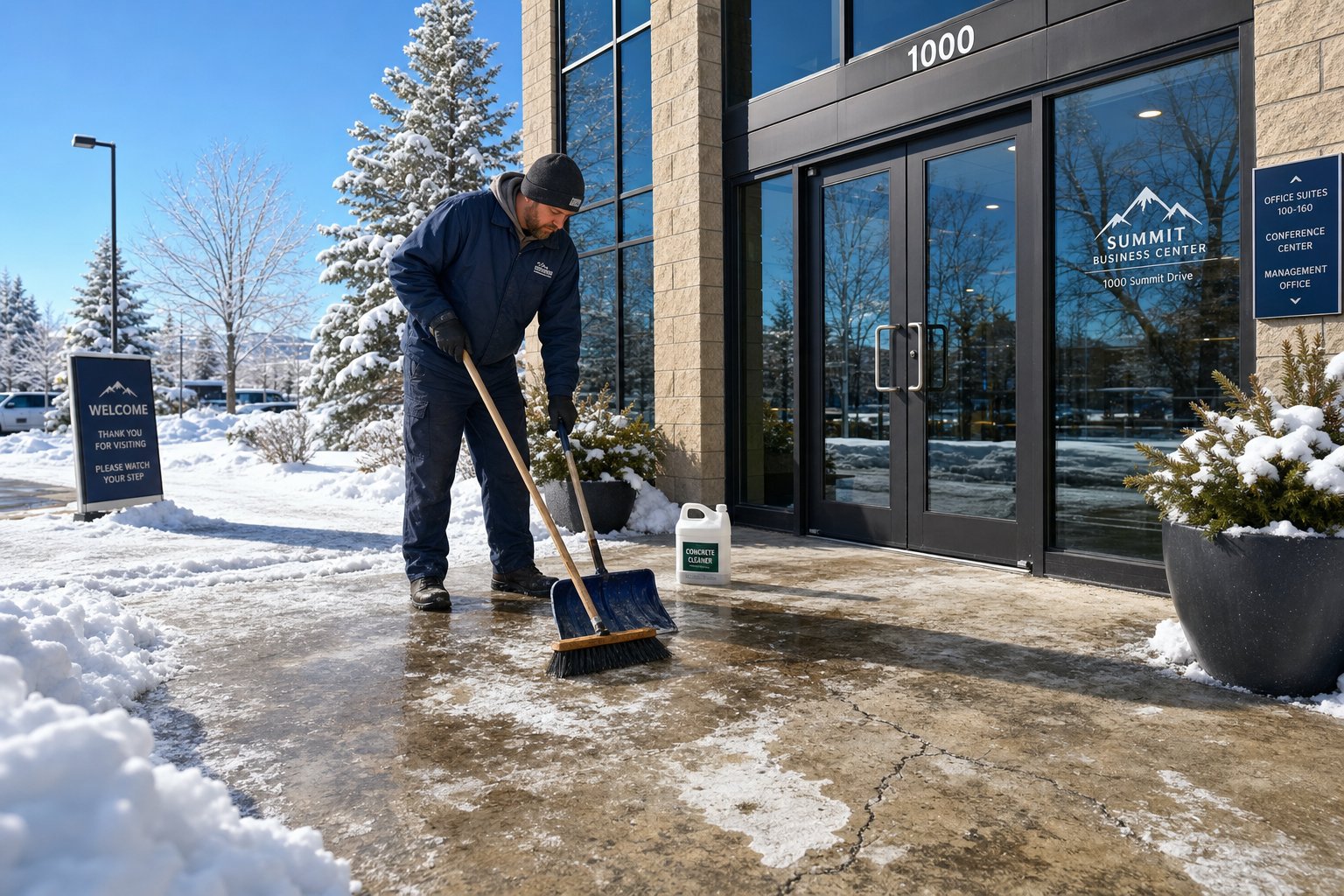
In the tri-state area, winter salt and de-icers are one of the fastest ways to ruin commercial floors. They etch stone, dull VCT, leave white residue lines in lobbies, and turn entryways into slip hazards—especially in Manhattan towers, Brooklyn multifamily lobbies, NJ corporate campuses, and Westchester medical buildings. GreenPoint Maintenance Services helps facilities prevent salt damage with a measured winter plan: entryway matting design, high-frequency soil removal, and restorative floor care that protects finishes instead of stripping them prematurely. For a floor walkthrough and fixed-price proposal, call 844-814-0810.
Why salt is so destructive: residue, abrasion, and chemical attack
Salt damage is a triple hit. First, salt residue attracts moisture and leaves white deposits that look like “dirty floors” even when the space is cleaned. Second, grit and tracked-in sand create abrasion that scratches finishes. Third, de-icing chemicals can chemically attack certain stones and weaken floor finish films. The outcome is faster dulling, more frequent burnishing needs, and ultimately expensive restoration.
GreenPoint Maintenance Services treats winter as a special operating season, not business-as-usual. We adjust frequencies, tools, and floor chemistry for the months when snow, slush, and salt are constant. If you’re seeing recurring salt lines at entrances or elevator lobbies, call 844-814-0810 to schedule a winter floor assessment.
Entryway matting: the highest ROI winter “floor care” investment
The most cost-effective way to protect floors is to stop salt at the door. A strong matting plan has three zones: exterior scraper mats (remove grit), vestibule wiper mats (absorb moisture), and interior runner mats (capture what remains). A practical benchmark is 10–15 feet of walk-off matting in the primary path of travel; more is better in high-traffic lobbies and transit-adjacent properties.
GreenPoint can help managers choose mat types, placement, and change-out cadence. We also build the cleaning scope around mat maintenance—because dirty mats become their own mess. For broader winter planning, see [winter facility maintenance checklist Northeast](/blog/winter-facility-maintenance-checklist-northeast/).
Winter cleaning frequencies: what should change from December to March
Most properties under-clean floors in winter because the contract frequency wasn’t designed for salt season. In many buildings, lobbies and entrances need multiple daily passes during storms: vacuum/microfiber dusting to capture grit, plus damp mopping or auto-scrubbing to remove residue before it dries. Elevator lobbies and stairwells often need increased attention because they receive concentrated traffic.
A useful planning heuristic: when snow is on the ground, increase entryway floor attention by 2–3x compared to summer. GreenPoint scopes this by zone so you’re not paying to “over-clean” low-traffic corridors while entrances suffer. To align frequencies with standards, reference [cleaning frequency standards by facility type](/blog/cleaning-frequency-standards-by-facility-type/).
Floor type matters: VCT vs stone vs polished concrete
Different floors fail differently in winter. VCT can lose gloss and develop a gray “traffic lane” if salt/grit abrades the finish film. Stone can etch or haze depending on mineral composition and cleaners used. Polished concrete can look cloudy if residue is left to dry. GreenPoint builds floor-specific methods—neutral cleaners for some stones, controlled dilution ratios, and preventative burnishing schedules for VCT that keep the finish protective layer intact.
If your VCT program relies on strip-and-wax, winter is the time to be strategic: stripping too often shortens floor life. Our technical guide on [VCT floor care: strip, seal, wax](/blog/vct-floor-care-strip-seal-wax-guide/) explains how to maintain appearance without unnecessary restoration.
Slip-and-fall risk: what facility managers should document
Slip risk spikes when slush melts in vestibules and residue creates slick films. The controls are simple but must be executed: wet floor signage, rapid response to puddles, and frequent removal of residue. From a liability standpoint, documentation helps—especially for high-traffic lobbies near transit hubs like Penn Station, Grand Central, Fulton Center, Port Authority, and PATH terminals where foot traffic is heavy.
GreenPoint uses StockPoint verification to document winter-condition cleaning: timestamped photo logs of entrance mats, lobby floors, and signage placement during storm days. This provides evidence of reasonable care and helps managers improve process after near-misses.
Restorative recovery: how to remove salt haze without damaging finishes
When salt haze is already visible, the instinct is to use stronger chemicals. That often backfires. The correct approach is usually: (1) dry soil removal (HEPA vacuum/microfiber), (2) controlled wet cleaning with appropriate neutralization, and (3) targeted burnishing or polishing based on floor type. For VCT, a top scrub and recoat may restore protection without full stripping.
GreenPoint Maintenance Services builds recovery tasks into a winter scope so you aren’t reacting each storm. If you manage multiple properties across Manhattan, Brooklyn, Queens, the Bronx, Staten Island, Westchester, or NJ, call 844-814-0810 for a fixed-price winter floor program that standardizes outcomes.
Cost control: why fixed-price floor care beats “hourly extra work” in winter
Winter often triggers “extra bill” events: storm days, salt residue complaints, emergency burnishing. Under hourly billing, costs become unpredictable and incentives misalign. GreenPoint operates on fixed, scope-based pricing with clear winter service tiers. Facility managers can budget with confidence and measure performance by outcomes: gloss level, residue control, complaint rate.
For benchmarking and contract planning, review [commercial cleaning cost per square foot](/blog/commercial-cleaning-cost-per-square-foot/) and [commercial cleaning contract key terms](/blog/commercial-cleaning-contract-key-terms/). Then call 844-814-0810 to schedule a walkthrough and align your winter floor plan to your building’s traffic reality.
Entryway matting math: how far salt actually travels into a building
ISSA and CRI (Carpet & Rug Institute) research consistently shows that 80 to 90% of the soil and salt tracked into a commercial building comes from the first 15 to 25 linear feet inside the entrance — but only if a properly specified matting system is in place. A 'properly specified' system means at least three distinct matting zones: exterior scraper matting (rubber or aggressive stiff-bristle), interior wiper-scraper matting (bi-level construction), and a final interior wiper mat (dense nylon). Most tri-state buildings we audit have one or two zones at most, which is why salt migrates 60 to 100 feet into their floor plans by mid-January.
GreenPoint Maintenance Services routinely walks facilities in October and specifies the matting layout, adhesive-backed edging, and daily vacuuming schedule required to actually intercept the salt. Investing in a proper matting system typically pays for itself within one winter through reduced [VCT and terrazzo damage](/blog/vct-floor-care-strip-seal-wax-guide/), and it also reduces slip-and-fall exposure — a legal cost many facility managers underestimate until they see a demand letter.
Chemistry of salt damage: chloride ions, alkaline residue, and finish failure
Rock salt (sodium chloride) and calcium chloride both leave behind ionic residues that attack floor finishes and grout in different ways. On VCT, the alkaline residue neutralizes the acid catalysts in most floor finishes and causes premature yellowing and delamination. On natural stone, chloride ions penetrate porous surfaces and cause efflorescence — the white powdery deposit that keeps returning no matter how many times you clean the surface. On carpet, salt crystallization within fibers causes both visual damage (the classic white 'tide line') and abrasive fiber wear from the crystalline structure grinding against fibers with foot traffic.
The remediation chemistry depends on the surface. GreenPoint uses a neutral-pH salt-neutralizer detergent on VCT (typical pH 6.5 to 7.5), a poultice-based treatment for efflorescence on stone, and a hot-water extraction protocol with an acidic pre-spray for carpet salt lines. Using the wrong chemistry — for instance, an alkaline degreaser on a terrazzo lobby — can compound the damage into a repair scope that costs 5 to 10 times the seasonal cleaning fee.
January and February deep-clean windows: when to strike and how much it costs
In the tri-state area, we schedule the primary winter salt-damage deep clean during the third or fourth week of January, after the New Year's Day thaw-and-refreeze cycle has driven the maximum salt intrusion. A second lighter cleaning is scheduled in mid-February to catch late-season storms, and a full restorative floor care visit is booked for the last week of March to strip, neutralize, and reseal any VCT or terrazzo that took winter damage. Budgeting benchmark for a typical 40,000 to 60,000 sq ft office building: $0.08 to $0.15 per sq ft for each mid-winter deep clean, and $0.25 to $0.45 per sq ft for the spring restoration.
These numbers vary by finish type, matting quality, and how aggressive your walk-off program is between visits. GreenPoint Maintenance Services can quote your facility on a fixed-price winter program at 844-814-0810 that combines the mid-winter neutralization work with the spring restorative visit for a predictable line item on your Q1 and Q2 budgets.
Documentation and StockPoint: proving the salt didn't cause the damage
For property owners whose leases require them to return tenant space in 'good condition,' salt-damage disputes at lease-end can be expensive and hard to resolve without evidence. GreenPoint's StockPoint platform captures GPS-tagged photos at every scheduled cleaning visit, so building owners have a photographic timeline of floor condition from October through May. When a tenant surrenders a space and the landlord's turnover contractor identifies salt-driven finish failure, the StockPoint record either resolves the dispute (the damage was there before the tenant moved in) or provides evidence supporting a chargeback. This documentation is one of the operational reasons GreenPoint holds a 98% client retention rate — facility managers report they don't want to give up the audit trail.
FAQ: winter salt damage and commercial floors
Q: How much matting do we need to reduce salt damage? A: A common benchmark is 10–15 feet of walk-off matting in the main travel path, plus exterior scraper mats and a vestibule wiper zone; high-traffic lobbies often need more. Q: Should we strip and wax more often in winter? A: Not automatically—often a top scrub and recoat plus better daily residue removal is safer than frequent stripping. Q: What’s the fastest way to fix white salt lines? A: Start with dry grit removal, then controlled wet cleaning with an appropriate neutral cleaner; avoid aggressive acids or over-strong chemicals that can etch stone or soften finish films. Q: Can StockPoint help with slip-and-fall documentation? A: Yes—time-stamped, GPS-tagged photos of entrance conditions, mats, and signage create a structured record of winter response. Q: Do you serve NJ and Westchester sites? A: Yes—GreenPoint supports NY (all boroughs plus Westchester/Long Island), NJ, and CT for tri-state portfolios.
Stop winter salt from destroying your floors. GreenPoint Maintenance Services provides tri-state winter floor programs with fixed pricing, restorative expertise, and StockPoint verification (timestamped, GPS-tagged photos). Call 844-814-0810 or email info@greenpointms.com to schedule a walkthrough and get a winter plan tailored to your lobby, corridors, and entrances.