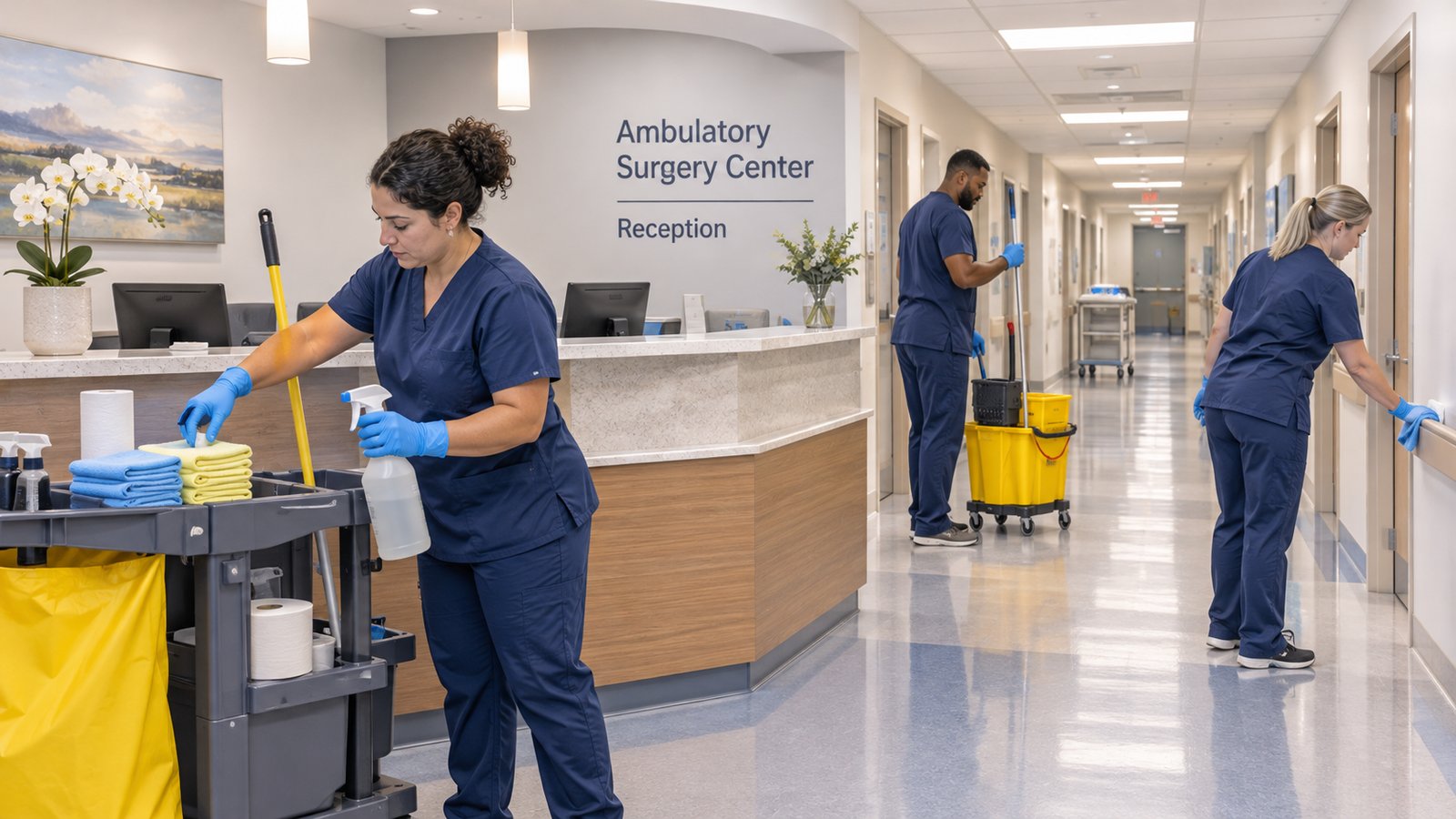
An ambulatory surgery center needs environmental cleaning that supports its infection-prevention program, worker safety, and patient flow. The cleaning contractor must follow facility-approved procedures, respect restricted clinical zones, and know when a task belongs to licensed clinical or reprocessing personnel rather than general janitorial staff. New Jersey centers should also confirm that their vendors understand the facility’s own licensure, survey, and quality expectations. GreenPoint Maintenance Services Corp provides commercial cleaning with documented quality checks and can scope non-clinical and approved environmental-services duties with the center’s leadership. Call 347-332-9348 to schedule a walkthrough with facilities and infection-prevention stakeholders.
Separate Clinical, Public, and Support Areas
Begin with a zone map for reception and waiting, consultation rooms, procedure rooms, recovery areas, staff offices, medication and supply spaces, public restrooms, soiled utility areas, and corridors. Identify surfaces touched by patients or staff, areas restricted to authorized personnel, and any locations that require a specific sequence or protective equipment. A 15-room center with two procedure rooms and a shared recovery area has different cleaning flow from a single-specialty office, even if both occupy similar square footage. GreenPoint uses a walkthrough to document the approved route and confirms which tasks remain under the center’s clinical control.
The contract should not imply that an outside janitorial crew sterilizes instruments, reprocesses devices, handles medications, or cleans equipment without facility authorization. Distinguish environmental surfaces and floors from patient-care equipment, reusable instruments, and clinical devices. Assign each activity to the role trained and authorized by the facility’s policies. GreenPoint Maintenance Services can create a responsibility matrix listing the area, task, frequency, approved product, required PPE, staff qualification, and sign-off. The center’s infection-prevention lead and facilities manager should review that matrix before work starts and whenever procedures, room use, or products change.
Follow a Risk-Based Cleaning Schedule
A center’s schedule should distinguish routine cleaning, between-procedure cleaning where applicable, terminal cleaning at the end of the day, and scheduled low-touch work. CDC’s environmental cleaning procedures describe different frequencies by care area, including cleaning and disinfecting patient-zone surfaces in procedural areas before and after procedures, with facility-approved methods. The center should adapt guidance to its services, patient population, layout, and written policies. GreenPoint follows the center-approved schedule rather than substituting a generic office checklist for clinical requirements.
Give high-touch surfaces and patient-contact zones a clearly defined priority. Examples can include door handles, switches, exam surfaces, chair arms, bed rails, sinks, and accessible counter edges, depending on the room and task. Set an explicit response for visible soil, spills, and room turnover delays. CDC’s core infection prevention and control practices recommend routine and targeted environmental surface cleaning based on patient contact and degree of soiling, and following product instructions for dilution, contact time, compatibility, storage, and safe use. GreenPoint records the approved method and does not independently change it.
Select Products by Label, Organism, and Surface
The center’s infection-prevention program should approve products for the intended surface and organism claim. A disinfectant does not replace physical cleaning unless it is a combined detergent-disinfectant used according to its label. Remove soil first where the protocol requires it, then apply the product for the full label contact time and keep the surface wet as directed. CDC’s disinfection and sterilization recommendations emphasize manufacturer instructions, material compatibility, safe use, and label directions for environmental disinfection. The chosen product should be available to staff with current directions and training.
Avoid unsupported claims such as “hospital grade” being enough to establish fitness for every task. Confirm the EPA registration and label claim when required by the center’s policy, check the stated contact time, and verify that the surface material can tolerate the product. Product substitution should go through infection prevention and facilities rather than a cleaner’s convenience decision. GreenPoint can use Green Seal-certified product options for appropriate nonclinical work, but environmental certification does not replace clinical product approval. The center should maintain the authoritative product list and provide written notice when a protocol or approved brand changes.
Protect Workers and Escalate Blood or Body-Fluid Events
Before assigning staff to clinical zones, determine whether their duties may create occupational exposure to blood or other potentially infectious materials and provide the controls required by the employer’s safety program. OSHA’s Bloodborne Pathogens Standard addresses exposure-control plans, work-practice controls, PPE, training, housekeeping, and related protections. A cleaning contract should define who responds to a spill, which workers are trained and equipped, where sharps containers are located, and when a clinician or supervisor must be called. GreenPoint confirms these responsibilities with the center before service starts.
A general cleaner should not pick up an unknown sharp, handle an uncontained specimen, or enter a room that has not been released for cleaning. The response plan should protect workers, patients, and visitors, and direct the cleaner to stop and notify the designated contact when the hazard is outside the authorized scope. OSHA’s bloodborne pathogens overview explains the employer’s exposure-control responsibilities. GreenPoint documents the escalation route, PPE expectations, and cleanup boundaries in the site plan. The center remains responsible for its exposure-control program and clinical decisions, while the vendor is responsible for the training and service procedures assigned to its own employees.
Document Room Turnover and Quality Checks
A turnover record should identify the room, procedure or service period as permitted by privacy rules, time of cleaning, checklist completion, exceptions, and supervisor review. Do not include patient names or protected health information in janitorial records unless the center has explicitly approved a compliant process. Define a verification method: visual inspection, fluorescent marker audit, ATP measurement, or another facility-approved measure. Each method has limits. ATP measures organic residue and is not a pathogen test; a visual check cannot prove microbiological absence. GreenPoint uses JaniTrack for timestamped work records, GPS-tagged photos when authorized, and a live dashboard, with the center setting privacy and audit rules.
Use findings to improve the process. If a repeated missed point appears on the same room, check whether the checklist is clear, supplies are available, the sequence is workable, and staff have adequate time. Review re-clean events, product/contact-time deviations, access delays, and supply shortages in a routine meeting. GreenPoint can record corrective actions and completion evidence in JaniTrack, while the center’s infection-prevention program interprets clinical significance. Ask for a sample report with identifiers removed and agree how long records are retained and who can access them. The vendor’s report supports oversight but does not replace the center’s required clinical audits.
Check New Jersey Facility and Procurement Expectations
New Jersey’s Department of Health regulates healthcare settings, including ambulatory care and surgery facilities. The center should verify its current facility category, licensure and survey obligations, and vendor requirements with its own compliance lead and the applicable state resources; a cleaning contractor cannot determine the center’s regulatory status from a marketing page. The state’s health facilities information and facility-type descriptions provide starting points for understanding the department’s oversight structure. GreenPoint can align the service records to the facility’s requested documentation but does not represent that a janitorial contract alone establishes regulatory compliance.
Before award, request training documentation, staff screening and access procedures, insurance, references, product lists, safety data sheets, backup coverage, and a written description of the work boundary. Confirm how subcontractors are handled and who owns corrective action when an audit identifies a deficiency. GreenPoint Maintenance Services Corp is MBE-certified and registered in SAM.gov; GreenPoint is also MBE/MWBE certified with New York State, NYC, and NYC DOE. Each center should check procurement eligibility and required documentation under its own policies. For related scope questions, review medical office cleaning requirements and OSHA and healthcare-associated infections and environmental cleaning.
Build a Transparent Vendor Scope and Review Cadence
Specify tasks by area and frequency, approved products, contact-time expectations, supply responsibility, staffing window, sign-off process, and exceptions. State which tasks occur nightly, between procedures, at terminal cleaning, and on a periodic schedule. Identify rooms that require clinical release, restricted access, or a facility escort. A fixed monthly price can be useful when the scope is stable, but it should not obscure the labor or audit plan. GreenPoint Maintenance Services offers fixed pricing without hourly billing or hidden fees for defined work and can list optional deep-cleaning or project work separately for approval.
Set a startup and review cadence with the center’s facilities lead, infection-prevention representative, and vendor supervisor. The first review should confirm access, staff competency, approved products, room sequence, and reporting. Later reviews can examine audit results, missed tasks, coverage, and changes in procedure volume. GreenPoint states that it has a 98% client retention rate; healthcare buyers should ask for the period and denominator behind this company-reported measure, plus references relevant to regulated environments. Call 347-332-9348 to request a New Jersey ASC walkthrough. A detailed quote should be based on the facility’s written protocols rather than assumptions about a generic medical office.
Frequently Asked Questions
Question: Can a janitorial contractor clean an ambulatory surgery procedure room? Answer: Only when the facility authorizes the defined environmental-cleaning tasks, trains and equips assigned staff, and releases the room under its own policy. Instrument reprocessing and clinical equipment duties remain with appropriately trained personnel.
Question: How often should an ASC procedure room be cleaned? Answer: Follow the facility-approved schedule based on the procedure, patient-care zone, visible soil, and applicable guidance. CDC procedures describe before-and-after cleaning for procedural areas, but the center’s infection-prevention program should determine its local protocol.
Question: Does ATP testing prove a room is pathogen-free? Answer: No. ATP is an indicator of organic residue and can support a broader verification program, but it is not a pathogen test or a substitute for facility-approved cleaning and disinfection.
Question: What should an ASC require from a cleaning vendor? Answer: Require a task matrix, product approvals, training and exposure-control information, access safeguards, room-turnover documentation, supervisor audits, corrective-action process, insurance, and references.
Question: How can a New Jersey center request a scoped quote? Answer: Share approved protocols, room inventory, procedure and operating hours, access rules, product list, and current audit concerns. Call GreenPoint Maintenance Services at 347-332-9348 to arrange a walkthrough with facilities and infection prevention.
Request a New Jersey ASC walkthrough with GreenPoint Maintenance Services at 347-332-9348 or info@greenpointms.com. GreenPoint provides fixed-price scopes and JaniTrack documentation; have your infection-prevention lead review the approved task matrix, product list, and verification limits before service begins.