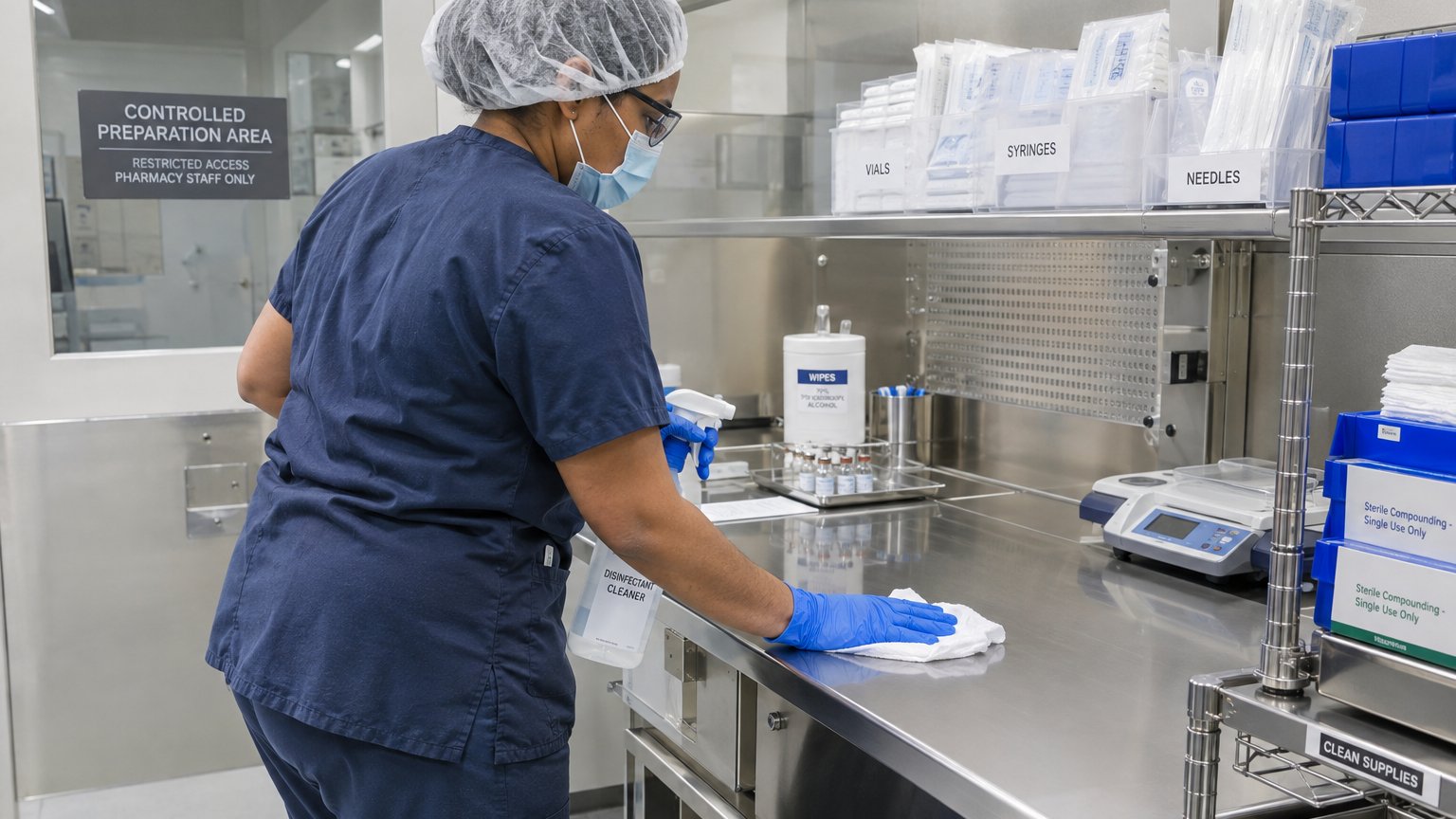
A compounding pharmacy cannot treat cleaning as a generic office service. Public areas, dispensing counters, storage, hazardous-drug rooms, and classified compounding spaces can have different ownership, access, materials, and documented procedures. This guide helps pharmacy owners and facilities buyers in New York City, New Jersey, and Connecticut decide what may be outsourced and what must remain under pharmacy control. GreenPoint Maintenance Services Corp begins with the pharmacy's written procedures and an approved room list; call 347-332-9348 to schedule a confidential walkthrough and define a fixed-price janitorial scope without implying that routine service replaces USP or board requirements.
Classify the facility before inviting a cleaning bid
A retail compounding pharmacy may include a public lobby, consultation area, retail shelves, dispensing counters, staff workroom, storage, and controlled compounding space. Sterile and nonsterile compounding, hazardous drug handling, and the facility's licenses affect the procedures that apply. The pharmacy's designated leadership must identify the applicable USP chapters, state board rules, and internal SOPs; a janitorial contractor should not interpret those requirements on the pharmacy's behalf.
For a clinic-linked pharmacy near Manhattan's hospital corridors, a Queens compounding site, or a New Jersey or Connecticut specialty pharmacy, use a room-by-room matrix. Record classification, permitted personnel, approved materials, cleaning ownership, documentation, and prohibited actions. GreenPoint Maintenance Services asks the pharmacy's quality or compounding lead to approve that matrix before an estimate is finalized. Call 347-332-9348 to arrange a walkthrough that includes the responsible pharmacy representative.
Keep classified compounding work under pharmacy governance
In sterile compounding areas, cleaning and disinfection are part of a controlled process, not an ordinary nightly route. FDA guidance on insanitary conditions in compounding facilities discusses risks such as inadequate cleaning, insufficient surface coverage, and failure to allow a disinfectant's required contact time. The pharmacy must determine the approved sequence, sterile or low-shedding supplies where required, frequency, product, training, and documentation. Do not let a contractor substitute a familiar product or cleaning order for the pharmacy's written procedure.
GreenPoint can provide routine service in approved non-classified zones and, only when authorized and trained, perform narrowly defined tasks under pharmacy SOPs. If a room requires gowning, garbing qualification, environmental monitoring, or controlled access, the pharmacy should specify those requirements before service is proposed. The contract should state who releases a room for cleaning and who documents completion. See medical office cleaning requirements and OSHA guidance and digital cleaning verification systems for related vendor-control considerations.
Separate routine janitorial work from hazardous-drug controls
Some pharmacy environments handle hazardous drugs or contaminated materials. The pharmacy's safety officer must define exposure controls, PPE, room segregation, spill response, waste streams, and which trained role may clean each area. A general janitorial worker should not handle hazardous-drug residue, compounding equipment, used needles, medication waste, or a spill unless the task is specifically authorized, trained, equipped, and included in the contract. Make stop-work and escalation instructions visible to every assigned cleaner.
OSHA's Hazard Communication requirements include communicating chemical hazards through labels, safety data sheets, and training. The contractor should provide its chemical inventory and SDS access, while the pharmacy explains site-specific hazards and access rules. GreenPoint can document which products are used in its contracted zones and maintain a clear boundary around pharmacy-controlled tasks. A phone call to 347-332-9348 can begin a scope review, but the pharmacy's quality and safety leads must approve any restricted-room procedure before mobilization.
Make product choice and contact time auditable
Different surfaces and claims may require different cleaning or disinfecting products. EPA states that a disinfectant must be used according to its label, including the time a treated surface must remain visibly wet. A pharmacy SOP may impose additional restrictions on residues, sterile products, wipe materials, or compatibility. The buyer should list allowed products, dilution method, lot or expiration tracking if required by its procedure, surface compatibility, storage, and rinse or dry steps. Avoid assuming that one product can serve public space, a cleanroom, and a food-contact surface.
GreenPoint uses Green Seal certified products where appropriate to the approved scope, but pharmacy quality leaders decide whether a product is permitted in a controlled zone. The EPA disinfectant registration guide explains why label claims and contact times matter. Include a change-control step so a product shortage never leads to an undocumented substitute. GreenPoint Maintenance Services can show product documentation and route logs during a walkthrough; call 347-332-9348 to ask that review be included in the proposal.
Define frequencies and sequencing by room function
Public entrances, waiting areas, restrooms, and nonclassified workrooms may follow daily schedules tied to hours and customer volume. A pharmacy counter may require repeated touchpoint care during operation under pharmacy procedures, while a storage room may need a less frequent routine. For controlled compounding areas, the frequency and sequence must come from the current pharmacy SOP and applicable standard, not a general janitorial benchmark. Document pre-operation tasks, between-process tasks, end-of-shift work, periodic work, and conditions that trigger additional cleaning.
As a pricing example, two sites of 3,000 square feet can require very different labor if one has an open retail floor and the other includes restricted rooms, additional documentation, or special access procedures. Count room types, fixtures, service windows, travel between zones, and task sign-offs. GreenPoint uses those variables to set fixed pricing rather than billing a vague hourly allowance. Schedule a pharmacy walkthrough at 347-332-9348 and request a separate price for routine public areas, optional periodic work, and any specialty task the pharmacy may later authorize.
Build records that support review without creating extra risk
A useful record identifies the room, task, worker or supervisor, completion time, approved product, exception, and corrective action. The pharmacy should determine which records become part of its quality system and how long they are retained. Do not photograph prescriptions, patient information, compounding worksheets, computer screens, or controlled substances. The vendor and pharmacy should set dashboard permissions, image boundaries, data retention, and incident notification before work begins.
GreenPoint's JaniTrack platform can support timestamped, GPS-tagged task photos and a live dashboard for assigned work; ATP testing should be used only where the pharmacy's procedure permits and the result is meaningful for the sampled surface. ATP is not a sterility test, endotoxin test, or pathogen identification method. GreenPoint Maintenance Services can demonstrate an example workflow that excludes confidential records and restricted work. Call 347-332-9348 to review how evidence will be collected and who will receive it.
Evaluate a tri-state cleaning vendor on controls and accountability
Ask each bidder for proof of insurance, employee screening, chemical inventory, SDS access, training records, supervisor coverage, business continuity plans, and references from comparable regulated settings. Confirm that the vendor accepts stop-work rules and can maintain the same approved process across New York, New Jersey, and Connecticut locations. New York and neighboring states have distinct pharmacy licensing and inspection frameworks, so the pharmacy must confirm its exact obligations with the relevant board and compliance counsel. A vendor's general certification cannot replace facility-specific approval.
GreenPoint Maintenance Services offers fixed-price agreements with scope boundaries, exclusions, and change-control terms stated in writing. GreenPoint is MBE/MWBE certified in New York State and New York City programs, has NYC DOE certification, is SAM.gov registered, and reports 98% client retention across its full client base. Those are company credentials, not a claim that a particular compounding area is qualified for outsourced cleaning; verify the details that apply to your site. Call 347-332-9348 or email info@greenpointms.com to arrange a walkthrough and quote.
Frequently asked questions about compounding pharmacy cleaning
Can a janitorial contractor clean a sterile compounding room? Only if the pharmacy authorizes the specific work, supplies, access, training, gowning, and documentation under its approved procedures. The contractor should not create or modify the pharmacy's SOP or decide what USP chapter applies.
Who decides how often a compounding area is cleaned? The pharmacy's responsible leadership sets the procedure based on the applicable standards, facility design, and its approved SOP. The cleaning vendor follows the assigned procedure and records the work; it does not independently set the regulatory frequency.
Can one disinfectant be used throughout a pharmacy? Not automatically. Product approval depends on surface compatibility, intended claim, controlled-room rules, residue concerns, and the written pharmacy procedure. Use the exact product and contact time authorized for the room.
Does ATP testing prove a cleanroom is sterile? No. ATP testing detects residual organic material on a sample and can support process monitoring, but it does not establish sterility or identify a microorganism. Use validated environmental monitoring and pharmacy quality procedures for those determinations.
How do we get a fixed-price quote for several locations? Provide floor plans, room classifications, hours, written cleaning procedures for any approved specialty zones, product rules, and exclusions for each location. GreenPoint can schedule a walkthrough and prepare a scope-specific quote at 347-332-9348.
Call GreenPoint Maintenance Services at 347-332-9348 to schedule a compounding pharmacy walkthrough and fixed-price quote. GreenPoint's JaniTrack workflow can document agreed tasks with timestamped, GPS-tagged photos and a live dashboard, while the pharmacy retains control of its SOPs, restricted access, and compliance decisions.