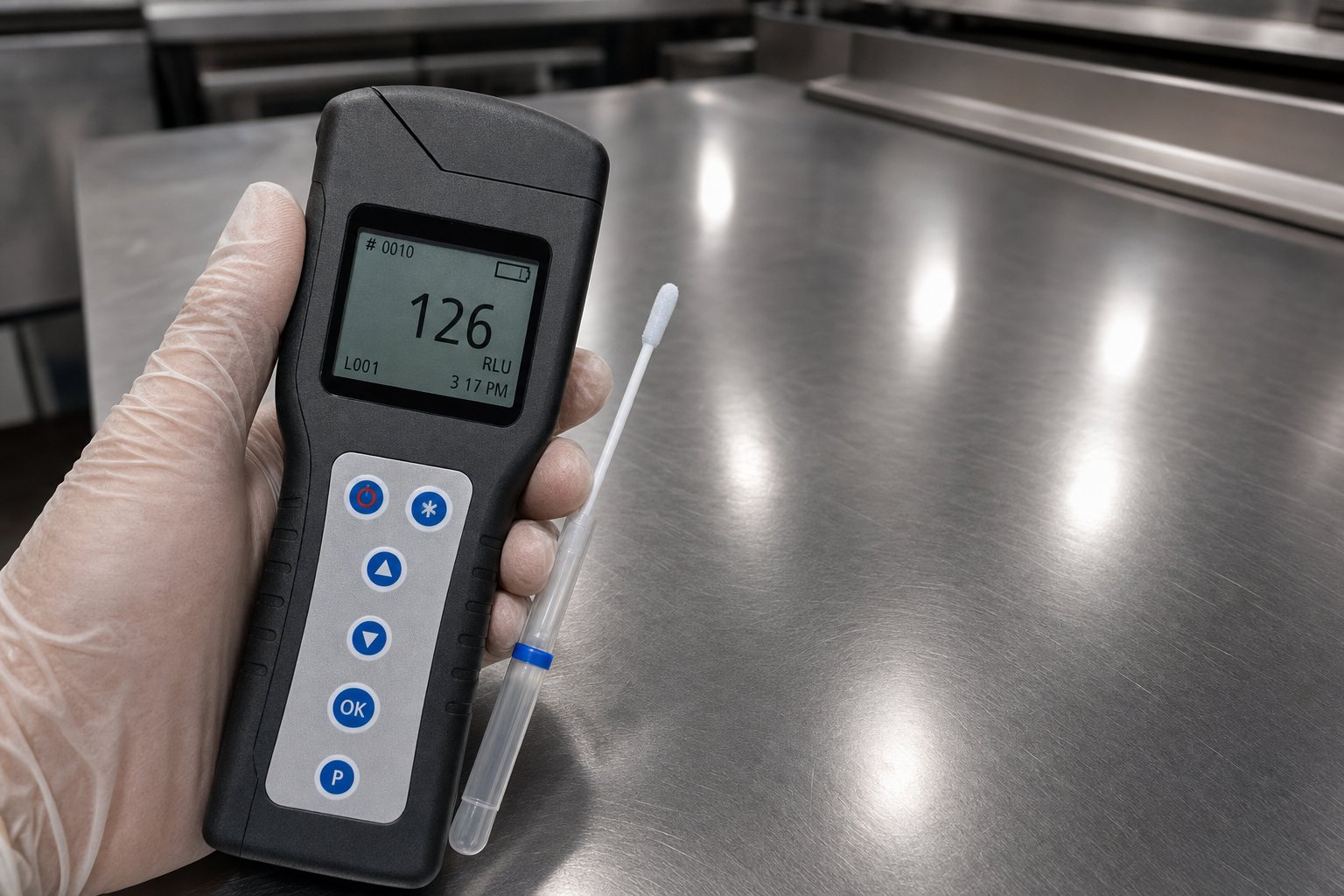
If you’re a facility manager in NYC, Northern NJ, or Westchester, you’ve probably heard the same claim from every cleaning vendor: “We clean thoroughly.” The problem is that “thoroughly” is subjective. ATP luminometer testing gives you a fast, repeatable way to measure cleanliness on high-touch surfaces and validate whether your cleaning program is actually working. GreenPoint Maintenance Services uses ATP testing to set baselines, coach crews, and provide proof-driven reporting—often integrated with StockPoint verification. To discuss an ATP-based quality program, call 844-814-0810 for a walkthrough.
What ATP testing measures—and what it doesn’t
ATP (adenosine triphosphate) is found in living cells and organic residues. ATP meters read swab samples and report results as RLUs (relative light units), which function as a proxy for “how much organic residue is present.” ATP testing does not identify specific pathogens and it’s not a replacement for laboratory microbiology. But it is extremely useful for comparing cleaning performance over time and across teams—especially on surfaces where fingerprints and residue are common. GreenPoint uses ATP as part of a broader evidence-based program, not as a gimmick.
Why ATP matters for tri-state facilities: accountability in dense buildings
In NYC buildings—especially Midtown offices, medical suites near major transit hubs, and high-occupancy schools—cleaning is a critical operational service that’s hard to supervise daily. When tenants complain, it’s often after weeks of performance drift. ATP testing helps catch drift early by turning subjective observations into numeric trends. GreenPoint Maintenance Services uses consistent swab points and repeatable sampling protocols so results can be compared month to month. If you’re managing multiple floors or multiple sites, call 844-814-0810 to set up a baseline program. See our detailed guide on [ATP bioluminescence testing](/blog/what-is-atp-bioluminescence-testing-cleaning/) for the full protocol.
Setting baselines: your first 2–4 weeks should be data collection, not judgment
One of the biggest mistakes is using ATP results as “gotcha” data on day one. The smarter approach is to collect baseline readings for 2–4 weeks across a representative set of surfaces: restrooms, break rooms, reception, and shared equipment. This baseline helps you set pass/fail thresholds that match your building’s risk profile. GreenPoint helps clients define sampling frequency and thresholds so you’re not over-testing low-risk surfaces or under-testing critical areas like restrooms and pantry counters.
Choosing swab points: the “top 15” surfaces that drive complaints
ATP programs work best when swab points are stable and meaningful. Common high-value swab points include: restroom door hardware, faucet handles, flush levers/buttons, partition latches, break room microwave controls, refrigerator handles, conference room table edges, shared printer touch points, and reception counters. In NYC, consider elevator call buttons or turnstile touch points if accessible. GreenPoint standardizes a “top 15” list and adds site-specific points based on how your tenants actually use the space.
Interpreting RLU results: trends beat single readings
RLU targets vary by industry and device, so it’s better to focus on consistency and trend improvement than to obsess over one number. If a surface reads high, the corrective action is usually practical: improve soil removal (microfiber technique, dwell time, correct dilution), adjust frequency, or fix a process issue like reusing cloths. GreenPoint uses ATP readings as coaching inputs, not blame—because the goal is a stable cleaning system that holds up even when staffing changes.
Linking ATP to cleaning frequency standards
ATP results are most powerful when paired with a written frequency standard. If a pantry counter fails ATP repeatedly, the solution might be to increase mid-day touch-ups, not to “work harder” at night. GreenPoint aligns ATP programs with clear frequency standards and scopes like those described in [cleaning frequency standards by facility type](/blog/cleaning-frequency-standards-by-facility-type/) so your vendor is accountable to a written plan. For multi-tenant buildings, that clarity reduces disputes about what is and isn’t included.
How GreenPoint uses StockPoint + ATP for proof-driven quality assurance
Photos and timestamps prove tasks were completed; ATP adds outcome data that surfaces can be measured. GreenPoint’s proof-driven model can combine StockPoint (timestamped GPS-tagged photos, live dashboard) with scheduled ATP audits on selected high-touch points. This hybrid approach is especially valuable for healthcare-adjacent spaces and schools where stakeholders want evidence. If you want to reduce tenant complaints and management time spent “checking the cleaners,” call 844-814-0810 and ask about our verification program.
Use cases in NYC: medical offices, schools, and high-traffic offices
ATP programs are most popular where risk and scrutiny are higher: medical offices in Manhattan, pediatric clinics in Queens, schools and daycare spaces, and offices with dense conference room usage. For medical spaces, your cleaning plan should also align with safety guidance and process discipline; see [medical office cleaning requirements (OSHA)](/blog/medical-office-cleaning-requirements-osha/) for additional context. GreenPoint Maintenance Services can deploy ATP as part of a broader quality program to keep these environments consistently clean.
What ATP Really Measures: A Ten-Second Science Primer
Adenosine triphosphate (ATP) is the energy-carrying molecule found in all living cells. When a swab collects residue from a surface and is inserted into a luminometer, the device measures the light output of a reaction between ATP and the luciferase enzyme on the swab. More ATP means more light means more organic contamination remaining. Results are reported in Relative Light Units (RLU) on a scale that typically runs from 0 to over 10,000. Most commercial cleaning benchmarks classify a food-contact surface as clean at under 30 RLU, caution zone at 30 to 100, and fail above 100. GreenPoint Maintenance Services publishes surface-specific pass/fail thresholds for every ATP testing point in a client's program and reviews trends quarterly. See our detailed guide on [quality assurance program](/blog/quality-assurance-commercial-cleaning-program/) for the full protocol.
ATP does not identify specific pathogens (that requires culture testing or PCR). What it does provide is a fast, quantitative, objective measure of overall cleaning effectiveness that lets facility managers move past the subjective 'looks clean' standard. A surface can look spotless and still fail an ATP test at 400 RLU, which is exactly the kind of finding that drives real process improvement.
Where to Test: Choosing High-Value Testing Points
A well-designed ATP program tests 10 to 20 surfaces per facility per audit cycle, chosen for a mix of high-touch high-risk points (door handles, keyboards, break room faucets, restroom stall latches, medical exam room surfaces) and challenging cleaning geometry (drain covers, chair arms, elevator buttons, phone handsets). Testing the same points at the same time each cycle produces trend data that reveals whether cleaning quality is stable, improving, or declining. GreenPoint's default corporate office program tests 15 points weekly, medical office programs test 20 points weekly, and food service programs test 12 points daily plus a monthly extended audit.
Interpreting Trends: One Data Point Is Not a Story
A single ATP failure does not mean the cleaning program is broken. It might mean the specific surface was missed, the disinfectant was ineffective against a particular residue, or the swab collection was flawed. What matters is the trend across weeks and months. GreenPoint Maintenance Services runs a 4-week rolling average on every testing point and flags any point that trends above threshold for two consecutive audits. That trigger initiates a corrective action review with the site supervisor, a targeted retraining, and a follow-up audit 14 days later. Clients see the entire loop in their StockPoint dashboard, with corrective action documentation attached to every failure. See our detailed guide on [cleaning audit checklist](/blog/cleaning-audit-checklist-facility-managers/) for the full protocol.
Cost, Vendor Selection, and Program Setup
An entry-level commercial luminometer costs 1,200 to 2,500 dollars, with per-swab costs of 1.50 to 3.50 dollars in bulk. A typical mid-sized facility program of 15 tests per week costs 1,400 to 2,700 dollars per year in consumables plus a one-time hardware investment. GreenPoint Maintenance Services includes ATP testing at no additional charge on StockPoint Premier accounts and logs all results directly into the client's compliance dashboard. Facility managers looking to prove cleaning effectiveness to their leadership team, tenants, or regulators find ATP data far more persuasive than photos alone. Call 844-814-0810 to add ATP testing to an existing GreenPoint contract.
FAQ: ATP luminometer testing and commercial cleaning
Q: Is ATP testing the same as testing for germs? A: No—ATP measures organic residue as a proxy for cleanliness; it doesn’t identify specific pathogens, but it’s useful for managing cleaning performance. Q: How many swab points do we need? A: Many facilities start with 10–20 stable swab points and adjust based on risk and occupancy; GreenPoint helps select high-value points. Q: How often should we run ATP audits? A: Common cadences are weekly during launch, then monthly or quarterly once performance stabilizes; higher-risk spaces may test more often. Q: Can ATP results be used to manage a vendor contract? A: Yes—when tied to a written scope and frequency standard, ATP trends can become part of a quality scorecard. Q: Do you provide reporting? A: Yes—GreenPoint can provide simple trend reporting and pair it with StockPoint verification so you have both task proof and outcome data.
Want measurable cleaning outcomes instead of “looks fine”? GreenPoint Maintenance Services can set up ATP luminometer testing, define baselines, and run proof-driven audits (optional StockPoint verification) across NYC, NJ, and CT. Call 844-814-0810 or email info@greenpointms.com to schedule a walkthrough and build a data-backed cleaning program.