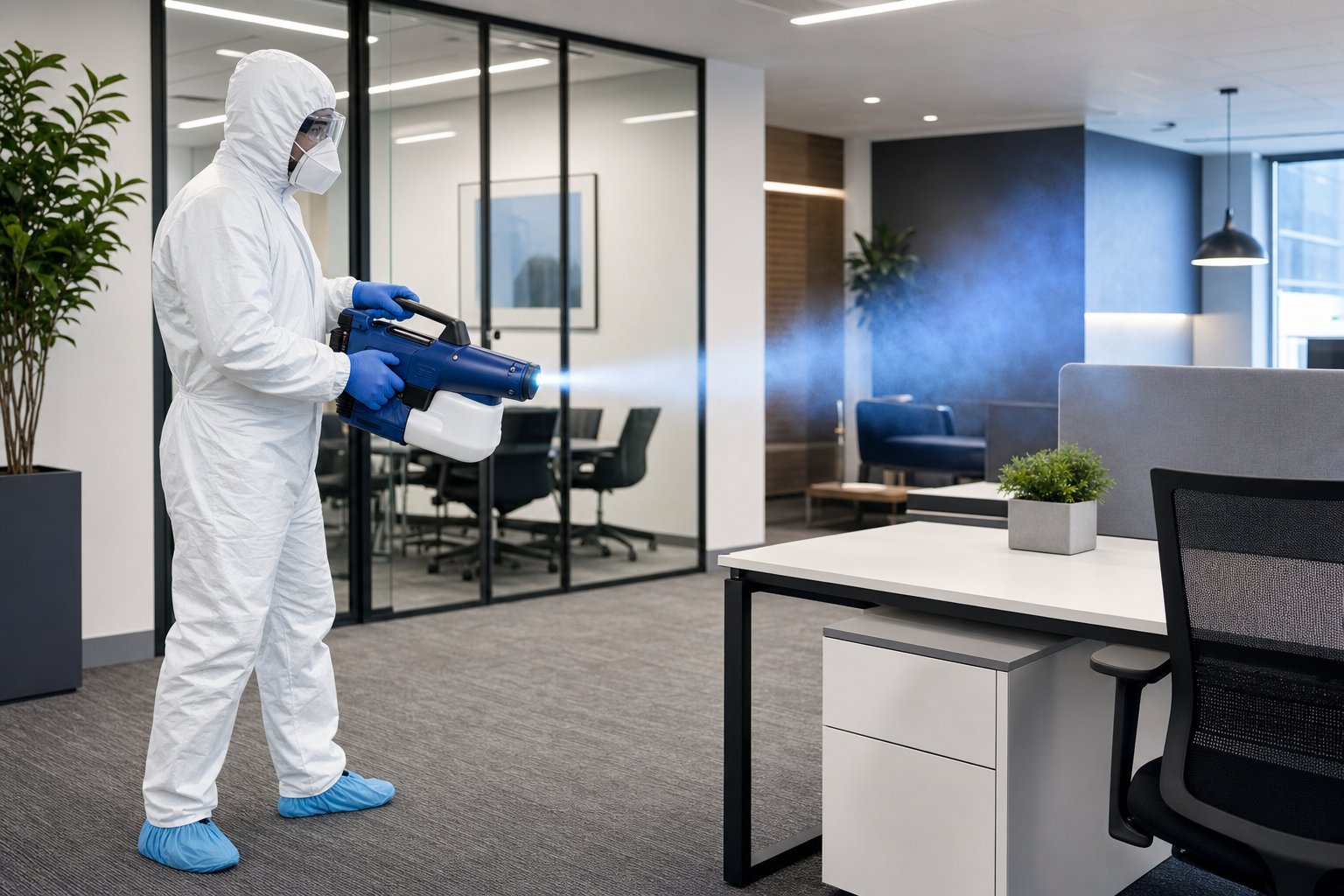
Electrostatic spraying is still one of the most misunderstood services in commercial cleaning. Some vendors sell it like a magic shield; others dismiss it entirely. In 2026, the truth is more practical: electrostatic spraying is a tool that can add value in specific situations—but only when paired with real cleaning, the right chemistry, and proof of results. GreenPoint Maintenance Services helps facilities across NYC, New Jersey, and Connecticut decide when electrostatic spraying makes sense, how to scope it, and how to verify it. For a walkthrough and a fixed-price proposal, call 844-814-0810.
What electrostatic spraying actually does (and what it doesn’t)
Electrostatic sprayers apply a charge to droplets so they’re attracted to surfaces, improving coverage in complex shapes like chair legs or restroom fixtures. That can be helpful for applying an EPA-registered disinfectant in a consistent way. However, spraying does not replace soil removal. If a surface has grease, dust, or biofilm, disinfectant performance can drop because the chemistry can’t contact the microorganisms effectively. GreenPoint’s stance is evidence-based: spray is a finishing step, not the first step. If you want a plan that avoids “spray theater,” call 844-814-0810.
Buyer intent reality: why NYC/NJ/CT facilities still ask for spraying
In the tri-state area, building owners and tenants still request electrostatic services after illness clusters, during tenant move-ins, or when a building wants a visible “extra step.” In high-density settings—Midtown offices, transit-adjacent coworking spaces, schools, and medical suites—leaders want risk reduction and a documented response they can communicate. GreenPoint frames electrostatic spraying as part of a broader hygiene program that includes high-touch cleaning, restroom standards, and indoor air considerations. For guidance tailored to your building, schedule a walkthrough at 844-814-0810.
Where electrostatic spraying is worth it (high-value use cases)
Electrostatic spraying tends to be most cost-effective in: (1) schools and daycare environments after outbreaks or before re-entry, (2) medical offices and urgent-care suites where high-touch surfaces and patient turnover are constant, (3) fitness facilities and locker rooms with many complex surfaces, and (4) event resets in spaces with dense seating. In these environments, the ability to rapidly coat hard-to-reach surfaces can reduce labor time compared with manual wipe-only approaches—assuming cleaning is done first. If you operate one of these facilities, call 844-814-0810 to discuss a practical scope.
When electrostatic spraying is NOT worth it
Spraying is often a poor use of budget when surfaces are already easy to wipe, when the main problem is visible soil (dust, grit, spills), or when ventilation and filtration are the bigger drivers of perceived “clean air.” It’s also not ideal as a daily add-on for low-risk office spaces if it crowds out core janitorial tasks like restroom detail and floor care. GreenPoint recommends allocating budget first to disciplined cleaning frequency and quality assurance; then use spraying for defined triggers, not as a constant subscription. If you’re unsure, GreenPoint can evaluate your program during a walkthrough—call 844-814-0810.
How to specify electrostatic spraying in a scope of work
To avoid vague “disinfection service” line items, specify: the target areas (classrooms, restrooms, reception, break rooms), the trigger event (outbreak response, monthly preventive, tenant move-in), the dwell time requirements per the disinfectant label, and the pre-cleaning steps required. Also specify what is NOT included (e.g., porous items, electronics that can’t be treated). If you’re building an RFP, pair this with a scoring rubric like the one in [how to write an RFP for commercial cleaning](/blog/how-to-write-rfp-commercial-cleaning/) and [commercial cleaning contract key terms](/blog/commercial-cleaning-contract-key-terms/).
Chemistry and safety: EPA registration and OSHA-aligned controls
Effective spraying depends on using an EPA-registered disinfectant according to label directions—especially concentration, contact time, and surface compatibility. From a safety perspective, spraying increases aerosol exposure risk, so controls matter: proper PPE, controlled access to treated areas, ventilation considerations, and correct chemical storage. GreenPoint follows OSHA-style hazard communication best practices with SDS availability and documented chemical handling procedures. For a safer program that still meets operational needs, call 844-814-0810.
Verification: how to prove results beyond “we sprayed”
The biggest problem with electrostatic spraying is that it’s easy to market and hard for clients to verify. GreenPoint solves that with quality assurance: supervisor audits, documentation, and optional digital verification through StockPoint (timestamped GPS-tagged photos with a dashboard). For outcome verification, some clients add ATP testing as a proxy for cleanliness on high-touch surfaces—especially in healthcare-adjacent settings. If you want a proof-driven “disinfection” program, connect it to measurable standards like those in [what is ATP bioluminescence testing](/blog/what-is-atp-bioluminescence-testing-cleaning/) and call 844-814-0810.
NYC-specific triggers: schools, NYC DOE expectations, and dense occupancy
NYC’s dense occupancy and constant transit use increases the “shared surface” problem. Schools and education environments also tend to have stricter expectations for cleaning documentation and custodial routines. If you manage a school facility, align your program with operational standards and use a checklist approach like [school cleaning checklist for custodial staff](/blog/school-cleaning-checklist-custodial-staff/) so spraying is used as a targeted supplement rather than a distraction from daily cleaning fundamentals. GreenPoint Maintenance Services can scope this across multiple buildings with fixed pricing.
How Electrostatic Sprayers Actually Work: The Physics in Plain English
An electrostatic sprayer applies a positive electrical charge to disinfectant droplets as they exit the nozzle. Because most surfaces (walls, chairs, keyboards, door handles) carry a slight negative or neutral charge relative to the charged droplets, the mist is physically pulled toward every exposed surface, including undersides and back sides that traditional trigger-sprayer application misses. Independent testing published in the American Journal of Infection Control found electrostatic application achieves 3 to 4 times greater surface coverage per fluid ounce than conventional spray-and-wipe, with dramatically improved wrap-around on complex geometry like desks, chairs, and equipment. GreenPoint Maintenance Services deploys electrostatic units on 40 percent of commercial accounts today, up from 8 percent in 2020. See our detailed guide on [electrostatic disinfection explained](/blog/electrostatic-disinfection-explained/) for the full protocol.
The chemistry is equally important. Not every disinfectant is compatible with electrostatic delivery. The product must be EPA-registered specifically for electrostatic application, have a viscosity between 20 and 40 centipoise, and carry a claim for the pathogens you need to control. GreenPoint uses a rotating panel of three EPA-registered electrostatic-compatible disinfectants selected for kill claim, dwell time, and material compatibility. Call 844-814-0810 for a product-specific recommendation for your facility.
Where Electrostatic Delivers Real Value and Where It Doesn't
Electrostatic spraying is a force multiplier for large open areas with lots of high-touch soft surfaces: waiting rooms, conference rooms, gyms, classrooms, retail floors, and vehicle interiors. In these environments, a single trained operator can disinfect 5,000 to 7,500 square feet per hour, roughly 3 to 5 times faster than trigger-sprayer application. Where electrostatic is a poor fit: heavily soiled surfaces (spraying disinfectant on visible dirt is ineffective and violates EPA label directions), food-contact surfaces requiring a specific dwell and rinse, and small dense-cabinet environments where the droplets can't reach interior geometry. GreenPoint's field supervisors are trained to identify when electrostatic is the right tool and when a traditional two-step clean-then-disinfect approach is required.
Training, PPE, and Documentation Standards
OSHA requires operators of electrostatic sprayers to complete training on the equipment, the specific chemistry being applied, and the required PPE (typically N95 respirator, safety glasses, and nitrile gloves at minimum). GreenPoint Maintenance Services maintains a documented electrostatic certification program with annual recertification, and every technician's certification status is visible in StockPoint. Documentation of application, including product, dilution, dwell time, and treated square footage, is logged for every service. See our detailed guide on [commercial cleaning industry statistics](/blog/commercial-cleaning-industry-statistics/) for the full protocol.
Total Cost of Ownership: Electrostatic vs Traditional Application
A commercial-grade electrostatic backpack sprayer runs 800 to 2,400 dollars per unit, with an expected service life of 3 to 5 years under regular use. Chemical costs are typically 30 to 50 percent lower per treated square foot because the wrap-around effect reduces waste. Labor is where the real savings show up: a facility that previously required 6 labor hours per disinfection cycle can drop to 2 to 3 hours with electrostatic, without sacrificing coverage. For a 40,000 square foot facility cleaned three times per week, GreenPoint clients typically see a full electrostatic program pay back within 90 to 120 days of switching.
FAQ: electrostatic spraying for commercial facilities
Q: Does electrostatic spraying kill viruses on contact? A: It depends on the EPA-registered product and the label dwell time; spraying improves coverage, but you still need the correct chemistry, contact time, and pre-cleaning. Q: Can spraying replace nightly janitorial? A: No—spraying doesn’t remove soil and shouldn’t replace restroom detail, floor care, or trash removal; it’s a supplement for specific triggers. Q: How often should we schedule electrostatic service? A: Many facilities use it for outbreak response, monthly preventive in higher-risk settings, or tenant move-ins; GreenPoint recommends tying frequency to risk and occupancy. Q: Is it safe around staff and tenants? A: With the right controls—PPE, controlled access, ventilation, and label compliance—it can be used safely; GreenPoint scopes procedures accordingly. Q: How do we verify it happened? A: Use documentation and verification systems like StockPoint plus audits; for outcome checks, some clients use ATP testing on selected high-touch surfaces.
Considering electrostatic spraying for your NYC/NJ/CT facility? GreenPoint Maintenance Services will help you scope it correctly, use EPA-registered products safely, and document completion with strong QA (optional StockPoint verification). Call 844-814-0810 or email info@greenpointms.com to schedule a walkthrough and get a fixed-price proposal.