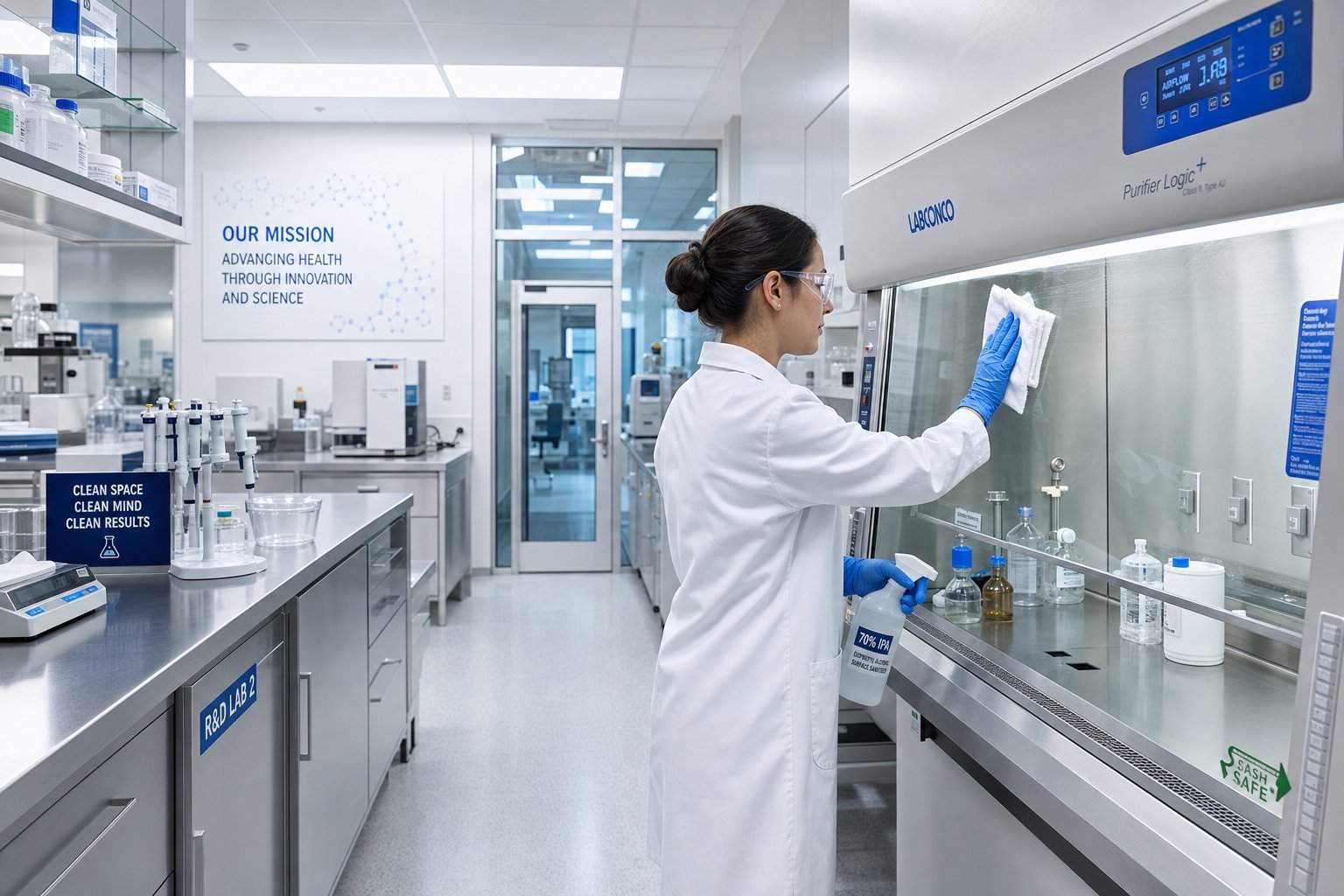
New Jersey’s biotech and pharmaceutical corridor—Princeton, New Brunswick, Newark, Jersey City, the Route 1/287 belt, and campuses near major transit like Newark Penn Station—runs on documentation. If you manage a lab-adjacent office, R&D facility, or regulated production support space, cleaning isn’t just about appearance; it’s about controlling risk, respecting SOP boundaries, and producing records that hold up in audits. GreenPoint Maintenance Services designs lab-sensitive cleaning programs with clear “do-not-touch” rules, color-coded tools, and StockPoint verification (timestamped, GPS-tagged photos) so facilities teams can confirm execution. To schedule a walkthrough and fixed-price quote, call 844-814-0810 or email info@greenpointms.com.
What BSL-1 vs BSL-2 means for cleaning scopes (and what it does not)
Biosafety levels are primarily about lab practices and controls, but they also affect how cleaning is planned around restricted zones. The most common mistake is writing a scope that assumes janitorial crews will clean inside active lab spaces without explicit authorization, training, and SOP alignment. GreenPoint typically separates the program into zones: general office/common areas, lab-adjacent corridors and support rooms, and restricted labs handled only under customer-approved procedures. This reduces risk while keeping the facility consistently clean. Call 844-814-0810 to review your boundaries during a walkthrough.
Facilities leaders also need clarity on expectations: standard janitorial is not the same as validated decontamination. When a vendor promises “sterile” outcomes without defined methods, it creates procurement and compliance risk. GreenPoint uses evidence-based language and measurable QA so your team can defend the program internally.
Access control, chain-of-command, and “do-not-touch” SOPs
In NJ lab environments, the biggest operational failures are access mistakes: a well-meaning crew member enters a restricted room, moves an item, or uses the wrong supplies. GreenPoint sets a chain-of-command with a site supervisor, approved access lists, and written “do-not-touch” rules (benchtops, pipettes, reagents, sample storage, labeled waste containers). These rules are reinforced through training and checklists, and verified with StockPoint photo proof in approved areas.
This is also where professional vendor oversight matters for safety and liability. OSHA’s Hazard Communication Standard requires that workers understand chemical hazards and SDS documentation, and your facility should expect a vendor to manage labeling, storage, and training as part of the program. GreenPoint builds that discipline into onboarding and refreshers.
Color-coded tools and separation by zone (the simplest way to reduce cross-contamination risk)
A zone-based tool system prevents avoidable mistakes. GreenPoint uses color-coded microfiber and dedicated tools by area (restrooms, break rooms, office spaces, and controlled corridors) so a mop head or cloth from a restroom never touches a lab-adjacent kitchenette. If you’re building your own SOPs, start with [color-coded microfiber systems guide](/blog/color-coded-microfiber-systems-guide/), then align the colors to your facility map.
For labs, even “adjacent” spaces can have special constraints (autoclave corridors, gowning areas, waste staging). GreenPoint documents the boundaries and assigns dedicated carts so the separation is operational, not just written.
Waste handling and autoclave-adjacent areas: plan the traffic flow
Facilities often underestimate how much cleanliness depends on traffic flow. Waste staging rooms, loading docks, and corridors leading to autoclaves can create odor, residue, and spill risk that spreads if not contained. GreenPoint builds a cleaning route that starts in cleaner zones and moves toward higher-risk areas, with glove changes and tool swaps defined at transition points. This mirrors best practices in contamination control and keeps “dirty-to-clean” movement from happening inadvertently.
When the scope includes chemical storage closets, OSHA-aligned practices matter: labeled containers, SDS access, and incompatible chemical separation reduce incident risk and help protect your team during inspections. For an operational lens on chemical safety in janitorial programs, see [osha cleaning chemical safety ghs sds](/blog/osha-cleaning-chemical-safety-ghs-sds/).
High-touch points, restrooms, and break rooms: where complaints and pathogens cluster
Even in advanced R&D sites, most day-to-day complaints come from the basics: restrooms, break rooms, and shared touchpoints. GreenPoint uses a frequency plan based on traffic (shift change times, cafeteria peaks, conference room schedules) so the building stays consistent. For best-practice workflows, see [restroom cleaning best practices high traffic](/blog/restroom-cleaning-best-practices-high-traffic/).
For regulated environments, it’s also important to document what products are used and how. GreenPoint can standardize Green Seal certified options where appropriate and maintain a product list for procurement and EHS review, reducing “surprise substitutions” that trigger internal concerns.
Audit readiness: what documentation facility managers should expect
If your site is audited (internally or by customers), the question is often “show me what happened” rather than “tell me you cleaned.” GreenPoint’s proof package can include StockPoint attendance visibility, timestamped task completion, GPS-tagged photos in approved areas, and optional ATP testing for verification on high-touch surfaces. To understand how verification systems work in modern janitorial programs, read [digital cleaning verification systems](/blog/digital-cleaning-verification-systems/).
Audit readiness also includes stability and consistent training. GreenPoint’s 98% client retention reflects a focus on defined scopes and repeatable processes, not rotating, unmanaged labor. If you’re comparing vendors, insist on a written QA cadence, supervisor coverage, and documented onboarding.
NJ and tri-state logistics: staffing, parking, and shift coverage
In New Jersey, practical details can make or break service: loading dock rules, security badges, parking constraints, and late-night access procedures. Sites near Newark Airport, Jersey City waterfront, or dense downtown corridors may need staggered shifts and coordinated deliveries. GreenPoint plans staffing and supplies so the facility doesn’t suffer from missed windows or last-minute substitutions—and pricing stays fixed rather than fluctuating with hourly variability.
If your facility spans NJ and NYC metro offices, a consistent vendor can reduce administrative overhead and standardize documentation. GreenPoint Maintenance Services covers NY, NJ, CT, PA, and FL with a proof-driven approach designed for multi-site oversight. Call 844-814-0810 to schedule a walkthrough.
Need biotech or pharma facility cleaning in New Jersey with clear BSL-1/BSL-2 boundaries, documented SOP compliance, and audit-ready proof? Call 844-814-0810 to schedule a walkthrough with GreenPoint Maintenance Services. You’ll receive a fixed-price proposal plus StockPoint verification (timestamped, GPS-tagged photos and optional ATP testing) so you can manage cleanliness like a measurable program—not a guess.