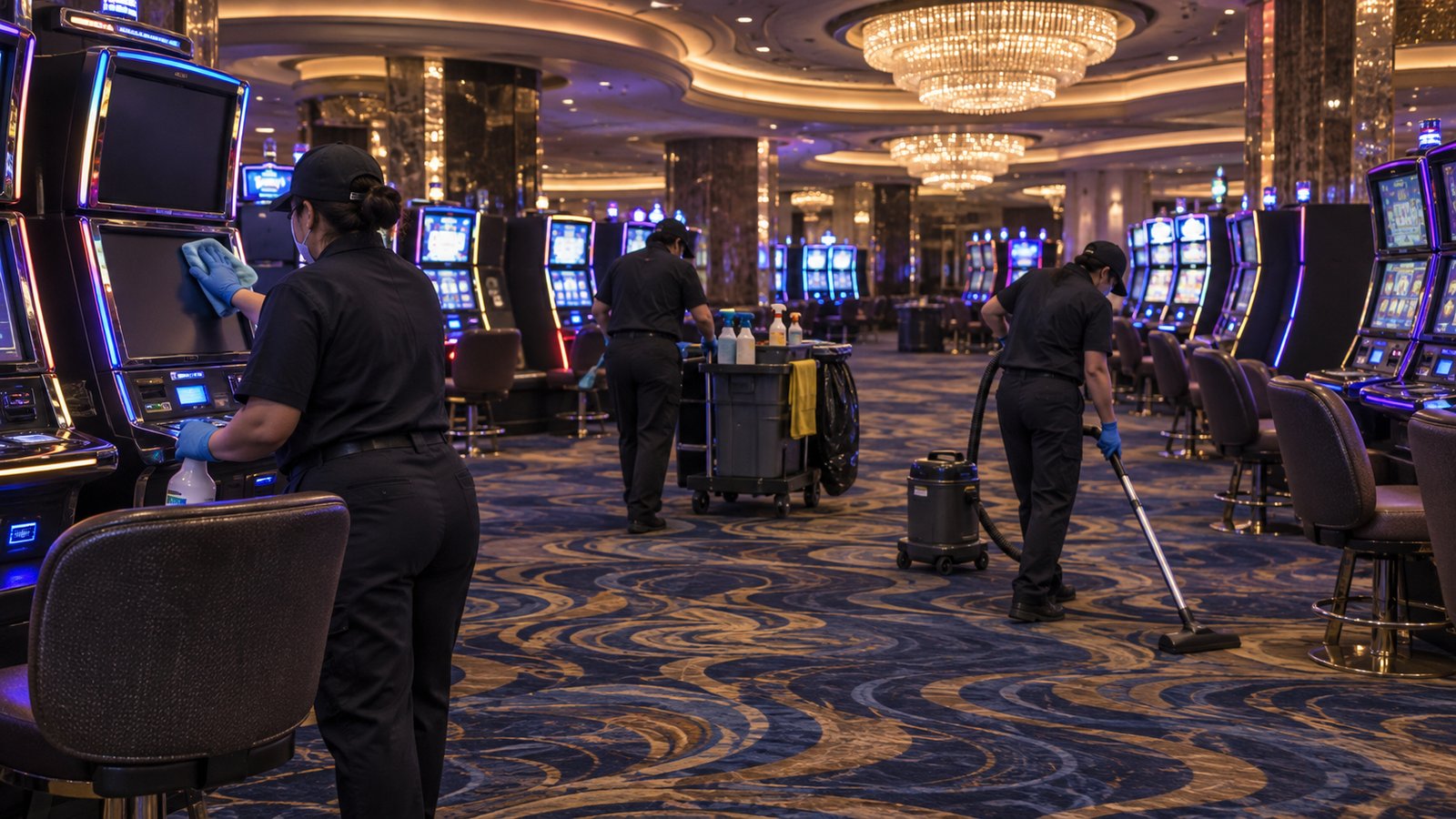
Casino cleaning in Atlantic City is an around-the-clock operating service, not simply an after-hours office route. A gaming floor, hotel tower, conference wing, food-service corridor, and employee entrance have different traffic, access rules, surfaces, and cleaning windows. Buyers comparing casino cleaning services in Atlantic City should ask how a vendor will protect gaming operations, coordinate with security, and prove that assigned tasks were completed. GreenPoint Maintenance Services Corp provides commercial facility cleaning with fixed scopes and documented checks. To discuss a casino or hospitality site walkthrough, call GreenPoint at 347-332-9348.
Map guest flows before setting a casino cleaning schedule
Start with the guest journey: parking garage elevators, hotel check-in, casino entrances, slot aisles, table-game zones, restrooms, restaurants, and exits. In Atlantic City, a resort near the Boardwalk, Pacific Avenue, the Atlantic City Convention Center, or the Atlantic City Rail Terminal may have surges tied to check-in times, weekend events, and convention turnover. GreenPoint recommends mapping each zone by access, soil load, touch frequency, and acceptable cleaning window. A square-foot total alone cannot tell a buyer whether one crew can safely service a crowded gaming floor while keeping walkways open.
Separate public spaces from employee-only and controlled areas. A floor plan should mark gaming equipment, cash-handling rooms, surveillance sightlines, back-of-house corridors, loading docks, and rooms where cleaning is restricted or escorted. Assign a named site contact who can approve access, close a section, report a spill, or pause work. GreenPoint can use the walkthrough to record room sizes, floor types, machine density, hours, and water access, then present a written scope instead of a vague promise to keep the property clean.
Ask the operations team to identify annual high-volume periods before the bid is finalized. Atlantic City properties may see materially different traffic during a major convention at the Convention Center, a holiday weekend, a summer Boardwalk event, or an ordinary weekday. Write those service assumptions into a base schedule and describe how the property requests temporary porter coverage. A defined event add-on with staffing lead time, service windows, and a fixed rate is easier to approve than an open-ended emergency charge after guest traffic has already increased.
Write task frequencies around traffic and surface risk
A practical plan divides work into opening checks, continuous response, scheduled rounds, and deeper periodic care. For example, a 24-hour property might inspect restrooms and food-adjacent areas every 30 to 60 minutes during a peak block, respond to spills immediately, and detail selected low-traffic sections during a planned window. Those are sample operating intervals, not a universal legal frequency. The property should choose its service levels from occupancy patterns, incident history, public-health guidance, and its own current internal procedures.
Specify the task, owner, trigger, method, and verification for each zone. A restroom round may include replenishment, touchpoint cleaning, waste removal, and a logged inspection; a carpeted slot aisle may call for litter pickup, spot response, and a later vacuum pass. GreenPoint can propose a frequency matrix with named rounds and escalation steps. Facility teams comparing broader schedules can review cleaning frequency standards by facility type and adapt the framework to casino occupancy rather than copying an office template.
Use a 30-day review period after mobilization to test whether the frequency assumptions match actual demand. Log restroom restocks, spill calls, guest-area complaints, and tasks delayed by access restrictions. If several weekend shifts repeatedly exceed the planned response window, the answer may be an added porter block rather than asking one cleaner to move faster across the whole property. GreenPoint can bring the trend summary to an operations meeting and adjust labor only through an approved scope change, keeping staffing expectations visible to both procurement and the casino's department leads.
Protect gaming equipment, finishes, and guest property
Gaming machines, touchscreens, table rails, felt, upholstery, polished stone, and decorative metals do not all tolerate the same chemistry or moisture. The owner should approve product lists and methods for each finish, and cleaners should never spray directly into electronics or move chips, cards, personal property, or gaming equipment without authorization. If a disinfectant is required for a defined exposure or surface, choose it for the label claim and surface compatibility, then follow its dilution, application, and wet-contact time. EPA says List N products are intended for SARS-CoV-2 when used according to label directions; List N inclusion is not an endorsement or a reason to disinfect every surface.
Include manufacturer instructions for specialty finishes in the property file. If a surface is scratched, sticky, cracked, or visibly damaged before service, photograph or report it through the approved channel instead of testing an unfamiliar cleaner on a guest-facing area. Confirm whether facility engineering or the gaming-equipment team performs periodic detail work so janitorial staff do not duplicate or conflict with maintenance. This division is especially useful when several departments share a casino floor and need to know who has authority over each surface.
Use color-coded cloths, separate tools for restrooms and food-adjacent areas, and a clean-to-dirty sequence so a crew does not carry soil between zones. Create a written rule for damaged equipment, bodily-fluid incidents, sharps, and unattended valuables: stop, isolate the area, notify the designated casino contact, and use only authorized response procedures. GreenPoint's proposed scope can distinguish routine janitorial tasks from specialty restoration or regulated cleanup so that a low-risk floor-care route is not mistaken for a hazardous-material response service.
Coordinate badges, escorts, and Atlantic City shift handoffs
A vendor schedule has to fit the resort's access system. Before work begins, document badge sponsorship, background-screening steps if required by the property, escort rules, keys, radio etiquette, emergency contacts, parking, and who may enter cash-sensitive rooms. Properties close to the Boardwalk or Atlantic City Expressway may have different delivery and parking conditions than a smaller property near the Absecon border. Do not leave a new crew to infer a route from a floor plan; conduct a supervised first shift and confirm that every checkpoint is accessible.
At shift change, pass forward open incidents, rooms awaiting access, replenishment shortages, wet-floor barriers, and any guest request still unresolved. A simple digital log can record location, timestamp, status, and supervisor review without capturing unnecessary guest information. GreenPoint uses JaniTrack for timestamped, GPS-tagged service photos and a live dashboard where the scope calls for that verification. Ask for a walkthrough and a sample reporting plan at 347-332-9348, then confirm how the proposed system fits the casino's security and privacy rules.
Verify safety training and chemical controls
Cleaning staff may encounter wet floors, broken glass, bodily fluids, concentrated chemicals, electrical equipment, and congested service corridors. OSHA's cleaning-industry resources identify hazard communication, chemical exposure, personal protective equipment, bloodborne pathogens, and slips and falls as subjects employers should address. For each product brought on site, define who approves it, where its current safety data sheet is available, what PPE is required, and how containers stay labeled. Never mix products or leave a chemical cart unattended in a public path.
A casino's own emergency and infection-control policies take priority for its premises, so vendor training must include escalation routes, incident reporting, and the boundary between routine cleaning and specialized cleanup. OSHA rules and product-label directions are not replaced by a marketing claim about green products. GreenPoint can document the agreed product list and train its assigned team on the written site plan. For a closer look at chemical selection, buyers can use the OSHA cleaning chemical safety and SDS guide as a procurement checklist, then validate site-specific requirements with the property's safety team.
Compare contractor bids on coverage, evidence, and cost
Request proposals that show labor hours by shift, staffing backup, supervisor coverage, included equipment, consumables, periodic floor work, and exclusions. A hypothetical 150,000-square-foot resort may need several different production rates: a public restroom, a carpeted gaming aisle, and a back office cannot be priced using one square-foot assumption. Compare the work plan and service windows before comparing the monthly total. GreenPoint uses fixed pricing rather than hourly billing, with scope, assumptions, and exclusions made explicit so buyers can budget without hidden fees.
Ask for a sample inspection, escalation response time, corrective-action process, and a monthly review format. ISSA's Clean Standard for institutional and commercial facilities combines objective ATP measurement with traditional audits; it is a measurement framework, not a guarantee that a room is sterile or completely free of contamination. GreenPoint can pair visual checks with optional ATP testing and JaniTrack records where the agreed service plan calls for them. A buyer can also review how to choose a commercial cleaning company and request a written quote after the site walkthrough.
Before award, ask each finalist to walk a representative route with the department manager and demonstrate how it handles a missed restroom round, unavailable room, guest complaint, or equipment failure. A short pilot in one lobby or hotel corridor can reveal whether the proposed crew size and supply staging are realistic without turning a full-property rollout into a guess. Record the starting condition, service dates, inspection score, and open corrections so that the first monthly review has a baseline. To request that kind of walkthrough and fixed-price quote from GreenPoint, call 347-332-9348.
Casino cleaning contractor FAQs
How often should a casino gaming floor be cleaned? There is no single schedule that fits every property. Set frequencies by traffic, spills, surface type, current site procedures, and staffing, then inspect the results and adjust after high-volume events.
Can a janitorial vendor clean slot machines and table-game surfaces? Only when the property authorizes the task, product, method, access, and timing. Electronics and gaming materials require finish-specific procedures, and the vendor should never handle gaming equipment or guest property without written permission.
What should an Atlantic City casino request in a cleaning proposal? Ask for a zone-based scope, shift coverage, badge and escort plan, staffing backup, incident escalation, approved product list, inspection evidence, and a fixed monthly price with exclusions stated.
How can a buyer schedule a GreenPoint quote? Call 347-332-9348 or email info@greenpointms.com to arrange a walkthrough. GreenPoint Maintenance Services can document agreed checks through JaniTrack, and reports a 98% client retention rate.
Planning casino cleaning in Atlantic City? Schedule a site walkthrough and fixed-price quote with GreenPoint Maintenance Services Corp at 347-332-9348 or info@greenpointms.com. Proof point: GreenPoint reports 98% client retention and offers JaniTrack timestamped GPS-tagged photos, optional ATP testing, and a live dashboard for agreed service checks.