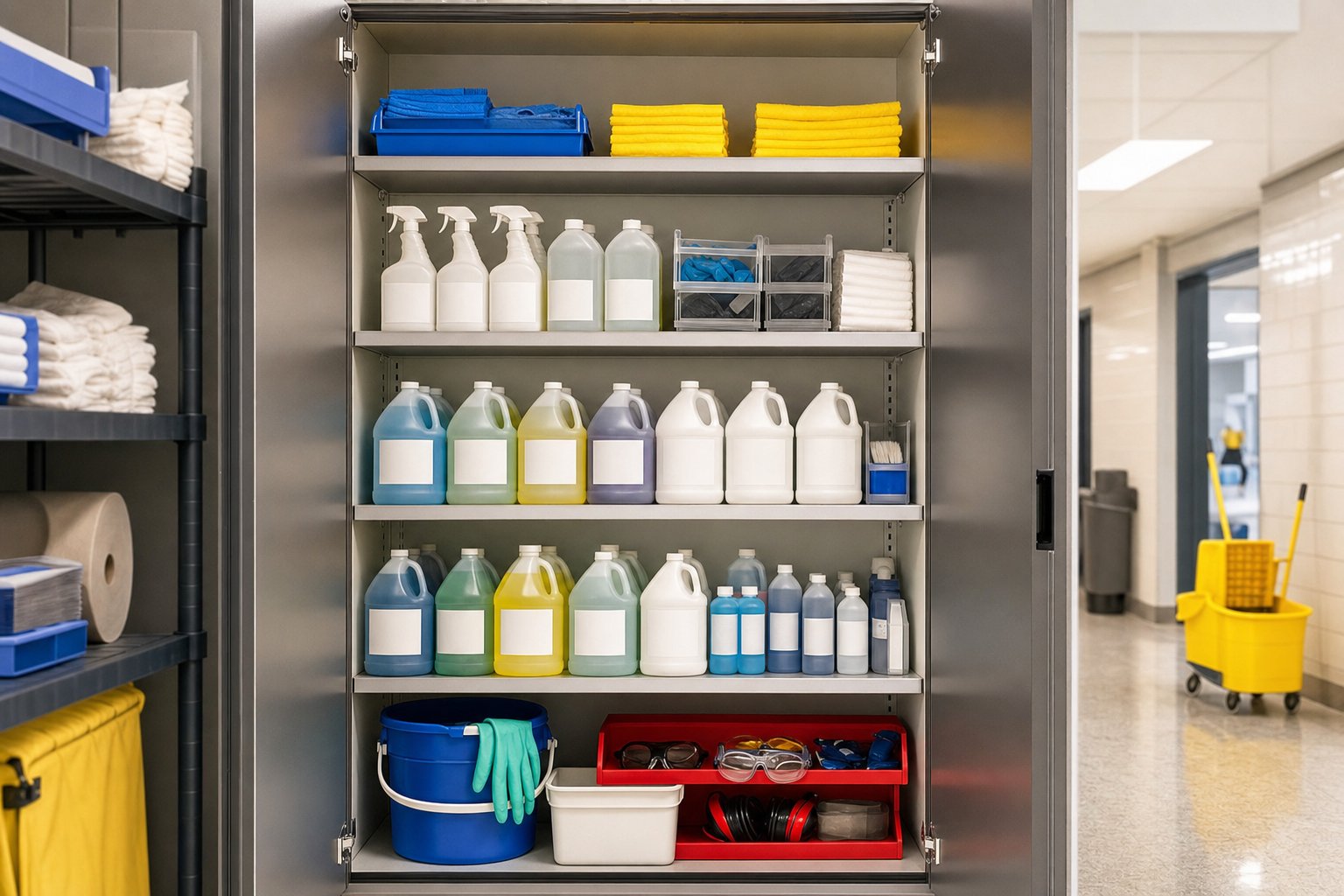
A commercial cleaning chemical inventory is a safety control, a purchasing tool, and an operational record. If the list does not match the bottles in the closet, a facility cannot reliably train staff, retrieve a Safety Data Sheet, respond to an exposure, or explain why a product was used. GreenPoint Maintenance Services helps offices, schools, medical suites, warehouses, and mixed-use buildings across New York, New Jersey, Connecticut, Pennsylvania, and Florida organize products, labels, storage, training, and verification. This guide follows OSHA-aligned principles without pretending one checklist replaces site-specific legal advice. Call 844-814-0810 to schedule an inventory walkthrough.
Why an accurate inventory matters
Managers often inherit a chemical closet that contains approved products, old contractor stock, unlabeled spray bottles, duplicate purchases, and specialty items no one remembers ordering. That creates cost and safety risk at the same time. GreenPoint starts by counting what is physically present, identifying the manufacturer and product name, checking the SDS, recording the use and dilution, and assigning an owner. The inventory should include routine cleaners, disinfectants, floor chemicals, glass products, degreasers, aerosols, hand soaps, and spill materials when they are part of the cleaning scope.
The register should be usable during a night shift, not just stored in a procurement folder. GreenPoint can produce a digital list with product photo, storage location, approved surface, PPE, first-response note, and SDS link or access point. A manager can then see whether a replacement product is truly equivalent before it reaches the cart. For a broader chemical safety framework, read [our OSHA cleaning chemical safety GHS/SDS guide](/blog/osha-cleaning-chemical-safety-ghs-sds/) and call 844-814-0810 for a site-specific quote.
Set the OSHA Hazard Communication foundation
OSHA’s Hazard Communication Standard, 29 CFR 1910.1200, requires employers to communicate chemical hazards through labels, Safety Data Sheets, and employee information and training. The facility and contractor must define their respective responsibilities. GreenPoint trains its staff on the products used in the scope, accessible SDS procedures, labels, dilution, PPE, spill response, and the prohibition on mixing chemicals. The owner should confirm how building staff, tenants, security, and emergency responders access the information when a cleaning product is involved.
Training should be repeated when a hazard, product, process, or work area changes, and it should be understandable to the people performing the task. A cleaner does not need a chemistry lecture, but does need to recognize a pictogram, understand a label, select gloves, avoid a splash, and report symptoms or a damaged container. GreenPoint records training and refreshers, while StockPoint can attach an inspection or corrective action to the account. Call 844-814-0810 when your SDS process depends on oral history.
Use a product register that supports purchasing and substitution
A practical register includes product name, manufacturer, category, primary use, dilution, surface restrictions, certification or claim, SDS date, storage zone, reorder point, and approved substitute. GreenPoint reviews purchasing against the register so a cleaner does not buy a different disinfectant because it is on a nearby shelf. A substitution should be evaluated for label claim, compatibility, dwell time, fragrance, PPE, waste, and cost before use. Green Seal certified products may support sustainability goals, but the correct product still depends on the soil, surface, and required outcome.
Centralizing purchasing can also reduce waste. If five floors each keep an emergency bottle of the same glass cleaner, the owner may be carrying expired stock and inconsistent labels. GreenPoint can consolidate products, set par levels, rotate inventory first-in-first-out, and review monthly consumption. [Our commercial cleaning cost per square foot guide](/blog/commercial-cleaning-cost-per-square-foot/) helps connect supply assumptions to a fixed-price scope, while [our Green cleaning commercial buildings guide](/blog/green-cleaning-commercial-buildings-guide/) covers product-selection questions.
Label secondary containers and control dilution
A spray bottle, bucket, or dispenser that contains a chemical is a secondary container and should be labeled according to the applicable hazard communication and site procedure. “Bathroom cleaner” written in marker may not be enough when several products look alike or a spill occurs. GreenPoint uses labels that identify the product, hazard information where required, and the intended use, and it trains staff to discard or relabel damaged containers rather than guessing.
Dilution control prevents both weak performance and unnecessary exposure. GreenPoint can use measured dispensing, closed-loop systems, or documented dilution ratios, then inspect the method during supervisor visits. Over-concentrated floor cleaner can leave residue and increase slip risk; under-dosed disinfectant may not meet the label method. StockPoint notes can capture a dispenser issue, a product substitution, or a coaching action. Schedule a walkthrough at 844-814-0810 to review the cart and closet together.
Store chemicals safely in real commercial buildings
Storage must match the product hazard and the building’s fire, insurance, and access rules. Keep containers closed, upright, labeled, and protected from damage; separate incompatible materials; keep aisles and electrical panels clear; and prevent unauthorized access. Do not store chemicals in food areas, on top of unstable shelves, or in a way that blocks exits, sprinkler controls, eyewash equipment, or mechanical access. GreenPoint photographs exceptions and recommends a correction rather than treating a crowded closet as normal.
Local access and weather shape storage operations. A Manhattan tower may have a small janitorial closet and a freight-elevator delivery window; a New Jersey warehouse may have a larger cage but more loading-dock movement; a Connecticut campus may need several satellite closets; Florida humidity can affect cardboard packaging and odor. GreenPoint maps each storage point, names the supervisor, and keeps an emergency contact visible. [Our fire-code cleaning chemical storage guide](/blog/fire-code-cleaning-chemical-storage/) provides additional questions for the building team.
Separate routine janitorial work from regulated or specialized waste
Chemical inventory management includes knowing what leaves the site and how. Empty containers, contaminated absorbent, aerosol cans, batteries, fluorescent lamps, and other materials may have different disposal routes depending on the product and jurisdiction. GreenPoint labels routine waste, records unusual conditions, and coordinates with the owner and authorized waste vendor rather than pouring a product into a drain or placing regulated material in an office trash bag. New Jersey DEP, New York State, municipal, and local building requirements can intersect; the owner should confirm obligations for its property.
Spill response also needs boundaries. A small routine cleaning spill may fit the trained crew’s procedure, while an unknown chemical, large release, incompatible mixture, exposure, or regulated waste event needs site emergency response and possibly a qualified specialist. GreenPoint lists those exclusions in the contract, supplies the appropriate information for escalation, and documents the event in StockPoint. Call 844-814-0810 if your current scope does not say where janitorial work ends.
Audit the inventory and connect it to service quality
A quarterly inventory review can catch expired products, missing SDS documents, broken labels, excess stock, incorrect dilution tools, and unapproved substitutions. GreenPoint’s supervisor compares the register to the closet, cart, and supply order, then records findings, owner, due date, and closure. StockPoint can add timestamped GPS-tagged photos and a dashboard view so the facilities team does not need to visit every closet to know whether the control is active.
Connect safety data to the cleaning outcome. If a product leaves residue, damages a floor, causes odor complaints, or slows a restroom response, the manager should review the method, not just reorder the same bottle. GreenPoint can test an approved alternative on a small area, document the result, and update the register after approval. GreenPoint Maintenance Services has 98% client retention because safety, appearance, and budget are reviewed together. Email info@greenpointms.com or call 844-814-0810 for a chemical program assessment.
Procurement and safety teams should review the inventory together. The least expensive product is not the least expensive choice if it damages a floor, increases PPE use, creates an odor complaint, or requires a separate disposal route. GreenPoint compares unit cost, dilution yield, labor, surface compatibility, training, storage space, and waste before recommending a change. The decision is recorded with the approver and date, so a later supervisor knows why the product is present and which method is authorized.
At account launch, GreenPoint can create a one-page emergency contact sheet that points staff to the SDS location, building security, first-aid response, spill kit, engineering contact, and supervisor. It should not turn a cleaner into an emergency responder beyond training, but it can reduce confusion during the first minutes of an incident. The sheet is reviewed after a tenant move, closet relocation, product substitution, or change in waste vendor. Call 844-814-0810 for an inventory launch plan.
A good inventory is also an onboarding tool. GreenPoint can show a new cleaner the approved cart, the label standard, the SDS access route, the PPE expectation, and the person to contact when a bottle is missing. The supervisor then observes the first task and records coaching. This reduces variation between shifts and makes the safety program durable when staff or buildings change. Call 844-814-0810 for an account-start checklist.
FAQ: commercial cleaning chemical inventory and SDS
Q: What should be on a commercial cleaning chemical inventory? A: List every product used or stored in the scope, including manufacturer, product name, use, dilution, surface restrictions, SDS access, storage location, approved substitute, and responsible supervisor. Include specialty floor and disinfecting products rather than only daily cleaners.
Q: Who is responsible for SDS access, the building or the cleaning company? A: Responsibilities should be written into the contract and safety plan. GreenPoint maintains product information for the products it uses and trains staff; the owner should ensure site access and coordinate building-wide emergency communication.
Q: Can cleaners pour products into an unlabeled spray bottle? A: No. Secondary containers should be labeled according to the applicable hazard communication and site procedure. GreenPoint uses controlled labels and removes damaged or unidentified containers from service rather than guessing.
Q: How often should a chemical inventory be reviewed? A: Review at launch, after every product or process change, and at least quarterly for active commercial accounts. High-change sites may review monthly. GreenPoint can combine the inventory check with supervisor inspections and StockPoint corrective actions.
Q: Can GreenPoint organize SDS and chemical storage across NYC, NJ, CT, PA, and Florida? A: Yes. GreenPoint can map closets, standardize approved products, train crews, and document storage and SDS controls across those service areas. Call 844-814-0810 to schedule a walkthrough.
Make every bottle accountable. Call GreenPoint Maintenance Services at 844-814-0810 for a chemical inventory and SDS walkthrough. GreenPoint brings OSHA-aligned training, Green Seal certified options, StockPoint inspections, fixed pricing, and 98% client retention.