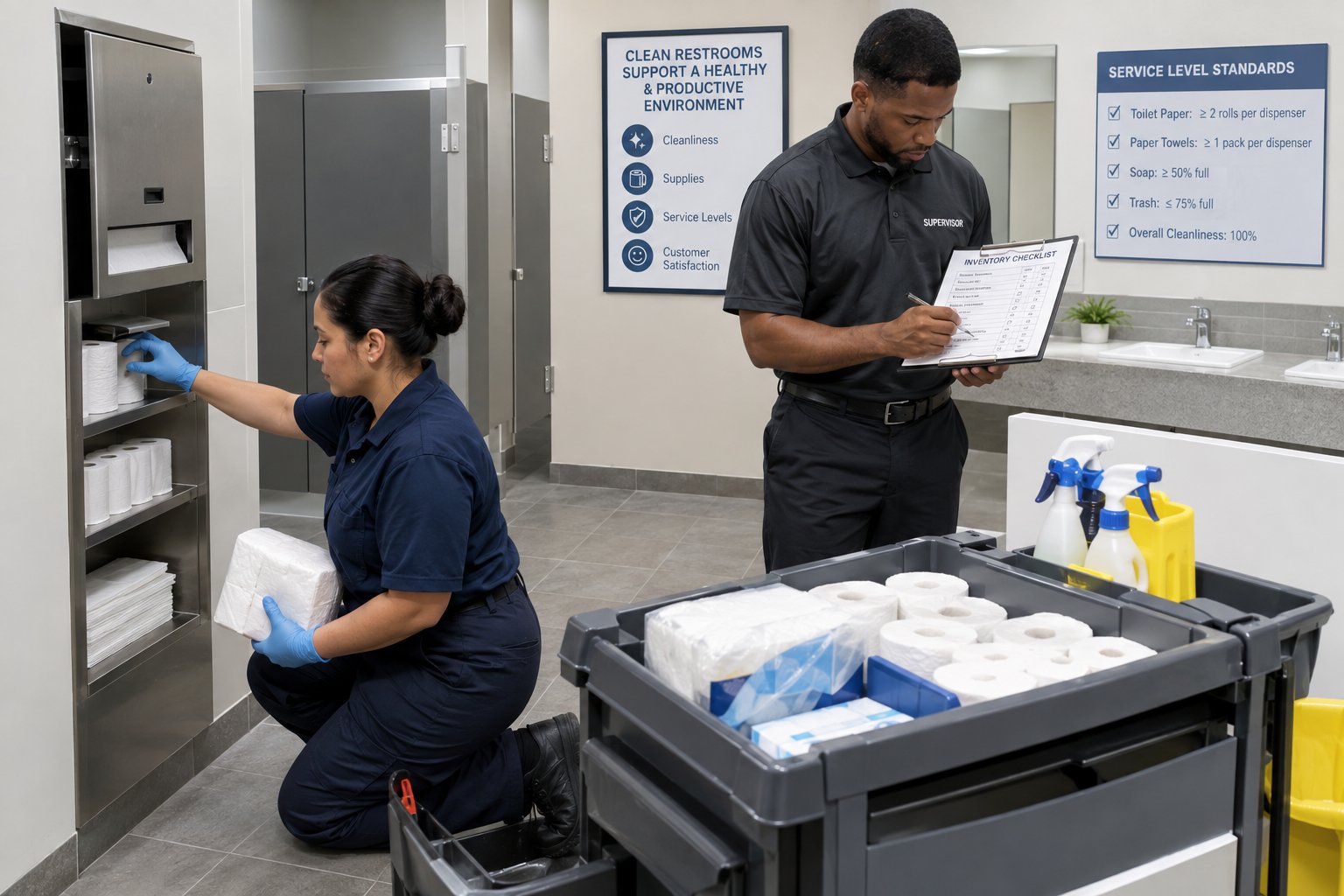
A restroom can be visibly clean and still fail the people who use it if soap, paper, liners, or hand-drying supplies run out. The strongest commercial restroom supply protocol connects demand forecasting, storage controls, refill routes, cleaning frequency, dispenser maintenance, accessibility, and documented escalation. This guide is designed for offices, schools, healthcare practices, warehouses, public buildings, and multi-tenant properties in Manhattan, the Bronx, Brooklyn, Queens, Staten Island, Westchester, Long Island, New Jersey, Connecticut, Pennsylvania, and Florida. GreenPoint Maintenance Services treats supplies as a service-level issue, not an afterthought.
Define the Restroom Service Level
Start by defining what users should experience at each inspection: fixtures clean and dry, floors free of visible soil, soap and hand-drying supplies available, liners changed before overflow, dispensers functional, odors controlled, and high-touch points addressed. Assign a frequency to each condition. A busy Midtown lobby may need checks every 60 to 90 minutes during peak hours, while a low-occupancy warehouse may need scheduled checks plus an escalation process. GreenPoint writes these expectations into a zone checklist so a refill and a full cleaning are not treated as the same task.
Use fixture counts and occupancy rather than square footage alone. A 20,000-square-foot Brooklyn coworking office can consume more paper and soap than a 100,000-square-foot warehouse. A Queens school needs service around arrival, lunch, and dismissal; a medical office near White Plains needs patient-room and public-restroom separation; a Florida facility may see higher water and sand load. OSHA hazard communication applies to cleaning chemicals, and accessibility rules require clear routes and usable dispensers. Schedule a walkthrough at 844-814-0810 to map the service level by restroom.
Create a Par-Level Inventory System
A par level is the amount of each product that should be available to cover normal demand until the next delivery, plus a reasonable safety stock. Track rolls, folded towels, soap, sanitizer, liners, feminine-hygiene supplies, urinal screens, air-freshener refills, and approved cleaning products separately. Record pack size, dispenser compatibility, units per fixture, lead time, and storage location. GreenPoint can build a simple count sheet or digital record that shows beginning inventory, deliveries, usage, damaged stock, and ending balance. The target is enough stock to protect service without tying up cash in cartons that sit unused.
Set reorder points using actual consumption. If a restroom uses 18 paper-towel cases per month and delivery takes five business days, a manager should not wait until the storeroom is empty to order. Add a safety factor for events, weather, occupancy changes, and supply delays. A property near Penn Station may have event-driven peaks; a Long Island campus may have infrequent deliveries; a New Jersey distribution center may need weekend access. Compare [restroom cleaning best practices for high-traffic facilities](/blog/restroom-cleaning-best-practices-high-traffic/) with the supply protocol, then call 844-814-0810 for a site count.
Inspect Dispensers, Not Just Refill Levels
A full carton does not help if a dispenser is jammed, empty at the point of use, mounted too high, leaking, or incompatible with the refill. Add dispenser function to every inspection: operate the soap pump, test the towel feed, check sensor batteries, verify toilet tissue rolls, inspect sanitary-napkin units, and look for leaks or loose mounting. GreenPoint records an exception when the issue is hardware rather than supply. The service level should identify who repairs a dispenser, how quickly, and what temporary solution protects users in the meantime.
In an older Bronx building, a loose dispenser may require building engineering; in a new Manhattan tower, access may require a work order; in a Florida property, humidity can affect adhesives and paper storage. Keep a fixture inventory with model numbers, keys, spare parts, and vendor contacts. Do not ask cleaners to improvise repairs or mix incompatible products. StockPoint can hold timestamped GPS-tagged photos and closure notes for recurring dispenser faults. GreenPoint can include the repair path in a fixed-price proposal so procurement sees the true operational requirement.
Separate Supply Storage From Chemical Storage
Paper products and personal-care supplies should be clean, dry, protected from leaks, and easy to count. Cleaning chemicals need their own organized storage with labels, safety data sheets, ventilation, spill controls, and access restrictions consistent with OSHA hazard communication and local fire-code requirements. Never store open chemicals above paper products. GreenPoint uses a controlled supply area, color-coded tools, Green Seal product options, and a replenishment route that reduces cross-contamination. The protocol should state who checks expiration, packaging integrity, and dilution equipment.
A multi-tenant office in Jersey City may have a shared loading area; a school in Queens may need separate custodial storage; a medical practice in Connecticut may have clinical products that cannot be mixed with janitorial stock. Put the storage map in the site book and keep emergency contacts visible. Inspect shelves weekly for water damage, pests, and blocked egress. If an item is backordered, record the substitute and obtain client approval rather than silently changing the user experience. Call 844-814-0810 when a walkthrough should include storage and fire-code risk points.
Forecast Demand Around Occupancy
Supply usage follows people, events, and service hours. Use occupancy counts, restroom visits if available, event calendars, school schedules, and historical consumption to forecast demand. A 10% occupancy increase can change hand-drying and soap demand more than a small square-footage change. GreenPoint reviews weekly usage and exception trends, then adjusts pars rather than over-ordering every product. For a public building, add an event protocol: increase checks before and during a large meeting, stage spare supplies, and assign a contact who can approve an emergency delivery.
Local patterns matter. A conference venue near Javits Center may have compressed peaks; a downtown Brooklyn property may see weekend events; a Long Island school has summer and holiday changes; a Florida facility may face storm-related deliveries. Put emergency stock in more than one approved location when a building is large. Train the day porter or security desk on how to report a failed dispenser without opening an unsafe chemical closet. GreenPoint's 98% client retention reflects responsiveness to the small operational details users notice first.
Measure Cleaning and Restocking Separately
A restroom report should distinguish cleaning completed, supply replenishment, fixture repair, odor response, and inspection result. Combining all work into one checkbox hides the reason a restroom failed. GreenPoint uses StockPoint to capture service time, timestamped GPS-tagged photos when appropriate, exceptions, corrective action, and closure. ATP testing can be added to an approved sampling plan for selected touchpoints, but it does not replace visual inspection or a check that users can actually obtain soap and towels. The report should be readable by a facility manager in under two minutes.
Set service-level metrics such as 98% of scheduled inspections completed, 100% of urgent supply outages acknowledged within 10 minutes, and repeat dispenser faults closed within one business day when parts are available. Choose targets the team can verify. A facility manager in Manhattan may need a live dashboard; a smaller Westchester office may prefer a weekly summary. Call 844-814-0810 to define the right evidence package. GreenPoint's process supports accountability without turning every restroom visit into paperwork no one reads.
Write the RFP and Contract Language
A restroom supply RFP should list fixtures, dispensers, products, pack sizes, approved alternatives, refill frequency, service windows, storage responsibilities, delivery terms, emergency response, repair exclusions, waste handling, and reporting. State whether consumables are included in the recurring price and how a change in occupancy is handled. GreenPoint offers fixed pricing with no hourly billing or hidden fees after the walkthrough. A clear list protects the buyer from a low cleaning price that excludes the products users depend on.
Require sample inspection forms and a transition plan. During mobilization, count opening inventory, photograph each dispenser, tag damaged hardware, confirm keys, and identify high-risk rooms. In a school or public building, coordinate with the facilities director and local access rules; in a medical setting, align products and cleaning steps with the practice's infection-prevention policy. Review [commercial cleaning contract key terms](/blog/commercial-cleaning-contract-key-terms/) before signing. Email info@greenpointms.com or call 844-814-0810 for a contract-ready restroom scope.
Review Exceptions and Improve the Route
The monthly review should show where service failed and why: empty dispensers, late delivery, incorrect pack size, blocked storage, heavy event use, repair backlog, or missed inspection. Look for repeat patterns by restroom, shift, building, and product. GreenPoint can use StockPoint to assign corrective action and confirm closure with a supervisor inspection. If the same restroom misses towels three weeks in a row, the answer may be a different dispenser, a new par level, or a route change rather than another reminder to the cleaner.
Keep a short service meeting with the client, cleaning supervisor, and supply contact. Review inventory variance, out-of-stock events, complaints, repair age, and upcoming occupancy changes. A 98% client retention record is strongest when the provider explains both successes and exceptions. GreenPoint serves the tri-state area and Florida, and can schedule a walkthrough at 844-814-0810 to remeasure a route after a renovation, tenant move, or seasonal change. A dependable restroom program is visible in every user interaction.
Frequently Asked Questions
How often should commercial restrooms be checked?
Frequency depends on occupancy, fixtures, hours, and complaints. High-traffic lobbies may need 60- to 90-minute checks, while lower-traffic areas may need scheduled checks plus escalation. GreenPoint confirms the service level during a walkthrough.
What should a restroom supply par level include?
Track paper, towels, soap, sanitizer, liners, feminine-hygiene supplies, screens, batteries, and pack sizes, plus lead time and safety stock. GreenPoint uses consumption and event patterns rather than a generic carton count.
Who repairs a broken dispenser?
The contract should name the responsible party, response time, temporary protection, parts policy, and approval path. GreenPoint records hardware exceptions separately from cleaning and can include the repair workflow in the proposal.
How does GreenPoint document restroom service?
StockPoint can capture scheduled inspections, service time, timestamped GPS-tagged photos, exceptions, corrective actions, and closure. ATP testing may supplement an approved plan but does not replace visual and supply checks.
How can a facility request a restroom supply review?
Call GreenPoint at 844-814-0810 or email info@greenpointms.com. GreenPoint serves NYC, Westchester, Long Island, New Jersey, Connecticut, Pennsylvania, and Florida with fixed pricing and no hidden fees after scope confirmation.
Call GreenPoint Maintenance Services at 844-814-0810 for a restroom supply and service-level walkthrough. Get par-level inventory, dispenser checks, StockPoint verification, fixed pricing, and a response plan backed by 98% client retention.