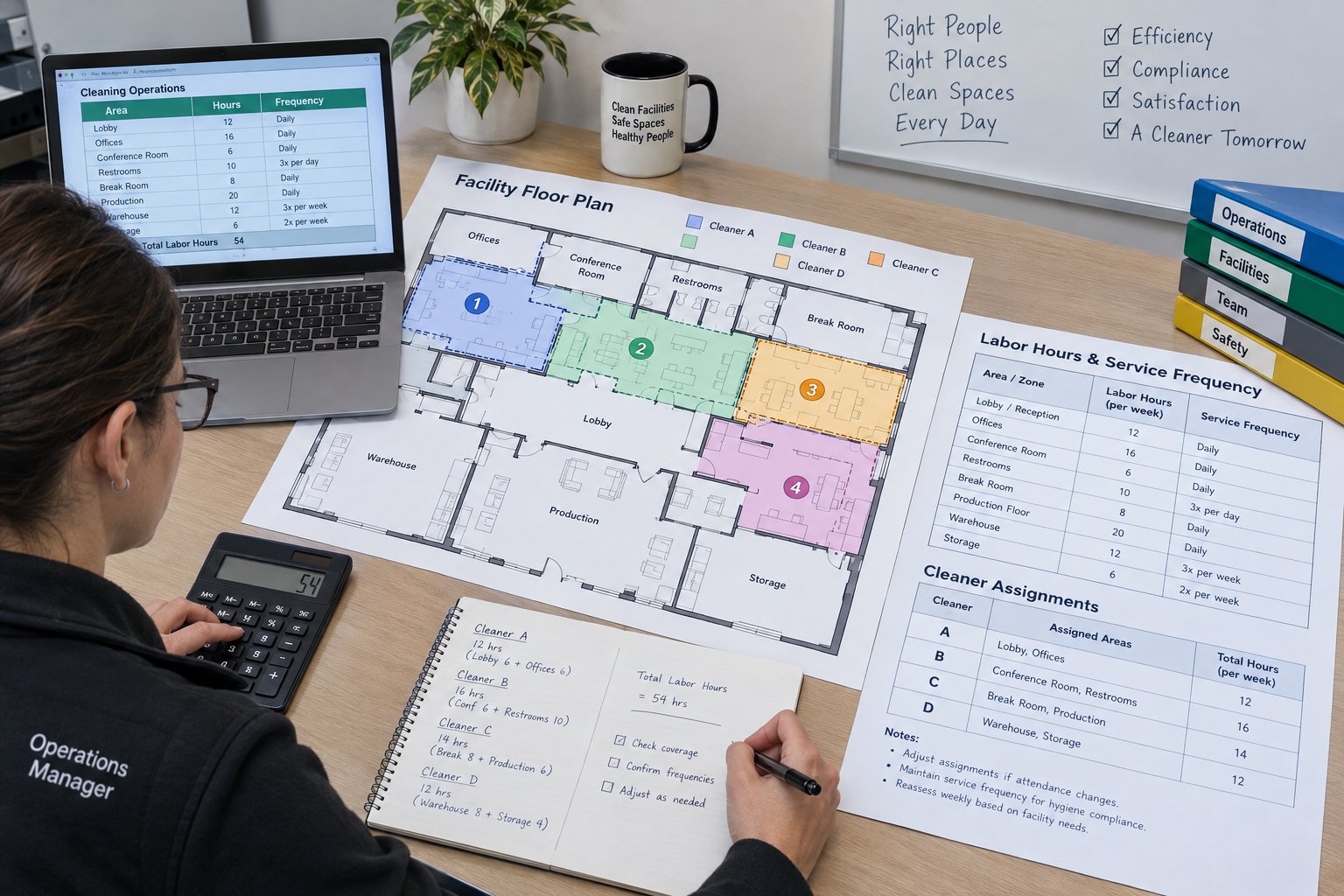
A staffing ratio is a planning tool, not a promise that one cleaner can produce the same result in every building. Occupancy, restroom count, floor type, security, transit access, frequency, and appearance level can double the labor needed for the same square footage. This guide shows facility managers and procurement teams how to estimate cleaning contract labor without underbidding the work. GreenPoint Maintenance Services uses a task-based walkthrough, documented production assumptions, and StockPoint verification so the lowest number of people on paper does not become a missed-service problem in Manhattan, Brooklyn, New Jersey, Connecticut, Pennsylvania, or Florida.
Why Square Footage Alone Misleads
A common starting point is 15,000 to 25,000 square feet per cleaner per shift for a light office, but that range is not a universal standard. A heavily furnished office with many small rooms, kitchens, and conference rooms may need less production per labor hour than an open warehouse. Healthcare, daycare, food service, and public buildings carry higher touchpoint and compliance demands. GreenPoint separates cleanable square footage from gross square footage, counts fixtures and rooms, and lists the tasks that consume time. That produces a labor estimate a buyer can inspect instead of a ratio that hides assumptions.
For example, a 50,000-square-foot Midtown office with two banks of restrooms, four pantries, a lobby, and daily service may need a different crew from a 50,000-square-foot Long Island warehouse with long aisles and fewer fixtures. A Bronx school adds classrooms, cafeterias, gyms, and NYC DOE access rules; a New Jersey distribution center adds loading-dock timing and shift overlap. Ask the bidder to show production rates by task, not just a total headcount. The companion guide [cleaning staffing ratios by square footage](/blog/cleaning-staffing-ratios-square-footage/) can help structure that request.
Build a Task and Frequency Matrix
List every service by area, frequency, method, and quality target. Daily work may include trash, restrooms, high-touch surfaces, vacuuming, dust-mopping, and breakrooms. Weekly work may include detailed edges, low ledges, and machine scrubbing. Monthly or quarterly work may include carpet extraction, high dusting, window cleaning, and floor restoration. Put the estimated minutes next to each task and state whether the time includes setup, travel between zones, replenishment, and documentation. GreenPoint uses a task matrix so a change from three to five service nights changes the estimate transparently.
A 12,000-square-foot medical office near Jamaica may have 16 exam rooms and require between-patient touchpoint work that a general-office ratio misses. A church in Staten Island may have a quiet weekday schedule but a heavy Sunday reset. A Philadelphia government building may have prevailing-wage requirements and controlled entrances. Ask who cleans each zone, when they clean it, and how the supervisor verifies it. Call 844-814-0810 for a walkthrough; GreenPoint will translate the floor plan into a staffing model instead of guessing from gross area.
Use Productive Hours, Not Paid Hours
Paid hours include more than hands-on production. Workers need time for opening and closing, supply staging, equipment checks, restroom replenishment, elevator travel, security sign-in, safety meetings, and reporting. A proposal that divides square footage by an ideal production rate and ignores those minutes will underbid the contract. Build a productive-hours factor into the model and show the client which assumptions can change. GreenPoint also includes supervisor time, training, relief coverage, and quality assurance so the contract does not collapse when one employee is absent.
A practical schedule might show 32 cleaner hours, 4 supervisor hours, and 3 relief or training hours for a five-night program, rather than pretending that 39 paid hours are all available for floor work. A high-rise in Manhattan may lose minutes to freight elevators; a campus in Westchester may lose minutes to distance between buildings; a Florida property may have heat or storm interruptions. Put travel and access into the bid. Fixed pricing should still be clear about the labor model. GreenPoint does not use hourly billing for the client, but it uses labor assumptions internally to protect service quality.
Adjust Ratios for Restrooms and Touchpoints
Restrooms are usually the strongest labor driver in an office, school, retail, or transit-adjacent property. Count fixtures, partitions, dispensers, floors, mirrors, and replenishment points, then account for occupancy and mid-day touch-ups. High-touch surfaces require their own route rather than a vague promise to wipe frequently. CDC and OSHA guidance supports risk-based cleaning and safe chemical handling, while ISSA standards help define appearance. GreenPoint identifies high-use areas and assigns time for inspection, replenishment, and corrective work. A ratio that ignores fixtures will look efficient until the first tenant complaint.
A 30,000-square-foot Brooklyn coworking site near Atlantic Terminal may have more restroom and kitchen demand than a 60,000-square-foot low-occupancy office. An elementary school in Queens or Newark needs cafeteria and restroom work after peak periods; a medical practice needs exam-room turnover. Put service windows in the scope and require the bidder to state the number of fixtures covered. Use StockPoint for photos, supervisor checks, and supply exceptions. Call 844-814-0810 when the current contract repeatedly runs out of paper products or leaves touchpoints undocumented; those are staffing signals, not merely supply problems.
Add Supervision, Training, and Relief
A credible staffing plan names who leads the shift, who performs inspections, who trains new hires, and who covers an absence. Industry turnover can be high, so a proposal that assumes every cleaner works every night is fragile. GreenPoint budgets onboarding, site orientation, chemical-safety training, cross-training, and relief coverage. The supervisor should inspect high-risk zones, review exceptions, communicate with the facility contact, and close corrective actions. A digital dashboard is useful only when a trained person acts on what it shows.
Ask bidders for a supervisor-to-cleaner relationship and the hours the supervisor is physically present. A 24-hour facility in Queens may need overlap at shift change; a school in Westchester may need a single accountable lead; a hospital-adjacent medical office in Connecticut may need documented terminal-cleaning review. Require a substitute plan for vacations, call-outs, weather, and transit disruption. GreenPoint's 98% client retention record reflects attention to continuity, while MBE/MWBE certification and SAM.gov registration help buyers document responsible sourcing. GreenPoint can outline the labor model during a walkthrough at 844-814-0810.
Price Compliance and Specialized Tasks
Not every cleaning hour is interchangeable. Healthcare, childcare, laboratory, food-service, and government work may require extra training, PPE, color-coded tools, product controls, or prevailing-wage compliance. OSHA hazard communication and bloodborne-pathogen requirements can add preparation and documentation time. NYC DOE or municipal buildings may specify access, background checks, or approved products. GreenPoint separates routine production from specialized tasks and records the assumptions in the proposal. This protects the buyer from a low base price that later becomes change orders when compliance work appears.
The same principle applies to floors and finishes. VCT strip-and-refinish, carpet extraction, high dusting, pressure washing, and post-construction work should have their own labor and equipment estimates. Include square footage, frequency, furniture movement, drying time, and protection of adjacent areas. A vendor should identify what is excluded and what triggers a quote. For a complete comparison, review [commercial cleaning cost per square foot](/blog/commercial-cleaning-cost-per-square-foot/) and [calculating true cleaning cost TCO](/blog/calculating-true-cleaning-cost-tco/). GreenPoint offers fixed pricing with no hidden fees after scope confirmation.
Test the Staffing Model With a Pilot
Before signing a multi-year contract, test the proposed staffing model in representative zones and compare planned versus actual minutes. Record room counts, fixture counts, access delays, missed tasks, supply use, inspection findings, and client complaints. A pilot should not be a free week that quietly uses extra labor; agree on the crew, scope, acceptance criteria, and reporting in writing. GreenPoint can use StockPoint to document attendance evidence, timestamped GPS-tagged photos, inspections, and corrective actions. The point is to validate the work content, not to reward a bidder for a low headcount.
Choose a week with normal occupancy and include a high-demand day. A pilot in a Manhattan office should include lobby, elevators, conference rooms, and restrooms; a Long Island school should include classrooms, cafeteria, gym, and entryways; a Florida property should include sand and weather-related entry soil. Review the results with operations and procurement together. If the model needs adjustment, say why. Call 844-814-0810 to schedule a GreenPoint walkthrough and receive a staffing estimate tied to the actual task matrix.
Use Evidence to Rebalance the Contract
Staffing should be reviewed when occupancy, hours, layout, or service expectations change. Monthly data can show whether labor is being spent on the right zones: repeat restroom exceptions, high-touch misses, carpet soil, supply outages, and response times are more useful than a single complaint. GreenPoint's StockPoint records can pair operational evidence with supervisor notes and client communication. A 98% retention rate depends on making those conversations early, before a small staffing gap becomes a contract termination.
A responsible adjustment may be a frequency change, a day porter, a different start time, a revised route, or an added specialist rather than simply more cleaners. Put the decision rule in the contract: for example, two repeat misses in a high-priority zone trigger a root-cause review within five business days. GreenPoint provides a named contact, fixed pricing, and no hourly billing or hidden fees, so an approved change can be priced clearly. Email info@greenpointms.com or call 844-814-0810 to review a staffing model for any tri-state or Florida facility.
Frequently Asked Questions
What is a reasonable cleaner-to-square-foot ratio?
There is no universal ratio. Light offices may plan around 15,000 to 25,000 square feet per cleaner per shift, while healthcare, schools, restrooms, dense furniture, and high-frequency work require lower production assumptions. GreenPoint confirms the task matrix during a walkthrough.
How should a cleaning contract account for supervisor time?
Show supervisor inspection, training, supply coordination, relief coverage, and reporting separately from hands-on production. GreenPoint uses StockPoint and named accountability so a low cleaner count does not eliminate quality control.
Why do two buildings with the same square footage need different staffing?
Fixture counts, rooms, floor types, occupancy, access, security, frequency, and compliance tasks change labor. A 50,000-square-foot school, clinic, warehouse, and office are not equivalent. Call 844-814-0810 for a site-specific estimate.
Does GreenPoint bill hourly?
No. GreenPoint uses internal labor assumptions to build a transparent fixed price with no hourly billing or hidden fees after the scope is confirmed. Schedule a walkthrough at 844-814-0810 or email info@greenpointms.com.
Where does GreenPoint provide staffing and janitorial service?
GreenPoint serves Manhattan, the Bronx, Brooklyn, Queens, Staten Island, Westchester, Long Island, New Jersey, Connecticut, Pennsylvania, and Florida. The scope confirms local access, staffing, and compliance needs.
Call GreenPoint Maintenance Services at 844-814-0810 for a task-based staffing walkthrough. Get a fixed-price labor model, supervisor and relief coverage, StockPoint verification, and a practical plan backed by 98% client retention.