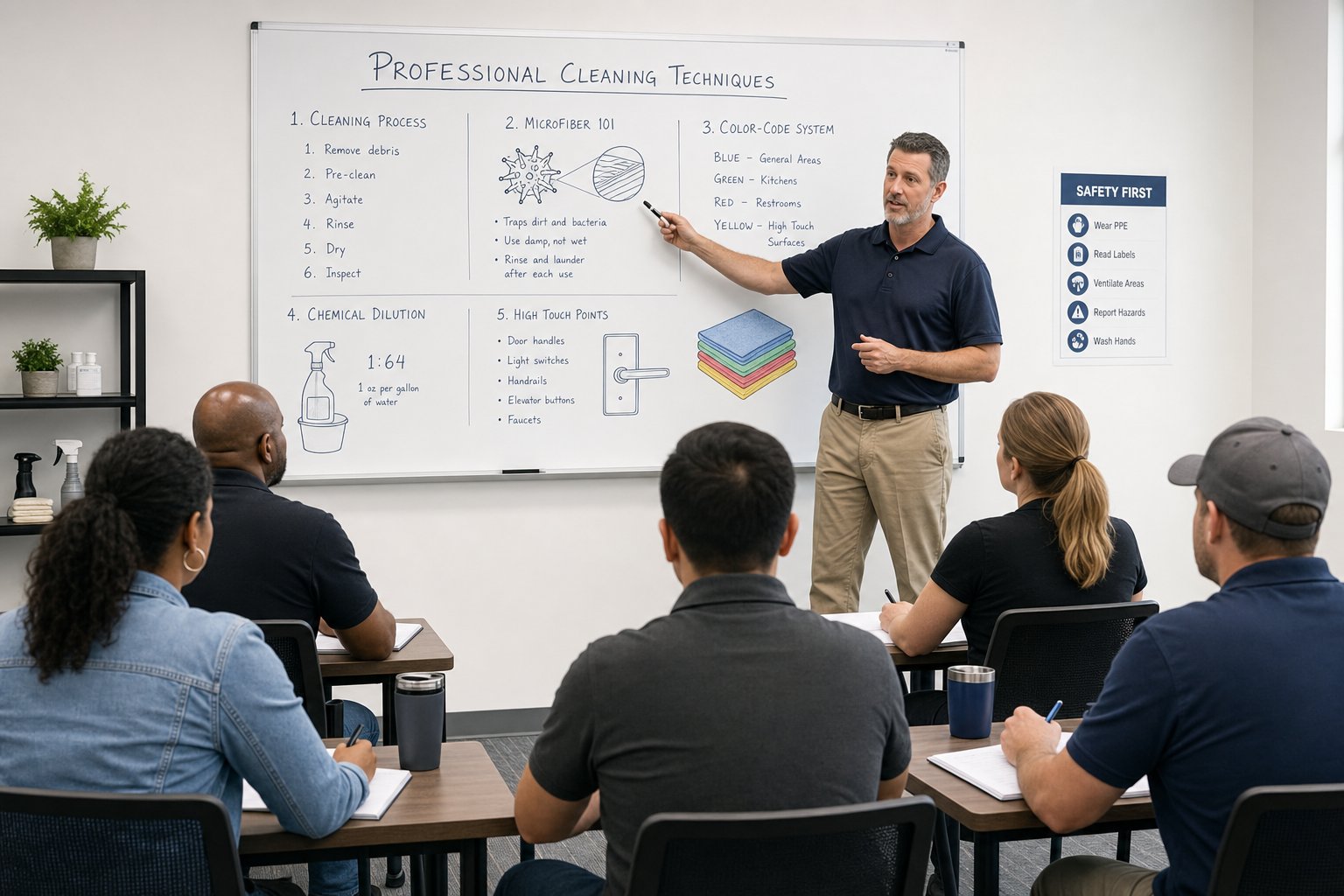
If you are buying commercial cleaning in NYC, New Jersey, Connecticut, or Pennsylvania, the single best predictor of day-to-day results is not a glossy proposal—it is the training system behind the crew that shows up at your building. GreenPoint Maintenance Services has built a proof-driven training and quality program for tri-state facilities that need consistent outcomes, documented compliance, and predictable pricing. Call 844-814-0810 to schedule a walkthrough and get a fixed-price scope built around your building’s risk profile, traffic, and inspection requirements.
Why training is the hidden variable in cleaning quality
In commercial cleaning, two vendors can quote the same scope and still deliver completely different results because the real work happens in the details: dwell times for disinfectants, correct dilution, microfiber handling, restroom sequence, and high-touch prioritization. When training is informal or inconsistent, quality becomes personality-dependent and turnover becomes a quality event. GreenPoint designs training to be repeatable and auditable, so quality does not depend on who happens to be on shift. If you want to compare vendors, ask to see their training matrix, onboarding checklist, and how they verify performance after day 1.
Facilities in the NYC metro area have extra complexity—mixed flooring, high-density vertical traffic, after-hours access rules, and building management requirements that vary by landlord. A trained crew must understand not just cleaning tasks but also building etiquette, elevator protocols, waste stream rules, and how to protect finishes. GreenPoint Maintenance Services trains with these realities in mind for Manhattan, Brooklyn, Queens, the Bronx, Staten Island, Westchester, and Long Island sites, and we support NJ and CT operations with the same verification standards. For an evidence-based approach, see our guide to digital verification: [Digital cleaning verification systems](/blog/digital-cleaning-verification-systems/).
What janitorial certifications matter (and what does not)
Certifications can be valuable signals, but they are not guarantees. Some credentials are program-level (how the company runs quality), while others are technician-level (how a person performs a specific task). The most useful buyer mindset is: treat certifications as a starting point, then verify outcomes with inspection data, corrective-action logs, and objective tests. GreenPoint uses a layered system: standardized training, documented SOPs, and on-site verification through StockPoint (timestamped GPS-tagged photos and reporting) plus targeted ATP testing when appropriate. If you want a walkthrough and a verification plan aligned to your building, call 844-814-0810.
For buyers, the question is not “Do you have a certificate?” but “Can you show me how you maintain performance over 30, 90, and 180 days?” A vendor that cannot explain how they prevent drift is telling you the quality system is informal. GreenPoint’s 98% client retention is tied to measurable QA and a transparent escalation process, not a sales promise.
IICRC: when it applies to commercial facilities
The IICRC is commonly associated with restoration and specialized cleaning disciplines (for example, water damage and certain remediation practices). If your facility has experienced a loss event—water intrusion, sewage backup, or a major contamination incident—an IICRC-aligned approach can matter because the work includes containment, safety controls, and documentation. For everyday janitorial, IICRC is usually less central than consistent SOP execution and verification.
GreenPoint can support post-incident cleaning coordination and will recommend the correct specialty pathway when a job goes beyond routine janitorial. If you need urgent help evaluating next steps after a loss, call 844-814-0810 for a same-day walkthrough when possible.
ISSA CIMS: what it signals about a cleaning company
ISSA CIMS (Cleaning Industry Management Standard) is best understood as a management-system signal: training, quality control, and operational consistency. Whether or not a vendor has formal CIMS certification, you can borrow the intent of the standard as a buyer checklist: documented procedures, clear staffing plans, supply chain control, and an inspection system that creates real corrective actions. GreenPoint’s program is built around repeatability and documentation because many of our clients operate in regulated or inspected environments—schools, healthcare-adjacent offices, government, and high-visibility commercial properties.
If you are issuing an RFP, pair training requirements with objective performance measures. Our pricing and scoping approach is fixed (no hourly billing and no hidden fees), and our QA approach uses measurable verification where it improves outcomes. For RFP structure, see: [How to write an RFP for commercial cleaning](/blog/how-to-write-rfp-commercial-cleaning/).
Core training modules every professional crew should have
A credible training program covers more than “how to mop.” At minimum, your cleaning provider should train and retrain on: chemical safety (SDS/GHS), dilution control, dwell time, PPE, ladder safety, sharps awareness where relevant, restroom sequencing, high-touch protocols, and cross-contamination prevention. OSHA-aligned chemical handling is essential in any commercial setting, and it should be reinforced with job-specific hazard assessments. GreenPoint trains teams using standardized SOPs and site-specific addenda so each facility’s unique risks—such as food service areas, labs, or high-density restrooms—are addressed.
In NYC-area buildings, floor care and surface protection are frequent failure points: improper pads, wrong chemistry, or rushed dwell times can permanently damage VCT, stone, or specialty coatings. We teach surface identification and finish protection so the work protects the asset. If your building has VCT, this reference is useful: [VCT floor care strip, seal, and wax guide](/blog/vct-floor-care-strip-seal-wax-guide/).
How GreenPoint verifies training shows up in results (StockPoint + objective QA)
Training only matters if it becomes consistent behavior on-site. GreenPoint uses StockPoint to verify completion and quality with timestamped, GPS-tagged photos and a live dashboard so facility managers can see proof of service without chasing people. For critical areas, we can add ATP testing to validate whether cleaning is reducing organic residue on targeted surfaces. These two layers—visual proof plus objective spot checks—reduce “it looks clean” ambiguity and create a clear feedback loop for crews.
This system is especially valuable in high-traffic environments like Midtown office towers near Grand Central, Downtown Brooklyn near Jay St–MetroTech, or transit-adjacent buildings along the 7, E, and F lines where foot traffic spikes drive rapid restroom and touchpoint recontamination. GreenPoint Maintenance Services designs schedules and checkpoints around real traffic patterns, not generic assumptions. To build a verification-forward scope for your site, call 844-814-0810 and schedule a walkthrough.
What to ask for during a walkthrough (a buyer’s verification checklist)
A walkthrough is where you separate a training-driven operation from a sales-driven operation. Ask for: a written scope by area, a frequency plan by task, a staffing plan, a training matrix, and an inspection process that includes corrective actions with dates. Ask how they handle absentee coverage without breaking quality. Ask how issues are documented and resolved, and who owns accountability. GreenPoint provides fixed-price scopes and quality checkpoints designed to prevent the “week 3 quality drop” many facilities experience after switching vendors.
Also ask whether the vendor uses Green Seal certified products or other safer chemistries where appropriate, and how they control dilution to prevent residue buildup and indoor air quality complaints. For IAQ considerations, see: [Indoor air quality and commercial cleaning](/blog/indoor-air-quality-commercial-cleaning/).
IICRC vs ISSA CIMS vs BSCAI: A Working Comparison for Facility Managers
IICRC (Institute of Inspection, Cleaning and Restoration Certification) focuses on technician-level certifications in specific hard skills: carpet cleaning, water damage restoration, floor care, upholstery, and mold remediation. IICRC certifications are individual and portable, meaning a technician carries them from employer to employer. ISSA CIMS (Cleaning Industry Management Standard) is a company-level certification that validates the cleaning organization's management systems, quality processes, safety programs, and customer service standards. BSCAI (Building Service Contractors Association International) offers management-level training and the RBSM (Registered Building Service Manager) credential aimed at supervisors and account managers. GreenPoint Maintenance Services holds ISSA CIMS certification at the company level and requires IICRC certifications for our floor care and restoration technicians. Call 844-814-0810 to receive our current certification roster.
For facility managers evaluating vendors, ask for two documents: the company's current ISSA CIMS certificate (renewed every three years) and a roster of technician-level IICRC certifications for anyone assigned to your account. Vendors that dodge these requests, or that show expired credentials, are signaling either weak training investment or poor documentation practices — either way, a leading indicator of quality problems.
OSHA-Required Training Hours by Job Function
OSHA sets specific training requirements for cleaning workers that vary by task and chemical exposure. Hazard Communication (HazCom) training under 29 CFR 1910.1200 is required for any worker handling cleaning chemicals and must cover Safety Data Sheets, chemical labels, and proper PPE. Bloodborne Pathogens training under 29 CFR 1910.1030 is required for anyone reasonably expected to encounter blood or body fluids, which includes almost every commercial cleaner working in restrooms or medical settings. Powered Industrial Truck training under 29 CFR 1910.178 is required for anyone operating floor scrubbers over a certain size. GreenPoint Maintenance Services documents 16 hours of new-hire OSHA training and 8 hours of annual refresher training for every field employee, logged in StockPoint with completion dates and instructor signatures.
Chemical Safety Training That Actually Reduces Incidents
The most common chemical incidents in commercial cleaning fall into three categories: mixing incompatible chemistries (bleach plus ammonia produces chloramine gas), improper dilution (concentrated products used at full strength), and lack of PPE (skin and eye burns from splashes). Effective training addresses each specifically with hands-on practice, not slide decks. GreenPoint's chemical safety curriculum includes live dilution practice with color-changing test strips, a chemical compatibility chart posted in every equipment closet, and mandatory eye-wash station demonstrations quarterly. Since implementing this program in 2020, GreenPoint has recorded zero OSHA-recordable chemical injuries across a workforce of over 200 technicians.
Ongoing Skill Development: Beyond the Initial Certification
The cleaning industry evolves constantly — new equipment (electrostatic sprayers, autonomous scrubbers), new chemistries (probiotic cleaners, plant-based degreasers), new pathogens (SARS-CoV-2, C. auris), and new regulations. Certifications earned once and never refreshed become quickly obsolete. GreenPoint Maintenance Services runs a monthly one-hour training refresh on a rotating curriculum: new products, updated OSHA guidance, technique refreshers, and customer service scenarios. Attendance is tracked in StockPoint and factored into performance reviews. Facility managers who want to verify a vendor's ongoing training investment can ask for the training calendar and attendance logs — GreenPoint provides both on request.
How Training Investment Correlates with Retention and Quality
The cleaning industry averages 200-300% annual employee turnover, per ISSA benchmarking. GreenPoint's turnover rate for tenured (12+ month) employees is under 25%, which we credit primarily to training investment and career progression. New hires who complete our 40-hour onboarding program stay an average of 3.2 years vs 8 months for the industry benchmark. That retention translates directly to service quality: tenured technicians know your building's layout, your priority zones, your special requests, and your facility manager's preferences. Turnover-heavy vendors force facility managers to re-onboard cleaners every quarter, which is exhausting and produces inconsistent results.
FAQ: cleaning crew training and certification
Q: Should I require certifications to hire a cleaning company? A: Certifications can help, but you should require outcomes: documented training, inspection results, and a corrective-action process. GreenPoint supports verification with StockPoint and transparent QA. Q: How long does onboarding a new crew take? A: For a typical office or mixed-use commercial space, a structured onboarding can be completed in 1–2 weeks with site-specific SOPs and supervisor oversight, then stabilized with inspections over the first 30 days. Q: How do I know training is actually happening after the first month? A: Ask for refresher training records, inspection trends, and proof-of-service reporting. GreenPoint’s dashboard and QA logs show ongoing performance, not just promises. Q: Does higher pay guarantee better cleaning? A: Pay matters, but systems matter more. The combination of training, supervision, and verification is what sustains performance across turnover. Q: What is the simplest proof of quality I can request? A: A consistent inspection scorecard tied to corrective actions plus photo verification for critical tasks.
Need a training-verified cleaning program in NYC, NJ, or CT? GreenPoint Maintenance Services delivers fixed-price commercial cleaning with StockPoint proof-of-service and a QA system designed for inspected, high-traffic facilities. Call 844-814-0810 or email info@greenpointms.com to schedule a walkthrough and receive a scope built around measurable results.