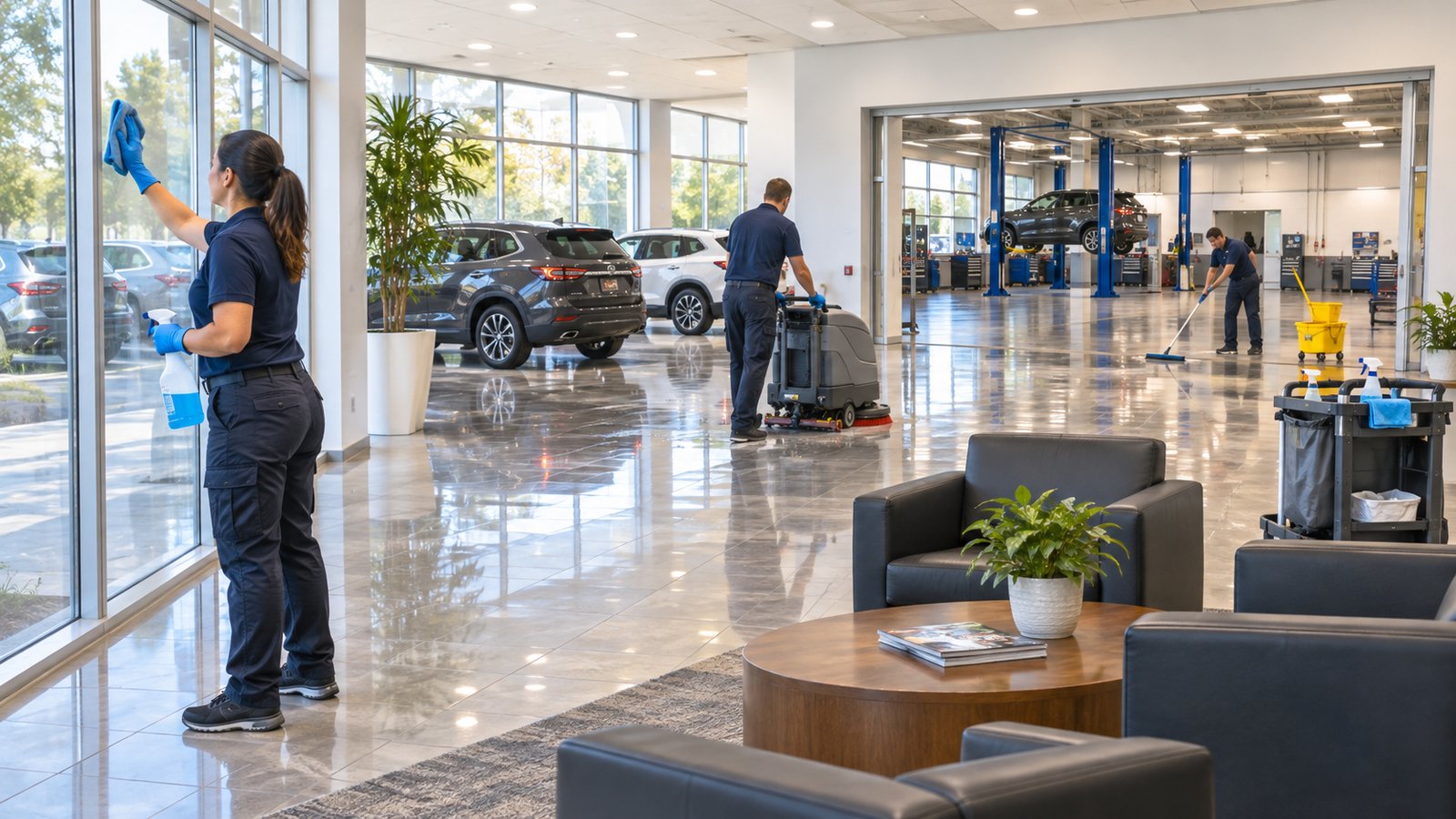
Automotive dealership cleaning is not a generic office janitorial assignment. A New York or New Jersey dealership may combine a glass-front showroom, sales offices, customer lounge, public restrooms, delivery bays, parts counters, and a service drive where grit, oil residue, tire marks, and vehicle traffic arrive throughout the day. A workable scope separates these zones, sets task frequencies around opening and delivery hours, and makes the completed work verifiable. GreenPoint Maintenance Services Corp provides commercial cleaning for facilities across the tri-state region, with fixed pricing, documented quality checks, and a walkthrough-based scope rather than an hourly-billing surprise. This guide explains what dealership managers should specify, what a vendor should prove, and how to compare service proposals.
Build the scope around dealership zones
Start with a floor plan and identify each operating zone instead of assigning one vague square-foot number to the whole property. A 35,000-square-foot dealership might include 12,000 square feet of showroom, 5,000 square feet of sales and finance offices, 4,000 square feet of customer-facing areas, 11,000 square feet of service support space, and 3,000 square feet of circulation and restrooms. Those areas have different soils, access windows, and inspection priorities. GreenPoint Maintenance Services documents the space by room, surface, and shift so a buyer can compare proposals line by line.
List who owns each adjacent task before bidding: dealership staff, the cleaning contractor, an automotive-detailing vendor, or a licensed specialty contractor. Routine janitorial work can include dust mopping, damp mopping, restroom sanitation, waste removal, glass spot-cleaning, and breakroom care. It should not silently expand into oil-spill remediation, hazardous-waste handling, vehicle detailing, lift-pit cleaning, or maintenance of automotive equipment. Put exclusions, access rules, alarm procedures, and who supplies consumables into the written scope. A site-specific plan is easier to price and safer to supervise than a broad promise to keep everything clean.
Keep the showroom and customer journey presentation-ready
Customers notice the front door, glass, vehicle-display floor, reception counter, finance waiting area, and restroom before they notice a back-office checklist. Schedule a pre-opening reset for fingerprints, entry mats, visible litter, high-touch points, and restroom readiness, then assign a day porter or scheduled touch-up for the busiest windows. Use a clean, dry method on polished flooring and confirm product compatibility with the floor finish; residue can make a glossy surface look cloudy or slippery. GreenPoint Maintenance Services trains teams to match tools and chemistry to each surface instead of applying one product everywhere.
Showroom glass often faces a mix of road dust, handprints, and seasonal salt. A useful scope distinguishes interior glass spot-cleaning from periodic full-height glass work, which may require separate access equipment and insurance. Entry matting should be sized and maintained for the actual route from sidewalk to reception, not chosen only for appearance. At a dealership near Fordham Road or the Bruckner Expressway in the Bronx, traffic grime can accumulate differently from a low-traffic suburban showroom in Garden City or Paramus. A walkthrough should record the glass height, floor finish, entrance exposure, and customer hours so the service plan reflects the property rather than a generic template.
Separate service-bay housekeeping from hazardous cleanup
Service departments need a clear boundary between ordinary housekeeping and regulated or specialized work. A janitorial crew may remove ordinary dry debris from approved walkways, clean staff break areas, and maintain designated customer-facing service lanes. Oil, fuel, coolant, brake dust, battery materials, and unknown liquids should follow the dealership's spill-response procedure and be handled by trained personnel with the correct equipment. Keep floor drains, eyewash stations, fire equipment, electrical panels, and marked pedestrian routes accessible. The applicable safety plan belongs to the facility, its environmental-health-and-safety lead, and qualified response vendors, not an assumption that routine cleaners can treat every substance.
Where cleaners use hazardous products, employers must maintain hazard communication information, accessible Safety Data Sheets, suitable labels, and worker training under OSHA's Hazard Communication Standard. GreenPoint Maintenance uses product-specific instructions and Green Seal certified options where appropriate, while checking that approved chemistry works with the dealership's finishes and process. Ask a bidder how it trains staff on dilution, PPE, storage, spill escalation, and the prohibition on mixing incompatible chemicals. A good answer names the responsible supervisor and shows how training records and product lists are kept current.
Plan schedules for New York and New Jersey traffic patterns
New York-area operating hours can make access as important as cleaning frequency. A dealership in Long Island City or Astoria may face delivery and customer peaks around Queens Boulevard, the Long Island Expressway, and the 7 or N/W subway corridors, while an East Tremont or Fordham Road location sees a different pedestrian rhythm. In New Jersey, Route 4 dealerships in Paramus, Newark properties near the New Jersey Turnpike, and Jersey City sites close to PATH stations each have their own loading, parking, and traffic constraints. Put the gate, loading-door, alarm, key-control, and vehicle-movement rules in the site plan.
Match labor windows to the dealership calendar: opening, evening close, month-end sales events, seasonal tire changes, and model launches. A day porter can respond to visible litter or restroom issues, while the evening crew completes floors, waste, and detail tasks after the last customer leaves. Holiday hours and snow events need a defined change process so a manager can request extra entry-mat attention or a post-event reset without rewriting the whole contract. GreenPoint Maintenance can scope scheduled service and approved periodic tasks in advance, with the service frequency and any separate specialty work written into the quote.
Estimate staffing and price from measurable work
Square footage is a starting point, not a complete price formula. A 30,000-square-foot single-level showroom with open floors may need a different labor plan from a smaller dealership with several restrooms, multiple glass levels, a busy service lane, and long public hours. The proposal should state the cleanable area, task list, visits per week, day-porter hours if any, periodic floor work, consumables, and assumptions about access. Compare the complete scope and service window rather than choosing the lowest rate per square foot. For a framework on separating scope from price, see commercial cleaning cost per square foot and calculating total cleaning cost.
Labor assumptions should be transparent. The U.S. Bureau of Labor Statistics reports a May 2025 median wage of $17.71 per hour for janitors and building cleaners nationally, a reference point for labor context rather than a commercial contract price; local wages, payroll burden, supervision, supplies, insurance, and service frequency all affect a bid (BLS Occupational Outlook Handbook). GreenPoint Maintenance quotes fixed pricing for an agreed scope, not an open-ended hourly tab, and flags requested work outside that scope before it begins. Ask bidders to show what is included, how change orders are approved, and whether periodic floor care is part of the monthly amount.
Require evidence, not just a promise of quality
A dealership manager should be able to answer three questions after a shift: which rooms were serviced, what exceptions were reported, and who owns the correction. GreenPoint Maintenance uses JaniTrack to support timestamped, GPS-tagged photos, ATP testing where the program calls for it, and a live dashboard for service visibility. Those records are useful when they are tied to an agreed checklist and a named area, rather than collected as a pile of unrelated images. Define inspection frequency, sample size, acceptable appearance, response time, and how repeat misses are escalated. GreenPoint Maintenance reports 98% client retention, and makes service verification part of the working relationship.
Choose indicators the operations team can actually use: restroom-ready checks, repeat floor or glass complaints, missed-room closeout, open corrective actions, and response time. Review the dashboard with the vendor monthly and use a short improvement log for recurring issues such as salt at the entry or dust on display ledges. A contractor should protect customer information in photos and avoid capturing license plates, paperwork, or people unnecessarily. For maintenance teams comparing more ways to verify work, see digital cleaning verification systems and quality assurance for commercial cleaning.
A low-risk transition from the incumbent
A transition should begin with a joint walkthrough, written room inventory, chemical and equipment review, and a list of locked or restricted spaces. Set the first-week schedule, confirm after-hours contacts, test alarm procedures, and identify which employee can approve an extra service request. Keep the first 30 days focused on baseline condition and reliable closeout, not an unrealistic promise to solve every old floor defect in one visit. Document pre-existing damage and agree on the escalation route for a missed task, access problem, or safety concern. GreenPoint Maintenance can prepare a transition checklist with the facility contact and review it before the first scheduled shift.
Before signing, request proof of insurance, references from facilities with a comparable mix of public space and back-of-house work, the proposed supervisor's name, a sample inspection record, and a clear list of specialty exclusions. Confirm whether the company can support more than one branch while preserving a local contact for each site. GreenPoint Maintenance Services Corp is MBE/MWBE-certified in New York State, New York City, and NYC DOE and is registered in SAM.gov, credentials that may matter for procurement documentation but do not replace a performance review. To schedule a dealership walkthrough or request a fixed-price quote, call 347-332-9348 or email info@greenpointms.com.
Frequently asked questions
Q: How often should an automotive dealership be cleaned? A: Public restrooms, entry points, and customer touchpoints usually need daily service, with daytime checks based on traffic. Showroom floors and offices are normally maintained on a recurring schedule, while full glass work and floor restoration are periodic tasks set by condition and finish.
Q: Can a janitorial contractor clean oil or automotive-fluid spills? A: Not by default. The dealership should identify the substance, use its spill-response plan, and assign qualified personnel with suitable training and equipment. Define ordinary housekeeping boundaries and emergency escalation in the contract.
Q: What should a dealership cleaning quote include? A: It should list each area, task frequency, service window, consumables, periodic work, exclusions, quality checks, and the process for additional requests. A site walkthrough makes the assumptions visible before pricing is finalized.
Q: Does GreenPoint Maintenance offer fixed-price dealership cleaning? A: Yes. GreenPoint Maintenance prepares fixed pricing for the agreed scope, with no hourly billing or hidden fees. Schedule a walkthrough and quote at 347-332-9348.
Request a New York or New Jersey dealership walkthrough at 347-332-9348 or info@greenpointms.com. GreenPoint Maintenance provides fixed-price commercial cleaning with JaniTrack timestamped GPS-tagged photo verification, ATP testing where specified, and a live service dashboard; the company reports 98% client retention.