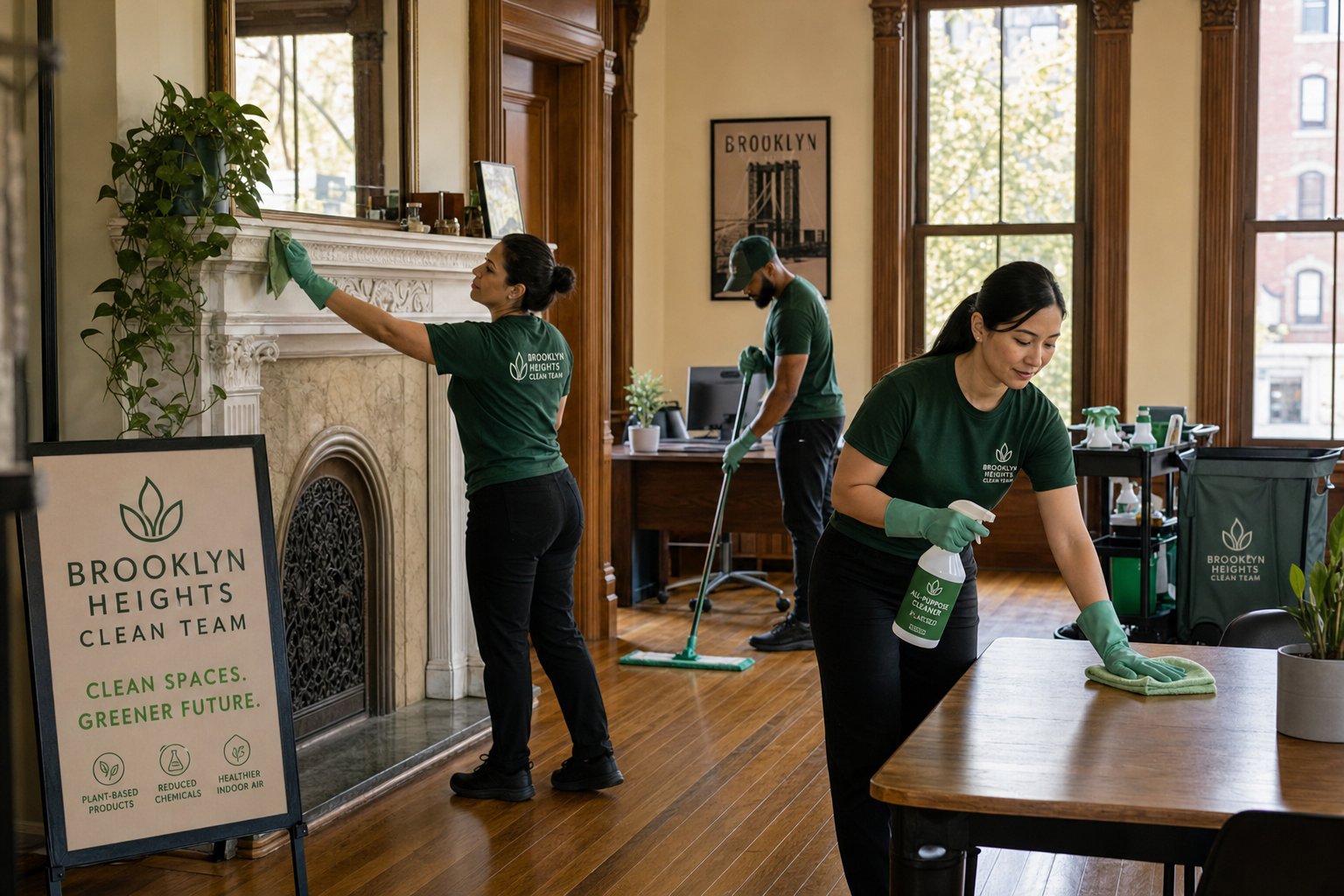
Commercial cleaning in Brooklyn Heights demands a careful balance: historic interiors and brownstone details, modern offices, nonprofit programs, schools, churches, and heavy pedestrian traffic all occupy a compact neighborhood. A janitorial plan must protect finishes and occupants without slowing a building's workday. GreenPoint Maintenance Services supports Brooklyn Heights facilities with fixed pricing, Green Seal certified products where appropriate, StockPoint timestamped GPS-tagged photos, and optional ATP testing. This guide explains what local facility managers should include in a scope and how to evaluate a Brooklyn janitorial company.
Why Brooklyn Heights has distinctive cleaning demands
Brooklyn Heights buildings range from converted townhouses and landmarked properties to office suites, cultural organizations, and newer waterfront developments. A lobby near Montague Street, a nonprofit near Court Street, and a commercial floor near the Brooklyn-Queens Expressway receive different traffic and soil loads. Pedestrians using the A, C, 2, 3, 4, 5, R, and nearby ferry connections concentrate traffic at entrances. GreenPoint maps each building's access, surfaces, touchpoints, and protected details before recommending frequency.
A complete scope distinguishes daily work from periodic restoration. Daily service may include trash, restrooms, vacuuming, dusting, damp mopping, and high-touch disinfection. Periodic service may include carpet extraction, high dusting, glass, stone care, or floor refinishing. GreenPoint uses fixed pricing with no hidden fees and writes assumptions about access, supplies, and event coverage. Call 844-814-0810 to schedule a walkthrough that accounts for the actual building, not a generic office cube.
Historic finishes and careful floor care
Historic properties require restraint. Abrasive pads, excessive water, aggressive chemistry, or unapproved polishing can damage wood, stone, metal, plaster, and decorative details. GreenPoint identifies material types and tests methods in a discreet area before broader use. Microfiber removes dust with less residue, while controlled moisture protects wood and reduces slip risk. When a landmarked or architecturally significant space needs restoration, the cleaning scope should defer to the owner's preservation requirements and qualified specialists.
Brooklyn Heights offices also see winter salt, spring pollen, and waterfront moisture. Entrance mats, stair edges, elevator thresholds, and lobby corners need scheduled attention because grit becomes visible and abrasive quickly. StockPoint records the completed zone and any condition that needs owner action, such as a failed mat, leak, or cracked tile. The [VCT floor care guide](/blog/vct-floor-care-strip-seal-wax-guide/) is helpful for resilient floors, but GreenPoint will not apply a generic method to a historic surface.
Office and nonprofit cleaning around daily programs
Nonprofits and offices often operate beyond a simple 9-to-5 schedule: board meetings, public programs, donor events, classes, and evening services create sudden occupancy changes. Shared kitchens, reception desks, conference rooms, copy areas, and restrooms should be assigned a frequency that reflects those uses. GreenPoint can provide scheduled daytime checks or an event reset while preserving the nightly scope. A 15,000-square-foot office may need five nightly visits, but a smaller nonprofit with public programs may need more touchpoint attention during event windows.
The building's staff should know what is included and how to request a correction. GreenPoint uses supervisor inspections and a live StockPoint dashboard for tasks, photos where suitable, and exception notes. Staff are not asked to interpret a cleaner's initials; they can see whether an area was visited and what follow-up was recorded. The [coworking space cleaning challenges](/blog/coworking-space-cleaning-challenges/) guide offers a useful comparison for shared spaces with hot desks and community kitchens.
NYC compliance and building coordination
Cleaning operations intersect with New York City building rules even when a janitorial company is not the party responsible for structural compliance. Facility teams should coordinate around Local Law 97 energy work, Local Law 11 façade projects, fire egress, elevator access, waste staging, and landlord rules. A cleaner should report blocked exits, wet floors, damaged handrails, leaks, or unsafe chemical storage. OSHA's Hazard Communication Standard still governs chemical labels, SDS access, and training for the cleaning team.
Brooklyn Heights also has tight sidewalks and limited loading space, so carts, deliveries, and waste cannot be staged casually. GreenPoint plans arrival, secure storage, and work routes with the building contact. If a scope includes recycling or commercial waste handling, responsibilities should be written down alongside pickup timing. The [NYC local law building maintenance](/blog/nyc-local-law-building-maintenance/) guide gives managers a starting list of local issues to discuss with ownership and engineering.
High-touch areas and indoor air quality
High-touch priorities include door pulls, intercoms, elevator controls, stair rails, restroom fixtures, shared appliances, and meeting-room tables. The correct frequency depends on occupancy and use; an apartment-adjacent lobby or public nonprofit may need daytime checks, while a low-occupancy office may need nightly service. GreenPoint cleans before disinfecting, follows product label contact time, and avoids overusing fragrance. HEPA-filtered vacuuming and microfiber can support indoor air quality when paired with adequate ventilation and building maintenance.
Cleaning is also an observation system. A recurring dust line, musty odor, condensation, or damp carpet can signal a building issue that janitorial staff should report. GreenPoint's StockPoint exception note can record location, time, photos where permitted, and routing to the responsible contact. Facility managers can use that history to identify repeat conditions rather than repeatedly treating symptoms. Call 844-814-0810 if you want a walkthrough that includes entrances, stairwells, restrooms, shared spaces, and protected finishes.
Brooklyn Heights pricing and staffing
Many standard office programs plan near $0.05–$0.15 per square foot per visit, but historic spaces, multiple stairwells, event activity, floor-care requirements, and restricted access can raise the labor need. BLS labor data and New York wage conditions affect sustainable staffing. A price that excludes relief coverage, consumables, or periodic work can produce visible inconsistency even if the monthly invoice looks attractive.
GreenPoint's fixed-price proposal states the service frequency, materials, periodic calendar, access assumptions, and change process. GreenPoint Maintenance Services is MBE/MWBE certified through NYS, NYC, and NYC DOE programs and registered in SAM.gov; buyers should confirm which certification applies to their procurement. GreenPoint's 98% client retention and StockPoint evidence support accountability, but references and sample reports should still be part of due diligence.
Choosing a Brooklyn janitorial company
Ask vendors how they protect historic finishes, handle winter salt, coordinate with landmarks or building engineers, document locked rooms, respond to events, and cover absences. Request insurance, product and SDS information, training records, sample inspections, and references from similar properties. Ask how the vendor protects privacy in photos and how complaints become corrective actions. The [questions to ask before hiring a commercial cleaning company](/blog/questions-to-ask-commercial-cleaning-company/) helps structure that interview.
GreenPoint offers a professional, evidence-based alternative to a lowest-bid approach. GreenPoint Maintenance Services combines trained cleaners, Green Seal certified products where appropriate, fixed pricing, and StockPoint timestamped GPS-tagged photos. A walkthrough at 844-814-0810 lets the team account for landmark details, public programs, transit-facing entrances, and building rules. Email info@greenpointms.com to request the scope in writing and see how quality will be verified after service begins.
Putting a measurable plan in place in Brooklyn Heights
A practical launch begins with a baseline inspection in Brooklyn Heights. GreenPoint photographs or records the condition of agreed areas, confirms the floor and surface inventory, and notes access limits before the first recurring visit. The facility contact then approves the task map, supply responsibilities, escalation path, and service windows. This step prevents a common failure: a vendor is held to an outcome that was never defined, while the building team assumes a task was included. GreenPoint writes the baseline into the scope so the first monthly review can compare actual service with an agreed starting point.
During the first 30 days in Brooklyn Heights, supervisors should review attendance, completed zones, exceptions, supply usage, and customer feedback at least weekly. GreenPoint uses StockPoint records to identify patterns such as a locked room, recurring spill, under-sized mat, or restroom that needs a daytime check. The response should be specific: revise the route, retrain the cleaner, change the product, or ask engineering to fix a building condition. A dashboard is valuable only when a person acts on its information and records the correction.
Facility managers should also set a small group of outcome measures for Brooklyn Heights: missed-task rate, corrective-action time, restroom supply availability, inspection score, and selected ATP readings where appropriate. These measures are not a substitute for professional judgment, and ATP does not prove sterility. They create a shared vocabulary for vendor meetings. GreenPoint can report visual inspection results, timestamped GPS-tagged photos, and exceptions without turning the program into a confusing spreadsheet of vanity metrics.
At the first quarterly review, GreenPoint and the client can compare the original scope with occupancy, seasonal conditions, and any change in the building. A new tenant, renovation, school program, or extended clinic schedule may justify a route adjustment; it should not create surprise billing. GreenPoint documents the reason, price impact, and approval before changing recurring work. That disciplined process gives a Brooklyn Heights facility a cleaning program that is consistent enough to audit and flexible enough to remain useful. It also makes renewal conversations factual, because both sides can see the service history, open risks, and approved improvements. The same record helps a new facilities leader understand why the current schedule exists.
Frequently asked questions
What does Brooklyn Heights commercial cleaning cost? Standard office cleaning often benchmarks around $0.05–$0.15 per square foot per visit. Historic details, stairs, public events, floor care, and access constraints can change that range, so GreenPoint quotes after a walkthrough.
How are historic finishes protected? The vendor should identify materials, test methods, control moisture, use appropriate pads and products, and follow owner or preservation requirements. GreenPoint avoids applying a generic floor method to a protected surface.
Does NYC Local Law affect cleaning operations? Building rules and projects such as Local Law 97 energy work or Local Law 11 façade work can affect access, routes, and reporting. GreenPoint coordinates with the building contact and reports safety or maintenance exceptions.
Can a nonprofit get event-based cleaning? Yes. GreenPoint can define routine service plus daytime checks or event resets for programs, meetings, and public activities. The scope states response windows and pricing assumptions.
How do I contact GreenPoint? Call 844-814-0810 or email info@greenpointms.com to schedule a Brooklyn Heights walkthrough. GreenPoint will provide a fixed-price scope and explain StockPoint verification.
Schedule a Brooklyn Heights walkthrough with GreenPoint Maintenance Services at 844-814-0810. Receive fixed pricing, careful historic-surface planning, StockPoint evidence, and the proof of a 98% client retention rate.