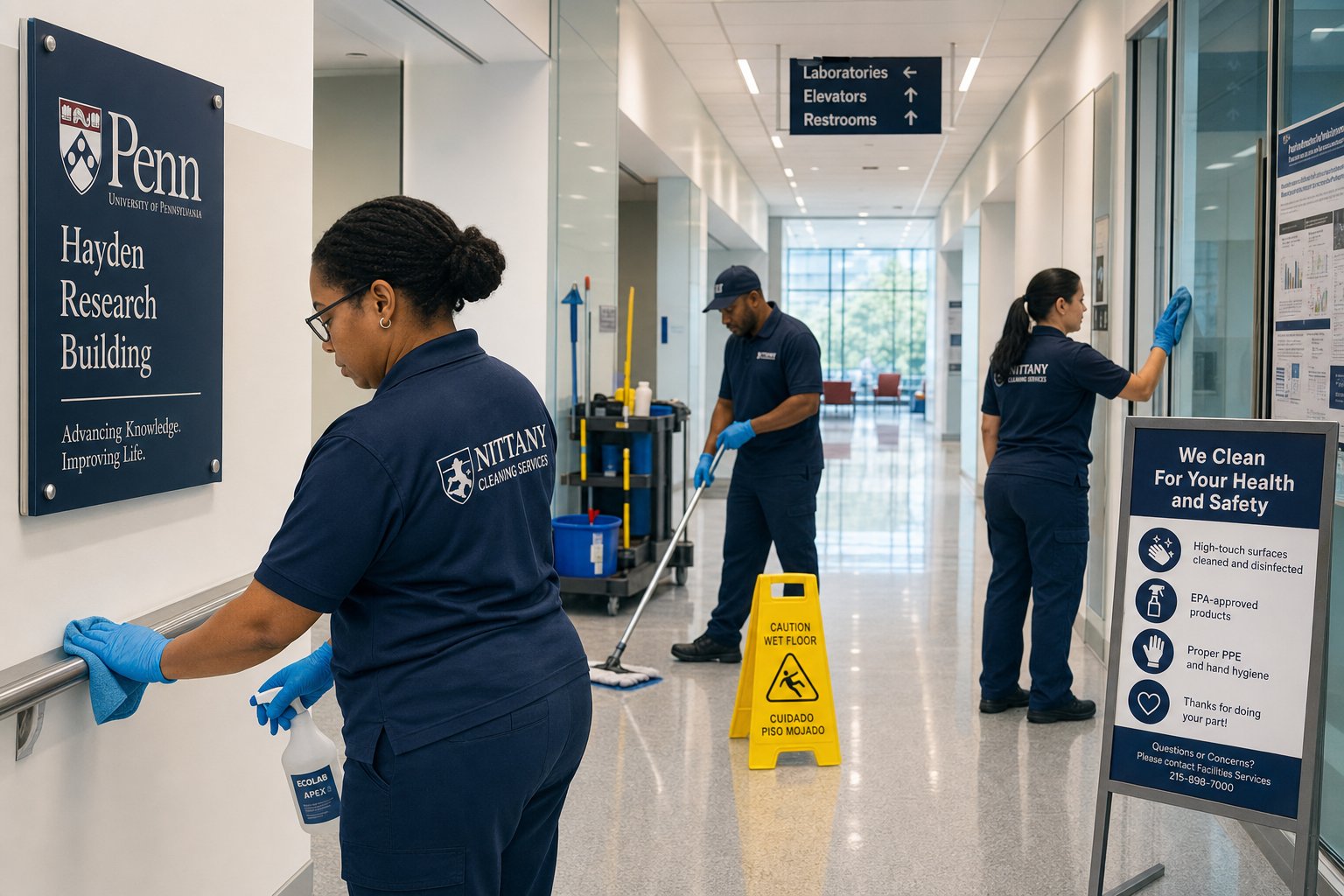
Commercial cleaning in Philadelphia's University City takes place inside a dense, mixed-use ecosystem: Penn and Drexel classrooms, biomedical labs, outpatient clinics, research offices, restaurants, and apartment-adjacent retail all share tight streets and demanding schedules. A vendor must protect people, materials, and access while keeping service evidence clear. GreenPoint Maintenance Services provides a proof-driven approach for University City facilities, using written zone plans, StockPoint timestamped GPS-tagged photos, optional ATP testing, and fixed pricing. This guide covers the questions a facility manager should answer before selecting Philadelphia janitorial services.
Why University City requires a local operating plan
University City is not one uniform building type. A clinical suite near 38th Street may have patient privacy and exam-room turnover; a research building near Chestnut Street may have controlled areas and chemical restrictions; a coworking floor near 30th Street Station may have extended access and frequent shared-surface use. SEPTA trolley, Market-Frankford Line, and regional rail traffic can bring heavy soil to entrances, while construction and deliveries change routes week to week. GreenPoint starts with occupancy, access, surface, and risk mapping rather than a generic square-footage multiplier.
The written scope should identify daily tasks, periodic tasks, service windows, escalation contacts, and areas cleaners must not enter without authorization. For a 25,000-square-foot office or clinic, that may mean daytime restroom checks, nightly floor care, and a monthly detail rotation. GreenPoint uses fixed pricing with no hourly billing and no hidden fees, but the scope still states assumptions so a buyer can see what changes price. A walkthrough at 844-814-0810 is the fastest way to make those assumptions visible.
Lab cleaning: zoning, contamination control, and records
Philadelphia labs require a disciplined boundary between general janitorial work and research-controlled tasks. GreenPoint can assign color-coded microfiber by zone, separate carts for support corridors, and written rules for benches, biosafety cabinets, freezers, and equipment that staff must clean themselves. Cleaners should never move samples, labels, instruments, or waste containers unless the responsible lab contact has approved the task. OSHA's Hazard Communication Standard and the lab's own SOPs determine chemical handling, PPE, and SDS access.
A lab manager should be able to answer who cleaned each area, when, with which product, and what exception occurred. StockPoint supports that chain with timestamps, location evidence, photos where permitted, and supervisor review. GreenPoint can pair visual checks with ATP testing in appropriate non-sensitive touchpoints, while recognizing that ATP is not a sterility test. The [digital cleaning verification systems](/blog/digital-cleaning-verification-systems/) guide explains why electronic evidence is stronger than a paper initials sheet when an audit or incident review requires a timeline.
Clinics and patient-facing offices
Clinics near Penn Medicine, Children's Hospital of Philadelphia, and private practices need cleaning routines that fit patient flow. Exam rooms should be cleaned and disinfected between patients under the practice protocol; waiting room chair arms, check-in counters, touchscreens, pens, door pulls, and restroom fixtures need scheduled attention. CDC guidance emphasizes cleaning before disinfecting, following the product label, and observing contact time. GreenPoint trains teams in PPE, color separation, bloodborne-pathogen awareness, and respectful behavior around patients and protected information.
A strong scope distinguishes routine cleaning from terminal or enhanced cleaning and states what happens after a spill or exposure. Supervisors should verify that a room was accessible, not simply mark it complete. StockPoint exception notes can show that a patient was still present, a room was locked, or a supply was missing, allowing the clinic to close the loop. GreenPoint's HIPAA-aware practice means cleaners do not read records or access systems. For a medical-office vendor comparison, review [medical office cleaning requirements](/blog/medical-office-cleaning-requirements-osha/) before requesting proposals.
Campus offices, classrooms, and shared spaces
Campus and commercial offices in University City often operate from early morning through evening events. A workable schedule cleans high-touch points before opening, resets classrooms between programs when possible, services restrooms at least daily with checks during high occupancy, and protects floors from tracked-in rain and winter salt. Libraries, lecture halls, and study lounges need focused vacuuming and furniture touchpoint work because users remain in place for long periods. GreenPoint can create a day-porter window for visible issues without turning every request into an unpriced extra.
Philadelphia weather adds seasonal detail work: salt residue on hard floors, wet mats during storms, and pollen in spring. GreenPoint rotates carpet extraction, glass, high dusting, and floor refinishing into a calendar so these jobs do not compete with nightly essentials. A campus contact sees open exceptions and completed zones through the live dashboard. That transparency is particularly useful when a building spans Walnut Street, Baltimore Avenue, and the Schuylkill River trail access points and each entrance experiences a different soil load.
Waste, loading docks, and building safety
A clean interior can still fail if waste staging and loading areas are neglected. Philadelphia facilities should keep waste streams labeled, prevent overflowing containers, clean dumpster pads when included in the scope, and report leaks or pests. Cleaning chemicals need secure storage away from food, samples, and public access. OSHA requires labels and safety data sheets for hazardous chemicals, and the building's fire-safety plan may add storage limits. GreenPoint documents blocked exits, wet floors, damaged dispensers, and unsafe access as exceptions instead of quietly working around them.
University City construction can also create dust and blocked approaches. A supervisor should coordinate with the building engineer before wet work near electrical equipment or work in a construction zone. GreenPoint uses Green Seal certified products where appropriate and selects methods that minimize residue and odor. It also clarifies whether recycling, regulated medical waste, sharps, and laboratory waste are handled by the cleaning vendor or a licensed specialist. The [osha cleaning chemical safety guide](/blog/osha-cleaning-chemical-safety-ghs-sds/) gives buyers a useful baseline for proposal questions.
Pricing and staffing for Philadelphia facilities
Commercial cleaning pricing in Philadelphia often falls around $0.05–$0.15 per square foot per visit for ordinary offices, while labs and clinics cost more because of zoning, PPE, documentation, and access restrictions. A 10,000-square-foot office with five nightly visits is not priced like a 10,000-square-foot lab with controlled rooms and daytime support. BLS labor data and the city's wage market affect the staffing plan. A realistic proposal explains production assumptions, not just a low monthly total.
GreenPoint's fixed-price proposals identify regular service, periodic work, consumables, response coverage, and exclusions. GreenPoint Maintenance Services is MBE-certified and SAM.gov registered, which can support procurement goals when the buyer's program accepts those credentials. The vendor should still be judged on local execution: who supervises, how absences are covered, and what happens when a room is inaccessible. Schedule a walkthrough through 844-814-0810 or info@greenpointms.com and ask to see sample StockPoint records before signing.
A University City vendor evaluation checklist
Interview at least two vendors with the same scope. Ask how they handle lab zoning, patient privacy, locked rooms, after-hours access, SDS training, winter floor care, and emergency spills. Ask for insurance, references from similar facilities, a sample inspection, and the name of the person who reviews corrective actions. Ask whether the service uses GPS evidence and photos, and whether photos are restricted in sensitive environments. The [how to choose a commercial cleaning company](/blog/how-to-choose-commercial-cleaning-company/) guide provides a broader comparison framework.
GreenPoint combines a trained team, Green Seal certified products where suitable, fixed pricing, and StockPoint verification. Its 98% client retention is a measurable operating result, not a substitute for a site-specific plan. GreenPoint will walk the building, note transit-facing entrances and controlled areas, and propose a frequency that fits the actual occupancy. Call 844-814-0810 for a University City quote; the goal is a clean facility that can prove what was done and surface what needs a decision.
Putting a measurable plan in place in Philadelphia’s University City
A practical launch begins with a baseline inspection in Philadelphia’s University City. GreenPoint photographs or records the condition of agreed areas, confirms the floor and surface inventory, and notes access limits before the first recurring visit. The facility contact then approves the task map, supply responsibilities, escalation path, and service windows. This step prevents a common failure: a vendor is held to an outcome that was never defined, while the building team assumes a task was included. GreenPoint writes the baseline into the scope so the first monthly review can compare actual service with an agreed starting point.
During the first 30 days in Philadelphia’s University City, supervisors should review attendance, completed zones, exceptions, supply usage, and customer feedback at least weekly. GreenPoint uses StockPoint records to identify patterns such as a locked room, recurring spill, under-sized mat, or restroom that needs a daytime check. The response should be specific: revise the route, retrain the cleaner, change the product, or ask engineering to fix a building condition. A dashboard is valuable only when a person acts on its information and records the correction.
Facility managers should also set a small group of outcome measures for Philadelphia’s University City: missed-task rate, corrective-action time, restroom supply availability, inspection score, and selected ATP readings where appropriate. These measures are not a substitute for professional judgment, and ATP does not prove sterility. They create a shared vocabulary for vendor meetings. GreenPoint can report visual inspection results, timestamped GPS-tagged photos, and exceptions without turning the program into a confusing spreadsheet of vanity metrics.
At the first quarterly review, GreenPoint and the client can compare the original scope with occupancy, seasonal conditions, and any change in the building. A new tenant, renovation, school program, or extended clinic schedule may justify a route adjustment; it should not create surprise billing. GreenPoint documents the reason, price impact, and approval before changing recurring work. That disciplined process gives a Philadelphia’s University City facility a cleaning program that is consistent enough to audit and flexible enough to remain useful. It also makes renewal conversations factual, because both sides can see the service history, open risks, and approved improvements. The same record helps a new facilities leader understand why the current schedule exists.
Frequently asked questions
What does commercial cleaning cost in University City? Many ordinary office programs benchmark around $0.05–$0.15 per square foot per visit; labs and clinics are higher because of access, zoning, PPE, and records. GreenPoint provides fixed pricing after a walkthrough.
Can cleaners work safely in a Philadelphia laboratory? Yes, when the scope defines zones, restricted equipment, PPE, SDS access, waste responsibilities, and escalation rules. GreenPoint trains teams to avoid samples and instruments unless authorized by the lab.
How should a clinic verify cleaning? Use a written room protocol, supervisor inspections, exception logs, and—where appropriate—ATP testing. GreenPoint uses StockPoint timestamps, location evidence, and photos where privacy rules allow.
Does GreenPoint cover campus and clinic facilities? GreenPoint can scope offices, classrooms, clinics, shared spaces, and support areas across a multi-building program. Availability and service windows are confirmed during the walkthrough.
How do I request a University City walkthrough? Call 844-814-0810 or email info@greenpointms.com. GreenPoint will review access, traffic, surface types, compliance needs, and documentation expectations before quoting.
For commercial cleaning in University City, call GreenPoint Maintenance Services at 844-814-0810. Get a fixed-price walkthrough quote, StockPoint evidence, and the accountability behind GreenPoint's 98% client retention.