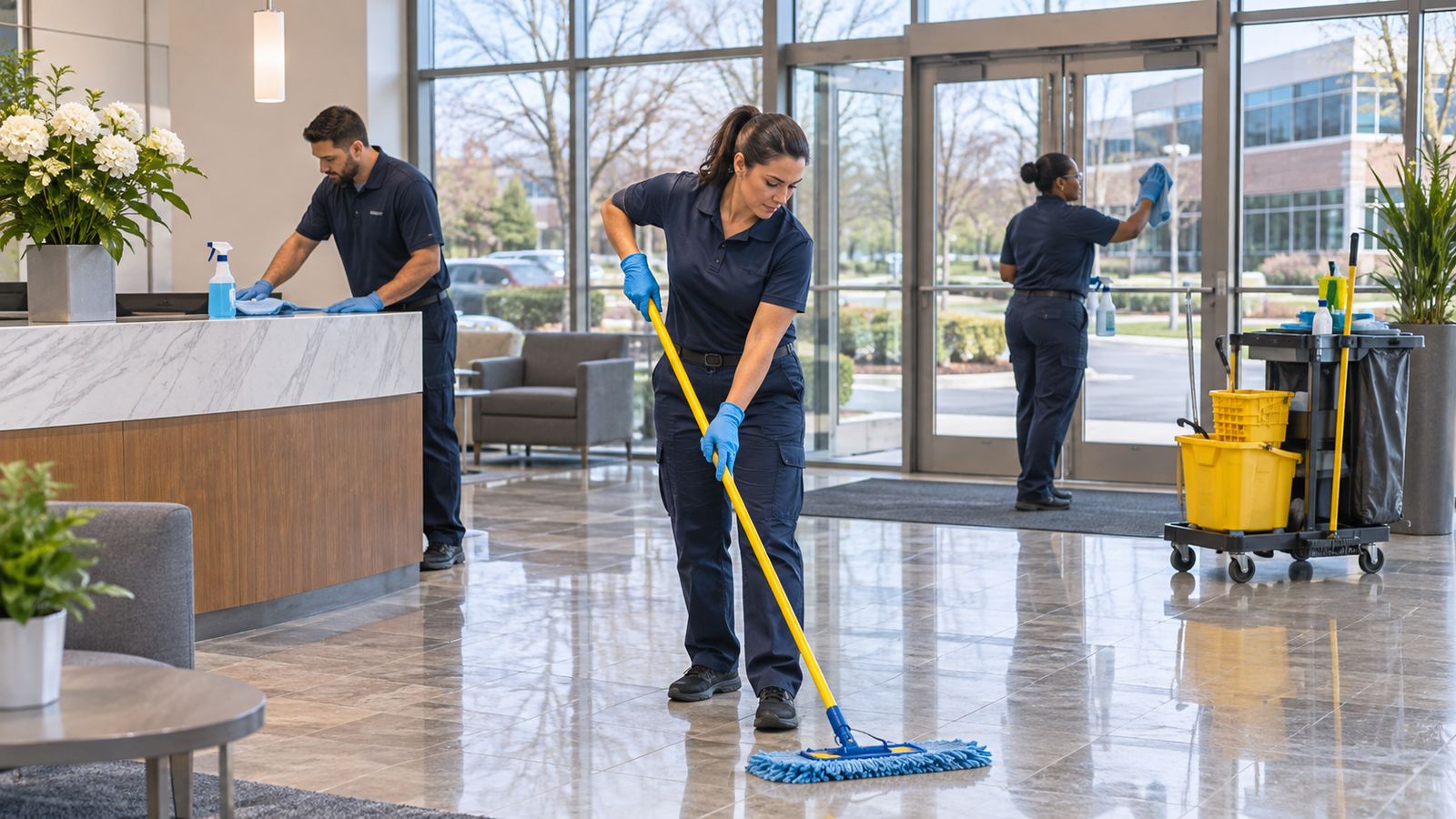
A commercial cleaning contract in Monmouth County should turn a broad promise of clean offices into specific tasks, frequencies, service windows, quality checks, and an agreed price. The county includes downtown storefronts in Red Bank, professional offices and medical practices in Long Branch, Freehold-area commercial properties, and suburban campuses near Holmdel, Eatontown, and the Garden State Parkway. Each location has different access, traffic, and seasonal needs. This guide helps property managers and business owners compare local janitorial vendors, manage service transitions, and avoid scope gaps. GreenPoint Maintenance Services offers site walkthroughs for New Jersey facilities; call 347-332-9348 to discuss a quote.
Define the service area and access plan
Monmouth County spans walkable business districts, medical and professional suites, retail centers, and office campuses. A storefront near Red Bank's Broad Street has different foot traffic from a professional building in Holmdel or a multi-tenant site near Route 18 and the Garden State Parkway. Some facilities rely on a front-door key and alarm code; others require badges, security desk sign-in, loading dock appointments, or use of a service elevator. The cleaning proposal should name the entrances and floors included, the service window, and the person authorized to address access problems.
Give all prospective vendors the same site information: cleanable area by floor, floor material, restroom and break-room counts, number of glass entries, occupancy by shift, and weekly schedule. Identify restricted areas such as patient records rooms, IT closets, laboratories, or tenant suites requiring separate permission. List recurring events, seasonal occupancy changes, and outdoor debris that affects interior entrances. GreenPoint Maintenance Services uses a walkthrough to verify those details and establish the service boundary before drafting a recurring proposal. That helps a Monmouth County buyer avoid paying for assumptions that one vendor includes and another excludes.
Set room-level tasks and frequencies
A practical cleaning schedule differentiates daily and weekly needs from periodic projects. For example, a 7,500-square-foot office might request four evening visits each week, with waste removal and restroom cleaning each visit, vacuuming on scheduled days, and one rotating detail zone each week. A 30,000-square-foot building may require a day porter for public spaces in addition to evening janitorial service. These examples are planning illustrations, not guaranteed staffing levels. The contractor should explain how task density, fixtures, floor finish, tenant use, and service access affect the actual plan.
Be precise about what clean means: whether trash liners are replaced every time, which high-touch points are included, how desks and electronics are treated, whether window ledges are dusted, and how food residue is handled in shared kitchens. Separate routine carpet vacuuming from extraction, and ordinary floor maintenance from stripping, refinishing, or restorative work. Link periodic services to a written schedule and approval process. For vendor questions and estimating variables, see how to choose a commercial cleaning company and commercial cleaning cost per square foot.
Account for New Jersey seasons and commuter access
Monmouth County properties experience wet leaves, tracked-in grit, winter precipitation, and salt residue at entrances, as well as pollen and mud during warmer months. Use entrance matting, floor inspections, and wet-floor signage as explicit parts of the cleaning plan. Buildings near the North Jersey Coast Line stations, including Red Bank and Long Branch, may have employee and visitor peaks tied to commuter schedules. Properties around Asbury Park or the shore can also see higher seasonal visitor traffic. Ask whether lobby and restroom checks should increase during events, tourist season, or weather-related surges.
Cleaning staff should have clear instructions for reporting icy entries, water leaks, unsafe floor conditions, or damaged fixtures, and should not be asked to repair systems beyond their training. For closures, severe weather, or building access restrictions, set out how the parties communicate a missed visit, confirm safe access, prioritize reopening, and approve any additional work. Local municipal waste separation or disposal rules may affect where bags, cardboard, or recycling can be placed; confirm each property's current requirements with the property manager and municipality rather than assuming a janitorial crew can decide. GreenPoint can record routine observations in JaniTrack and refer building issues to the designated contact.
Compare proposals and recurring contract terms
Ask each bidder to price the same schedule. A hypothetical comparison might use a 16,000-square-foot professional suite, five cleaning visits weekly, four restrooms, one kitchen, monthly interior glass, and two annual carpet projects. Request a clear statement of what the monthly charge includes, such as routine labor, supervision, standard tools, and approved cleaning products. Identify separately priced work and all exclusions. A square-foot calculation can normalize offers, but it is not a reliable local price benchmark when vendors have different task lists, service frequencies, access constraints, or assumptions.
The contract should state start date, service schedule, missed-visit reporting, complaint response, inspection method, insurance, access credentials, confidentiality, subcontractors, price changes, renewal, termination notice, and change-order approval. If the buyer has public-sector, union, prevailing-wage, or other labor requirements, the procurement and legal contacts should confirm which rules apply to the specific contract instead of assuming all cleaning contracts have the same obligations. GreenPoint Maintenance Services provides fixed pricing for the agreed scope, without hourly billing or hidden fees, and any added task should be documented. See commercial cleaning contract key terms for a pre-signature review list.
Check the contractor’s quality and service-recovery process
Before award, ask the vendor to demonstrate an inspection form and explain how a failed check is assigned and closed. GreenPoint's JaniTrack system can provide timestamped, GPS-tagged photos and a live dashboard for selected work locations and tasks. The client should choose useful checkpoints such as the main entrance, public restrooms, kitchen, elevator, and a rotating sample of office areas. If ATP testing is included, agree on the sampling plan and interpretation; ATP indicates organic residue on a sampled surface, not a specific microorganism or proof of infection risk.
Use both service records and outcome checks. Count scheduled visits, spot-check high-traffic areas, log missed or incomplete tasks, and measure how long corrective actions remain open. For a 12-zone office, one possible monthly plan is to inspect three rotating zones each week while checking restrooms on every inspection. The property manager can tune the sample based on complaints and risk. GreenPoint reports 98% client retention across its business, which is one company-level indicator; it does not replace a Monmouth County client's own references, service-level measures, or regular account reviews.
Review chemical safety and environmental practices
Ask for product labels, Safety Data Sheets, dilution procedures, employee training, and a secure storage plan. OSHA's Hazard Communication standard addresses how covered employers communicate workplace chemical hazards through labels, safety data sheets, and employee information and training. Clarify who maintains SDS access at the building, how cleaning workers are told about site-specific hazards, and what happens if a product is spilled or a container is damaged. Do not allow products to be mixed or used outside the manufacturer's directions. GreenPoint uses Green Seal certified products where suitable for the surface, task, and client-approved program.
Set out waste and recycling responsibilities by location: what goes in each receptacle, when bags are moved, who handles cardboard, and where secure or regulated waste is excluded. In medical or laboratory settings, ordinary janitorial service should not silently expand into sharps or clinical waste handling. New Jersey's mandatory recycling law covers commercial and institutional businesses, while designated materials differ by county and municipality; identify the applicable local list and collection arrangement with the site contact. A clear product and waste plan supports safer work and makes the service easier to audit. For more context on environmentally preferable processes, see green cleaning for commercial buildings.
Make the first month of service deliberate
A good startup protects both the customer and the incoming crew. Inventory keys, badges, alarm instructions, closets, approved products, equipment, security contacts, tenant limitations, and building emergency procedures. Walk each floor together and note existing stains, damaged finishes, and fixtures that need repair. In Red Bank or Long Branch, coordinate service with downtown deliveries, parking restrictions, or nearby transit access; on a campus in Holmdel or Eatontown, document the approved employee entrance and parking area. Share the complaint process with tenants before the first shift.
Review the account after the first week and again around day 30. Confirm visit completion, task timing, consumable use, quality results, and how quickly service issues are corrected. Track new requests separately from contracted tasks so the recurring price and expectations stay clear. GreenPoint supervisors can review JaniTrack records with the client's designated contact and document approved changes. Schedule a Monmouth County walkthrough with GreenPoint Maintenance Services at 347-332-9348 or email info@greenpointms.com to review facility needs and receive a written quote.
Frequently asked questions about Monmouth County janitorial contracts
Q: How do I compare commercial cleaning prices in Monmouth County? A: Send each bidder the same scope, floor area, visit calendar, restroom counts, supply responsibilities, and periodic work schedule. Compare monthly price and exclusions together. A site walkthrough is important because two buildings with the same square footage may have very different traffic, flooring, access, and fixture density.
Q: How many visits per week does an office need? A: The right number depends on the number of occupants, public access, washroom use, food activity, and desired appearance. A low-occupancy suite may require fewer visits than a busy clinic or shared building. Define which areas receive attention on every visit and which are maintained on a rotation.
Q: Should winter salt and wet-floor response be part of a janitorial contract? A: Yes, specify routine entry mat care, floor inspection, signage, and how staff report hazards or water intrusion. The property owner must still manage snow and ice removal and decide what areas are safe to access. Identify who handles exterior conditions and how extra cleanup is authorized.
Q: What evidence can a cleaning vendor provide? A: Ask for task schedules, inspection scores, photos or digital records where appropriate, issue logs, and corrective-action closure. GreenPoint's JaniTrack can provide selected timestamped, GPS-tagged photos and dashboard records. Verification should match the contract and should not be mistaken for laboratory certification.
Q: Does a janitorial bid include New Jersey labor or public-contract requirements? A: Requirements depend on the buyer, contract, funding, site, and applicable law. Have procurement or counsel identify whether wage, labor, background-check, or other provisions apply to the specific solicitation and include them in the bid documents. Do not rely on a generic cleaning proposal to resolve those obligations.
For a Monmouth County commercial cleaning walkthrough and fixed-scope quote, call GreenPoint Maintenance Services at 347-332-9348. GreenPoint is MBE-certified, has a reported 98% client retention rate, and offers JaniTrack documentation for selected completed work.