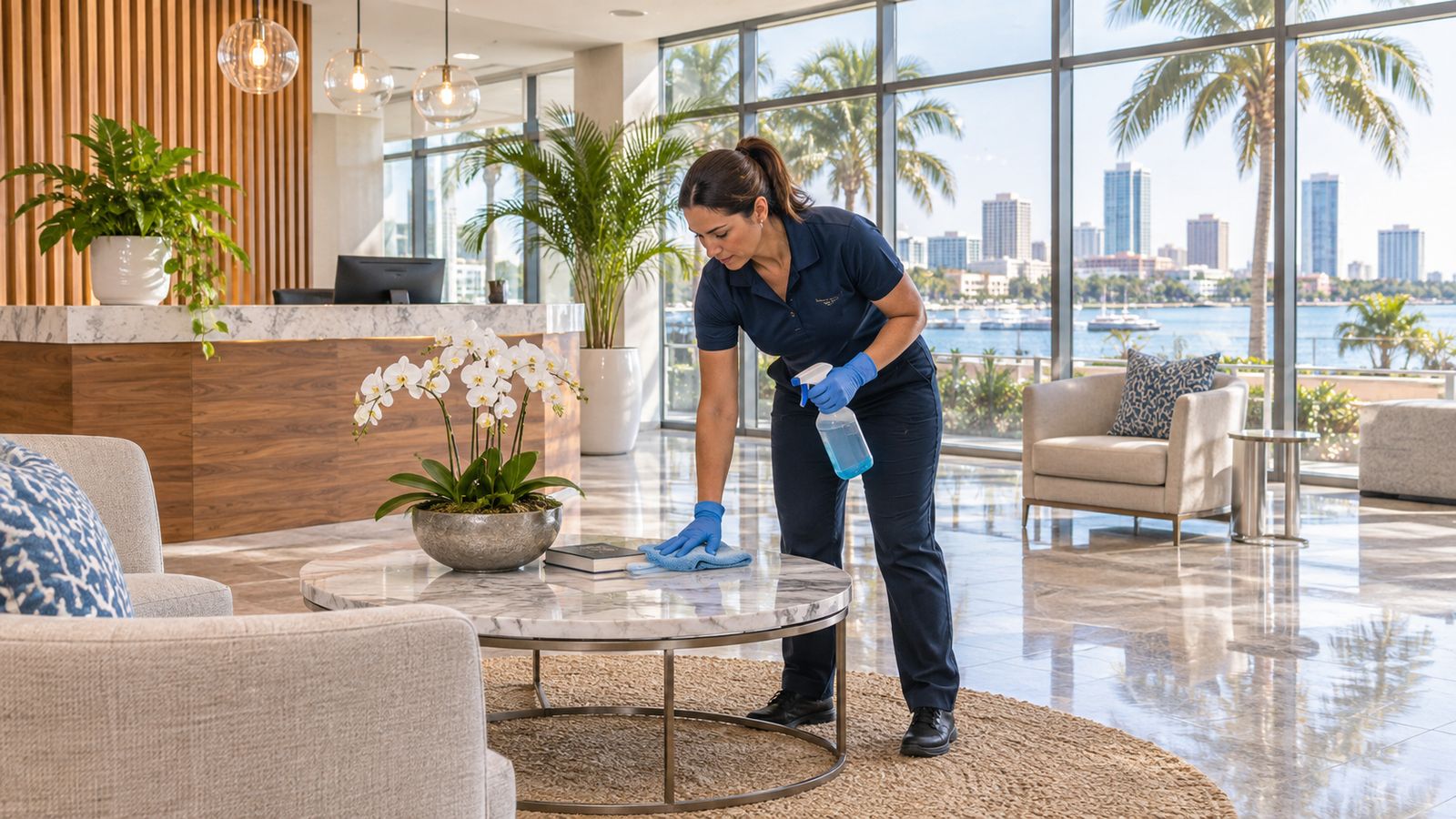
Hiring commercial cleaning in St. Petersburg means choosing a partner who can protect the daily experience of employees, tenants, visitors, and customers while providing proof that the agreed work was completed. Downtown offices near the St. Pete Pier, creative businesses along Central Avenue, healthcare practices, and commercial properties in Carillon or the Gateway area have different access and traffic patterns. Coastal rain, tracked-in sand, and seasonal storms can also change how entrances and floors perform. This guide helps Pinellas County facility buyers scope services, compare bids, verify quality, and manage contractor transitions. To arrange a GreenPoint Maintenance Services walkthrough, call 347-332-9348.
Start with local property use and traffic patterns
St. Petersburg's commercial areas include the downtown waterfront around the St. Pete Pier and the Museum of Fine Arts, offices and shops along Central Avenue, medical and professional space near major corridors, and larger employment campuses in Carillon and Gateway. A small professional office near the waterfront may have a few employees and frequent visitors, while a multi-tenant campus may need consistent service across several entrances, elevators, break rooms, and restrooms. GreenPoint asks about occupancy, public access, hours, flooring, tenant mix, event activity, and security before proposing a routine.
Give each bidder a consistent site brief: cleanable square footage by zone, floor finish, number of restrooms and sinks, glass entry area, break rooms, conference rooms, and any specialized spaces. Describe the difference between a task that happens every visit and one that is periodic, such as high dusting, carpet extraction, or machine scrubbing. State whether the client expects daytime response, evening service, weekend coverage, or event support. The questions to ask a commercial cleaning company guide can help organize interviews, while commercial cleaning cost per square foot explains why a floor-area figure alone is not a complete quote.
Specify a measurable cleaning scope for each space
A useful scope says what the cleaner does, how often, and what an acceptable result looks like. For instance, a 9,000-square-foot office could define nightly trash removal, vacuuming of traffic lanes, touchpoint cleaning, and restroom service on four visits per week, with a rotating weekly detail task. Another 9,000-square-foot property with public waiting rooms, two break areas, and a high-traffic lobby may need a different staffing plan. Treat those numbers as examples for scope design, not a promise of a particular staffing ratio or a market price.
Define sensitive surfaces and client-owned items that should not be moved. Clarify how cleaners handle desk items, electronics, tenant food, confidential papers, recycling, and found property. Include service windows and response expectations for spills or restroom issues during business hours. A strong contractor can explain why a frequency is recommended and what would trigger a change. GreenPoint Maintenance Services uses fixed pricing for a written recurring scope, so the customer can track the agreed work without an open-ended hourly invoice.
Plan for coastal sand, rain, and humidity
Near the St. Pete Pier, beach routes, or outdoor dining districts, shoes can bring sand and moisture into entries and corridors. Properties with a drop-off lane, garage access, or open-air walkways may need mat vacuuming and inspection more frequently than an interior office with controlled access. St. Petersburg's humid conditions make it especially important to follow dilution and use directions, avoid leaving wet surfaces without warning signs, and notify building staff about persistent moisture or visible leaks. These steps support appearance and safe operations without suggesting that janitorial staff diagnose building-envelope problems.
Ask how the vendor handles tropical weather disruptions and post-closure access. The client should specify who authorizes entry, what cleaning tasks are prioritized before reopening, and whether additional work requires a written change order. The cleaning contractor should not be assigned structural assessment, mold remediation, or regulated restoration tasks unless separately qualified and contracted for them. GreenPoint can document the routine work assigned to its team through JaniTrack and report observations to the property contact. The building's emergency plan and applicable local directions remain the owner's responsibility.
Review bids using the same assumptions
To compare St. Petersburg bids fairly, ask all vendors to quote the same service calendar and list of rooms. A hypothetical 18,000-square-foot office might request five evening visits per week, restroom service each visit, weekly detail rotation, and quarterly carpet work. Ask whether the quoted monthly amount includes routine labor, supervision, equipment, standard products, and consumables, and separate any optional services. Do not call the example a local price benchmark; the actual cost depends on property condition, floor materials, security, frequency, staffing, and the scope.
Contract review should cover insurance, subcontractors, key and badge custody, complaint response, service credits, quality inspections, price adjustments, renewal, termination, and approval of extras. For a site with tenant turnover, identify who pays for move-in or move-out cleaning and how that work is authorized. GreenPoint does not use hourly billing or hidden fees for the agreed recurring program; one-time projects and scope changes should be priced and approved in writing. Use commercial cleaning contract key terms as a checklist before signing.
Ask for verifiable quality assurance
A facilities manager should be able to answer three questions: what was supposed to be cleaned, what was checked, and what happened when something failed inspection. GreenPoint's JaniTrack verification can include timestamped, GPS-tagged photos and a live dashboard for agreed points of service. A photo can support a record of a visible task, while ATP testing may be used on selected surfaces to measure organic residue under a standard collection method. ATP is not a pathogen test and does not prove a room is sterile, so a vendor should never overstate what a reading means.
Create a practical inspection rotation based on risk. A property might check the lobby and public restrooms daily, inspect one third of tenant floors each week, and review all zones monthly. Track scores, repeated defects, corrective-action closure, customer complaints, and missed visits together so a strong photograph does not conceal poor service in another area. GreenPoint reports 98% client retention as a company-level figure; buyers should still define their own service-level measures and review them with the account supervisor at a regular monthly or quarterly meeting.
Check product, chemical, and waste handling procedures
Ask for the cleaning chemical list, labels, Safety Data Sheets, storage plan, dilution process, and employee training approach. OSHA's Hazard Communication standard requires covered employers to communicate chemical hazards to workers through labels, safety data sheets, and employee information and training. Make sure the site contact tells the vendor about building-specific restrictions, such as fragrance sensitivities, stone flooring, secure storage, or limits on drain disposal. GreenPoint uses Green Seal certified products where they are appropriate for the task and compatible with the surface, while following product directions and client approvals.
Waste requirements can vary by property and by the type of materials handled. A general office cleaner should not be expected to handle clinical sharps, chemical waste, or other regulated materials unless the scope and training specifically address them. The City of St. Petersburg says it does not currently offer commercial recycling collection; businesses may arrange service with an independent provider, and private collectors operating in the city must submit a permit application. Check the City's commercial sanitation guidance and the property's own disposal rules before assigning tasks. For an overview of product and process choices, see green cleaning for commercial buildings. GreenPoint can record the approved routine and escalate requests that fall beyond ordinary janitorial work.
Manage startup, access, and recurring vendor reviews
Start with a documented handoff. List keys, access cards, alarm procedures, supply closets, approved equipment, floor finish history, tenant contacts, service restrictions, emergency phone numbers, and the process for reporting damage. Take a baseline walk before service begins and record conditions that already exist. For downtown properties, coordinate garage, elevator, and delivery schedules; for Carillon or Gateway sites, confirm parking and campus entry instructions. Tell tenants which channel to use for routine requests and who approves work outside the contract.
Set an early review after the first week and a more complete review after 30 days. Use the period to confirm access, task times, restocking levels, and inspection patterns, not to change the scope through informal requests that no one has approved. A recurring scorecard can track the planned and completed service dates, inspection results, corrective actions, exceptions, and approved extras. GreenPoint supervisors can review JaniTrack activity with the client and adjust the documented program through an agreed change. Call GreenPoint Maintenance Services at 347-332-9348 to discuss an office or commercial property walkthrough in St. Petersburg.
Frequently asked questions about St. Petersburg cleaning vendors
Q: How often should a St. Petersburg office receive janitorial service? A: Start with occupant count, visitor traffic, restrooms, food use, and operating hours. Many facilities schedule recurring service several times each week, but busy public zones may need daily attention while lower-use spaces can be placed on a rotation. Require the vendor to show the task calendar and explain the basis for each frequency.
Q: Does a cleaning company quote by square foot? A: Square footage may be one input, but a reliable price also accounts for layout, floor surfaces, fixtures, service frequency, access, consumables, and periodic tasks. A site walkthrough reduces missing assumptions. GreenPoint can review those conditions before preparing a fixed-price scope.
Q: What is JaniTrack? A: GreenPoint's JaniTrack program supports service verification with selected timestamped, GPS-tagged photos and live dashboard records. The client and contractor should agree on what is photographed and how exceptions are handled. Photos document selected observable work; they are not a laboratory test or proof that a surface is pathogen-free.
Q: Should a vendor handle storm cleanup or water damage? A: Routine janitorial crews can perform authorized cleaning tasks after the property manager confirms access and safety. Structural evaluation, mold remediation, and restoration often require separate qualifications and a separately defined scope. The contract should name the person who authorizes re-entry and approve any added work in writing.
Q: What documents should a facility buyer request? A: Ask for a detailed task schedule, proof of insurance, chemical list and SDS access, training and supervision approach, sample inspection report, complaint escalation procedure, and references. Clarify key control, employee access rules, and subcontracting before award. GreenPoint Maintenance Services can walk through these items during a quote appointment.
Request a St. Petersburg commercial cleaning walkthrough from GreenPoint Maintenance Services at 347-332-9348. GreenPoint is MBE-certified, reports 98% client retention, and can provide JaniTrack service records with timestamped GPS-tagged photos and dashboard visibility.